
Skip to product information
1 of 4

Vintage and Antique Gifts

Antique Town Talk Cigar Band Pair 🎨 Lancaster PA 1920s–1930s Set of Two, New Old Stock Tobacciana

Antique Town Talk Cigar Band Pair 🎨 Lancaster PA 1920s–1930s Set of Two, New Old Stock Tobacciana

Regular price $9.00 USD
Regular price Sale price $9.00 USD
Sale Sold out
Shipping calculated at checkout.

Size: 2 3/4" x 3/4"

🚚 Free US Shipping — ships within one business day. International shipping calculated at checkout.

Quantity

Why Would a Cigar Be Called Town Talk? 🎨 An Antique Town Talk Cigar Band from Lancaster, Pennsylvania Tobacco Country

Size: 2 3/4" x 3/4" each

You get two of these Town Talk bands with this listing, both unused.

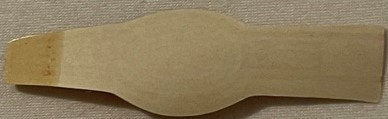
A waisted paper cigar band printed in one deep red on cream: TOWN TALK in white letters inside a beaded oval, scrollwork panels running out to each side, and at the narrow end a tiny round mark with a size number, 2 3/4, in a ring of type that reads CONSOLIDATED LITHO CORP. The back is plain cream with the gum tab at one end. These are new old stock - never wrapped around a cigar.

One color, and still this crisp - that takes a good pressman. Cigar bands show you what antique advertising was all about, little pieces of commercial art that were supposed to be thrown away with the butt, and most of them were.

🌿 Lancaster tobacco country

These came to me as Lancaster, Pennsylvania bands, attributed to W. M. Applegate, and Lancaster is about as deep in American tobacco as you can get. Lancaster County was growing 65 percent of Pennsylvania's tobacco crop by 1859, mostly seed leaf that went into cigars as filler, and tobacco stayed the county's leading cash crop from 1840 all the way to 2000.

The city built for it. Philadelphia cigar houses Bayuk Brothers and Otto Eisenlohr & Brothers put up big tobacco warehouses on North Water Street in the early 1900s. On Columbia Avenue you can still find the J. B. Milleysack Cigar Factory, built in 1898, and the Slater Cigar Company's two buildings, one from around 1895 and one from 1905 or 1906. All three are on the National Register of Historic Places, listed together on September 21, 1990.

And right in the middle of Lancaster stood Demuth's Tobacco Shop, opened in 1770 and counted as the oldest tobacco shop in the country. It served the city until it closed its doors in 2010, and the Demuth Museum keeps it today.

🗣️ Town Talk

Town Talk was a name a lot of tobacco men liked - it promises the smoke everybody in town is talking about. One of them was Lichtenstein Bros. & Co., a big New York house on the Bowery, which put out Town Talk brand cigars, cigarettes and chewing and smoking tobacco. A friendly, everyday name like that sat on a lot of neighborhood cigars.

👑 Where cigar bands came from

Cigar historians give the credit to Gustave Bock, a Dutch-born cigar maker, who started banding the cigars he shipped to Europe in the 1830s, hoping the paper ring would say quality and prestige. The legend is better, though: the story goes that Catherine the Great had her cigars wrapped in silk so they wouldn't stain her fingers, and her courtiers copied her. Another old tale has paper bands put on cigars bound for England to keep gentlemen's white gloves clean. Historians call both of those fanciful, and I still enjoy them. Whatever the truth, by the end of the 1800s the band was how a cigar maker told you whose cigar you were smoking.

The real trade was simpler. Printers cut the bands in advance and sent them to the cigar makers in bundles of 100, and the cigar maker slipped each one on by hand. Kids saved the bright ones in albums and pasted them into scrapbook collages, which folk art collectors now go looking for. Band collecting even has a name, vitolphilia, and one American collector, Joe Hruby, got into the Guinness Book of World Records with more than 165,000 different bands.

📅 How old is it?

Nothing on it is dated, but that little ring mark names the printer: the Consolidated Lithographing Corporation of Brooklyn, which took that name in the mid-1920s and by the 1930s was the biggest cigar band printer in the world. So this band is mid-1920s or later, and I've always had these running into the 1930s. Collectors count roughly 1890 to 1920 as the golden age of the cigar band, when even an everyday nickel cigar got a printed band of its own. By the 1920s, cheaper four-color printing was making bands more plain and practical, and a band like this sits at the plain, one-color end of that tradition.

🎨 About these bands

Every one I have is this same unused band, 2 3/4 by 3/4 inches. A red Town Talk is a good everyday piece for an album, a little frame with a cigar box, or for anybody with Lancaster roots. The supply is finite - nobody is banding cigars like this anymore, and once these last unused ones are in collections, they'll be very difficult to acquire.

Shipping

🚚 Shipping & Handling

  • Shipping costs and timing are calculated at checkout.
  • Items curated and shipped directly by me include U.S. shipping at no additional cost, professionally packed to ensure safe arrival of your artifact.

Items from Vetted Pro Collectors
Shipping for items offered by vetted Pro Collectors is determined at checkout. All Pro Collector listings are reviewed to ensure fair, reasonable shipping practices.

For full details, please refer to our Shipping Policy.

Returns & Exchange

Take your time — you've got a full six months. If a piece isn't right for you, send it back the way it reached you and we're good.

In the first 30 days your money goes straight back the way you paid. After that it's store credit, so you can put it toward something you'd rather have.

Return shipping we sort out between us, case by case. I don't make this difficult.

If something arrives damaged, or it isn't what I said it was, send me a photo within 48 hours and I'll make it right.

Email info@vintageantiquesgifts.com or call 802-356-9872 — that's me answering, not a call center.

The only things I can't take back are custom or special-order pieces and gift cards.

View full details

Preserving History: Authentic Objects Across Eras

— Curated by Travis Weigel