Skip to product information
1 of 5

Vintage and Antique Gifts

Antique 1930s Artesian Birch Beer Bottle Label 🥤 M.T. Dwyer Co Clinton Mass, NOS Soda Advertising Lithograph Well Water Graphic

Antique 1930s Artesian Birch Beer Bottle Label 🥤 M.T. Dwyer Co Clinton Mass, NOS Soda Advertising Lithograph Well Water Graphic

Regular price $16.00 USD
Regular price Sale price $16.00 USD
Sale Sold out
Shipping calculated at checkout.

Size: 4 1/2" x 3 1/2"

🚚 Free US Shipping — ships within one business day. International shipping calculated at checkout.

Quantity

Who Bottled Artesian Birch Beer? Clinton Gave Boston Its Water. Its Own Bottler Sold Birch Beer Under a Picture of a Well.

Size: 4 1/2" x 3 1/2" ~ New old stock, never applied.

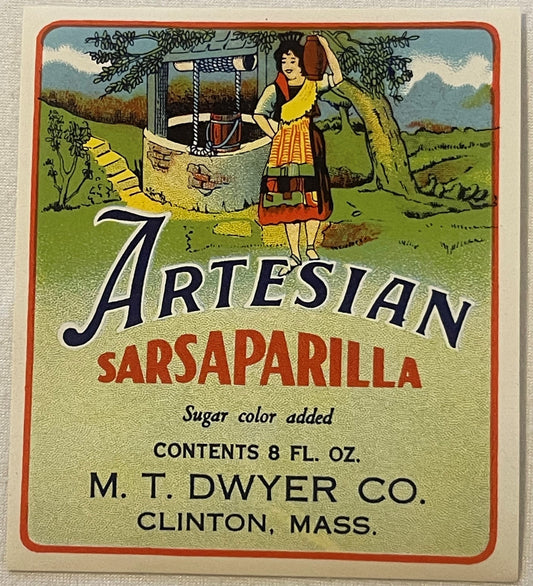
Between 1897 and 1905 the little mill town of Clinton, Massachusetts watched the Nashua River valley above it disappear behind a 200-foot masonry dam, so that Boston could drink. Down in town, a hometown bottler called the M. T. Dwyer Co. was selling birch beer under a single word: Artesian. On the label it put a village well, a coiled rope, a wooden bucket and a girl carrying a jug. This is that label, new old stock, never pasted to a bottle.

The Label

A paper bottle label, 4.5 x 3.5 inches, printed in full color by offset lithography. Look closely at the sky and the grass and you can see the fine stipple of the printing screen.

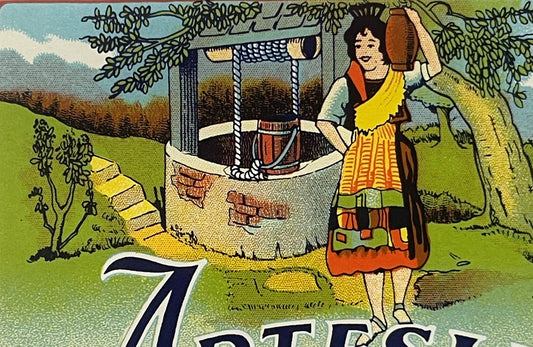
The picture fills the top two-thirds. A stone well with patched brick and a gray peaked roof stands on a green rise, its rope wound over the windlass and a banded wooden bucket hanging above the dark water. Yellow stone steps climb up to it from the left. Beside the well a dark-haired young woman in folk costume balances a brown earthenware jug at her shoulder with one hand and rests the other on her hip. She wears a yellow shawl, a yellow-and-orange striped apron, a dark bodice and a skirt banded in orange, green and black. A leaning tree shades her from the right, and behind her roll green hills, a line of autumn-brown trees and pale blue mountains under white cloud.

The printed text, word for word:

  • CONTENTS 1 PT. 12 FL. OZ. (upper right, in blue)
  • Artesian (tall navy script outlined in white)
  • BIRCH BEER (red block capitals)
  • Sugar color added (small italic)
  • M. T. DWYER CO. CLINTON, MASS. (navy capitals along the bottom)

A thin red rule frames the whole design inside a cream margin. The back is blank paper, and the design reads faintly through it in reverse.

M. T. Dwyer Co. and Clinton's Hometown Soda Trade

Before national brands filled every cooler, a mill town of Clinton's size kept several bottlers of its own busy. A collection of Clinton soda history that came to market in 2009 held about 170 bottles from the town's bottlers: Kleer Kool, Artesian, Million Dollar, Smack Punch, MarBert, J.F. Burke, Hastings & O'Toole, M.T. Dwyer Co., J.H. Kilcoyne, Big Boy and George A. Hartshorn. With them came a framed 1943 Kleer Kool membership certificate from the American Bottlers and two painted pressed-metal signs. One advertised Million Dollar grape soda. The other read M.T. Dwyer, Clinton Beverages.

That sign is the company in its own words. Dwyer sold under the town's name, and this label shows the brand it gave its birch beer. Artesian bottles sit in the same collection, and the label ties the brand to Dwyer in print. Stamping "Clinton, Mass." on the bottle was the whole point of a hometown bottler. It told the grocer, the tavern keeper and the family at the kitchen table that this soda was made down the street.

Clinton, Massachusetts: Gingham, Carpets and a Drowned Valley

Clinton sits on the Nashua River in Worcester County, in central Massachusetts, about fifteen miles north-northeast of Worcester, and it began as the mill district of Lancaster. In 1838 the brothers Erastus and Horatio Bigelow formed the Clinton Company to build and run the power looms Erastus had invented, and his looms wove coach lace, counterpanes and gingham. A gingham mill followed in 1843, and the village around it grew so fast that it split from Lancaster and was incorporated as the Town of Clinton on March 14, 1850. The founders named it after the DeWitt Clinton Hotel in New York.

Erastus Bigelow went on to build the world's first power carpet looms and patented at least 35 looms in his lifetime. He invented the loom for weaving wire cloth too, and by 1890 Clinton was known for its carpets and its woven wire. I'm glad to see the wire side finally getting its due: the old Clinton Wire Cloth Company buildings on Sterling and Parker Streets went onto the National Register of Historic Places as a historic district in May 2024. The Bigelow carpet mill in Clinton, begun in 1847 and enlarged again and again until 1922, turned out Brussels and tapestry carpet far more cheaply than hand looms could. That changed who could own a carpet: the middle class could. The town's own history says Bigelow carpets went into the White House, the Waldorf-Astoria and the Titanic. Then the Depression came. The big carpet mill closed in the 1930s, and its buildings sat empty or held storage for years before new industry moved in. The complex was listed on the National Register of Historic Places in 1978.

Clinton is also a town of Irish families. Emigrants from Louisburgh in County Mayo settled there in the early 1900s, and the connection is still alive today. And Clinton has a baseball record it will not let go of: Fuller Field, where the first official game was played on June 15, 1878, is certified by Guinness World Records as the oldest baseball diamond in the world. London, Ontario, says the same about its own Labatt Park, and the argument goes on.

The Dam That Changed Clinton and Changed the Law

Boston needed water, and the Metropolitan Water Board, created in 1895, chose the south branch of the Nashua River just above Clinton. Work on the Wachusett Dam began in 1897. The McArthur Brothers of Chicago won the contract in 1900, and the dam was finished in 1905. More than 4,000 acres were cleared, some 500 buildings came down and about 4,000 graves were moved. The water covered 4,380 acres in four towns: Boylston, West Boylston, Sterling and Clinton itself. When the reservoir filled, it was the largest man-made water supply reservoir in the world.

The work was done by Black Americans and by Irish and Italian immigrants, for poor pay that came irregularly. Thirty-five workers were killed. Italian laborers struck six times in four years, demanding $1.50 a day, paid weekly. The investigations that followed led to legislation requiring weekly pay and ending the rule that men had to live at the job site, early groundwork for later labor law. The Old Stone Church still stands at the reservoir's west end as a reminder of the people who lived in the valley and the workers who built the dam. Local lore, passed down from old-timers who remembered the dam years, holds that the reservoir boom and the crowds of workers it brought to town helped seed the small hometown trades that served Clinton, bottlers like M. T. Dwyer among them.

Why "Artesian" Sold Soda

An artesian well is one where water rises under its own natural pressure from a confined layer underground, with no pump needed. The word entered English around 1830 from the French puits artésien, "well of Artois," after the old province in northern France. The story goes that monks in Artois were boring flowing wells as early as the 12th century, and one well there is said to have run since 1126. To anyone buying a drink, "artesian" meant deep, cold and clean.

New England already had a legend about water like that. In 1844 Hiram Ricker, a farmer in Poland, Maine, was suffering from dyspepsia and drank nothing but the water from a spring at the edge of his family's land. After ten days, the story says, he was cured. The Rickers began sharing the water in 1845, made their first commercial sale in 1859 and opened the grand Poland Spring House in 1876. By the time Dwyer printed this label, a New England bottler who promised good water was speaking a language its customers had heard for generations.

The well in the picture reaches back further still. Celtic and Germanic peoples believed wells and springs were the homes of gods or spirits and left them offerings. By Roman times people were dropping coins into springs and wells, and that habit survives as the wishing well. A well on a label promised clean water, and it also made people think of luck and home.

What Birch Beer Is, and What "Sugar Color Added" Means

Birch beer is a close cousin of root beer. It was once brewed from birch bark and sweetened with birch sap, and a recipe from 1676 ferments birch sap with sugar, yeast, cinnamon and mace. The soft drink version gets its flavor from oil distilled from the bark of black birch, also called sweet birch. That oil tastes of wintergreen, because it is rich in methyl salicylate. Birch beer is still mostly a drink of the Northeastern United States and Newfoundland. Clear "white" birch beer is more common in New England, and the dark red style is more common in the Mid-Atlantic.

"Sugar color" is burnt sugar: sugar cooked until it turns dark, the ingredient now sold as caramel color. Brewers have used it for generations to darken beer, and soda makers used it the same way. The little italic line on this label tells the buyer the birch beer was colored, so Dwyer's Artesian was not a clear white birch beer.

A 28-Ounce Bottle

"1 PT. 12 FL. OZ." is 28 ounces, a table bottle meant to be shared around the family. For decades the everyday soda was a single serving. Coca-Cola's standard bottle held 6 ounces. In 1934 Pepsi-Cola shook up the trade by selling 12 ounces for the same nickel. Coca-Cola did not bring out its own 26-ounce Family Size until 1955. A 28-ounce bottle of hometown birch beer from a Clinton bottler was a big bottle for its day.

Shipping

🚚 Shipping & Handling

  • Shipping costs and timing are calculated at checkout.
  • Items curated and shipped directly by me include U.S. shipping at no additional cost, professionally packed to ensure safe arrival of your artifact.

Items from Vetted Pro Collectors
Shipping for items offered by vetted Pro Collectors is determined at checkout. All Pro Collector listings are reviewed to ensure fair, reasonable shipping practices.

For full details, please refer to our Shipping Policy.

Returns & Exchange

Take your time — you've got a full six months. If a piece isn't right for you, send it back the way it reached you and we're good.

In the first 30 days your money goes straight back the way you paid. After that it's store credit, so you can put it toward something you'd rather have.

Return shipping we sort out between us, case by case. I don't make this difficult.

If something arrives damaged, or it isn't what I said it was, send me a photo within 48 hours and I'll make it right.

Email info@vintageantiquesgifts.com or call 802-356-9872 — that's me answering, not a call center.

The only things I can't take back are custom or special-order pieces and gift cards.

View full details

Preserving History: Authentic Objects Across Eras

— Curated by Travis Weigel