Skip to product information
1 of 4

Vintage and Antique Gifts

Vintage 1950s Brass Ring Dish ✨ Silver-Toned Cornucopia Medallion, Classical Horn of Plenty Trinket & Coin Catchall

Vintage 1950s Brass Ring Dish ✨ Silver-Toned Cornucopia Medallion, Classical Horn of Plenty Trinket & Coin Catchall

Regular price $26.00 USD
Regular price Sale price $26.00 USD
Sale Sold out
Shipping calculated at checkout.

Size: 4 3/4"

🚚 Free US Shipping — ships within one business day. International shipping calculated at checkout.

Quantity

What Story Is in This Brass Ring Dish? 🌾 A Little Dish With a Very Old Story in the Middle

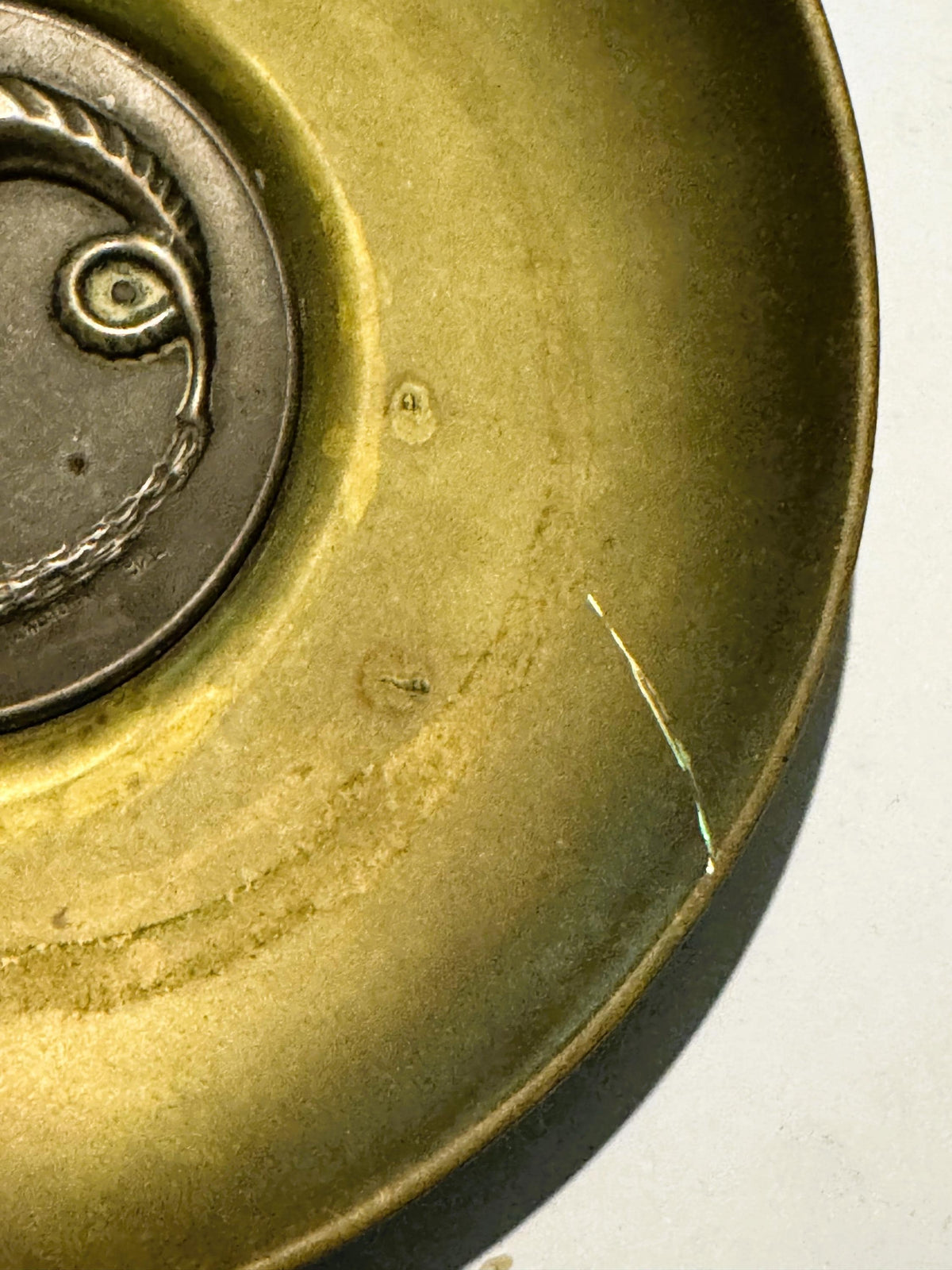
Size: 4 3/4" ~ Aged patina throughout; the fine line in from the rim is a scratch, not a crack.

I love finding a small thing that's quietly showing off. This one's a brass dish - a wide, sloping rim dropping into a stepped well - with a silver-toned medallion set flush at the center. Struck into that medallion is a cornucopia: a ribbed horn, curling up into a tight little spiral at the tip, pouring out a garland of blossoms, berries and wheat that sweeps almost all the way back around a smooth, blank oval field. Somebody left that field bare on purpose - medals like this were often struck with the name space open for later engraving, and this one never got its name. What's in the photos is exactly what ships - there's only the one dish.

There's a scrap of tiny raised lettering near the top edge of the medallion, too small for me to read. There's no maker's mark anywhere on the piece, medallion or dish - the back is plain brass, nothing stamped into it at all.

🐐 Where the Horn Comes From

Cornucopia is just Latin stitched together: cornu, horn, and copia, plenty. The story the Greeks told is that the infant Zeus was hidden away in a cave on Crete and nursed by a goat named Amalthea, and in the roughhousing he snapped off one of her horns. That horn never stopped giving - whatever was wished for, it poured out. There's a rougher version too, where Heracles wrestles the river god Achelous and comes away with one of his horns instead; the American painter Thomas Hart Benton put that fight into his mural Achelous and Hercules.

💰 Who Got to Carry It

Once the horn existed, everybody wanted it in their hands. Plutus, the god of wealth, holds one. So does Demeter, goddess of the grain, and Fortuna, goddess of luck, and Abundantia, whose whole job was personifying abundance itself. Painters and sculptors kept coming back to it long after the myths were old news. In 1553 Jean Goujon carved Ceres, Demeter's Roman counterpart, with her cornucopia into the Lescot Wing of the Louvre, on the face that looks onto the Cour Carrée. Peter Paul Rubens painted his Abundantia around 1630, and Coysevox carved L'Abondance for the gardens at Versailles in 1682.

🗽 Still On Our Flags and Our Tables

The symbol never really left. Idaho put two cornucopias on its state flag and seal, and North Carolina's Great Seal pairs a figure of Liberty with one of Plenty holding a horn of her own. Colombia, Panama, Peru and Venezuela all carry it in their coats of arms. It turns up on the far side of the world too: on the arms of the Australian state of Victoria, the figure of Prosperity holds a cornucopia, and the Ukrainian city of Kharkiv crosses a horn of plenty with Mercury's staff on its green shield. Closer to home, it turned into the woven wicker horn spilling gourds and fruit that shows up on the table every November - the same old idea, just dressed for Thanksgiving.

One place the horn ended up is a little town that took it as its name. Cornucopia, Wisconsin, sits right on Lake Superior at the northern end of the Bayfield Peninsula, along the shore of Siskiwit Bay. In 1903 two land speculators from Iowa, T.J. Stevenson and Albert Wescott, set up a post office there and named the place Cornucopia for the wealth of resources all around it. Cornucopia's post office is still the northernmost one in Wisconsin. All through the 1900s commercial fishermen worked out of its harbor after lake trout, whitefish and herring, and the mainland sea caves of the Apostle Islands National Lakeshore are only a few miles east along the shore. The 2020 census counted 103 people living there.

🤝 Why I'd Keep This One On My Dresser

A dish like this is where the good stuff lands at the end of the day - rings, a watch, the key you always misplace - so putting the oldest symbol of plenty right at the bottom of it feels like a nice little joke that also happens to be true. It's the kind of thing I'd hand someone moving into a new house.

Shipping

🚚 Shipping & Handling

  • Shipping costs and timing are calculated at checkout.
  • Items curated and shipped directly by me include U.S. shipping at no additional cost, professionally packed to ensure safe arrival of your artifact.

Items from Vetted Pro Collectors
Shipping for items offered by vetted Pro Collectors is determined at checkout. All Pro Collector listings are reviewed to ensure fair, reasonable shipping practices.

For full details, please refer to our Shipping Policy.

Returns & Exchange

Take your time — you've got a full six months. If a piece isn't right for you, send it back the way it reached you and we're good.

In the first 30 days your money goes straight back the way you paid. After that it's store credit, so you can put it toward something you'd rather have.

Return shipping we sort out between us, case by case. I don't make this difficult.

If something arrives damaged, or it isn't what I said it was, send me a photo within 48 hours and I'll make it right.

Email info@vintageantiquesgifts.com or call 802-356-9872 — that's me answering, not a call center.

The only things I can't take back are custom or special-order pieces and gift cards.

View full details

Preserving History: Authentic Objects Across Eras

— Curated by Travis Weigel