Nice shirt!
Very nice nickel. Charming vender. Fast service. He has other very cool stuff on sale as well.
Very nice labels in excellent condition. Well packaged and arrived timely.
The Cadillac poster was great, very well made and great graphics.
Everything authentic. Nothing reproduced. 🏛️ Vintage and Antique Gifts is a multi-channel...
$0.00 USD
Vintage and Antique Gifts
Size: 3 3/4" x 3"
🚚 Free US Shipping — ships within one business day. International shipping calculated at checkout.
Couldn't load pickup availability
Size: 3 3/4" x 3" each
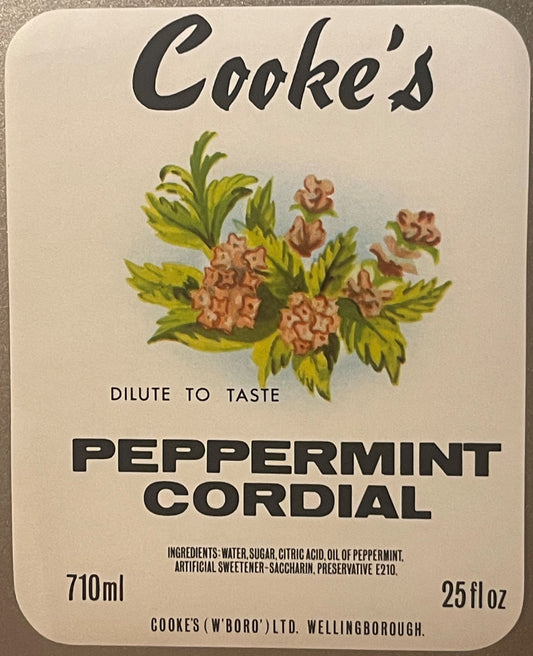
This one's a pair - two of these Cooke's Blackcurrant Cordial labels come to you together.
A paper bottle label from Cooke's (W'boro') Ltd. of Wellingborough, England, for Blackcurrant Cordial: a cluster of glossy blackcurrants on bright green leaves, a big brush-script "Cooke's" across the top and DILUTE TO TASTE beside the fruit. Blackcurrant is the flavor that wartime Britain handed free to its babies and that the United States banned from its farms, and this label carries a second transatlantic divide in its small print: a green food dye that American food makers may not use. That small print also dates it. The preservative and both colors are listed by European E number, E220, E102 and E142, and the saccharin is listed under "artificial sweetener," the category name in Britain's 1984 labeling law. That makes this a 1980s label. Vintage, not antique.
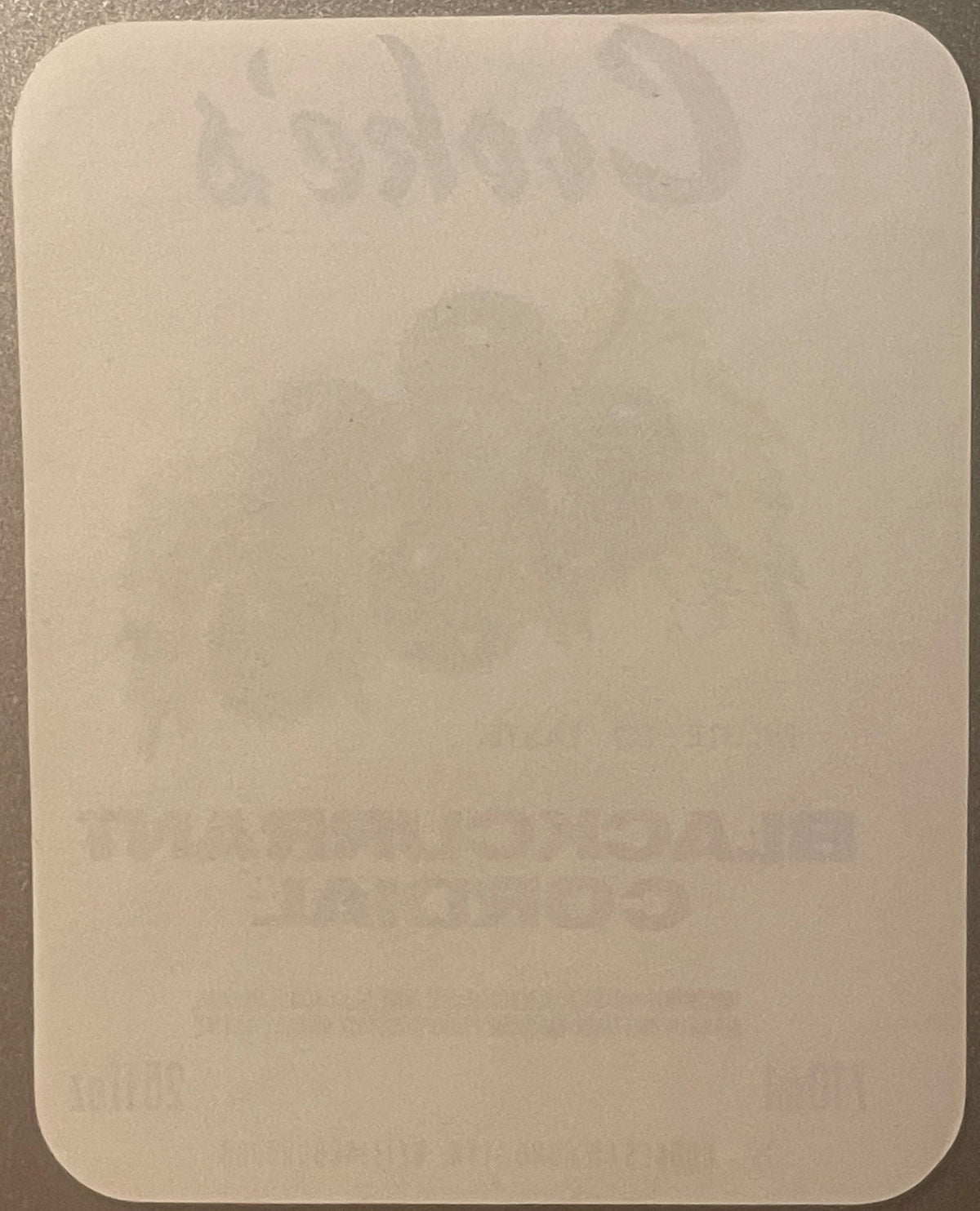
Each measures 3 3/4" x 3" ~, printed on white paper with rounded corners. Along the foot run 710ml on the left and 25 fl oz on the right (710 millilitres is 25 imperial fluid ounces), with the maker's line beneath: COOKE'S (W'BORO') LTD. WELLINGBOROUGH. The back is plain paper, with the currants and lettering faintly showing through in reverse.
The ingredients panel reads: water, sugar, blackcurrant juice, citric acid, flavoring, artificial sweetener-saccharin, preservative E220, color E102, E142. Real blackcurrant juice, sweetened with sugar and saccharin together, kept with sulfur dioxide, and colored with two synthetic dyes.
E numbers are codes from a single European list of approved food additives. The list was first agreed for food colorings in 1962, and preservatives were added in 1964; the E stands for Europe.
In England and Wales the Food Labelling Regulations 1984 (SI 1984/1305) came into operation on 19 September 1984, with a schedule of additive categories to be named in a list of ingredients and a schedule of serial numbers for additives. On 20 November 1984 the government gave the House of Commons its deadline: all additives, except flavorings, which present special labeling problems, had to be identified by name or serial number in the ingredients list on prepackaged foods by 1 July 1986. The Cooke's panel is set out in exactly that way. "Colour" and "preservative" are followed by numbers, "artificial sweetener" by its name, and "flavouring" is left as a plain word, just as the exception for flavorings allowed. Even that "artificial sweetener" is the 1984 law talking: it was one of the category names in the regulations' own schedule, and by the Food Labelling Regulations 1996 the category had become plain "sweetener." So the panel was set under the 1984 rules, and I put it in the 1980s.
The numbers were news in Britain at the time. Maurice Hanssen's guide E for Additives, published in October 1984 to explain the codes to shoppers, became a bestseller.
E102 is tartrazine, a synthetic lemon-yellow azo dye discovered in 1890 by the Swiss chemist Johann Heinrich Ziegler in Basel, at a chemical laboratory that later became CIBA. In 2007 a study commissioned by the UK Food Standards Agency, known as the Southampton study, found a possible link between a mix of six artificial colors, tartrazine among them, taken with the preservative sodium benzoate, and increased hyperactivity in children. The European Union now requires foods containing any of the six to carry the words "May have an adverse effect on activity and attention in children." This label's plain "COLOUR E102" comes from well before that warning.
E142 is Green S, a synthetic coal-tar dye used in mint sauce, desserts, gravy granules, sweets, ice cream and tinned peas, and in eye clinics as a stain that shows up the surface of the eye. It is approved as a food additive in the European Union, Australia and New Zealand, and prohibited in the United States, Canada, Japan and Norway.
Blackcurrant's hold on Britain comes out of the Second World War. With German submarines sinking cargo ships, oranges and other citrus fruit became almost impossible to get, and the government encouraged the growing of blackcurrants for their vitamin C. The Vitamin Welfare Scheme, launched in December 1941, provided blackcurrant syrup and cod liver oil free of charge to children under two, and the syrup went out from 1942. The story goes that those free wartime spoonfuls are why the flavor stayed a British favorite for the rest of the century.
The best-known blackcurrant drink came out of Bristol. The University of Bristol scientist Vernon Charley developed it with the biochemist Audrey Green in 1933, and in 1938 S. M. Lennox of Bristol named it Ribena, from Ribes nigrum, the blackcurrant's botanical name. H. W. Carter & Co. made it; production moved to the Royal Forest Factory at Coleford in the Forest of Dean in late 1947, and the Beecham Group bought Carter's in 1955. The soft drinks trade's own history records that wartime conditions gave concentrated drinks a push that carried on into peacetime, with blackcurrant drinks built on vitamin C from home-grown fruit. Today Britain grows about 1,400 hectares of blackcurrants, almost all under contract to the juicing industry, and 95 per cent of the crop goes into Ribena and similar syrups and juices.
Across the Atlantic the fruit went the other way. Currants are a host of white pine blister rust, a disease that threatened the logging industry, so in the early twentieth century growing currants was banned in the United States. The federal ban was handed to the individual states in 1966, and New York lifted its ban only in 2003, through the efforts of the horticulturist Greg Quinn; several other state bans stayed in place.
The label lists sugar and saccharin side by side. Saccharin was discovered in 1879 by Constantin Fahlberg, working in Ira Remsen's laboratory at Johns Hopkins University, who noticed a sweet taste on his hand one evening and traced it to the compound he had been working on that day. When the First World War made sugar hard to import, the British Saccharin Company was founded in 1917 at the Paragon Works near Accrington, Lancashire.
W'BORO' on the label is Wellingborough, a Northamptonshire market town whose charter King John granted on 3 April 1201. Its name comes from Wendelingburgh, "Waendel's burh", and five wells stand on its coat of arms. The town was famous for its waters in the seventeenth century. On 14 July 1627 Queen Henrietta Maria, wife of Charles I, came with her physician Théodore de Mayerne to take them, and the county's old historians handed down the legend that the King and Queen lived in tents a whole season beside the iron-rich Red Well.
Later Wellingborough lived on boots, shoes and iron, brewed its own beer and bottled its own mineral waters; a joint price notice of January 1916 carries four Wellingborough mineral water firms, F. Cooke Ltd., Campbell Praed & Co. Ltd., C. Cobley, and W. Dulley & Sons Ltd. In 1918 the town became the first constituency in southern England outside London to be represented by the Labour Party.
Imagine hanging this vintage advertising on your wall as home decor in any room: the black fruit on green leaves stands out in a kitchen, a pantry or a café corner. My pictures seriously don't do it justice.
The supply is finite - nobody's printing these Cooke's labels again, and once these last unused ones are gone, they'll be very difficult to acquire.
Items from Vetted Pro Collectors
Shipping for items offered by vetted Pro Collectors is determined at checkout. All Pro Collector listings are reviewed to ensure fair, reasonable shipping practices.
For full details, please refer to our Shipping Policy.
Take your time — you've got a full six months. If a piece isn't right for you, send it back the way it reached you and we're good.
In the first 30 days your money goes straight back the way you paid. After that it's store credit, so you can put it toward something you'd rather have.
Return shipping we sort out between us, case by case. I don't make this difficult.
If something arrives damaged, or it isn't what I said it was, send me a photo within 48 hours and I'll make it right.
Email info@vintageantiquesgifts.com or call 802-356-9872 — that's me answering, not a call center.
The only things I can't take back are custom or special-order pieces and gift cards.

Preserving History: Authentic Objects Across Eras
Nice shirt!
Looks great !
Very nice nickel. Charming vender. Fast service. He has other very cool stuff on sale as well.
Very nice labels in excellent condition. Well packaged and arrived timely.
The Cadillac poster was great, very well made and great graphics.
Nice shirt!
Looks great !
Very nice nickel. Charming vender. Fast service. He has other very cool stuff on sale as well.
Very nice labels in excellent condition. Well packaged and arrived timely.
The Cadillac poster was great, very well made and great graphics.