Skip to product information
1 of 4

Vintage and Antique Gifts

Vintage 1960s Howard Johnson Stock Certificate 🍊 Blue Border, HoJo Roadside Americana

Vintage 1960s Howard Johnson Stock Certificate 🍊 Blue Border, HoJo Roadside Americana

Regular price 6.00 USD
Regular price Sale price 6.00 USD
Sale Sold out
Shipping calculated at checkout.
Quantity

🍊 Remember When a Bright Orange Roof Meant You Were Almost There? 🛣️

For a certain generation, three words on a highway sign — Howard Johnson's — meant the trip was going well. It meant fried clams in a red-and-white paper boat, a swivel stool at the counter, and a scoop of one of twenty-eight ice cream flavors before everyone piled back into the station wagon. This certificate is a piece of that company's actual paper trail — not a menu, not a postcard, but a genuine share of stock in the corporation behind those orange roofs, engraved with the same care Wall Street gave to banknotes and government bonds.

This is a Howard Johnson Company common stock certificate, issued in the years the chain traded publicly and was expanding across the American highway system. The company was incorporated under the laws of the State of Maryland, with an engraved corporate seal reading "Maryland 1961" anchoring the design — the year Howard Johnson Co. reorganized and went public. The certificate itself belongs to the mid-1960s, printed by the Security-Columbian Banknote Company of New York in true steel-engraved intaglio, rendered in soft blue-gray ink on heavy cream stock and measuring 12 x 8 inches — a substantial, wall-ready size straight out of a stock certificate binder or a Wall Street brokerage vault. At the top, an allegorical seated woman — the classic personification used on so much mid-century American financial engraving — holds a sprig of wheat aloft, flanked by two small silhouetted vignettes: children gathered together at a table on one side, and a lamplighter with a child beside a street lamp on the other, both rendered in the crisp black-and-white cutout style favored by security engravers of the era. Beneath it all sits the embossed corporate seal, raised right into the paper the way old-fashioned notarized documents were sealed, reading "Howard Johnson Company — Maryland — 1961."


🍦 The Company That Paved America's Roadside

Howard Johnson's did not start as a restaurant chain — it started as a single soda fountain. In 1925, a young Massachusetts entrepreneur named Howard Deering Johnson borrowed money to buy a small corner drugstore in Wollaston, a village within Quincy, Massachusetts, that sold medicine, cigars, newspapers, and candy. It was the marble-topped soda fountain in the back that caught his attention — it was the busiest part of the store. Johnson bought an old family ice cream recipe and doubled the butterfat content most makers used, chasing a richer, creamier scoop. By 1928 he had developed twenty-eight flavors, a number that would become the company's signature for the rest of its existence.

In 1929 he opened his first true sit-down restaurant in Quincy, and in 1935 he did something that would reshape American business itself: he partnered with a Cape Cod businessman to open a Howard Johnson's in Orleans, Massachusetts, under an arrangement where the operator bought Johnson's ice cream and food supplies and Johnson set the standards for everything served. It is widely credited as one of the first modern restaurant franchises in the country — a model that would eventually put more than a thousand orange roofs along American highways.

The orange roof and turquoise cupola became so recognizable that old-timers still describe spotting one from the highway the way sailors once described a lighthouse — a beacon that meant clean restrooms, familiar food, and a break from the road. The chain built its own network of commissaries — central kitchens that prepared ice cream and recipes to exact specification and shipped them frozen to restaurants nationwide, guaranteeing that a hot dog or a plate of fried clams tasted the same in Maine as it did in Florida. In the very year this certificate's corporate seal commemorates, the company brought in two young chefs, Pierre Franey and Jacques Pépin — both of whom would go on to become titans of American culinary television and writing — to help develop recipes at the Brockton, Massachusetts commissary that could be flash-frozen and shipped across the country without losing quality.

By the time this stock was trading on Wall Street, Howard Johnson Company was no small operation: hundreds of company-owned and licensed restaurants, dozens of Red Coach Grill steakhouses, and a growing chain of Howard Johnson's Motor Lodges stretched across more than thirty states and into the Bahamas, backed by a network of manufacturing plants. Sales and earnings climbed every year through the mid-1960s. By 1975 the company had grown to more than a thousand restaurants and over five hundred motor lodges across the United States and Canada — the peak of its orange-roofed empire.


🏛️ Maryland Charter, Massachusetts Roots, Wall Street Money

There's a quiet irony engraved right into this certificate: a restaurant chain born from a Massachusetts soda fountain was legally chartered in Maryland, a common practice among mid-century American corporations seeking Maryland's favorable business statutes, while its actual headquarters, commissary, and operating heart remained in New England. The certificate itself even notes it was transferable in Boston or New York — a nod to both the company's operational home and the financial machinery of Wall Street that kept its shares moving. Registrar duties fell to Manufacturers' Hanover Trust Company and transfer agent duties to The Chase Manhattan Bank, two of the giants of mid-century American banking, whose names appear on countless blue-chip and growth-stock certificates of the era.

Shares like this one, marked "less than 100 shares," moved constantly through the great brokerage houses that lined Wall Street in the 1960s — firms like Goodbody & Co., once among the largest stock brokerages in the country before the paperwork crisis of the late 1960s overwhelmed it and it was folded into Merrill Lynch. It's a small footnote of financial history that a certificate this size could have passed hands right in the thick of that era, when a boom in trading volume was quietly breaking the back-office systems of even the biggest firms on the Street.


👨‍👦 The Family Behind the Signature

The facsimile signature engraved as "President" on certificates in this series belongs to Howard B. Johnson — known to nearly everyone in the business as "Bud" — who took over day-to-day leadership of the company from his father in the years just before this certificate was printed. Howard Deering Johnson, the founder, stepped back from the presidency in 1959 but remained chairman and the guiding hand behind the brand for years afterward, a classic case of a founder loosening the reins while still very much watching over the shop. It was Bud Johnson's signature that authorized the paper that shareholders across the country held onto, often for years, as a stake in the company that had become a fixture of the American road trip.


🖋️ The Engraver's Craft: Security-Columbian Banknote Company

The imprint at the base of the design — Security-Columbian Banknote Company — names one of the serious players in American security printing. Formed in 1957 from a merger of older engraving houses, the firm produced stock and bond certificates for companies across the country using the same steel-engraved intaglio processes used for currency and government bonds: hand-cut master dies, fine cross-hatched shading, and raised, tactile ink that catches the light differently than ordinary lithography. Security-Columbian would later become the nucleus of the U.S. Banknote Corporation, which in time completed one of the largest consolidations in the American banknote printing industry when it absorbed the venerable American Bank Note Company — meaning a certificate like this one carries the fingerprints of a printing lineage that eventually swallowed up its own great rival.


🎬 From Highway Icon to Memory

Howard Johnson's decline in the years after its 1975 peak has become its own piece of American business lore. As fast food chains and interstate rest-stop competition multiplied, the company tried cutting costs on food quality and staffing to compete — a decision that, as old-timers and longtime patrons often recall, broke the trust that had made the brand feel like a reliable old friend on the road. The Johnson family sold the company in 1979, and by the following decade the orange roofs that had once defined the American vacation began disappearing one by one. The very last Howard Johnson's restaurant, standing in Lake George, New York, finally closed its doors in the 2020s, closing the book on a chain that had once been the largest restaurant company in the country. What remains today are the memories — and pieces of paper exactly like this one, engraved evidence of a company that shareholders once bet on the way families once bet a summer vacation on finding an orange roof at the next exit.


🖼️ Display Ideas

  • 🍽️ Frame it alongside vintage diner menus or postcards for a mid-century roadside Americana gallery wall
  • 🚗 Pair it with old road maps and motor lodge memorabilia for a classic American road-trip corner
  • 💼 Hang it in a home office or study — the engraved detail and blue-gray palette read as understated and archival
  • 🎁 Give it to a family member who remembers stopping at Howard Johnson's on childhood vacations
  • 📈 Add it to a scripophily collection alongside other mid-century American stock and bond certificates
  • 🛋️ Group several vintage restaurant and hospitality-brand certificates together for a themed conversation piece

🎁 Who Collects These

This piece speaks to several kinds of collectors at once: scripophily enthusiasts who chase engraved stock and bond certificates for their artistry and printing history; roadside Americana and diner memorabilia collectors filling out a Howard Johnson's or mid-century highway culture display; fans of Wall Street and corporate history drawn to the printers, banks, and brokerages named right on the page; and anyone who simply remembers the orange roofs and wants a tangible, framable piece of that memory to pass down or gift to a family member who grew up on the road.


❓ FAQ

Is this a real, historically issued stock certificate?

Yes — it is a genuine Howard Johnson Company common stock certificate from the company's publicly traded era, engraved by Security-Columbian Banknote Company, carrying real registrar and transfer agent designations from Manufacturers' Hanover Trust and The Chase Manhattan Bank.

What era does this certificate date to?

The certificate carries an embossed "Maryland 1961" corporate seal marking the year Howard Johnson Company was incorporated and went public, and this issue of certificates dates to the 1960s, the decade of the chain's strongest publicly traded growth.

Can this be used to actually buy or claim Howard Johnson Company shares?

No — this is a collectible historical artifact, not a negotiable financial instrument. It's prized today for its engraving, its design, and the story of the company it represents.

How big is the certificate, and is it suitable for framing?

It measures 12 x 8 inches, printed on heavy stock — a substantial size that displays well framed on its own or grouped with other vintage paper ephemera.

What does the artwork on the certificate depict?

An allegorical seated female figure holding a sprig of wheat sits at the top center, flanked by two silhouetted vignettes — one showing children gathered together, the other a lamplighter scene — all rendered in fine steel-engraved detail, with an embossed corporate seal at the bottom.

Why is the printing style so detailed compared to ordinary paper?

It was produced using steel-engraved intaglio printing, the same painstaking process security printers used for currency and government bonds, which is why the linework is so fine and the corporate seal is raised right into the paper.

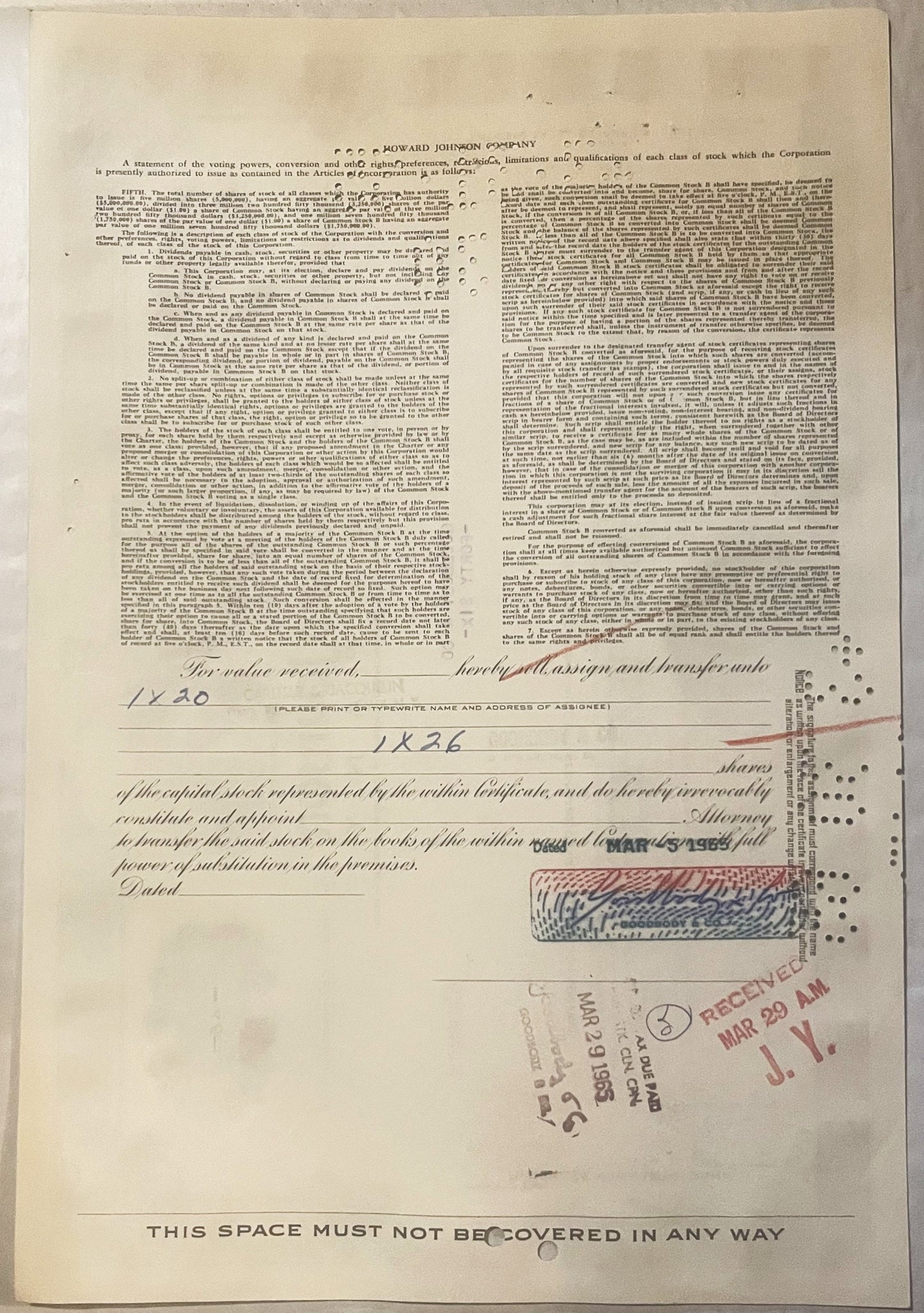
These are issued instruments rather than blanks. Certificates of this type were filled in for a holder in ink, countersigned by the transfer agent and registered by the registrar, then punch- or cut-cancelled when they were redeemed and retired. Expect financial writings, markings, stamps, hole punches and staple holes as part of the life of the instrument: endorsements and signatures, transfer-agent and registrar stamps, revenue or documentary tax stamps, cancellation punches, staple holes from being bound into a transfer book, pencil ledger notations. That is the paper trail of a security that actually did its job, and it is what separates a document that lived from a blank that never did. No two are alike: holder details, serial numbers, dates, signatures, stamps and punch patterns vary from example to example, so the photographs show the type rather than the exact sheet that ships.

Shipping

🚚 Shipping & Handling

  • Shipping costs and timing are calculated at checkout.
  • Items curated and shipped directly by me include U.S. shipping at no additional cost, professionally packed to ensure safe arrival of your artifact.

Items from Vetted Pro Collectors
Shipping for items offered by vetted Pro Collectors is determined at checkout. All Pro Collector listings are reviewed to ensure fair, reasonable shipping practices.

For full details, please refer to our Shipping Policy.

Returns & Exchange

Take your time — you've got a full six months. If a piece isn't right for you, send it back the way it reached you and we're good.

In the first 30 days your money goes straight back the way you paid. After that it's store credit, so you can put it toward something you'd rather have.

Return shipping we sort out between us, case by case. I don't make this difficult.

If something arrives damaged, or it isn't what I said it was, send me a photo within 48 hours and I'll make it right.

Email info@vintageantiquesgifts.com or call 802-356-9872 — that's me answering, not a call center.

The only things I can't take back are custom or special-order pieces and gift cards.

View full details
  • 5 stars: 1 (100%)
  • 4 stars: 0 (0%)
  • 3 stars: 0 (0%)
  • 2 stars: 0 (0%)
  • 1 star: 0 (0%)
D
David

A great piece of history. Very beautiful to look at. Worth framing. shipped very fast and very securely. 5 stars all around for this seller and this transaction. Thank you