Skip to product information
1 of 4

Vintage and Antique Gifts

Vintage 1985 McDonald's Ronald & Grimace Puffy Stickers ๐ŸŸ McDonaldland Set

Regular price 9.00 USD
Regular price Sale price 9.00 USD
Sale Sold out
Shipping calculated at checkout.

Description

Do You Remember the Exact Shade of McDonaldland Purple? ๐Ÿ’œ

There's a particular color of purple that belongs to no crayon box, no paint chip, no rainbow โ€” it belongs to Grimace, and if you grew up anywhere near a McDonald's in the 1980s, your brain has it filed away permanently, right next to the smell of a Happy Meal box and the specific crinkle of a French fry bag. That purple, that grin, that halo of red hair โ€” they were the visual shorthand of an entire childhood decade, printed on placemats, cups, playground equipment, and yes, little puffy stickers just like these. Holding a piece like this isn't really about the plastic and the ink. It's about the fact that somewhere, a kid your age once peeled a sheet like this apart at a McDonald's counter, or found one tucked into a pack traded at recess, and for a second, McDonaldland felt like a real place you could visit.

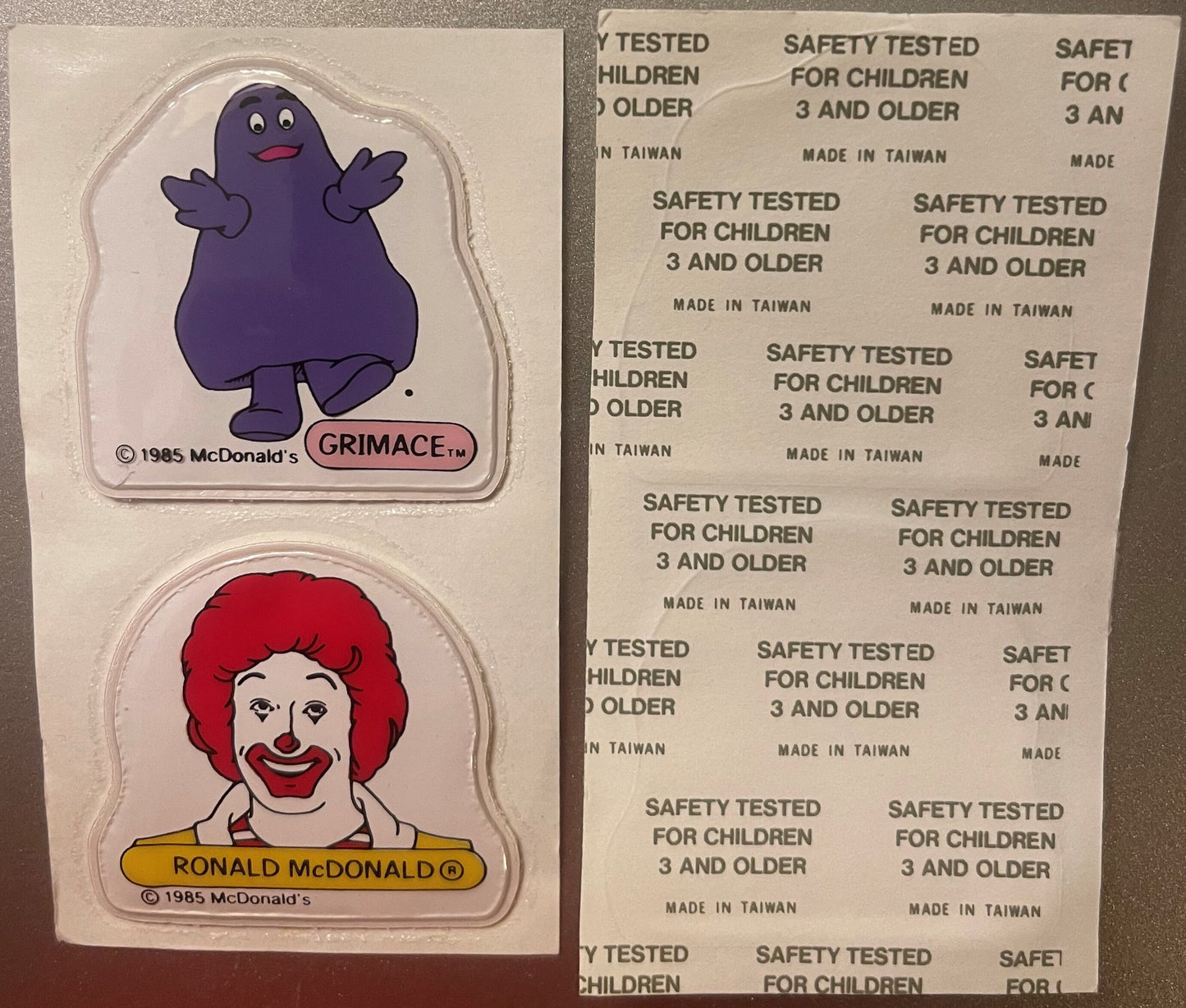
What you're looking at is a matched pair of original McDonald's puffy stickers from 1985 โ€” one depicting Grimace, the other depicting Ronald McDonald โ€” each carrying the printed copyright line ยฉ 1985 McDonald's directly on the artwork, which anchors this pair firmly to the mid-1980s heart of the McDonaldland era. Each sticker measures 2 inches by 2 inches, a compact, almost badge-like size that made these things so perfectly suited to trading, collecting, and sticking onto whatever a kid's imagination decided needed decorating that week. The artwork is printed in full offset color โ€” rich purple, crisp white, bold red, sunny yellow, and soft pink โ€” and raised beneath a clear, dimensional plastic coating, the glossy "puffy" construction that gave 1980s stickers their signature sculpted, almost candy-like presence on the shelf. The Grimace sticker captures him mid-stride, both gloved hands thrown wide in that unmistakable happy shrug, his blob-like purple body caught in motion, with GRIMACEโ„ข lettered across a soft pink pill-shaped banner at his feet. The Ronald McDonald sticker gives us the character's grinning bust portrait โ€” the towering red afro, the painted red nose and mouth, the red-and-white striped sleeves โ€” with RONALD McDONALDยฎ set in bold black lettering across a golden-yellow banner beneath him. Both pieces are offered as New Old Stock (NOS) โ€” meaning they exist today exactly as they left the printing process, never applied, never peeled, never pressed into use.


๐Ÿ” San Bernardino to Oak Brook: The Empire Behind the Arches

The trademark stamped onto these stickers carries one of the great American business stories inside it. It begins in 1940, when brothers Richard and Maurice McDonald opened a drive-in restaurant in San Bernardino, California. In 1948, the brothers tore the whole concept apart and rebuilt it โ€” stripping the menu down to burgers, fries, and shakes, and reorganizing the kitchen into what they called the Speedee Service System, an assembly-line approach to food that let a handful of workers serve customers faster than any restaurant had managed before. It worked so well that it caught the attention of a traveling salesman named Ray Kroc, who arrived at their restaurant in 1954 selling Multimixer milkshake machines and left convinced he'd just seen the future of American food service. Kroc became the brothers' franchise agent, and in April 1955 he opened his own McDonald's location in Des Plaines, Illinois โ€” the store that would become the seed of the entire modern McDonald's Corporation. By 1961, Kroc had bought out the McDonald brothers entirely, and the company he built went on to plant its corporate flag in Oak Brook, Illinois, a quiet Chicago suburb that would become, almost improbably, the nerve center of a worldwide fast-food empire. Old-timers in the industry still repeat the sign Kroc reportedly kept above his desk โ€” "In God we trust; all others pay cash" โ€” a little piece of company folklore that captures just how relentlessly practical the empire's founder actually was, even as his restaurants were busy selling pure childhood magic to the rest of the country.

Before Ronald McDonald ever wore a red wig, the company's mascot was a chef-like character named Speedee, a grinning hamburger-headed figure who symbolized that original speedy service system. Speedee gave way to the Golden Arches themselves as the company's visual signature, and it would take another decade before McDonald's found the character who would truly define its brand for the rest of the century.


๐Ÿคก A Clown Named Ronald and a Milkshake Thief Named Grimace

Ronald McDonald first appeared not on national television, but in local Washington, D.C. commercials in 1963, played by a weatherman and radio personality named Willard Scott โ€” the very same Willard Scott who would later become a beloved fixture on NBC's Today Show. Scott's homespun, cup-nosed clown was such a hit locally that McDonald's took the character national in 1966, refining his design into the friendlier, more polished version that would eventually anchor an entire fictional universe.

That universe arrived in 1971 under the name McDonaldland, dreamed up by the company's advertising team to give kids a whole world of characters to fall in love with โ€” Ronald, the Hamburglar, Mayor McCheese, Birdie the Early Bird, and a strange, gentle giant named Grimace. Grimace himself started out rougher around the edges than the sweet character on this sticker: his earliest 1971 appearance cast him as "Evil Grimace," a four-armed purple villain who ran around McDonaldland stealing milkshakes. Kids, it turned out, didn't want a villain โ€” they wanted a friend โ€” and within a year the character had been redesigned down to two arms and reimagined as the affectionate, clumsy, big-hearted figure collectors and longtime fans still recognize today, the very pose captured on this 1985 sticker, arms thrown open in greeting rather than mischief. Local legend among old McDonaldland watchers has long held that Grimace was meant to represent nothing more specific than "a giant taste bud" โ€” an idea the company itself has floated over the years, though never with total consistency, which somehow only adds to his charm as one of advertising's strangest and most lovable inventions.

McDonaldland's early years weren't without controversy โ€” the fictional world drew a legal challenge from Sid and Marty Krofft, creators of the children's show H.R. Pufnstuf, who argued the whole colorful, oversized landscape of McDonaldland leaned a little too heavily on their own television creation. The case wound its way through the courts for years and ultimately went in the Kroffts' favor, a fascinating footnote in advertising history that only underscores how thoroughly McDonaldland had been built as a fully imagined fantasy world, not just a backdrop for burger commercials. By the time these stickers were printed in 1985, that world was firmly established and at the peak of its cultural reach, appearing in Saturday morning-style commercials with an entire ensemble cast, each character with a name, a personality, and โ€” evidently โ€” a puffy sticker of their own.


๐Ÿ“บ Sticker Trading, Saturday Mornings, and the Golden Age of McDonaldland

The mid-1980s were arguably McDonaldland's commercial high-water mark. Ronald, Grimace, and the rest of the gang were everywhere a kid looked โ€” on television between cartoons, on restaurant tray liners, on playground equipment out back, and on exactly the kind of small collectible items represented here. Puffy stickers themselves were a defining fad of the decade, prized by kids precisely because of that raised, glossy, almost three-dimensional surface โ€” a tactile quality flat paper stickers simply couldn't match. They were traded at school, pressed into sticker books and photo albums, stuck to notebooks, lunchboxes, and bedroom windows, collected the way earlier generations collected marbles or bottle caps. A McDonald's-branded set carried extra weight in that culture, because it wasn't just a sticker โ€” it was a piece of a brand that already felt like a personal friend to an entire generation of American kids who grew up celebrating birthdays under the Golden Arches and measuring good report cards by how many Happy Meals they'd earn as a reward.


๐Ÿ’œ Why Grimace and Ronald Still Matter Today

Long after the original McDonaldland commercials stopped airing, Ronald McDonald and Grimace have both refused to fade quietly into corporate history. Ronald remains one of the most recognized commercial characters ever created, instantly identifiable across generations who never even watched his original animated adventures. Grimace, meanwhile, experienced an unexpected second act in recent years, when a birthday-themed promotional shake built around his character unexpectedly became a massive viral moment online โ€” proof that a purple blob invented to sell milkshakes in 1971 could still capture the internet's imagination decades later. That kind of staying power is rare in advertising, and it's exactly what makes original, period-correct pieces like these two stickers so meaningful to collectors: they're not just company memorabilia, they're artifacts of a shared cultural memory that keeps circling back around, generation after generation.


๐Ÿ–ผ๏ธ Display Ideas

  • ๐Ÿ–ผ๏ธ Framed together in a small shadow box as a matched McDonaldland pair, letting Ronald and Grimace share the spotlight side by side
  • ๐Ÿ“” Mounted in a vintage sticker album or scrapbook alongside other 1980s advertising ephemera for a themed collection page
  • ๐Ÿ—„๏ธ Displayed inside a glass-top curio case with other McDonald's collectibles โ€” cups, Happy Meal boxes, or promotional toys from the same era
  • ๐ŸŽ Given as a nostalgic gift tucked inside a card for someone who grew up on McDonaldland commercials
  • ๐Ÿงธ Added to a retro treasure box or memory box project celebrating 1980s childhood keepsakes
  • ๐Ÿ  Propped on a bookshelf or desk in a small acrylic stand as a pop of purple-and-red color among other collectibles

๐ŸŽ Who Collects These

These stickers tend to land in the hands of a few overlapping kinds of collectors. There are the dedicated McDonald's memorabilia collectors, who chase down anything from cups and Happy Meal boxes to promotional pins and premiums, building out collections organized by decade or by character. There are Ronald McDonald and Grimace specialists specifically, drawn to the character design history and the evolution of McDonaldland's cast over the decades. There are 1980s childhood nostalgia collectors, often building out a broader collection of the era's fast-food, cereal-box, and Saturday-morning advertising ephemera. And there are gift-givers looking for a small, easily displayed piece of pure childhood memory for someone who grew up trading puffy stickers on the playground โ€” a genre of collectible that, thanks to its size and charm, tends to bring an instant smile the moment it's unwrapped.


โ“ FAQ

Are these stickers actually from 1985?

Yes โ€” both pieces carry the printed copyright line "ยฉ 1985 McDonald's" directly in the artwork, which is what dates this set to that year.

What does "puffy sticker" mean?

It refers to the raised, dimensional plastic coating over the printed artwork, a construction style that gave 1980s stickers their signature glossy, sculpted look and feel, distinct from flat paper stickers.

Have these ever been used or applied?

No โ€” this set is New Old Stock (NOS), meaning it survives today in the same unused state it existed in when it was originally produced.

How big are the stickers?

Each sticker measures 2 inches by 2 inches.

Is this an official McDonald's product?

Yes โ€” both the Grimace and Ronald McDonald artwork carry McDonald's own copyright and trademark/registered marks printed directly on the pieces.

Why does Grimace only have two arms here, when some early versions had four?

Grimace's earliest 1971 appearance in McDonaldland advertising gave him four arms as a mischievous milkshake-stealing character; he was redesigned into the friendlier two-armed figure within about a year, and it's that later, gentler version reflected on this 1985 sticker.

Do the two stickers come together as a set?

Yes โ€” this listing is for the matched pair, Grimace and Ronald McDonald together.

Shipping

๐Ÿšš Shipping & Handling

  • Shipping costs and timing are calculated at checkout.
  • Items curated and shipped directly by me include U.S. shipping at no additional cost, professionally packed to ensure safe arrival of your artifact.

Items from Vetted Pro Collectors
Shipping for items offered by vetted Pro Collectors is determined at checkout. All Pro Collector listings are reviewed to ensure fair, reasonable shipping practices.

For full details, please refer to our Shipping Policy.

Returns & Exchange

Product Page Return Policy

  • 60-Day Returns โ€“ Items must be in original condition.
  • Refunds โ€“ Issued after inspection (excluding shipping costs).
  • Return Shipping โ€“ Customer is responsible unless item is damaged or incorrect.
  • Damaged/Incorrect Items โ€“ Contact us within 48 hours for a replacement or refund.
  • Easy Returns โ€“ Email [email protected] or call 802-356-9872 to initiate a return.

For full details, visit our Refund Policy.

View full details