








Skip to product information
1 of 3

Vintage and Antique Gifts

Vintage Sands Peach Wine Label 🍑 Richards Wine Cellars Petersburg VA Bonded Winery No. 20 NOS 1940s American Made

Regular price 24.00 USD
Regular price Sale price 24.00 USD
Sale Sold out
Shipping calculated at checkout.

Description

Can You Still Smell the Orchard? 🍑 A 1940s Virginia Peach Wine Label That Never Met a Bottle

There is a particular kind of American artifact that stops you cold — not because it is grand or gilded, but because it is so completely, honestly itself. This Sands Peach Wine label from Richards Wine Cellars of Petersburg, Virginia is exactly that kind of object. It is a rectangle of mid-century commercial printing, roughly three inches wide and four inches tall, and it carries in that modest footprint an entire world: the warm weight of a Southern peach harvest, the quiet pride of a Virginia winery doing things right, and the plain-spoken graphic confidence of an era that had not yet learned to overcomplicate anything. Pick it up and you are holding the 1940s. Set it down on a table in good light and it glows like the fruit it celebrates.


🍑 What This Label Is — Every Detail, Honestly Told

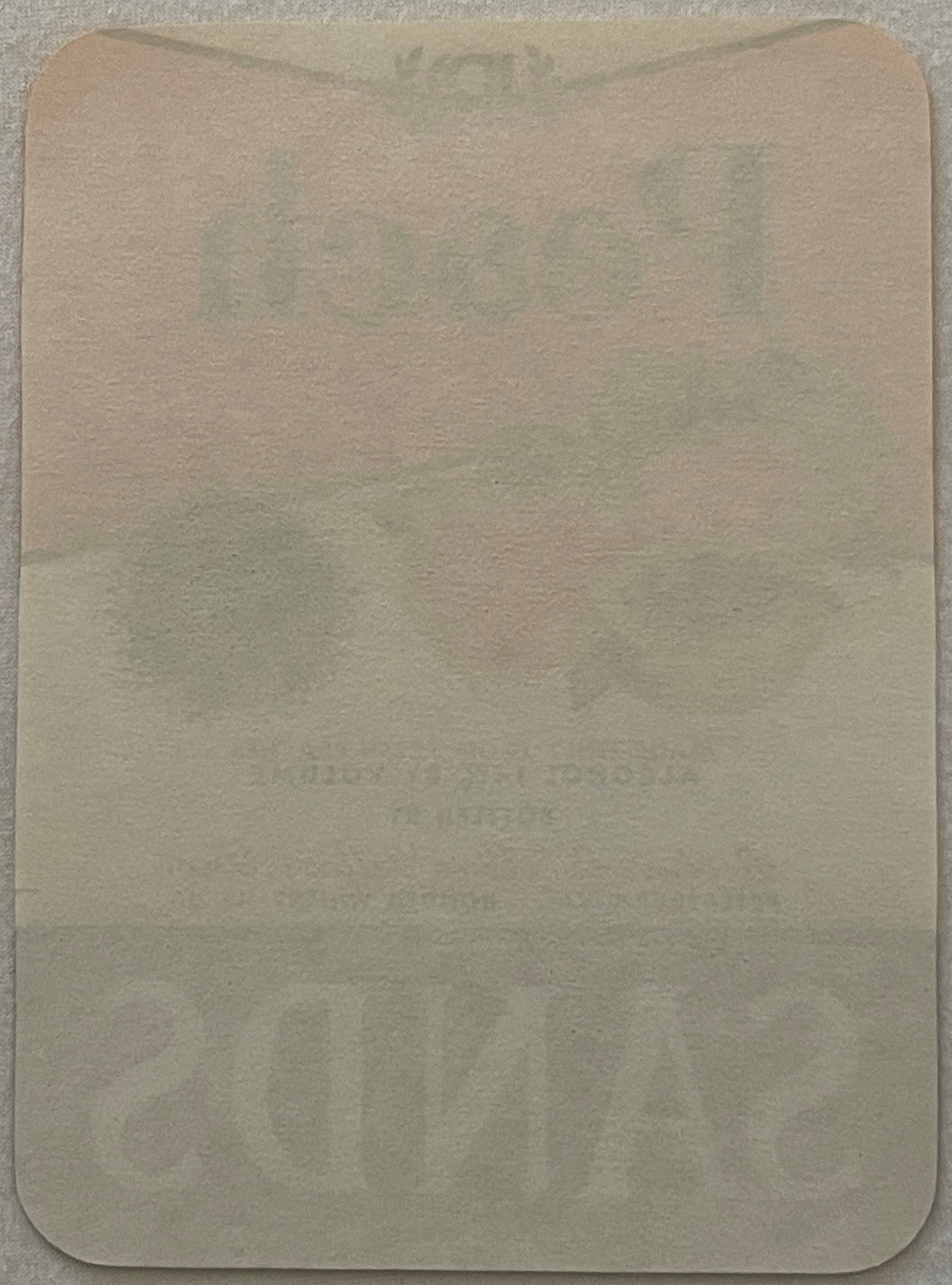
This is a genuine, original, never-applied paper wine bottle label produced for Sands Peach Wine, bottled by Richards Wine Cellars, Inc., located in Petersburg, Virginia, and operating as Bonded Winery No. 20 under federal alcohol licensing. The label dates to the 1940s era and arrives in what the collecting world calls New Old Stock condition — meaning it was printed, stored, and never once pressed against a bottle of wine. The gum on its reverse has never been activated by moisture or a human hand. It is, in the most literal sense, a label that outlived its purpose and became something rarer than the wine it was meant to dress.

The label measures approximately 3 inches wide by 4 inches tall — a compact, upright format standard to wine bottle labeling of the period, designed to sit smartly on the lower third of a standard claret-style bottle. It was printed using the commercial letterpress and lithographic processes typical of mid-century American label printing houses, which favored bold spot colors, clean typography hierarchies, and hand-drawn decorative elements that a modern printer would build from a font menu. Nothing here came from a menu. Everything here was drawn, set, and pressed by someone who took the craft seriously.

The color palette is precisely what mid-century American commercial art does best: a rich amber-orange fills the upper portion of the label, warm as a late-August afternoon in the Virginia piedmont, grading downward into a crisp white lower field before anchoring at the base in a deep charcoal-black band where the brand name SANDS runs in large, commanding white display lettering. At the top center sits an ornate crowned letter R flanked by delicate laurel branch flourishes — the Richards Wine Cellars house mark, elegant and old-world in a way that signals the winery understood its own ambitions. At center right, a serrated circular seal carries the words This Is A Pure Peach Wine — a phrase so direct and confident it reads today almost like a philosophical statement. The full label text declares: Made Only From Fresh Peaches, Alcohol 14% by Volume. No hedging. No asterisks. Just the facts of a product made with intention.


🏭 Richards Wine Cellars — Bonded Winery No. 20 and the Virginia Fruit Wine Tradition

The story of Richards Wine Cellars is the story of American ingenuity meeting Southern agricultural abundance in the years just after Prohibition's long shadow finally lifted. When the Eighteenth Amendment was repealed in 1933, the American wine industry did not simply resume where it had left off in 1920. It had to rebuild — and it had to rebuild fast, in a country where grape-growing infrastructure varied wildly by region but where fruit orchards, particularly in the mid-Atlantic and Upper South, were thriving and productive. Virginia's peach country, particularly the belt running through the central and southside regions of the state, was ready-made for a winery that understood how to work with what the land gave you.

Richards Wine Cellars took that opportunity seriously. Establishing themselves in Petersburg, Virginia and earning their federal designation as Bonded Winery No. 20, the company positioned itself as a regional producer of fruit wines made to an honest standard — not wines that apologized for not being grape, but wines that led with the pure, concentrated flavor of Virginia-grown stone fruit and stood behind that identity with the kind of label copy that says This Is A Pure Peach Wine in a sealed medallion, center label, where no one could miss it. That is not the language of a company hedging its bets. That is the language of a company proud of what it made.

Fruit wines occupy a fascinating and often underappreciated chapter of American viticulture history. In the post-Prohibition era, before California's dominance of the national wine conversation was fully established, regional fruit wineries from Virginia to Michigan to New York's Hudson Valley held genuine market share and local loyalty. Peach wine, in particular, was a category that resonated deeply in states like Virginia where peach orchards had been a cornerstone of agricultural identity since the eighteenth century. Richards was not an outlier — it was a participant in a legitimate American wine culture that the mid-century market supported and that serious collectors now chase with real enthusiasm.

The Bonded Winery designation itself is worth understanding. Under post-Prohibition federal alcohol regulations administered by what was then the Federal Alcohol Administration (later folded into the Bureau of Alcohol, Tobacco and Firearms), every operating winery in the country was assigned a bonded winery number — a federal registration that authorized the production, storage, and sale of wine under government oversight. The bond referred to a financial surety posted to guarantee tax compliance on alcohol produced. To hold a bonded winery number was to be a legitimate, federally recognized operation. Number 20 tells us Richards was among the early post-Repeal registrants in Virginia — an established house, not a newcomer.


📍 Petersburg, Virginia — A City That Earned Its Place in American History

Petersburg, Virginia sits roughly twenty-three miles south of Richmond, at the confluence of the Appomattox and Pocahontas rivers, and it is a city with a depth of American history that most people only begin to appreciate when they start pulling at the threads. Long before it was known as the site of the extended Civil War siege of 1864-1865 — one of the most grueling campaigns of that conflict — Petersburg was a thriving commercial and manufacturing center, one of Virginia's most productive inland port towns, moving goods up the Appomattox River to the James and onward to the Atlantic trade.

By the 1940s, when this label was printed, Petersburg had rebuilt and reinvented itself multiple times over. It was a city with industrial capacity, agricultural connections to the surrounding Southside Virginia farmland, and a civic identity that balanced its Confederate memorial culture with a working-class productivity that kept factories, tobacco processing facilities, and yes, wineries, operating through the Depression and the war years. Richards Wine Cellars was a Petersburg business in the fullest sense — rooted in the region's agricultural output, serving a regional market, and carrying the city's name, through its address, on every bottle.

The peach orchards that fed a winery like Richards were part of a Virginia agricultural landscape that stretched from the northern Shenandoah Valley south through the piedmont. Southside Virginia, the region immediately surrounding Petersburg, was known for tobacco primarily, but the mixed-farming culture of the area included fruit cultivation that could supply a winery with the raw material it needed. Local growers, many of them operating family farms that had been in continuous use since before the Civil War, would have been the supply chain behind a label like this one — and the phrase Made Only From Fresh Peaches was almost certainly not marketing language but an accurate description of a direct relationship between orchard and cellar.

Local legend has it that Richards Wine Cellars maintained relationships with specific orchard families in the surrounding counties, and that during peak harvest seasons the winery operated around the clock to process fruit before it turned — a timeline that imparted a particular freshness to the wine that regular grape vintners, working on longer fermentation schedules, could not always match. Whether that lore is literal truth or the kind of warm story that clusters around beloved regional producers, it reflects a genuine truth about how fruit wineries operated: seasonally, urgently, and with a direct connection to the land that bottled wine rarely makes visible.

Lore passed down among Virginia breweriana and label collectors holds that Richards Wine Cellars labels are among the more elusive finds in the mid-Atlantic paper ephemera world — not because the winery was obscure, but because its labels, being paper and perishable, survived in far smaller numbers than the bottles themselves. A label in New Old Stock condition, never applied, represents the rarest tier of that survival: not a label that was soaked off a bottle decades later and dried flat, but one that never made that journey at all. The ones that survived did so by being forgotten in storage, tucked away in the back of a filing cabinet or a warehouse drawer, waiting for someone like you to find them.


🎨 The Graphic Design — Mid-Century American Commercial Art at Its Most Honest

It would be a mistake to pass over the visual design of this label without pausing, because what you are looking at is also a document of American commercial graphic arts in a period that produced some of the most enduring visual language in the country's design history. The 1940s were the decade when American advertising and packaging design reached a particular maturity — influenced by European modernism but never entirely surrendering the warmth and directness that characterized domestic commercial printing.

The crowned letter R at the top of this label is a house mark in the old European tradition — a brand identifier borrowed from the heraldic vocabulary of Old World wine producers, adapted here for a Virginia fruit winery with no apology and considerable style. The laurel branches flanking it speak the same language: these are symbols of quality and distinction, used without irony by a producer that believed in what it was selling. The serrated circular seal reading This Is A Pure Peach Wine echoes the certification seals and guarantee medallions that American food and beverage producers used throughout the late nineteenth and early twentieth centuries to signal authenticity in a market where adulteration was a genuine consumer concern. By the 1940s, that seal was partly a legacy design element and partly a sincere statement of product philosophy — Richards was telling you, plainly, what was in the bottle.

The typography — SANDS in large white letters on that deep charcoal band — is display lettering of the kind that letterpress printers kept in wooden type cases, selecting and spacing by hand. The weight and spacing of those letters has a warmth that digital reproduction cannot fully capture, because it was achieved physically, with ink and pressure, by a craftsman making decisions in real time. That is what you are holding when you hold this label: the residue of a physical process performed by human hands, in a print shop that no longer exists, for a winery that has passed into history.


🖼️ Display Ideas

  • 🖼️ Frame it in a simple black or warm wood shadow-box mat alongside a period Virginia travel map or orchard trade catalog page for an instant wall piece that anchors a kitchen, bar cart alcove, or home cellar display.
  • 🍷 Group it with other mid-century fruit wine or regional American winery labels in a multi-opening gallery frame — Virginia, Georgia, and Carolinas fruit labels together make a stunning mid-century Southern agriculture tableau.
  • 📚 Slip it into a rigid archival sleeve and display it upright in a vintage wooden recipe card box or small tabletop easel on a bar or kitchen shelf — it reads beautifully at close range.
  • 🎁 Pair it with a reproduction or period peach crate label, a small antique kitchen scale, and a vintage glass bottle stopper in a styled vignette on an open kitchen shelf or farmhouse sideboard.
  • 🏛️ Donate or loan a scan to a local Virginia history archive, Petersburg historical society display, or regional winery museum installation — original ephemera like this is exactly what those collections need to tell the full story of post-Prohibition Virginia viticulture.
  • ✍️ Use it as the centerpiece of a scrapbook or journal page documenting Virginia food and agricultural history — its rarity and NOS condition make it worthy of archival presentation in any serious paper ephemera collection.

🎁 Who Collects These — and Why They Search So Hard for Them

Vintage wine and beverage labels occupy a wonderfully broad collecting world, drawing in people from half a dozen adjacent passions who converge on this category from different directions and stay because the material rewards them so consistently.

Virginia history collectors and local heritage enthusiasts are perhaps the most immediately drawn to this piece — anyone with roots in Petersburg, Southside Virginia, or the broader Central Virginia corridor feels the pull of a label that carries their region's name and commercial history. For that collector, this is not just paper ephemera; it is a primary source document about how their community participated in American economic and agricultural life in the mid-twentieth century.

Breweriana and wine label collectors — a serious and well-organized community with their own shows, clubs, and grading standards — know exactly how rare an NOS label from a small regional post-Prohibition fruit winery is. The survival rate for paper labels from this era is genuinely low, and a never-applied example commands attention in any collection. Bonded Winery No. 20 as a designation adds a layer of specificity that serious collectors note and value.

Mid-century commercial art and graphic design enthusiasts collect labels like this for purely visual reasons — as specimens of a print culture that no longer exists, made by processes that are now either obsolete or painstakingly revived as craft practice. The crowned R, the serrated seal, the hand-set display type: this label is a portfolio piece for an anonymous commercial artist who likely never imagined anyone would prize their work eight decades later.

Food history and culinary Americana collectors are drawn to the text itself — Made Only From Fresh Peaches and This Is A Pure Peach Wine speak directly to the farm-to-table supply chain integrity that food historians trace through exactly this kind of primary source material. This label documents a moment in American food culture when regional identity and product authenticity were selling points stated directly on the label.

Gift-givers with a sense of history find that a framed vintage label from a specific town or region makes one of the most personal and irreplaceable gifts available — particularly for someone with Virginia roots, a connection to Petersburg, or a love of wine culture and its history. There is only one of these.


❓ Frequently Asked Questions

What exactly does "New Old Stock" mean for a paper label like this?

New Old Stock — NOS in collector shorthand — means the item was manufactured, stored, and never used for its original purpose. In the case of this Sands Peach Wine label, it was printed for Richards Wine Cellars, held in inventory (likely in a print shop, warehouse, or winery storage room), and never applied to a bottle of wine. The gum or adhesive on the reverse has never been moistened or pressed to a surface. It is, in condition terms, as close to the day it left the press as paper ephemera from the 1940s can realistically be. For collectors, NOS is the gold standard of label condition — rarer and more desirable than even a cleanly removed and dried example from an actual bottle.

Is this label authentic — how do I know it's genuinely from the 1940s?

Several elements confirm the period authenticity of this label. The paper stock, printing technique, and ink characteristics are consistent with mid-century commercial label printing. The design vocabulary — the crowned monogram, the serrated certification seal, the specific typographic choices — all belong unmistakably to pre-1950s American commercial graphics. The federal Bonded Winery designation and the specific regulatory language on the label (including the alcohol by volume declaration format) align with post-Prohibition federal alcohol labeling requirements as they existed before subsequent regulatory revisions changed those requirements. Richards Wine Cellars of Petersburg, Virginia is a historically verifiable operation. No element of this label reflects the aesthetic or regulatory conventions of a later era.

What condition should I expect, and are there any flaws to know about?

The label is presented in New Old Stock condition, which for a piece of paper ephemera from the 1940s is genuinely remarkable. These are not flaws; they are the honest evidence of age and authenticity. Both the front and reverse of the label are shown in the listing images, so you can assess the specific condition of this exact piece with your own eyes before committing. If you choose to frame it, use UV-protective glazing (either acrylic or glass rated for archival use) and acid-free matting and backing board. Avoid displaying it in direct sunlight or under high-UV artificial lighting, which will fade period printing inks over time. Keep it away from high humidity environments — basements and unconditioned spaces are not ideal for paper this old. Stored properly in a sleeve or archival box away from light and moisture, this label will remain in its current condition for generations. Framed properly, it will display beautifully for decades without perceptible change.

Can I find out more about Richards Wine Cellars and Petersburg's wine history?

Richards Wine Cellars and the broader story of Virginia's post-Prohibition fruit wine industry are documented in Virginia state alcohol licensing records, period business directories, and the archives of Petersburg's local historical institutions — the Petersburg Museums system and the Appomattox Regional Library's Virginia Room both hold materials that can illuminate this period of the city's commercial history. The Library of Virginia in Richmond maintains business and agricultural records that often include winery licensing documentation. For the wider context of American fruit wine history, academic food history journals and the collections of major breweriana and wine label collector organizations have published research on mid-Atlantic regional wineries of this era. This label itself, as a primary source document, is the kind of object those researchers wish more people had preserved.

Is this the kind of item that appreciates in value over time?

Vintage paper ephemera from specific regional American producers — particularly items in NOS condition from operations that no longer exist — has shown consistent collector market strength over the past several decades, for reasons that are not difficult to understand: the supply is finite and shrinking, while the community of collectors drawn to mid-century Americana, Virginia history, breweriana, and commercial graphic arts continues to grow. A never-applied label from a 1940s Virginia fruit winery with a verifiable federal bonded number is not a mass-produced item; it is a survivor. That said, collecting should always be driven first by genuine passion for the material — the best reason to own this label is because it connects you to a real place, a real era, and a real American story that deserves to be remembered and preserved.

This says "Sands" — was Sands a person, a place, or a brand name?

That is one of the genuinely interesting unanswered questions this label carries. The name Sands as a wine brand under the Richards Wine Cellars umbrella could reflect several origins common to mid-century American regional wine branding: a family name associated with the orchards or founding partners, a geographic reference to the sandy loam soils characteristic of certain Virginia growing areas (which are genuinely well-suited to peach cultivation), or a brand name chosen for its warm, evocative quality — sand and sun and summer heat being sensory associations entirely appropriate to a peach wine. Richards Wine Cellars appears to have operated a portfolio of named wine products under their bonded winery license, with Sands representing their peach expression. Local legend has it that the name carried a personal connection to orchard families who supplied the fruit, though the paper trail that would confirm this has not, to this collector's knowledge, been definitively established. What we know for certain is that whoever chose the name understood their product: Sands Peach Wine sounds exactly like what a warm Virginia August tastes like.

Shipping

🚚 Shipping & Handling

  • Shipping costs and timing are calculated at checkout.
  • Items curated and shipped directly by me include U.S. shipping at no additional cost, professionally packed to ensure safe arrival of your artifact.

Items from Vetted Pro Collectors
Shipping for items offered by vetted Pro Collectors is determined at checkout. All Pro Collector listings are reviewed to ensure fair, reasonable shipping practices.

For full details, please refer to our Shipping Policy.

Returns & Exchange

Product Page Return Policy

  • 60-Day Returns – Items must be in original condition.
  • Refunds – Issued after inspection (excluding shipping costs).
  • Return Shipping – Customer is responsible unless item is damaged or incorrect.
  • Damaged/Incorrect Items – Contact us within 48 hours for a replacement or refund.
  • Easy Returns – Email [email protected] or call 802-356-9872 to initiate a return.

For full details, visit our Refund Policy.

View full details