Skip to product information
1 of 3

Vintage and Antique Gifts

Vintage Tin Cricket Clicker 🎵 Aigami Japan NOS Girl in Red Lithograph – Dime Store Find American Made

Vintage Tin Cricket Clicker 🎵 Aigami Japan NOS Girl in Red Lithograph – Dime Store Find American Made

Regular price 12.00 USD
Regular price Sale price 12.00 USD
Sale Sold out
Shipping calculated at checkout.

Description

Do You Remember the Sound a Cricket Clicker Makes? 🎵

There is a particular frequency of childhood that lives entirely outside language. It isn't a word or a song — it's a sound. A quick, percussive snap that your thumb and forefinger know before your brain does, the kind of noise that carried across a linoleum floor, bounced off the metal shelves of a five-and-dime, and made every adult in the vicinity instinctively wince. If you grew up anywhere in mid-century America, you know exactly what that sound is. And if you were lucky enough to find one of these tucked in a wire bin near the penny candy — between the spinning tops and the paper-wrapped bubble gum — you also know the particular joy of pressing that curved tin curve and hearing it answer back. Twice, always twice. Once on the press. Once on the release. That is the cricket clicker. That is this piece. And this one has never been pressed. Not once. Not by anyone. Until you.

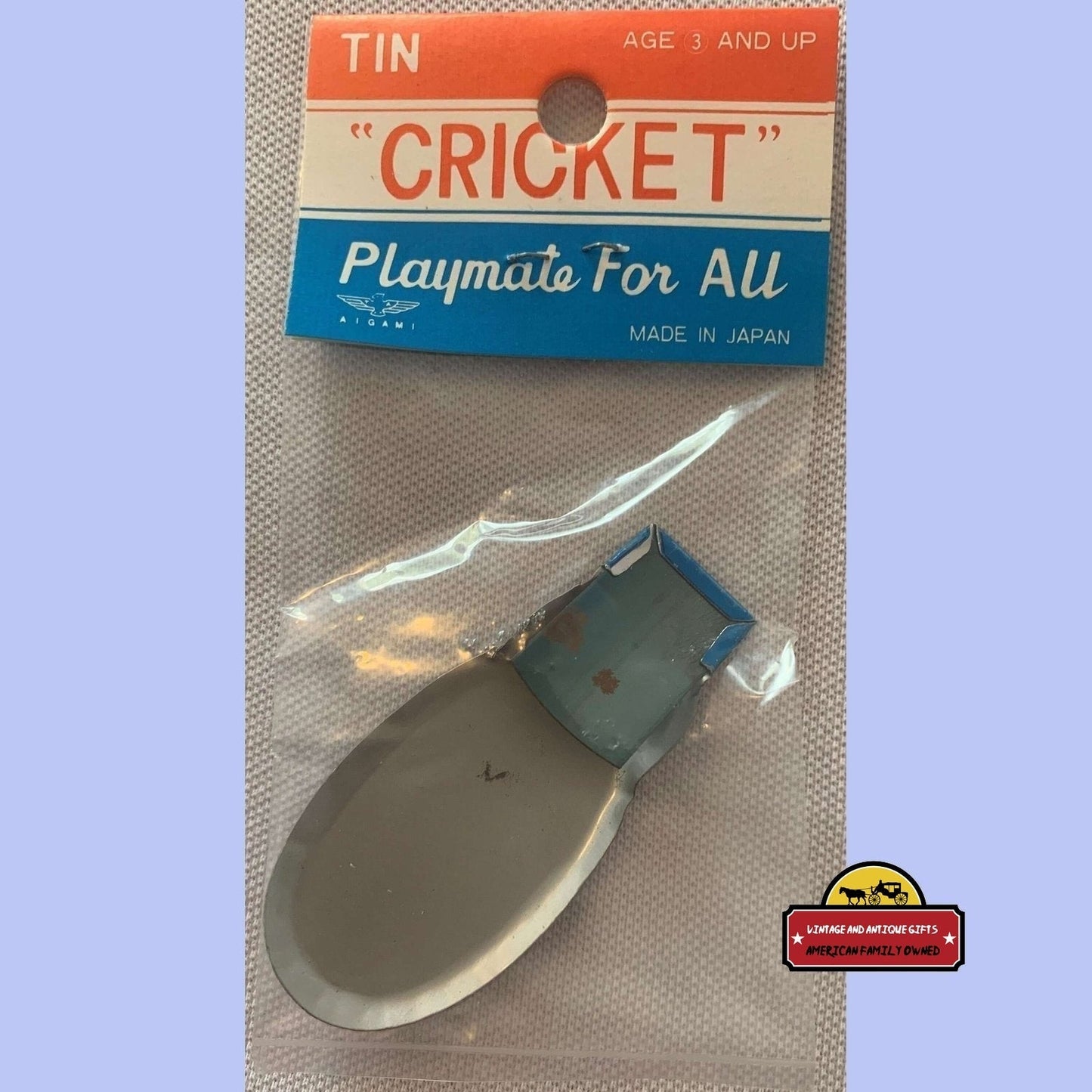
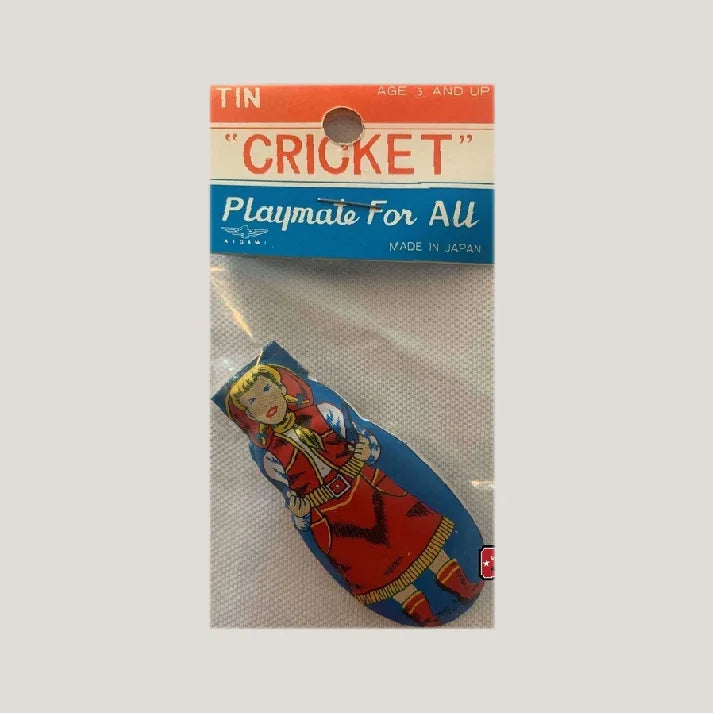
This is one of those finds that makes you stop mid-sort and just hold it for a moment. A brand-new, never-touched, still-sealed-in-its-original-cellophane-sleeve tin cricket clicker, still riding its original header card, New Old Stock in the most complete sense of that phrase. Sixty-plus years of patient waiting, and here it is — the paper crisp, the lithography vivid, the cellophane intact, the click mechanism as taut and responsive as the day it left the factory floor sometime in the 1950s or early 1960s. This is the kind of NOS that serious collectors will recognize on sight and feel in their chest.


🎠 What It Is — Brand, Origin, Printing, and the NOS Miracle

This is a vintage tin cricket clicker manufactured in Japan by Aigami, a maker active in the postwar Japanese toy export trade. The header card identifies it plainly and proudly as a "Cricket" noisemaker — no ambiguity, no branding acrobatics — just the honest functional name that American dime store buyers would have recognized instantly when they placed their import orders. The toy itself is the classic cricket form: a curved, slightly tapered stamped-tin body sized to fit in a child's palm, with just enough arch to create that satisfying spring action when pressed. It is the archetypal shape. Generations of children on three continents understood how to operate it without instructions.

The face of this clicker is lithographed in the bold, confident flat-color printing style that defines postwar Japanese tin toy production at its most accomplished. A blonde girl in a vivid red outfit is rendered in the comic-illustration idiom of the era — not dainty, not precious, but graphic and immediate. The background is a clear, clean blue. The color relationships are the kind of thing a mid-century graphic designer would call "punchy." She was designed to be seen from across a wire merchandise bin under fluorescent lighting, and she succeeds. The lithography is applied directly to the tin, not a paper label over tin, which means what you are looking at is a printed metal surface — color and metal fused together — which is a significant part of why these pieces age so gracefully when they are protected from moisture and handling.

The cellophane sleeve is intact. The header card is present and attached. This piece never entered commerce in the conventional sense — it was tucked into old store stock and simply waited. That is the definition of New Old Stock, and among toy and Americana collectors, NOS in this condition, on card, in original packaging, is the gold standard. It is not restored. It is not cleaned. It is not "presented." It is original.


🏭 The Postwar Japanese Tin Toy Industry — A Moment That Defined a Generation

To hold a piece like this is to hold a small piece of one of the most remarkable industrial pivots in modern manufacturing history. In the years following World War II, Japan's industrial sector — its factories, its metalworkers, its lithographers, its tool-and-die craftspeople — turned with extraordinary speed toward consumer goods production, and specifically toward toys and novelties destined for the American and European export market. The occupation-era "Made in Occupied Japan" marks on the earliest postwar pieces give way, by the early 1950s, simply to "Made in Japan," and that label on a tin toy or novelty during the 1950s and early 1960s represents the height of a very specific and irrepeatable industrial moment.

The factories that produced these goods were located primarily in and around Tokyo, Osaka, and the Aichi Prefecture, and they ranged from large, organized operations to small family workshops where lithography was done in one room and stamping in another. The supply chain was tight and local — tin plate came from domestic steelworks, lithography inks were sourced from regional suppliers, and the finished goods moved through export brokers in Yokohama and Kobe onto container ships bound for American ports, where they were received by import distributors who supplied the national five-and-dime chains. Woolworth's, Kresge's, Ben Franklin, McCrory's, Newberry's — these were the retail destinations for pieces exactly like this one, and the economics were simple: a child's pocket money, maybe a dime, maybe a quarter, could buy a tin toy that had traveled thousands of miles by freighter across the Pacific and still turned a profit at every point in the chain. That math speaks to an astonishing efficiency of production.

There is a piece of lore passed down among serious collectors of postwar Japanese tin that deserves to be recorded here plainly, because it is the kind of story that gets lost when it isn't written down: that some portion of the raw tin sheet stock used in early postwar Japanese toy production came from reclaimed American military supply materials — tin cans, surplus packaging, and light-gauge metal containers that had been imported into Japan as part of military logistics operations and then entered the civilian material stream as the occupation wound down. Collectors who specialize in this era repeat this with conviction, and it carries its own kind of poetry: that a child's toy, pressed out of stamped tin and sent back across the same Pacific it came from, might have begun its life as something utilitarian and military before being transformed into something joyful and frivolous. Whether this is precisely documentable for any specific piece or any specific factory is difficult to say with certainty, but the story persists among collectors as received wisdom, and it gives objects like this cricket clicker an additional layer of historical resonance that is worth sitting with for a moment.

Aigami, the maker named on this header card, operated within this export-toy ecosystem. The brand appears on a range of novelties and small tin toys that turn up in collections across the country — always mid-range in the quality sense, meaning solidly constructed, attractively lithographed, functional, and priced to move at mass-market retail. These were not high-end tin toys. They were not collector's items when new. They were democratic toys — made for every child, accessible on every block, in every small town, in every five-and-dime from Maine to California. That is precisely what makes surviving NOS examples so compelling to collectors today: they were not meant to survive. They were meant to be used up, clicked into irrelevance, lost under car seats and between sofa cushions, thrown away. The fact that this one didn't follow that path is its own small miracle.


🎶 The Cricket Clicker Itself — Form, Function, and Folklore

The cricket clicker as a toy form predates the postwar Japanese production era significantly. Tin noisemakers of this general type — curved, springy, designed to be pressed repeatedly to generate a percussive click — appear in American and European toy catalogs going back well into the late nineteenth century. The name "cricket" for these devices is itself interesting: it references the insect's mechanism, the way a cricket produces its characteristic sound by stridulation — the rubbing or flexing of a hardened structure to produce a repeating note. The tin cricket clicker mimics this not in pitch but in the mechanical principle of a sprung surface snapping between two positions. It is one of the simplest possible mechanical toys, and it has never needed to be improved upon, because it works perfectly as it is.

By the 1950s, the cricket clicker had been a staple of American dime store toy sections for decades, and the postwar Japanese manufacturers simply continued producing what the market had always demanded. What changed was the lithography. Earlier versions tended toward simpler decoration or plain tin. The postwar Japanese pieces brought full-color graphic illustration to the format — bold figures, bright backgrounds, the visual vocabulary of mid-century American commercial illustration applied to Japanese tin by Japanese artists working from American cultural references. The girl in the red outfit on this clicker is a perfect example: she is not a Japanese artistic convention. She is a mid-century American comic-book and advertising illustration archetype, translated through a Japanese lithographer's sensibility and printed on tin in a factory somewhere in a Tokyo suburb or an Aichi workshop, packed into a cellophane sleeve, loaded onto a pallet, and shipped to a store in some American town where she sat in a wire bin until someone bought the store stock and put her away.

Local legend among dime store collectors — the people who spend their weekends at estate sales and their evenings cataloging old store stock — holds that the biggest undiscovered caches of NOS dime store toy stock are still sitting in the back rooms of former five-and-ten buildings in small Midwestern and Southern towns, in buildings that became hardware stores or insurance offices and simply never disturbed the inventory that got pushed to a back shelf in 1968. This may be wishful thinking. It may also be entirely true. The pieces that surface in collections today tend to come from exactly that kind of long undisturbed storage, and they arrive in exactly this kind of condition: cellophane intact, card crisp, never touched by the child who was supposed to find them.


🖼️ Display Ideas

  • 🗂️ Pin it to a shadow box display alongside other NOS dime store card toys — spinning tops, jacks sets, balsa gliders — for a curated five-and-dime counter tableau that works beautifully in a mid-century modern or Americana room.
  • 🪟 Frame it flat behind UV-protective glass, header card and all, as a piece of graphic design and commercial art — the lithographed girl in red reads as bold pop art at any scale, and the "Cricket" typography is a wonderful period document.
  • 📦 Group it in a vintage wooden or wire bin display with other small NOS toy finds for an authentic period-retail vignette — this is the kind of installation that stops people cold when they walk into a room.
  • 🎪 Pair it with a small tin advertising piece or lithographed candy tin from the same era for a tight, cohesive mid-century Japanese export toy vignette on a bookshelf or entry table.
  • 🧒 Anchor a childhood memory display in a den or playroom alongside other postwar toy pieces — Little Golden Books, tin banks, a View-Master reel — for a full-room evocation of a specific American childhood moment.
  • 🎨 Use it as a teaching piece in a classroom, library, or museum children's exhibit about postwar American consumer culture, trade, or toy history — the intact NOS presentation makes it a complete primary source artifact.

🎁 Who Collects These — and Why This One Matters

The collector community that gravitates toward pieces like this is broader and more varied than you might expect, and it is worth describing honestly because it helps you understand what you are acquiring and what kind of company this piece will keep in a serious collection.

Postwar Japanese tin toy collectors are the most obvious audience, and among them, NOS on-card examples command a premium that out-of-package examples simply cannot match. The combination of intact cellophane sleeve, original header card, and unplayed-with condition is the highest possible grade, and serious collectors in this category maintain want lists specifically for NOS pieces they have never been able to source.

Dime store and five-and-ten Americana collectors are a passionate and deeply knowledgeable community, people who are preserving the material culture of the American mass retail experience of the mid-twentieth century. For them, this cricket clicker on its original header card is a primary document — evidence of what was sold, how it was presented, what it cost in implied economic terms, and what the visual language of inexpensive children's retail looked like at its peak.

Graphic design and commercial art enthusiasts recognize immediately that the lithography on a piece like this represents serious applied art — a professional illustrator and a professional lithographer collaborated to create something that had to work visually under the worst possible display conditions, and the result is a piece of color design that holds up beautifully as pure image. The red-outfit girl against that blue background is not accidental. Someone made thoughtful decisions there.

Noise toy and mechanical toy specialists — yes, this is a real collecting category — pursue cricket clickers specifically as examples of the simplest possible successful mechanical toy: one moving part, one satisfying action, infinite repeatability. The fact that this example is unplayed means its spring mechanism is completely uncompressed and at full original tension, which matters to this community.

And then there are the memory collectors — people who are not academic about any of this, who simply remember the sound and the feeling and the dime store light and want to have that thing again, held in the hand, available to be pressed. For them, this piece delivers something that no reproduction can: the actual object from that actual moment, unmolested by time, exactly as it was.


❓ Frequently Asked Questions

Is this really New Old Stock — what does that mean exactly for this piece?

NOS, or New Old Stock, means merchandise that was manufactured and entered the retail supply chain but was never sold at the point of consumer purchase and never used. For this cricket clicker, it means the following specifics: the original cellophane sleeve is intact and sealed around the toy; the original header card — the printed card it was packaged on for display — is present and attached; and the toy mechanism itself has never been pressed by a child or anyone else. It left the factory in Japan, traveled to an American distributor, went to a retail location, sat in stock, and was eventually set aside when it didn't sell through. From that point it was simply stored, untouched, until it surfaced as a collector's piece. This is not restored. It is not cleaned up to look like NOS. It is NOS. The cellophane and the header card together constitute the proof, and both are present here.

Does the click mechanism still work after all these years?

Yes — and in fact, a never-used NOS example like this one should have a mechanism in better operating condition than a played-with example of the same age, precisely because the spring tin has never been fatigued by repeated flexing. The satisfying snap-and-release action of a cricket clicker comes from the springback tension of the stamped tin, and in a piece that has been stored carefully and never used, that tension is fully preserved. This clicker clicks exactly as it was designed to click. One of the joys of NOS tin is that the mechanism is as fresh as the lithography.

The header card says "Made in Japan" — what can you tell me about Aigami and when this was made?

Aigami was a Japanese manufacturer operating within the robust postwar export toy trade, producing novelties and small tin toys for the American five-and-dime market. The "Made in Japan" mark — as opposed to "Made in Occupied Japan," which was required on goods exported during the American occupation period (1945–1952) — dates this piece to 1952 at the earliest, and the lithography style, header card graphic design conventions, and production characteristics point most strongly to the 1950s through early 1960s as the likely production window. Aigami appears across a range of small tin novelty pieces from this era that turn up in American collections, consistently representing solid export-quality production with attractive lithography. They were not the largest or most famous manufacturer in this space, which is part of what makes intact branded NOS pieces like this one particularly worth preserving — the smaller makers are less thoroughly documented, and surviving examples carry more of the historical record.

What is the toy made of — is the lithography a paper label or printed directly on the tin?

The toy is stamped tin — thin-gauge steel sheet with a tin coating, which was the standard material for this entire category of postwar Japanese toy production. The decoration is lithographed directly onto the tin surface before stamping, which means the color is fused with the metal rather than applied as a paper or sticker label over a formed surface. This is an important distinction for collectors, because direct lithography on tin is significantly more durable than paper label decoration, it ages more gracefully under stable conditions, and it is the mark of a production process that required skilled setup and substantial equipment. The bold, flat-color printing style — the vivid red, the clean blue background, the confident black outlines — is characteristic of the offset lithography on tin that Japanese manufacturers in this era executed at a high level.

How should I store or display this to preserve it?

Tin lithography is vulnerable to two things above all else: moisture and handling. For long-term preservation, the most important factors are a stable, low-humidity environment — avoid basements, garages, and exterior walls where temperature cycling can create condensation — and minimal handling of the lithographed surface, especially with bare hands, since skin oils can accelerate oxidation of the tin coating over time. For display, UV-filtering glass or acrylic in a framed presentation is ideal if you want to show the piece while protecting it. The cellophane sleeve provides a useful layer of protection if kept intact. Acid-free archival enclosures are appropriate if the piece goes into a collection drawer rather than on display. This is not a fragile piece — tin is robust — but it rewards thoughtful storage, as all lithographed tin does.

Is the girl in red a recognizable character, or original artwork?

She is not an identifiable licensed character from an American or Japanese franchise — she is original commercial illustration created specifically for this toy, in the widely-used mid-century comic and advertising illustration style that characterized dime store toy packaging across this entire era. You will find similar graphic sensibilities — bold outlines, flat color, confident figure drawing — on tin toys and novelties from dozens of Japanese manufacturers from this period, because they were all working from the same broadly shared visual language of mid-century American popular illustration. This was deliberate: the toys were made for the American market, and the graphics were designed to speak to American children and parents in familiar visual terms. The specific girl in the red outfit on this clicker is unique to this header card design, making her a piece of original commercial folk art in the most honest sense of that phrase.

What makes this different from cricket clickers I might find at reproductions or nostalgia gift shops?

This is the original article — a surviving example of the actual mass-market toy produced in Japan in the 1950s or early 1960s and sold through American five-and-dime stores. The NOS status means it has never been used, and the intact header card and cellophane sleeve make it a complete, unmodified artifact of both the toy itself and its original retail presentation. What you are acquiring is a piece of mid-century material culture in its original, unaltered state — which is categorically different from any reproduction or nostalgia piece, however well-intentioned. The lithography, the tin gauge, the header card typography, the cellophane — these are period-specific details that cannot be perfectly replicated, and they are the things that make experienced collectors stop and look twice when they see this piece. Age and authenticity are not abstract values here; they are physically present in the object itself, readable by anyone who knows what to look for.

Shipping

🚚 Shipping & Handling

  • Shipping costs and timing are calculated at checkout.
  • Items curated and shipped directly by me include U.S. shipping at no additional cost, professionally packed to ensure safe arrival of your artifact.

Items from Vetted Pro Collectors
Shipping for items offered by vetted Pro Collectors is determined at checkout. All Pro Collector listings are reviewed to ensure fair, reasonable shipping practices.

For full details, please refer to our Shipping Policy.

Returns & Exchange

Product Page Return Policy

  • 60-Day Returns – Items must be in original condition.
  • Refunds – Issued after inspection (excluding shipping costs).
  • Return Shipping – Customer is responsible unless item is damaged or incorrect.
  • Damaged/Incorrect Items – Contact us within 48 hours for a replacement or refund.
  • Easy Returns – Email info@vintageantiquesgifts.com or call 802-356-9872 to initiate a return.

For full details, visit our Refund Policy.

View full details