Skip to product information
1 of 3

Vintage and Antique Gifts

Vintage 1950s Woodbury Special Police Badge 🚔 Tin Litho on Original Pin, NOS Japan Collectible

Regular price 29.00 USD
Regular price Sale price 29.00 USD
Sale Sold out
Shipping calculated at checkout.

Description

Do You Remember the Moment a Badge Made You Feel Invincible? 🚔

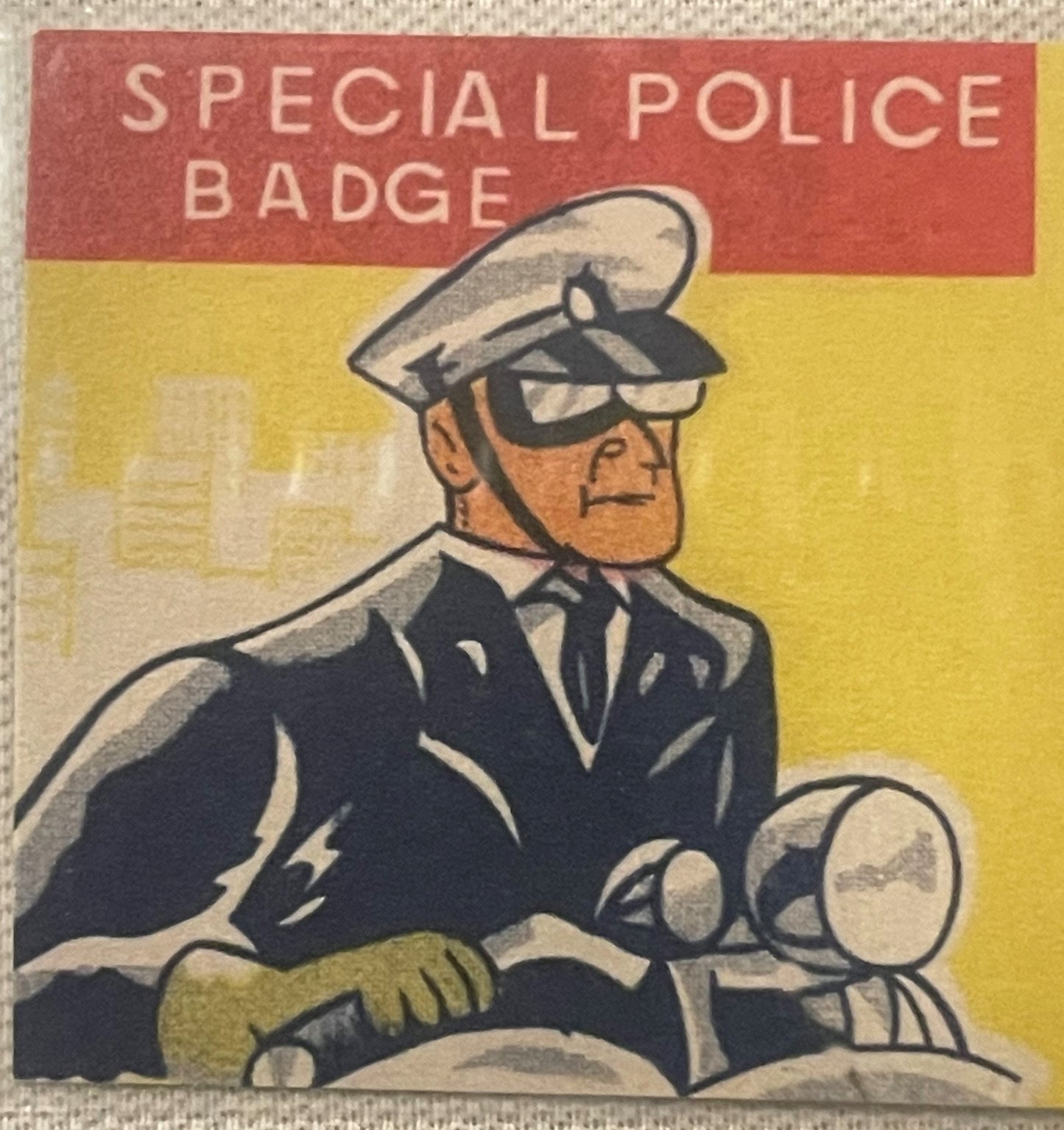
There is something that happens the moment you hold one of these. The tin is cool and solid beneath your fingers, the domed face catches the light just right, and seventy-some years collapse in an instant. Suddenly you are back at the dime store — standing at one of those spinning wire racks loaded with cellophane-wrapped treasures, a coin burning a hole in your palm, and the whole world of law and order and Saturday morning heroes spread out before you for the taking. The motorcycle officer on the card stares straight ahead with that square jaw and those dark glasses, and he looks exactly like every masked hero who ever crackled through a radio serial or galloped across a black-and-white television screen. You knew, even then, that whatever was pinned to that card was something worth keeping.

Most kids tore these open on the spot. This one survived — card, badge, and all — and that survival is exactly what makes it worth talking about at length.


🏅 What This Piece Is

This is a New Old Stock mid-century "Special Police Badge" — a tin lithograph pin-back button still riding its original full-color illustrated display card, marked Japan, and bearing the proud shield-and-eagle design of the Woodbury Police. The badge itself measures approximately 1.5 inches in diameter; the rectangular display card measures 4 x 2.25 inches — compact enough to fit in a shirt pocket, bold enough to command a shadow box or a curio shelf from across the room. The piece is New Old Stock (NOS): it was never removed from its card, never played with, never pinned to a Halloween costume or a cowboy vest. It came out of old inventory exactly as it left the factory floor, and it presents today as the excellent early example of mid-century American popular-culture ephemera and postwar Japanese tin-litho craftsmanship that it genuinely is.

The badge face is a properly crafted, domed, glossy tin lithograph — not a punched-out flimsy novelty but a piece with real heft and a confident, liquid sheen. The design is rendered in red, blue, orange, gold, white, and black, and every color still carries the declarative confidence of lithography done by craftsmen who understood that a child's first encounter with civic authority had to look the part. WOODBURY arcs across the top of the inner shield in clean orange capitals. POLICE anchors the bottom with equal weight. Between them, a golden eagle spreads wide, dramatic wings — feathers layered in warm amber and deep gold — leaning forward over a heraldic shield bearing the scales of justice. Flanking the eagle below, two crossed flags fly: the American flag on the left, what reads as the Ohio state flag on the right, grounded in wheat sheaves and an olive branch. Above the eagle's head, a small police cap badge floats like a crown. The whole composition is framed in a bold shield shape set against a deep royal blue field, then ringed by a vivid red border that gives the piece its visual snap from across a room.

The display card is every inch the equal of the badge. A bold red header block at the top reads SPECIAL POLICE BADGE in clean white capital letters. Below it, on a rich yellow ground, a motorcycle officer rides directly toward you — dark uniform, white-peaked cap, aviator-dark glasses that give him the bearing of every masked hero of the era, one gloved hand gripping the handlebar. He has the jaw and the posture of a man who has never once doubted himself. In the lower right corner, the card is marked simply: JAPAN. That single word is the key to dating the piece — and to understanding the remarkable industrial and human story behind it.


🌏 The Industry Behind the Badge — A Story of Postwar Reinvention

To hold this badge is to hold a small chapter of one of the most extraordinary economic recoveries in modern history. When the Second World War ended in 1945, Japan's tinplate manufacturing industry had been entirely redirected toward wartime production. The factories that had once turned out tin toys, novelties, and decorative goods for export to the United States were silent, damaged, or repurposed. The skill was still there — the engravers, the lithographers, the tin pressers — but the civilian economy had to be rebuilt almost from nothing.

Under the Allied Occupation led by General Douglas MacArthur, that rebuilding became a deliberate and systematic project. Beginning as early as 1947, General Headquarters authorized the resumption of civilian toy and novelty manufacturing for export, reasoning that hard currency earned from American dime stores and five-and-ten-cent stores would accelerate Japan's economic stabilization. The label "Made in Occupied Japan" was mandatory on all export goods during the Occupation period. When the Occupation formally ended in 1952, the label requirement changed to simply "Made in Japan" — and that single change is one of the most reliable dating tools a collector of postwar Japanese novelties has at hand. A piece marked "Made in Occupied Japan" dates to before 1952. A piece marked simply "Japan," like this one, postdates the Occupation — placing it squarely in the mid-century dime-store era that followed.

The "Special Police Badge" was part of a family of companion designs that moved through American dime stores, five-and-tens, and toy counters as a set. Documented sibling pieces include "Officer's Badge" and "Deputy Sheriff" cards — each featuring the same illustrated motorcycle officer card format, each carrying a different tin-litho badge face. Lore passed down among collectors of postwar Japanese tin novelties holds that these sets were produced in large master cases packed in rice paper for shipment — a detail that surfaces repeatedly in old dealer inventory descriptions and that speaks to the care taken in packing goods that needed to survive a trans-Pacific voyage and still look pristine on a wire rack in Akron or Tulsa. The badges that made it through in their original carded, unplayed condition are, as one long-time dealer in this material put it plainly, uncommon today.

What separated the better-made examples from the purely throwaway novelties was the lithography itself. The tin litho process — applying color imagery directly to sheet tin before pressing and forming — demanded skilled platemakers and press operators who understood ink adhesion, registration, and the way a domed surface would distort a flat design if the artwork wasn't compensated in advance. The craftsmen producing these badges were not amateurs. They were industrial workers in a tradition that stretched back to the late nineteenth century, and the postwar export badges represented a continuation of that craft even in constrained circumstances. The result, in the best examples, is exactly what you see here: a domed face where the colors hold their separation and the design reads crisply from the center to the edge of the ring.


🏙️ Woodbury — The Name on the Badge

The name Woodbury carries its own weight in American civic history, and it is worth spending a moment with it. The Woodbury Police Department — the real, municipal law enforcement agency of Woodbury, New Jersey, seated at 220 South Broad Street — is one of the older municipal police institutions in the Garden State, serving a city whose own history stretches back to colonial-era settlement and whose civic character was well established long before the mid-century. Woodbury, New Jersey was incorporated as a city in 1871 and sits in Gloucester County, roughly twelve miles south of Philadelphia. It carries the particular civic pride of a small American city that has always punched above its weight — a county seat with the courthouse, the history, and the institutional memory to match.

Whether this specific badge design was produced under any formal arrangement with that police department, or whether the name "Woodbury Police" was applied to the design as one of many generic American city names cycled through the same lithograph card format to give each badge a local identity — that question sits at the heart of what makes these pieces so interesting to collectors of mid-century police memorabilia and Americana. Local legend among collectors of New Jersey law-enforcement ephemera holds that certain of these dime-store badge designs were indeed commissioned or authorized by small-city police departments as promotional pieces — a way of building civic goodwill and putting a version of the department's imagery into the hands of every kid in town for a nickel. The evidence is anecdotal and passed down rather than documented, but it is the kind of local knowledge that lives in conversations at antique shows and in the memory of dealers who have handled these pieces for decades, and it deserves to be recorded rather than dismissed.

What can be said with confidence is that the imagery on this badge is not generic. The shield design, the specific arrangement of the eagle over the scales of justice, the crossed flags, the wheat sheaves and olive branch, the small cap badge above the eagle's head — this is a composed heraldic design with the specificity of a real departmental seal. Someone drew this. Someone made deliberate choices about what symbols would represent the concept of "Woodbury Police" to a child holding this card in front of a wire rack. That intentionality is part of what gives the piece its visual authority even at 1.5 inches in diameter.


🎨 The Art of the Card — The Motorcycle Officer as American Archetype

It would be a mistake to talk only about the badge and overlook the card, because the card is doing serious cultural work. The motorcycle officer illustration is not incidental decoration — it is a carefully constructed image that draws on the full vocabulary of mid-century American hero mythology. The dark glasses. The set jaw. The peaked white cap. The suggestion of forward motion even in a static image. This figure belongs to the same visual tradition as the Lone Ranger, as the square-jawed radio serial detective, as every comic-book lawman who stood between the town and chaos and never once looked uncertain about it.

The color lithography on the card — that saturated red header block against the warm yellow ground, the deep navy of the officer's uniform, the confident white of the lettering — reflects the graphic design sensibility of the period with considerable skill. These were not high-art productions, but they were not careless ones either. The people who designed and printed these cards understood visual hierarchy, understood how a child's eye moves across a display, and understood that the product had to earn its place on a rack crowded with competitors. The result is a piece of commercial graphic design that holds up as an artifact of its era and as a genuinely attractive object in its own right.


🖼️ Display Ideas

  • 🗃️ Shadow box with period companions — pair this carded badge with a small badge wallet, a tin toy police car, or a period-appropriate cap gun to build a complete mid-century law-enforcement vignette that tells the whole story in one frame.
  • 🏠 Local history focal point — for collectors with a New Jersey connection, a Woodbury connection, or simply a passion for Garden State civic history, this makes an exceptionally specific and personal display piece mounted alongside a period map or postcard of the region.
  • 📌 Pinboard of Americana — arrange several carded dime-store badges of the era together on a corkboard or fabric-covered board for a wall display that captures the full flavor of the postwar five-and-ten experience.
  • 🪟 Store display tribute — reproduce the original retail experience by mounting the card on a small wire stand or in a shallow vitrine, lit from above so the domed badge face catches the light the way it would have on a dime-store wire rack circa the Eisenhower years.
  • 🎁 Presentation gift, still carded — because this piece is NOS and has never left its card, it is ready to give exactly as it is — no framing required — to the police memorabilia enthusiast, the New Jersey history collector, or the mid-century Americana devotee who has most things but not quite this.
  • 🏛️ Municipal history display — local historical societies, police department lobbies, and library local-history rooms frequently build rotating displays of civic ephemera; a carded dime-store badge carrying the department's own name is exactly the kind of unexpected, resonant piece that makes those displays memorable.

🎁 Who Collects These

The collector audience for a piece like this is broader and more varied than you might expect, and that breadth is part of what gives mid-century police badge ephemera its market durability. Police memorabilia collectors pursue departmental imagery across every medium — official badges, patches, caps, photographs, and yes, the commercial novelties that carried a department's name and seal into popular culture. For that collector, a carded dime-store badge with a specific departmental design is a legitimate piece of the department's visual history, not a lesser cousin of the real thing. New Jersey and Woodbury local history enthusiasts collect anything that carries their town's name and civic imagery, and pieces with that specificity are always harder to find than generic Americana. Postwar Japanese tin-litho collectors pursue the badge format specifically for the craftsmanship story — the lithography, the domed construction, the NOS card survival — and place these pieces alongside tin toys, friction cars, and space-age novelties in collections organized around the postwar Japanese export industry as a subject in its own right. Mid-century Americana and dime-store ephemera collectors are drawn to the card as much as the badge — the graphic design, the illustration style, the commercial printing craft of the era. And then there are the gift-givers — people who recognize immediately that a piece like this, still on its original card, still carrying the full charge of its original moment, is the kind of gift that a child of the 1950s or '60s receives with a sharp intake of breath and holds for a long time before saying anything.


❓ Frequently Asked Questions

Is this an official Woodbury Police Department badge, or a toy?

This is a mid-century commercial novelty badge produced for the American dime-store trade — it was sold to children as a play badge, a costume piece, or simply as a collectible novelty, not issued by the Woodbury Police Department as an official credential. That said, the heraldic design on the face — the specific eagle, the scales of justice, the crossed flags, the departmental shield — carries the composed intentionality of a real departmental seal rendered for popular reproduction. Collector lore holds that certain of these carded badge designs were produced with the knowledge or informal blessing of the departments whose names they carried, as a form of civic goodwill and community presence. Whether that applies to this specific design is a question that adds to its intrigue rather than diminishing its value. What it unquestionably is: a beautiful, specific, and genuinely scarce piece of mid-century American popular-culture ephemera bearing the Woodbury Police identity.

What does "New Old Stock" mean, and why does it matter for this piece?

New Old Stock — NOS — means that this badge was produced, packaged on its card, and then stored rather than sold at retail. It never passed through a child's hands, never spent time pinned to a Halloween costume or a play uniform, never left its card. For a piece of this type, NOS survival on the original card is genuinely significant: the card and the badge together tell the complete story of the piece as a commercial object — the graphic design, the retail presentation, the manufacturing mark, the era. Separated from its card, a badge like this is still interesting; on its original card in NOS condition, it is the full artifact. That completeness is what collectors of postwar American ephemera and Japanese tin novelties actively seek and reliably pay a premium to obtain.

How do I know this is from the mid-century period?

The primary dating evidence is the country-of-origin mark: JAPAN, printed plainly on the card. This is the key that collectors and dealers of postwar Japanese novelties use to establish era. Export goods produced during the Allied Occupation of Japan (1945–1952) were required by General Headquarters to carry the mark "Made in Occupied Japan." When the Occupation ended in 1952, that requirement lapsed, and goods were marked simply "Made in Japan" or, as on this card, simply "JAPAN." This piece carries the post-Occupation mark, placing its production in the mid-century dime-store era that followed the Occupation's close. The illustration style on the card — the graphic design vocabulary, the color palette, the rendering of the motorcycle officer — is entirely consistent with commercial printing of that same period, and multiple experienced dealers in this material have independently identified the same production window for the badge format.

What is the badge made of, and how was it produced?

The badge is a tin lithograph pin-back button — a domed disc of sheet tin onto which the design was applied via the lithographic printing process before the metal was pressed and formed into its final domed shape. Tin lithography involves printing color imagery using oil-based inks onto sheet tin, then curing and forming the printed sheet. The process demands careful registration — the alignment of each color layer — and skill in compensating the flat artwork for the distortion that forming a dome introduces. The result, in well-made examples of this era, is exactly what you see here: a bold, clean design that reads crisply across its curved surface, with colors that hold their separation and their vibrancy. The pin mechanism on the back is the period-standard straight-pin fitting used on badge-style buttons of the era.

Are there companion badges in this series?

Yes — the "Special Police Badge" design was part of a family of related dime-store badge cards. Documented companion designs include "Officer's Badge" and "Deputy Sheriff," each using the same illustrated card format with a different badge face. Collector lore associated with these sets holds that they were sold both individually and in paired sets, and that master cases of old inventory were packed in rice paper for trans-Pacific shipment — a handling detail that surfaces consistently in old dealer descriptions of this material. Collectors who pursue the format typically seek examples across multiple departmental names and multiple badge designs within the same card series, building displays that capture the full scope of the dime-store law-enforcement badge trade as a coherent mid-century commercial phenomenon.

Is this appropriate as a gift?

Absolutely — and the buyer reviews for pieces like this one bear that out consistently. A carded NOS badge of this type is one of those rare gifts that works equally well for the serious collector who has most things and the casual recipient who simply grew up in the era and responds to the immediate emotional charge of the object. It arrives complete, displayable, and self-explanatory — the card tells the story, the badge delivers the visual impact, and the NOS survival means the recipient is holding something that has waited, intact, for the right person to come along. For the child of the 1950s or early '60s who remembers standing at a wire rack with a coin in hand, the recognition is instant and the response is visceral. For their children or grandchildren buying this as a gift, it is a way of handing someone a small piece of their own past in the most literal sense.

How do I display and care for this piece?

The best display approach honors both the badge and the card as a unified object. A shadow box or small vitrine keeps the piece protected from handling and atmospheric dust while allowing it to be displayed face-out, where the lithography and the card illustration can both be appreciated. Avoid direct, prolonged sunlight, which is the primary environmental concern for any paper-backed lithographic piece — a position with ambient or artificial lighting will serve the piece better over the long term. The badge face itself, being tin litho, is durable and stable; the card, being period paper stock, benefits from the stable humidity and temperature that any good display case provides. If you choose to frame the piece, a mat-and-frame approach with UV-protective glazing is the collector-standard method for paper-backed ephemera of this era. Beyond those basic considerations, this is a piece built to be seen — display it where it can be.

🚔 The Real Junior Programs Behind Badges Like This

Dime-store tin badges did not live in a vacuum. Across mid-century America, real law enforcement agencies ran junior deputy and junior police programs: sheriffs swore in wide-eyed honorary junior deputies at county fairs and school assemblies, police departments sponsored school safety patrols — a movement that began in the 1920s and put belts and badges on millions of schoolchildren — and an officer handing a kid a badge at a parade or classroom visit was a familiar piece of civic life. A Woodbury Special Police badge in a child's hand belonged to that same world, the era when a badge from a trusted grown-up could make a kid stand a little straighter. That is the history a carded survivor like this carries beyond its tin and ink.

Shipping

🚚 Shipping & Handling

  • Shipping costs and timing are calculated at checkout.
  • Items curated and shipped directly by me include U.S. shipping at no additional cost, professionally packed to ensure safe arrival of your artifact.

Items from Vetted Pro Collectors
Shipping for items offered by vetted Pro Collectors is determined at checkout. All Pro Collector listings are reviewed to ensure fair, reasonable shipping practices.

For full details, please refer to our Shipping Policy.

Returns & Exchange

Product Page Return Policy

  • 60-Day Returns – Items must be in original condition.
  • Refunds – Issued after inspection (excluding shipping costs).
  • Return Shipping – Customer is responsible unless item is damaged or incorrect.
  • Damaged/Incorrect Items – Contact us within 48 hours for a replacement or refund.
  • Easy Returns – Email [email protected] or call 802-356-9872 to initiate a return.

For full details, visit our Refund Policy.

View full details