Skip to product information
1 of 4

Vintage and Antique Gifts

Vintage Florida Highway Patrol 🍊 Special Police Badge Pin NOS Carded Tin Litho Made in Japan Mid-Century

Regular price 32.00 USD
Regular price Sale price 32.00 USD
Sale Sold out
Shipping calculated at checkout.

Description

🍊 A Dime-Store Toy Badge That Copied the Real Thing — Right Down to the Orange

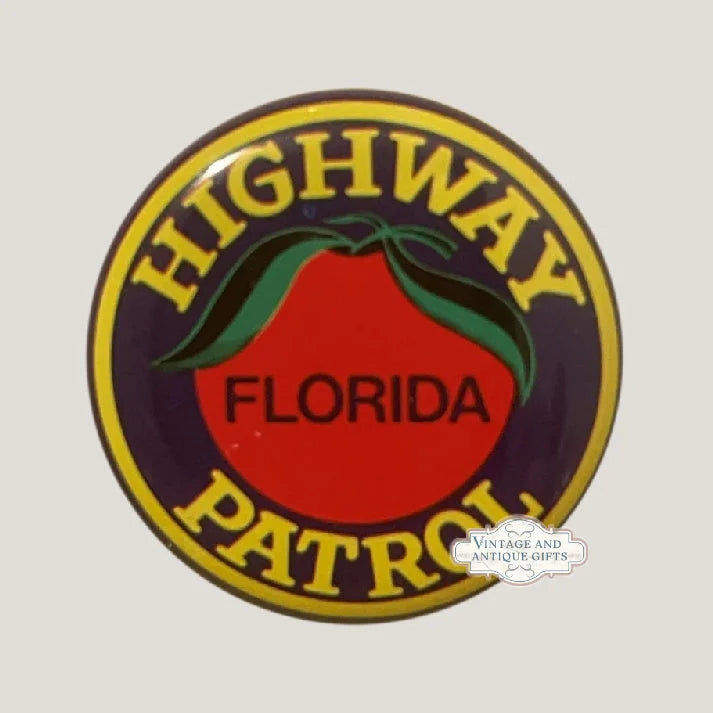
This is one of those small objects that tells a much bigger story than its size suggests. It is a mid-century tin-litho novelty toy badge reading HIGHWAY PATROL FLORIDA, still mounted on its original illustrated store card, sealed in the cellophane sleeve it left the factory in. We want to be clear from the very first line about what it is: a toy — a five-and-dime pretend-police badge made for a child’s game of cops and robbers — and never a real, issued law-enforcement badge. That honesty matters, and it costs the piece nothing, because the charm here is precisely that a little Japanese novelty maker looked at one of the most distinctive real police insignia in America and copied it, beautifully, onto a penny toy.

The badge itself is a small round tin button: a bright yellow outer ring with HIGHWAY arced across the top and PATROL across the bottom in bold black lettering, a deep navy field, and at its center a vivid red-orange citrus orange with green leaves, the word FLORIDA lettered across the fruit. The card behind it is pure period joy: a sunny yellow ground, a red SPECIAL POLICE BADGE banner, and a cartoon motorcycle officer in cap and sunglasses roaring along on his bike. Down in the corner, one small word gives the game away — JAPAN.


🚔 The Real Florida Highway Patrol — Born of the 1939 Legislature

To appreciate the toy, it helps to know the genuine article it imitates. The Florida Highway Patrol was created by the Florida Legislature in 1939, under Chapter 19551 of that year’s laws, and organized under its first director, Colonel H. Neil Kirkman. Patrols hit the road on August 1, 1939, with a first class of roughly sixty troopers spread across a very large state — a tiny force charged with policing Florida’s rapidly growing network of highways as the automobile age arrived in full.

From the beginning, the FHP dressed its identity in Florida’s own colors and symbols. The patrol adopted an orange-and-blue scheme from 1939, and by 1943 it wore the emblem it is still known for: a citrus orange with the word FLORIDA — as far as we know the only fruit insignia in American law enforcement, and one the patrol proudly wears to this day. There is something wonderfully Floridian about a state trooper’s badge built around an orange, and it is exactly that unmistakable emblem — the fruit, the leaves, the FLORIDA lettering, the encircling HIGHWAY PATROL ring — that this Japanese toy copies so faithfully.


🌏 Made in Japan — the Postwar Tin-Toy Boom

Why would a Florida police emblem end up on a toy stamped JAPAN? Because of one of the great manufacturing stories of the twentieth century. Japan’s tin-toy industry, which reached back to the 1880s, was granted the right to resume operations and export in 1947, and through the 1950s and early 1960s it became the powerhouse of the world’s toy trade — by the middle of the 1950s Japan had overtaken both the United States and Germany as the number-one toy manufacturer on earth. Bright tin-litho novelties poured out toward American dime stores and carnival midways, and among them were whole series of pretend-police badges bearing the names and emblems of American towns, counties, states, and patrols. This Florida Highway Patrol badge is a product of exactly that boom: an anonymous small-maker novelty, chromolithographed in glowing color on tin and paper, built to sell for pennies at a five-and-dime.

Collectors sometimes repeat a colorful bit of lore about these badges — the story that they were part of a single General MacArthur rebuilding initiative, produced as an American-goodwill exercise during the occupation. The broad postwar rebuilding context is real, but the notion that anyone personally directed the production of specific American police badges is unsupported, and we pass it along strictly as collector lore, not fact. What is solid is the honest frame: a mid-century Japanese export toy, dated by its plain “JAPAN” mark to after 1952.


💠 New Old Stock, On the Original Card

What makes this particular example a treat is its state of preservation. It is new old stock — never played with, never worn — and it survives on its original illustrated “Special Police Badge” card, still inside the original cellophane sleeve. The store card with its cheerful motorcycle-cop artwork is honestly half the charm; separated from the card, these little badges lose most of their story, and complete carded survivors like this are the way a collector most wants to find them. Everything described here is read directly from the badge and card in the photographs — the emblem, the lettering, the artwork, and the JAPAN mark — and we invite you to look closely at every image, since with a small carded piece the pictures are the truest description we can give.


🍊 Why an Orange? Florida's Emblem, Explained

The single most charming thing about both the real badge and this toy copy is the fruit at the center, and it is worth explaining why it is there. Florida and the orange are practically synonymous: the citrus industry shaped the state’s economy, its landscape, and its very image of itself across the twentieth century, and the orange became a kind of unofficial state symbol long before it was made official. When the Highway Patrol was building its identity in the early 1940s, it reached for that emblem — wrapping the word FLORIDA around a bright citrus orange — and in doing so created something genuinely unique in American policing. Law-enforcement insignia across the country lean on eagles, stars, shields, and state seals; a piece of fruit is, as far as we know, unheard of anywhere else. That distinctiveness is exactly why a Japanese novelty maker, scanning American police emblems to copy for its toy series, could not resist this one. The orange made the real patrol instantly recognizable, and it makes the toy instantly delightful.

It is a small, happy irony worth savoring: one of the most serious things a state does — police its highways — wearing one of the friendliest emblems imaginable, and then that same cheerful orange traveling across the Pacific to be printed on a child’s five-and-dime toy. The whole story is right there in the little tin button.


🏍️ The Card Art — a Snapshot of the Cops-and-Robbers Age

Do not overlook the card, because it is half of what you are getting and a period piece in its own right. Its illustration — a square-jawed cartoon motorcycle officer in a peaked cap and sunglasses, leaning into his ride against a sunny yellow ground beneath a bold red SPECIAL POLICE BADGE banner — is a perfect little window onto mid-century American play. This was the height of the cops-and-robbers age, when children pinned on badges, buckled on toy holsters, and patrolled the neighborhood as lawmen and outlaws, their imaginations fed by radio serials, matinee Westerns, and the new medium of television. A dime-store badge like this was a passport into that game. The card’s artwork was designed to catch a child’s eye from a crowded spinner rack, and it still does its job today — which is exactly why a badge that survives complete on its illustrated card is so much more evocative than a loose button. The card is the toy’s stage set, and here it is intact.


🛡️ Strictly the Toy Lane — Said Plainly

We want to be completely clear on one point, because it matters both for honesty and for how you understand the piece. This is a novelty toy and nothing more. It was never issued to anyone, never carried authority, and was never intended to resemble an officer’s working credential in use — it is a printed tin button that a child pinned on for play, sold openly at a five-and-dime as the toy it plainly is. We celebrate it entirely on those terms. Its interest lies precisely in being a charming imitation: a mass-market plaything that happened to copy a real and unusually beautiful emblem. Framing it that way is not a limitation on the piece; it is the whole point of it, and it is the only honest way to present it.


✨ A Florida Sole-Source Charmer — and Who It's For

Within the wide family of these Japanese tin-litho toy badges, the specific ones matter, and a genuine Florida Highway Patrol example — carrying that unmistakable citrus-orange emblem, carded and preserved — sits in a location-specific niche all its own. It is the kind of piece a Florida collector could look for a long while without turning up another carded example. It will delight collectors of vintage tin toys and dime-store novelties; lovers of Florida history and Sunshine-State memorabilia; and anyone charmed by the idea of a state trooper’s orange emblem reborn as a child’s toy. We offer it the honest way — a genuine mid-century Japanese novelty toy badge, new old stock on its original card, correctly framed as the delightful toy it is, and never confused with the real, issued insignia it so lovingly copies. That, to us, is the whole point: the right little object, described truthfully, ready for someone who will treasure the story it carries.

👮 Junior Deputies, Safety Patrols, and the World This Badge Lived In

There is a real history standing behind every mid-century toy badge. This was the era of the junior deputy and the school safety patrol: sheriffs' offices swore children in as honorary junior deputies at fairs and school assemblies, safety patrol programs — running strong since the 1920s — pinned badges on generations of schoolchildren, and a visit from an officer with badges to hand out was a fixture of American civic childhood. A Florida Highway Patrol badge belonged to that world. When a child pinned one on, the game borrowed its seriousness from programs that were entirely real — and that is part of the history a survivor like this one still carries.

Shipping

🚚 Shipping & Handling

  • Shipping costs and timing are calculated at checkout.
  • Items curated and shipped directly by me include U.S. shipping at no additional cost, professionally packed to ensure safe arrival of your artifact.

Items from Vetted Pro Collectors
Shipping for items offered by vetted Pro Collectors is determined at checkout. All Pro Collector listings are reviewed to ensure fair, reasonable shipping practices.

For full details, please refer to our Shipping Policy.

Returns & Exchange

Product Page Return Policy

  • 60-Day Returns – Items must be in original condition.
  • Refunds – Issued after inspection (excluding shipping costs).
  • Return Shipping – Customer is responsible unless item is damaged or incorrect.
  • Damaged/Incorrect Items – Contact us within 48 hours for a replacement or refund.
  • Easy Returns – Email [email protected] or call 802-356-9872 to initiate a return.

For full details, visit our Refund Policy.

View full details