Skip to product information
1 of 3

Vintage and Antique Gifts

Vintage 1960s-1970s Abilene Police Special Police Toy Badge 🦅 Tin Litho Pin-Back Button NOS Japan Card Mid-Century

Vintage 1960s-1970s Abilene Police Special Police Toy Badge 🦅 Tin Litho Pin-Back Button NOS Japan Card Mid-Century

Regular price 18.00 USD
Regular price Sale price 18.00 USD
Sale Sold out
Shipping calculated at checkout.
Quantity

Does a Toy Badge Know Something About a Town's Soul? 🦅

Pick this up and hold it for a moment. Really hold it. A round tin button, barely bigger than a half dollar, dressed in red and black and gold — and on its face, a fierce American eagle spreads its wings wide over an open book and a sword, rendered in that flat, graphic, unmistakable mid-century lithograph style that makes everything feel simultaneously serious and mythic. Above the eagle, arched in bold red lettering against a dark field: ABILENE. Below: POLICE. Around the whole design, a red border ring frames it like a medal worth framing. This is not a subtle piece. It was never meant to be. It was meant to stop a child cold in the aisle of a five-and-dime, and seventy-some years later, it still does exactly that.

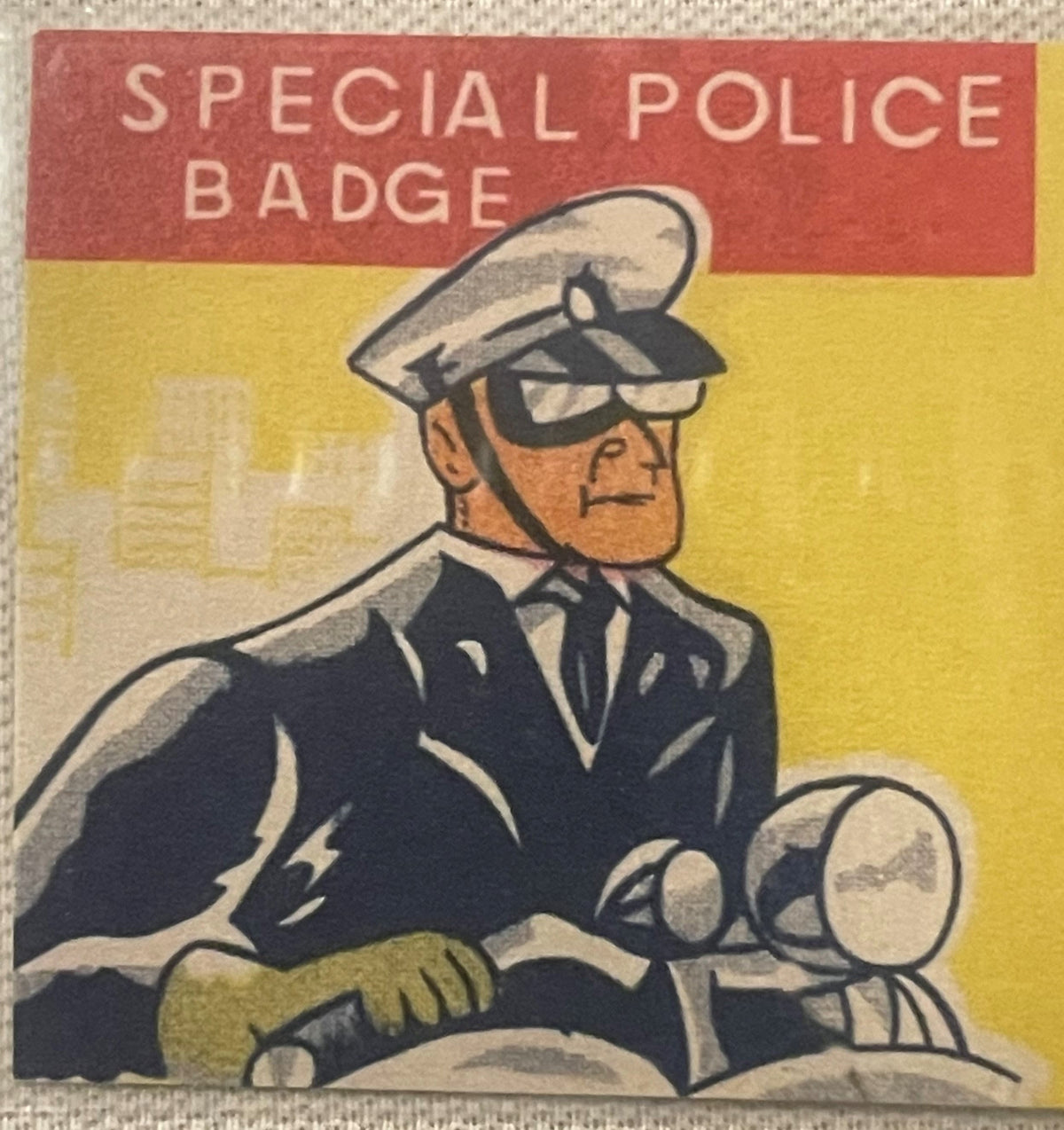
This is a New Old Stock mid-century Special Police Badge pin-back button on its original display card — carded, sealed in its original clear plastic sleeve, and marked JAPAN in small, honest print at the lower right of the card. The whole package is exactly as it would have sat in a dime store spinner rack or behind a glass counter during the heart of the postwar era. The card itself is a small piece of graphic art in its own right: a yellow field printed with a masked motorcycle officer leaning forward over his handlebars, dark uniform, white cap, heavy goggle-mask over his eyes — the words SPECIAL POLICE BADGE printed in bold white across a red banner at the top. He looks like a cross between a superhero and a traffic cop, which is precisely the fantasy these badges were designed to sell to a seven-year-old who wanted to be the law. The card measures approximately 4 by 2.25¼ inches. The badge itself is a round tin litho pin-back button, approximately 1½ inches in diameter — small enough to pin to a shirt pocket, large enough to mean business.


🏭 The World That Made This — Japan, Dime Stores, and the Art of the Tin Litho Toy

To understand what you are holding, you have to understand the world that produced it. In the years following the Second World War, Japan's export manufacturing sector — rebuilt under Allied occupation and recalibrated for peacetime goods — became one of the great engines of American childhood. Japanese factories, many of them small family operations running offset lithography presses that could print directly onto sheet tin, found a ready and voracious market in the American five-and-dime trade. Woolworth's. Kresge's. Ben Franklin. McCrory's. Newberry's. These stores lined the main streets of every city and small town in postwar America, and their toy and novelty counters were stocked deep with exactly this kind of item: small, colorful, printed in vivid lithographic inks on tin, priced at a few cents, and irresistible to a generation of children raised on cowboy serials, police radio dramas, and the romance of the uniform.

The tin lithography process itself is worth pausing on. A flat sheet of tinplate — thin steel coated in a fine layer of tin — is run through a lithographic printing press that transfers ink designs directly onto the metal surface. The colors are laid down in successive passes, one ink at a time, building up that rich, layered visual depth you see in the eagle on this badge: the deep black background, the red border ring, the warm red-to-gold gradient of the eagle's wings, the crisp white of its head, the cream of the open book pages. After printing, the sheet is cut, shaped, and fitted with the pin-back hardware. What emerges is a finished piece that can last decades without fading — the same process that gave us the great tin toy trains, the lithographed penny banks, and the iconic advertising tins that collectors still hunt today. These were not cheap in the sense of poorly made. They were inexpensive at retail, but the craft behind them was real.

Passed-down wisdom among dealers who have broken open original wholesale lots says the badges at the center of a full case come out looking like the day they were packed. Whether the case this particular badge traveled in has long since been broken apart and scattered across half a century of garage sales and estate lots, only the seller knows — but the tradition of finding these in remarkable NOS condition, still in their original sleeves, is well established among collectors.

The specific manufacturer who pressed and printed this badge has not been conclusively documented. These were anonymous export novelties, produced by factories whose names rarely made it onto the packaging, distributed through wholesale importers whose paper trails have mostly dissolved. What survives is the object itself — and the object is eloquent enough.


🌾 Abilene — Where the Badge Points

The name Abilene carries serious weight in the American imagination, and it earns every ounce of it. There are two Abilenes in American history, and both of them matter.

Abilene, Kansas is one of the foundational addresses of the American West. It was the northern terminus of the Chisholm Trail — the storied cattle route that drove millions of longhorns north from Texas to the Kansas railheads in the post-Civil War decades, transforming a small prairie settlement into the first great Kansas cow town. Wild Bill Hickok served as its marshal. The cowboys who came up the trail with the herds brought their money, their dust, and their trouble, and the marshals of Abilene stood between order and chaos on a street that didn't always know the difference. The town's reputation for both lawlessness and hard-handed law enforcement made it legendary in dime novels and, later, in every Western film tradition that followed. Abilene, Kansas is also the hometown of Dwight D. Eisenhower, born there in 1890, and the site of the Eisenhower Presidential Library and Museum — a place that anchors the town firmly in the American civic story as well as the frontier one. The image of authority, of law, of an eagle over an open book: in the context of Abilene, Kansas, these symbols arrive loaded.

Abilene, Texas tells a complementary story. Founded in 1881 by land developers who named it deliberately after the Kansas cow town — invoking that same frontier authority — Abilene, Texas grew into the commercial and cultural center of the Texas Big Country, a vast stretch of West Texas plains anchored by ranching, agriculture, and later, military installations including Dyess Air Force Base. The Texas Abilene has its own long tradition of law enforcement reaching back to the early ranch country days, when a sheriff's jurisdiction might cover territory larger than some Eastern states.

The most resonant names in American law-enforcement mythology were the ones that moved product. Abilene was on that short list. Whether the name was applied by the Japanese factory, the American importer, or somewhere in the wholesale chain between them is a question the paper trail has not answered — but the choice was not accidental. The eagle, the open book, the sword: these are symbols of justice and recorded law, and they sit under the name of a town that the American public associated, viscerally, with the idea of the lawman standing his ground.

Whether any Abilene merchant or civic group ever handed out exactly this badge to a crowd of wide-eyed children on a summer afternoon is a story that may live only in family memory now. But the tradition was real, and the possibility gives this small piece of tin a human dimension that a pure collectible never quite achieves on its own.


🦅 The Eagle Over the Book — What the Design Means

Take a second look at what the artist put on this badge, because it is not a generic police eagle. The eagle perches not on a shield, not on a star, but on an open book — and it holds what appears to be a sword or quill in its talons. This is a specific iconographic choice. The open book in Western civic symbolism represents the law as written — the rule of law, the recorded code, the idea that justice is not arbitrary but anchored in text and precedent. The sword or writing instrument speaks to both enforcement and documentation: the law is recorded, and the law is upheld. The eagle overhead is the classic American symbol of sovereign authority, rendered here in warm red-to-gold lithographic ink against the dark field, wings spread in that heraldic display posture that signals power without aggression.

Whoever designed this badge — an unknown artist working for an unknown Japanese factory sometime in the postwar decade — understood the visual grammar of American civic authority well enough to compress it into one and a half inches of tin. That is a form of craft that deserves recognition independent of the badge's origins as a toy. Mid-century graphic design produced for the mass market was, in its best examples, as considered and purposeful as anything in the fine arts tradition. This is one of those examples.

The card art reinforces the message from a different angle. The masked motorcycle officer — leaning hard into the handlebars, goggles down, jaw set, uniform crisp — is not quite a policeman and not quite a superhero. He occupies exactly the space that postwar American popular culture had carved out for the lawman: part civic servant, part romantic figure, part protector of the innocent. The bold graphic style of the card illustration, the flat color fills, the strong outlines — this is the visual language of the comic strip and the Saturday serial, applied to a retail display card for a five-cent badge, and it works completely.


🖼️ Display Ideas

  • 🗂️ Frame it on the card. The original display card and badge together make a complete piece of mid-century commercial art — frame them together in a small shadow box and hang them with other dime-store Americana for an installation that tells the whole story of the era.
  • 🤠 Western law enforcement wall. Group this with other Western-themed badges, wanted posters, and vintage sheriff's department ephemera for a focused collection wall centered on the mythology of American frontier law.
  • 📚 Local history shelf. Place it alongside books, photographs, and maps of Abilene — Kansas or Texas — as a tangible pop-culture artifact that connects the town's legendary identity to everyday mid-century American life.
  • 🏪 Dime-store nostalgia vignette. Style it in a small display with other carded Japanese-made toy novelties of the era — cap guns, tin clickers, lithographed rings — to recreate the feel of a five-and-dime counter circa 1957.
  • 🦅 Eagle and law enforcement iconography collection. Pair it with other eagle-themed law enforcement pins, patches, and insignia to build a display around the enduring American use of the eagle as a symbol of civic authority.
  • 🎁 Gift presentation. Still in its original sealed card and sleeve, this presents beautifully as a gift — no additional wrapping needed. It arrives as a complete, self-contained artifact of the era.

🎁 Who Collects These

The collector base for mid-century carded toy badges is broader and more passionate than you might expect, and it tends to run deep rather than wide — meaning the people who want these really want them, and they know exactly what they are looking at.

Dime-store and five-and-dime collectors pursue the whole category of Japanese-made tin litho novelties — badges, rings, clickers, toy money, carded toys of every description — as a unified collecting field. For them, the original card and sleeve are as important as the badge itself: a carded example in NOS condition represents the full artifact, not just the button.

Western Americana collectors are drawn specifically to the Abilene name and its freight of frontier mythology. Anything that carries the Abilene name and connects to the law enforcement tradition of the American West sits at an intersection of several collecting categories at once.

Law enforcement memorabilia collectors — a large and active community — pursue badges, patches, pins, and insignia from departments real and commemorative across American history. A mid-century novelty badge bearing a specific department name occupies an interesting edge of this field: it is not an issued badge, but it is a documented piece of the popular culture surrounding American law enforcement in a specific era.

Tin lithography and graphic design enthusiasts collect these purely for the printmaking craft — the color palette, the registration of the ink layers, the flat graphic style that defines mid-century commercial art. The eagle design on this badge is a strong example of the form.

Gift-givers find these endlessly useful: they make a perfect present for the retired officer, the history buff, the Western enthusiast, or the child who loves the romance of the badge and the star. The fact that it arrives sealed in its original card and sleeve means it presents beautifully without any additional effort.

Nostalgia collectors — people who grew up in the 1950s and 1960s and remember the dime-store toy counter with the kind of fondness that never quite leaves — often find these and feel something that more expensive antiques never quite manage. This is a piece of lived American childhood, compressed into tin and ink and a yellow card.


❓ Frequently Asked Questions

Is this an actual badge issued by the Abilene Police Department?

No — and it is worth being direct about this, because it matters to the right buyer. This is a mid-century novelty toy badge, a children's play item produced for the American dime-store trade and manufactured in Japan. It was not issued by, commissioned by, or associated with any official Abilene police department — whether in Abilene, Texas or Abilene, Kansas. The "Abilene Police" designation on the badge is part of the toy's design, not a credential. What this is, accurately described, is a fascinating piece of mid-century American popular culture: a toy that used the authority and romance of the Abilene name to sell a childhood fantasy of being the law. For collectors of dime-store Americana, Western memorabilia, and tin litho toys, that context is entirely the point — and it is a genuinely interesting one.

What does "NOS" mean, and why does it matter for this badge?

NOS stands for New Old Stock — meaning this badge has never been removed from its original display card and plastic sleeve, never been pinned to a shirt, never been played with, never been separated from the packaging it left the factory in. It has sat, somewhere in the long quiet of American retail and storage history, untouched and complete since it was first sealed. For collectors, NOS condition is significant not because it implies perfection in a graded sense, but because it means you are receiving the full artifact: badge, card, and sleeve together as a unified piece. The card art, the "JAPAN" marking, the graphic design of the packaging — all of it intact. That completeness is what makes a carded NOS example a different order of thing from a loose badge found in a junk drawer.

Why does the card show a masked figure — is that the Green Hornet or a superhero?

It is a fair observation, and collectors notice it consistently. The motorcycle officer on the card wears what appears to be a dark mask or heavy-framed goggles over his eyes, giving him a distinctly superheroic silhouette that sits somewhere between a traffic officer and a comic-book vigilante. This was entirely intentional on the part of the card's designer. Mid-century toy marketing understood that the fantasy of the lawman and the fantasy of the superhero occupied the same imaginative territory for a child, and the card art was designed to activate both at once. The Green Hornet was a genuine cultural reference point in this era — radio serial, later television — and the masked authority figure was a recognizable archetype. Whether the artist had a specific character in mind or simply synthesized the era's visual shorthand for "exciting lawman," the result is a piece of graphic design that captures the mid-century romantic imagination of policing with remarkable economy.

What is the eagle-and-book design on the badge, and is it specific to Abilene?

The central image — an eagle perched over an open book, holding what appears to be a sword or quill — is a specific iconographic combination drawn from Western civic and legal symbolism. The open book represents codified law; the sword or writing instrument represents both enforcement and documentation; the eagle represents American sovereign authority. It is a thoughtful design for a toy badge, more considered than the generic star or shield used on many comparable items from the same era. Whether this specific combination was used on other badges in the same manufacturer's line — under different town names — is possible; the dime-store badge trade did produce families of designs applied to multiple geographic names. But the design itself is strong and distinctive, and the eagle executed in red-to-gold lithographic ink against the dark field is visually arresting at any scale.

How does the "Made in Japan" marking date this piece?

The marking is an important dating clue. During the Allied Occupation of Japan, which ended with the peace treaty ratified in 1952, goods exported from Japan to the United States were required to be marked "Made in Occupied Japan." After the Occupation ended and Japanese sovereignty was restored, the required marking became simply "Made in Japan" or "Japan." A piece marked only "JAPAN" — as this card is — therefore dates to the post-1952 period. Combined with the graphic style of the card art, the dime-store distribution context, and the overall aesthetic of the badge design, the mid-century placement is well-supported. This is consistent with the broad collector consensus that dates these Special Police badge cards to the 1950s, with some examples possibly extending into the early 1960s.

Is the plastic sleeve original, and should I remove the badge from the card?

The clear plastic sleeve is the original retail packaging — it is part of the artifact, not a later addition. The recommendation among collectors of carded NOS toys is nearly universal: leave it sealed. The moment a carded NOS piece is opened, the full-artifact status is gone and cannot be restored. The badge on its card in its original sleeve is a more complete and more historically significant object than the badge alone. If you are buying this to wear or to give to a child to play with, that is a completely valid use of it — these were made to be enjoyed. But if you are a collector, the sealed card is the prize, and it is worth preserving as such.

What makes this a good gift for someone who loves Western history or law enforcement?

Several things converge here that make this an unusually good gift in that category. The Abilene name carries genuine historical resonance — one of the great addresses in the American law-enforcement story, from the Chisholm Trail marshals to Eisenhower's hometown. The eagle-and-book design is substantive and visually strong, not generic. The NOS condition means it arrives as a complete, self-presenting artifact that needs nothing added to it. And the mid-century dime-store context gives it a nostalgic dimension that connects to lived American memory in a way that a reproduction never could. For a retired officer, a Western history enthusiast, a collector of Eisenhower-era Americana, or anyone who grew up in the 1950s and remembers the feeling of pinning a badge to their shirt and becoming, for an afternoon, the law — this is a piece that lands.

Shipping

🚚 Shipping & Handling

  • Shipping costs and timing are calculated at checkout.
  • Items curated and shipped directly by me include U.S. shipping at no additional cost, professionally packed to ensure safe arrival of your artifact.

Items from Vetted Pro Collectors
Shipping for items offered by vetted Pro Collectors is determined at checkout. All Pro Collector listings are reviewed to ensure fair, reasonable shipping practices.

For full details, please refer to our Shipping Policy.

Returns & Exchange

Take your time — you've got a full six months. If a piece isn't right for you, send it back the way it reached you and we're good.

In the first 30 days your money goes straight back the way you paid. After that it's store credit, so you can put it toward something you'd rather have.

Return shipping we sort out between us, case by case. I don't make this difficult.

If something arrives damaged, or it isn't what I said it was, send me a photo within 48 hours and I'll make it right.

Email info@vintageantiquesgifts.com or call 802-356-9872 — that's me answering, not a call center.

The only things I can't take back are custom or special-order pieces and gift cards.

View full details