Skip to product information
1 of 3

Vintage and Antique Gifts

Vintage Indianapolis Police Special Badge Pin 🚔 Tin Litho on Card Mid-Century Japan Dime Store NOS

Regular price 29.00 USD
Regular price Sale price 29.00 USD
Sale Sold out
Shipping calculated at checkout.

Description

Do You Remember the Weight of a Badge in Your Hand? 🚔

There is a specific feeling that belongs to the postwar American childhood — a feeling that has nearly vanished from the world but lives on, whole and intact, in objects like this one. It is the feeling of holding something small and round and serious, something that carried the full weight of civic authority in miniature, and believing completely that it made you part of something larger than yourself. A kid with the right badge could pull over traffic. Could keep the peace. Could be the law on a summer afternoon in 1957, and no one on the block would argue the point.

This Indianapolis Special Police tin litho badge is exactly that object. It arrived in the world as a dime store novelty — a few cents, a cardboard card, a cellophane sleeve — and somehow it has come down to us seventy-some years later, still on that card, still in that sleeve, carrying every bit of its original charge. Pick it up and you feel it immediately: the cool weight of the lithographed tin, the boldness of the design, the pride built into every color choice. This is not a relic of something forgotten. It is a portal back to a particular American moment, and it is still wide open.


🔍 What You Are Looking At

This is a mid-century novelty "Special Police" pin badge, lithographed in tin, produced in Japan for the American dime store market and sold — almost certainly through the five-and-ten-cent retail pipeline that reached into every small city and neighborhood in postwar America. The badge itself measures approximately 1.5 inches in diameter. It rides on its original display card, which measures 4 inches by 2.25 inches and remains inside its original cellophane sleeve. What you have here is New Old Stock — NOS in collector shorthand — meaning it went from the factory to a card, from a card to a shelf, and from a shelf into storage without ever truly being claimed. It waited. And here it is.

The badge is round and bold, lithographed in deep navy, warm gold, and a sharp ring of red-orange at the outer rim that gives the whole piece a focused, almost heraldic authority. Dead center is a white and black linework rendering of the Soldiers and Sailors Monument — Indianapolis's own landmark, its permanent civic anchor — rising from a wide, bracketed base into a tapering spire. The word INDIANAPOLIS arcs across the top of the inner circle. POLICE anchors the bottom. The lettering is clean and strong, in that particular mid-century sans-serif weight that reads as both official and optimistic at the same time.

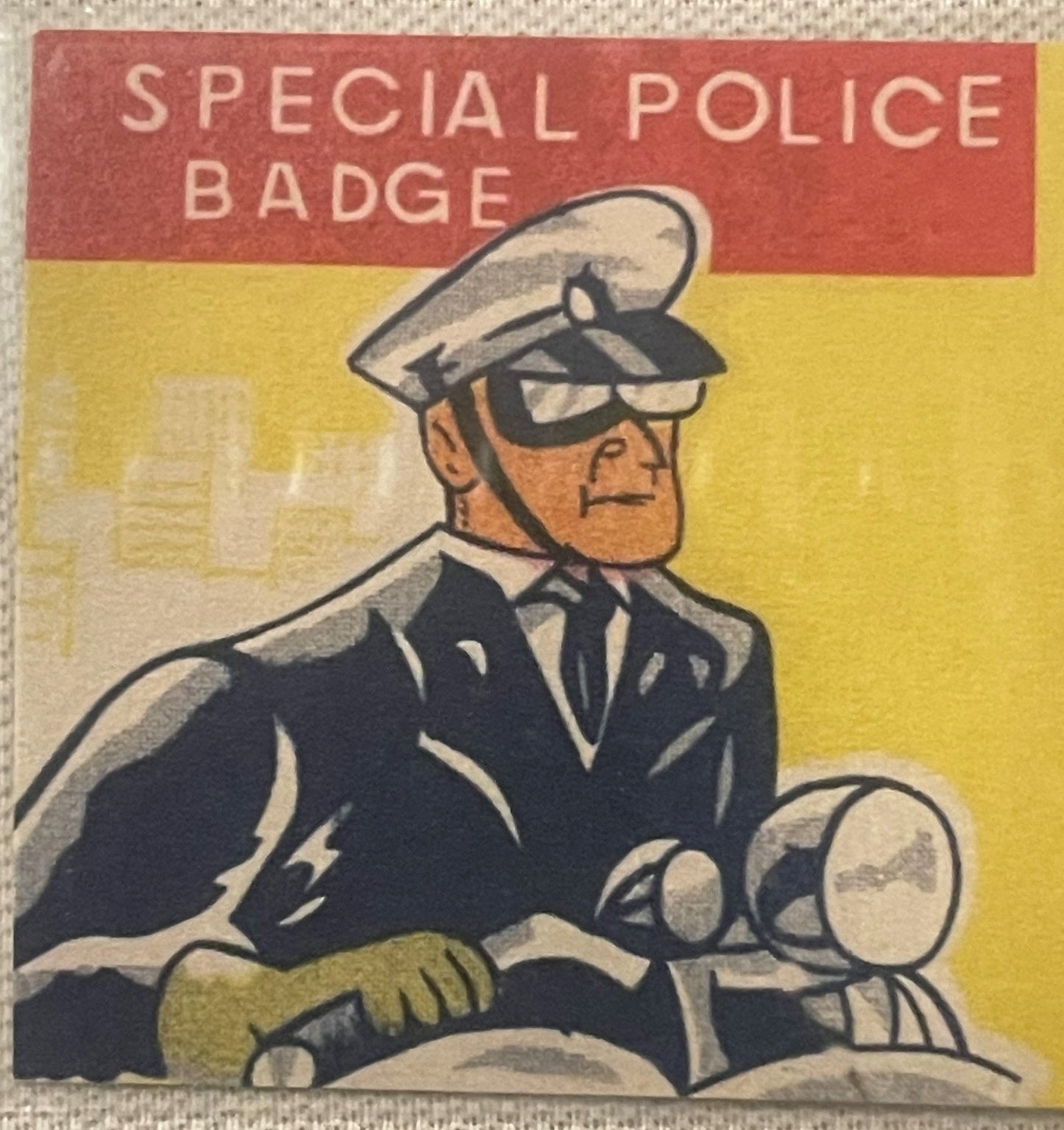
The original card is its own piece of graphic art. A motorcycle officer dominates the left side — square-jawed, masked at the eyes in the best tradition of the radio serial hero, leaning into his machine with that particular combination of authority and cool that the era perfected. The banner above him reads SPECIAL POLICE BADGE in white on red. In the lower right corner of that yellow card, quietly and precisely, is the single word that places the entire object in its historical moment: JAPAN. Color lithography, bold illustration, a confident graphic sensibility — this is mid-century commercial art at the height of its craft, produced for a market that expected its children's toys to look serious.


🏛️ Indianapolis and the Monument That Became a City's Signature

If you know Indianapolis, you know that tower. The Soldiers and Sailors Monument at the center of Monument Circle was completed in 1902 and immediately became the visual shorthand for the entire city — the anchor of every civic image, every official seal, every badge of any kind that wanted to say Indianapolis without spelling it out. It stands 284 feet tall, built of Indiana limestone, and it was designed by German-born architect Bruno Schmitz, who won an international competition that drew serious submissions from across Europe and the United States. The commission was given its scale deliberately — Indianapolis wanted a monument that would hold its own against anything in any American city — and Schmitz delivered something that has never stopped asserting itself on the skyline.

By the heart of the mid-century, that monument silhouette had been stamped, pressed, printed, and lithographed onto more city-themed objects than anyone could inventory. It appeared on police badges, on city letterhead, on souvenir plates and pennants, on every piece of civic merchandise that wanted to root itself in place. The image had become so thoroughly identified with Indianapolis that a factory on the other side of the world, producing novelty badges for American five-and-dimes, reached for it as naturally as any local printmaker would have. For Indianapolis, the tower was the city. Full stop.

The badge gets it right. The linework is lean and geometric — the monument rendered in miniature but with real fidelity to its character, radiating upward from the wide bracketed base into the tapering spire that any Indianapolis resident would clock in an instant. For a collector who knows the city, or for anyone who has ever stood at Monument Circle and looked up, the image snaps into place immediately. This was not a generic police badge with a generic design. Someone made a decision to represent Indianapolis accurately, and that decision gives this small piece of tin a specificity and a dignity that generic novelty work rarely achieves.

Local legend among Indianapolis collectors holds that the monument badge design was one of the most requested city-specific patterns in the postwar novelty badge series — that the bold geometry of the spire translated better to small-format tin lithography than almost any other American landmark, which is why the Indianapolis badge has survived in recognizable, collectible form when so many others from the same production runs have faded into obscurity. Whether or not that story can be fully documented today, it has been passed down among Hoosier collectors with enough consistency that it deserves recording here. The image works. That much is simply true.


🗾 Japan, MacArthur, and the Dime Store Pipeline

The story of how a tin badge reading INDIANAPOLIS POLICE came to be made in Japan is one of the stranger and more genuinely moving chapters of American mid-century history, and it deserves to be told in full — because without that context, the word JAPAN in the corner of this card is just a country of origin. With it, that word is an entire economic and human story compressed into four letters.

When Allied forces occupied Japan beginning in the summer of 1945, General Douglas MacArthur — appointed Supreme Commander for the Allied Powers — oversaw one of the most deliberate and thoroughgoing industrial rebuilding projects in modern history. The goal was not merely to demilitarize Japan but to rebuild its manufacturing economy along peaceful, export-oriented lines, redirecting the industrial capacity that had been pointed at war production toward the production of goods that the rest of the world actually wanted to buy. The American consumer market was the primary destination. Japanese factories, retooled and redirected, began producing the full range of inexpensive consumer goods — toys, ceramics, textiles, novelties, giftware — that would fill the shelves of American five-and-dime stores through the 1950s and into the early 1960s.

The dating distinction built into the marking convention tells its own story. Items produced during the Allied Occupation — from 1945 through April of 1952, when the Treaty of Peace formally ended the occupation — were required to carry the mark "Occupied Japan" or "Made in Occupied Japan" on anything intended for export to the United States. That marking requirement was a direct product of MacArthur's administration of the occupation, a way of tracking the provenance of export goods in the American market. After April 1952, when Japan regained its sovereignty, the occupation mark was retired, and export goods returned to the simpler "Made in Japan" or just "Japan" designation that had been standard before the war.

This badge carries the post-occupation mark. The word on the card is simply JAPAN — not "Occupied Japan," not "Made in Occupied Japan." That places it in the years after the occupation ended, in the long mid-century stretch when Japanese export manufacturing had fully hit its stride and American dime stores were its primary market. The production infrastructure MacArthur's occupation had helped rebuild was now running at full speed, turning out exactly this kind of brightly lithographed, carefully designed, inexpensive novelty for the American children's market. Every single one of these badges was part of that story.

Lore passed down among collectors of Japanese export novelties holds that the city-specific police badge series — of which this Indianapolis example is one of the most striking surviving specimens — was produced by a cluster of small lithography workshops in the Aichi and Gifu regions, which had long traditions in tin toy and novelty production stretching back to the prewar era. Those shops are not named on the cards, and the specific factory behind this badge cannot be documented today. But the quality of the lithography — the registration, the color saturation, the crispness of the linework — is consistent with the better end of the postwar novelty trade, produced by craftsmen who took the work seriously regardless of the price point at which it would be sold.

The dime store pipeline itself is worth a moment's attention. Woolworth's, Kresge's, Ben Franklin, McCrory's — the five-and-ten-cent store chains that were the retail backbone of mid-century American small cities and neighborhoods — were among the primary importers and distributors of Japanese export novelties in this period. A child in Indianapolis could walk into a Woolworth's on Washington Street, put down a few coins, and walk out with a badge that carried the city's own monument on its face, manufactured thousands of miles away by workers who had never seen Monument Circle but had rendered it faithfully from a reference image and a production order. That particular circuit — American city, Japanese factory, American dime store, American child — is one of the quietly extraordinary commercial networks of the postwar world, and this badge is a surviving artifact of it.


📺 The Motorcycle Officer and the Masked Hero Tradition

The illustration on the card deserves its own attention, because it is doing something specific and culturally deliberate. The officer depicted is not a straightforwardly realistic policeman. He wears a mask across his eyes — the same kind of mask that radio serial heroes and comic strip crime fighters wore in the era when this card was designed. The square jaw, the commanding posture, the lean into the motorcycle handlebars — these are the visual codes of the mid-century American hero archetype, applied to a figure in a police uniform.

This was intentional and entirely characteristic of how children's novelty goods were marketed in the 1950s. The era of the radio hero was giving way to the era of the television hero, and both drew on the same well of masked, principled, physically imposing crime fighters who operated just at the edge of official authority. The Lone Ranger. The Green Hornet. Any number of Saturday morning serial protagonists. By putting that masked-hero visual language on the packaging of a "Special Police" badge, the card's illustrator was telling a child precisely what kind of story this badge was for. You were not just playing police officer. You were playing the kind of police officer who had a secret identity and a motorcycle and a square jaw and a moral code that no ordinary villain could touch.

The graphic execution of that illustration is confident and economical — the kind of commercial illustration that the mid-century American market produced at extraordinary volume and occasional real quality. The color palette of the card, yellow and red with the navy figure, is warm and attention-grabbing in the way that dime store display goods needed to be. This was merchandise designed to stop a child's eye at twenty paces and not let go until the purchase was made. Seventy-some years later, it still works.


🖼️ Display Ideas

  • 🗄️ Frame it on the card. The badge, still mounted on its original display card in its original cellophane sleeve, makes an ideal shadow box centerpiece — a complete, self-contained piece of mid-century commercial art that needs nothing added to tell its story.
  • 🏛️ Pair it with Indianapolis memorabilia. Alongside a vintage Monument Circle postcard, a period city map, or a mid-century Indiana souvenir pennant, this badge anchors a focused Indianapolis display that tells the story of the city's postwar civic identity.
  • 👮 Build a novelty police badge collection. City-specific dime store police badges from the postwar Japanese export era are a collectible category unto themselves — Indianapolis, Chicago, New York, Los Angeles. A grid display of four or six on a single backing board is a striking piece of mid-century Americana.
  • 📺 Style a mid-century playroom or entertainment space. In a room decorated around the era of early television westerns, radio serials, and Saturday matinees, this badge reads as exactly the kind of artifact that would have lived in that world. It belongs there.
  • 🎨 Use it as a starting point for a Japan export novelty display. Paired with other "Made in Japan" and "Occupied Japan" toys, lithographed tin pieces, and dime store novelties of the era, this badge tells the larger story of MacArthur's postwar rebuilding of Japanese export manufacturing — a display concept with real historical depth.
  • 🏠 Give it its own small shelf moment. A vintage card display stand, a small easel, a narrow floating shelf — this badge on its card has enough graphic authority to hold a space entirely on its own, without anything else around it. Sometimes the right object just needs room to breathe.

🎁 Who Collects These

The collector community for pieces like this Indianapolis Special Police badge is broader and more varied than you might expect, because this object sits at the intersection of several distinct collecting passions that rarely fail to overlap in interesting ways.

Indianapolis and Indiana collectors are the most obvious audience — anyone building a collection around the city's history, around Monument Circle, around Hoosier civic identity and mid-century Indianapolis culture. The monument silhouette on this badge is a genuine piece of the city's visual history, and for a collector who cares about Indianapolis specifically, finding it rendered faithfully on a mid-century Japanese export novelty is exactly the kind of unexpected discovery that makes collecting worthwhile.

Occupied Japan and Made in Japan collectors form a dedicated and well-organized community with deep knowledge of the postwar export trade. Within that community, city-specific lithographed novelties occupy a respected niche — they are more visually interesting than generic designs and more historically specific than most of what the export factories produced. A badge that names a real American city and renders its landmark accurately is a step above the ordinary within this category.

Tin toy and dime store Americana collectors are natural collectors of this object — people drawn to the tactile reality of mid-century commercial objects, to the lithography craft, to the chain of hands a piece like this has passed through on its way from a Tokyo-area workshop to a Woolworth's counter to a child's toy box to a collector's shelf. The NOS status here — still on its card, still in its sleeve — makes it particularly appealing to collectors who value the complete, unaltered object.

And then there are the pure nostalgia collectors — people who grew up with objects like this, or whose parents did, and who respond to the immediate emotional charge that a tin badge on a yellow card delivers. Those collectors are not always the most vocal in the hobby, but they are often the most committed, because what they are buying is not just an object. It is a feeling. It is the weight of a badge in a child's hand on a summer afternoon, and the particular American belief that went with it.


❓ Frequently Asked Questions

Is this a real Indianapolis Police Department badge?

This is a novelty badge — a children's dime store toy of the mid-century era, not a badge issued by or connected to the Indianapolis Police Department as an official credential or department artifact. "Special Police" was the generic legend used across an entire series of city-labeled novelty badges produced for the American market by Japanese export manufacturers. What makes this piece historically interesting is precisely that it was a commercial artifact of its moment — a product of the postwar dime store economy, the Japanese export manufacturing revival, and the mid-century American childhood — not that it has any institutional connection to the actual Indianapolis Police Department. It is a piece of popular culture history, and that is its genuine value.

What does "New Old Stock" (NOS) mean for this badge?

New Old Stock means that this badge went from manufacture to its original display card, was packaged in its original cellophane sleeve, and was never sold at retail or put into use. It has lived its entire life as a stored, unissued piece of inventory rather than as a played-with or displayed object. For collectors, NOS status is significant because it means you are getting the object in its original, complete, unconditional form — card, badge, and packaging as a unit, as the manufacturer and retailer intended it to be encountered. This is not a badge that was pinned to a costume, worn on a bicycle, or separated from its card. It is the whole thing, intact.

How do I know when this was made?

The dating of Japanese export novelties of this kind relies primarily on the marking convention. Items produced during the Allied Occupation of Japan — which ran from 1945 through April 1952 — were required to carry the mark "Occupied Japan" or "Made in Occupied Japan" for the American export market. This badge carries the mark "JAPAN" — the simpler, post-occupation designation — which places it after the occupation formally ended in April 1952. Combined with the graphic style of the card illustration, the color lithography technique, and the retail context of the dime store novelty trade, a mid-century placement is well-supported. A precise manufacture year cannot be documented from the piece itself, as no additional factory or production markings are present — which was entirely typical of anonymous export novelty production of the era.

What is the Soldiers and Sailors Monument on the badge?

The Soldiers and Sailors Monument is Indianapolis's defining civic landmark, located at the center of Monument Circle in the heart of downtown. Completed in 1902 and built from Indiana limestone, it stands 284 feet tall and was designed by German architect Bruno Schmitz following an international competition. It was constructed to honor Indiana's veterans of the nation's wars and quickly became the most recognizable visual symbol of the city — appearing on seals, badges, letterheads, and souvenirs across more than a century of Indianapolis civic life. The linework rendering on this badge — lean, geometric, rising from its wide bracketed base to a tapering spire — is a faithful miniature of the monument's actual profile, and any collector familiar with Indianapolis will recognize it immediately.

What is the graphic on the card — is that a specific character?

The motorcycle officer on the display card is an original commercial illustration in the style of mid-century American graphic art, rather than a licensed character from a specific radio serial or comic strip. He bears the visual signatures of the era's hero archetype — the eye mask, the square jaw, the commanding posture, the motorcycle — which were shared across many different properties and hero types of the period without belonging exclusively to any one of them. The illustrator was drawing on a visual vocabulary that any child of the early television and late radio era would have recognized instantly as the language of the crime-fighting hero. It is original period commercial art, and it is beautifully executed for what it is.

What is the best way to preserve and store this piece?

The original cellophane sleeve that this badge came in is itself a piece of the object's history, and keeping the badge on its card inside that sleeve preserves the complete artifact as it was manufactured and intended to be presented. For long-term storage or display, a UV-protective sleeve or archival polyethylene bag of the appropriate size will protect the card from light exposure without requiring any alteration to the original packaging. If you choose to frame it, a shadow box with UV-protective glazing and an acid-free backing board is the standard approach for paper and mixed-media collectibles of this kind. The goal is to keep the whole unit — card, badge, sleeve — together and unaltered, because that completeness is a significant part of what makes a NOS piece worth preserving.

Is this a common piece, or is it hard to find?

City-specific tin lithograph novelty badges from this era survive in reasonable numbers, but finding a specific city — particularly one with as distinctive and recognizable a landmark design as Indianapolis — still on its original card, in its original sleeve, as New Old Stock, is a genuinely uncommon circumstance. Most of these badges were sold, pinned to costumes, played with, and eventually lost to the ordinary entropy of childhood. The ones that survived intact tend to have done so through the kind of accidental preservation that NOS pieces represent — bought in bulk, stored in a storeroom, and simply never opened. This Indianapolis example, complete and unissued, is an excellent early specimen of mid-century dime store Americana and postwar Japanese export lithography craft, and pieces in this condition and completeness do not turn up constantly.

🚔 The Real Junior Programs Behind Badges Like This

Dime-store tin badges did not live in a vacuum. Across mid-century America, real law enforcement agencies ran junior deputy and junior police programs: sheriffs swore in wide-eyed honorary junior deputies at county fairs and school assemblies, police departments sponsored school safety patrols — a movement that began in the 1920s and put belts and badges on millions of schoolchildren — and an officer handing a kid a badge at a parade or classroom visit was a familiar piece of civic life. An Indianapolis Special Police badge in a child's hand belonged to that same world, the era when a badge from a trusted grown-up could make a kid stand a little straighter. That is the history a carded survivor like this carries beyond its tin and ink.

Shipping

🚚 Shipping & Handling

  • Shipping costs and timing are calculated at checkout.
  • Items curated and shipped directly by me include U.S. shipping at no additional cost, professionally packed to ensure safe arrival of your artifact.

Items from Vetted Pro Collectors
Shipping for items offered by vetted Pro Collectors is determined at checkout. All Pro Collector listings are reviewed to ensure fair, reasonable shipping practices.

For full details, please refer to our Shipping Policy.

Returns & Exchange

Product Page Return Policy

  • 60-Day Returns – Items must be in original condition.
  • Refunds – Issued after inspection (excluding shipping costs).
  • Return Shipping – Customer is responsible unless item is damaged or incorrect.
  • Damaged/Incorrect Items – Contact us within 48 hours for a replacement or refund.
  • Easy Returns – Email [email protected] or call 802-356-9872 to initiate a return.

For full details, visit our Refund Policy.

View full details