Skip to product information
1 of 3

Vintage and Antique Gifts

Vintage 1950s Royal Oak Auxiliary Police Tin Litho Toy Badge 🚔 NOS on Card Michigan Seal Made in Japan

Regular price 32.00 USD
Regular price Sale price 32.00 USD
Sale Sold out
Shipping calculated at checkout.

Description

🏛️ A Small Michigan Time Capsule, Still On Its Card

Every so often a piece comes across the curator's table that has survived exactly the way it left the factory: never pinned, never played to death, never separated from the little printed card it was born on. This Royal Oak Auxiliary Police badge is one of those survivors. It is a tin lithographed toy badge — a five-and-dime novelty from the golden age of American variety stores — and it has spent the decades since sealed to its original “Special Police Badge” card in its factory sleeve. We catalog it here not because it was ever real police equipment (it never was, and we will never pretend otherwise), but because a genuinely unused mid-century play badge, still married to its display card, is the kind of small, honest artifact that quietly tells you what an ordinary childhood looked like seventy years ago.

Our whole reason for gathering objects like this one is preservation of the everyday. Museums keep the grand things. Somebody has to keep the ten-cent things — the dime-store toys, the counter-display cards, the little tin shields a kid clipped to a flannel shirt and felt ten feet tall wearing. A badge like this rarely makes it to us intact. Most were pried off their cards on Christmas morning and lost by New Year's. To find one still carded, still crisp, still sealed, is to find a page of American retail history that never got torn out.

🦅 What the Little Shield Actually Shows

The badge itself is a round pinback button, bright and graphic in the way only mid-century tin litho can be. A glossy red rim frames a deep navy-blue shield printed across the face, and every letter and figure is rendered in warm orange. Arched across the top, the lettering reads ROYAL OAK and, just beneath it, AUXILIARY; the word POLICE curves along the bottom edge. Between them, dead center, sits a small circular medallion carrying a miniature of the Michigan state coat of arms.

For a piece barely larger than a silver dollar, the little state seal is charmingly ambitious. You can pick out the eagle perched at the top, and the two supporting animals that flank the central shield — an elk on one side and a moose on the other, the pair that appears on Michigan's arms. There are the tiny motto ribbons the state device always carries, but on a badge this size they are printed far too small to read, so we describe them only as part of the design and leave it at that. The overall impression is confident and cheerful: a pocket-sized coat of arms, an honest orange-on-navy color story, and a shape that reads instantly as “badge” from across a room.

  • Format: round tin lithograph pinback button (toy / novelty badge)
  • Lettering: ROYAL OAK / AUXILIARY / POLICE in orange on a navy shield
  • Central device: the Michigan state coat of arms — eagle above, elk and moose supporters
  • Palette: red, navy blue and orange, printed on a yellow card
  • Origin mark: JAPAN, printed at the lower right of the card

🎨 The Craft Behind a Ten-Cent Toy

It is easy to underrate a dime-store badge until you look closely at how it was made. Tin lithography was a small marvel of mid-century mass production: the artwork was printed directly onto flat sheets of tinplate in layered colors, the sheet was then cut and the thin metal formed into a shallow domed button and crimped over a pin back. Every color you see — the red rim, the navy field, the orange line work of the seal — was laid down as its own pass, in register, on metal, at a price that let a store sell the finished piece for pocket change. The result has a depth and a gloss that a paper sticker could never match, and a durability that is exactly why examples like this one can still look this good three generations later.

That same process is why these badges photograph so beautifully and display so well. The light catches the domed metal, the colors stay saturated, and the graphic simplicity — bold shield, big letters, one tidy emblem — reads clearly at any size. There is real design intelligence packed into a novelty that was never meant to be taken seriously. Part of the mission of keeping these pieces is simply to give that anonymous mid-century commercial art its due: someone drew this little Michigan seal to fit a button, chose the palette, set the type on a curve, and did it well.

🚔 Royal Oak, the Auxiliary, and the Civil-Defense Years

Half the pleasure of a local badge is the local story printed right into it. Royal Oak is a Detroit suburb in Oakland County, the kind of leafy town that grew up along Woodward Avenue as the automobile city spread north. Its real police department is genuinely old: it was founded in 1918 under Philip H. Beauvais, which means the department actually predates the city's own 1921 incorporation — the badge on a squad car was pinned before the city limits were officially drawn. That is the sort of civic detail a small town keeps and repeats, and it is exactly the flavor a novelty maker was borrowing when it stamped a town name onto a dime-store badge.

The “Auxiliary” on this one points at something real, too. Auxiliary police units — volunteer citizens who train and turn out to help — were a fixture of the postwar civil-defense era, and Royal Oak's is a genuine, still-operating volunteer organization to this day. In the mid-1950s, with Cold War civil defense woven into everyday suburban life, the volunteer auxiliary was a proud and visible thing, the neighbor who directed traffic at the parade or stood a post during a drill. A toy that let a kid play at joining the local auxiliary fit the moment perfectly. We want to be precise about the line here: the real Royal Oak Auxiliary Police is a serious community institution, and this little tin button is a period plaything that borrowed its name and its town pride. Both things are true, and both are worth remembering.

📦 Condition, As a Curator Reads It

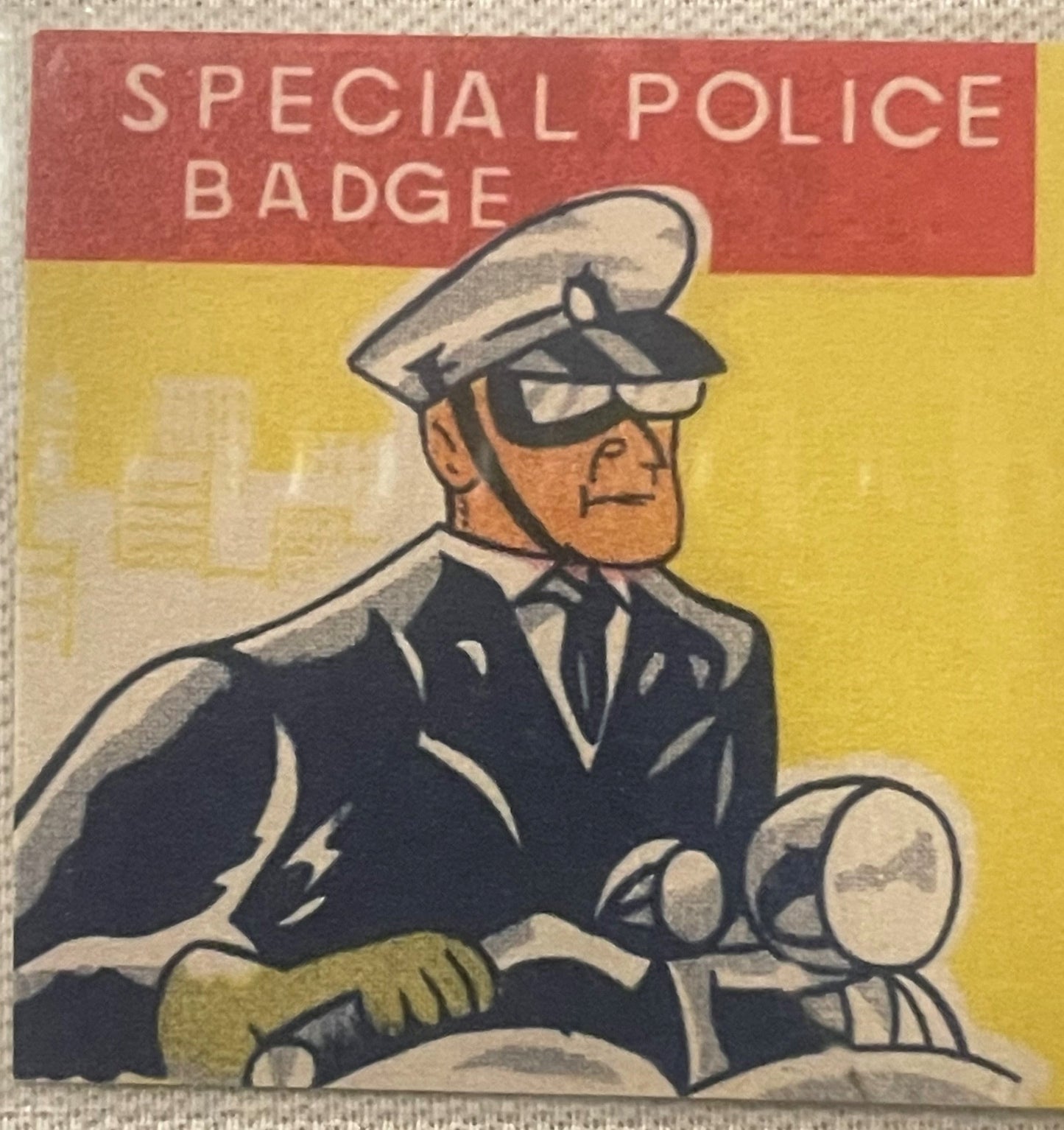
This is New Old Stock in the truest sense: factory stock that was never sold to a child and never put into play. The badge remains pinned to its bright yellow retail card, which is headed by a red “SPECIAL POLICE BADGE” banner and illustrated with the era's stock artwork — a square-jawed motorcycle patrolman in a white peaked cap and dark goggles, leaning into his handlebars against a faint city skyline. Down in the lower right corner the single word JAPAN records where it was made. That mark matters for dating: Japanese export goods carried a plain “Japan” stamp from 1952 onward (the earlier “Occupied Japan” era had ended), which places this badge comfortably in the mid-century window and squares neatly with the 1950s suburban civil-defense story printed on its face.

The badge and card sit together inside their original cellophane sleeve, the way they hung on a store rack. Tin litho of this age can show honest surface sheen and the faint waviness of thin stamped metal; that is simply the character of the medium, not damage. What you are getting is the complete object — badge, card, sleeve, country-of-origin mark — as a single preserved unit, which is worlds rarer than the loose badge alone.

🔎 Why It Earns a Place in a Collection

Town-name novelty badges are a wonderful, under-appreciated corner of Americana, and a specific municipality — Royal Oak, Michigan, with its own genuine auxiliary unit — is exactly the kind of narrow, place-anchored piece that seldom surfaces carded and sealed. This is a sole-source sort of find: the kind of small artifact you can hunt for a long while and simply not turn up in this condition. It belongs with mid-century dime-store toys, with Michigan and metro-Detroit local history, with civil-defense and postwar collectibles, or in a shadow box of tin litho at its cheerful best.

A note on living with it: we would keep this one carded. The card is more than half the story, and the sealed sleeve is what carried the badge unscathed this far — so display it as the complete unit, out of direct sun and away from damp, and let the graphics do the talking. It slots naturally into a frame, a riker-mount display case, or a shelf of other town-name and civil-defense novelties, where its Michigan seal and its confident orange lettering hold their own against pieces many times its original price. Gift-wise, it is a thoughtful little find for anyone with Royal Oak or metro-Detroit roots, a first responder in the family, or a soft spot for the honest toys of the variety-store era.

However you shelve it, it does the quiet thing the best small artifacts do: it holds a whole decade in the palm of your hand — a Woodward-Avenue suburb, a Cold War auxiliary, a variety-store counter, and a kid who wanted, for a dime, to be on the force. We are glad to have kept it whole, and glad to pass it on that way.

Shipping

🚚 Shipping & Handling

  • Shipping costs and timing are calculated at checkout.
  • Items curated and shipped directly by me include U.S. shipping at no additional cost, professionally packed to ensure safe arrival of your artifact.

Items from Vetted Pro Collectors
Shipping for items offered by vetted Pro Collectors is determined at checkout. All Pro Collector listings are reviewed to ensure fair, reasonable shipping practices.

For full details, please refer to our Shipping Policy.

Returns & Exchange

Product Page Return Policy

  • 60-Day Returns – Items must be in original condition.
  • Refunds – Issued after inspection (excluding shipping costs).
  • Return Shipping – Customer is responsible unless item is damaged or incorrect.
  • Damaged/Incorrect Items – Contact us within 48 hours for a replacement or refund.
  • Easy Returns – Email [email protected] or call 802-356-9872 to initiate a return.

For full details, visit our Refund Policy.

View full details