Skip to product information
1 of 3

Vintage and Antique Gifts

Vintage 1960s-1970s Special Police Toy Badge 🔴 Sauk County Sheriff's Dept Wisconsin Tin Litho Button on Original Card Japan

Vintage 1960s-1970s Special Police Toy Badge 🔴 Sauk County Sheriff's Dept Wisconsin Tin Litho Button on Original Card Japan

Regular price 18.00 USD
Regular price Sale price 18.00 USD
Sale Sold out
Shipping calculated at checkout.
Quantity

Could This Little Tin Button Be the Last Surviving Example of Sauk County's Mid-Century Badge Culture? 🔴

There is something about holding one of these that stops you cold. A round tin button, not much bigger than a half dollar, dressed in red and black and gold — and on the face of it, a Native American chief in full war bonnet stares off to the side with the quiet authority of someone who has seen everything. Above him, in bold yellow lettering arched across a dark shield: SHERIFF'S DEPT. Below: SAUK COUNTY WIS. It is a complete world compressed into an inch and a half of tin litho. A whole county's identity — its Indigenous roots, its frontier lawman tradition, its postwar Main Street optimism — pressed flat into a button a child could pin to a shirt and feel, for one afternoon, like the most important person in Baraboo.

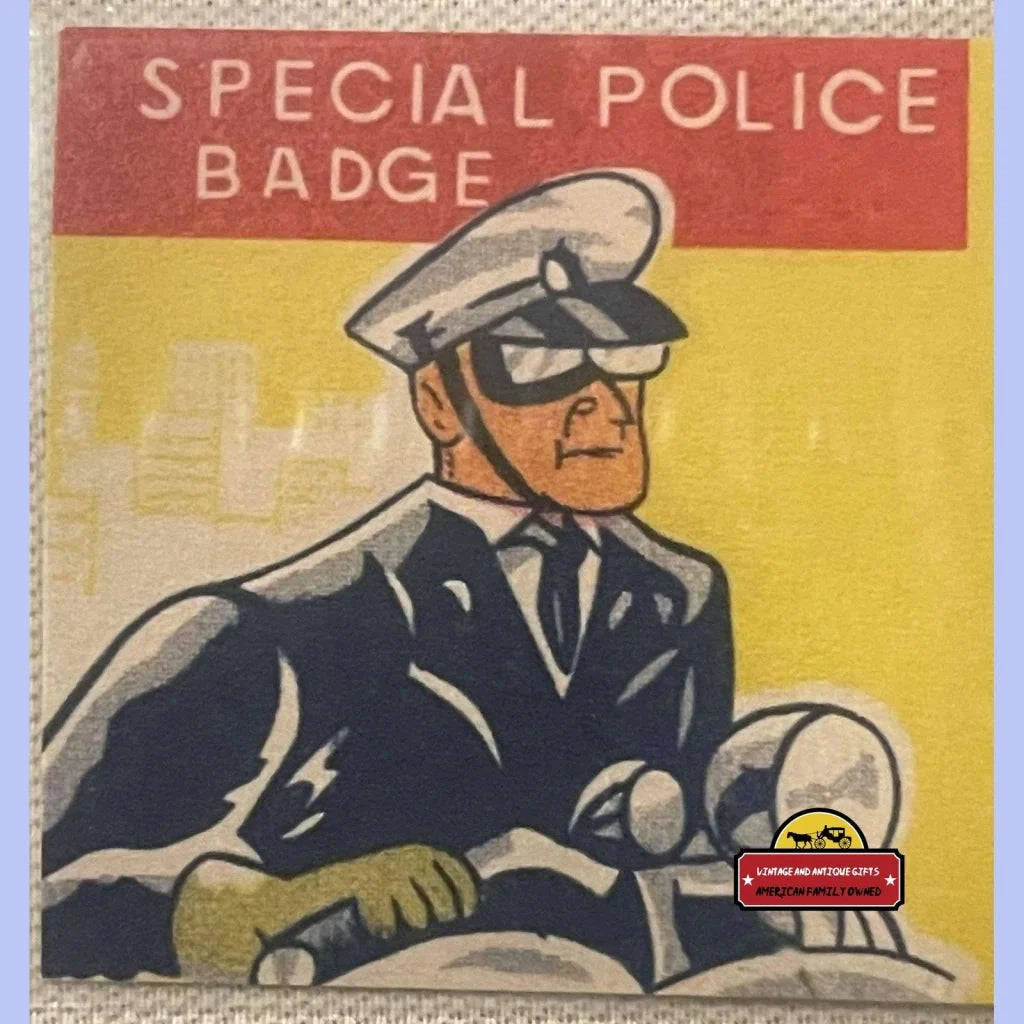
I have been collecting pieces like this for a long time, and I will tell you honestly: the ones that come through still sealed in their original card sleeve are the ones that make you pause. This is exactly that find. New Old Stock — carded, sleeved, untouched — exactly as it would have sat in a dime-store spinner rack or behind a glass counter sometime in the heart of the mid-century era. The badge rides on its original display card, a yellow card printed with a masked motorcycle officer leaning forward over his handlebars, the words SPECIAL POLICE BADGE printed in bold across a red banner at the top. The card is marked JAPAN in small print at the lower right. The whole package remains in its original clear plastic sleeve. That sleeve is part of the story.


🎖️ What You Are Actually Looking At — The Object, the Craft, the Card

Let's be precise about what this piece is, because precision is how a collector respects a thing. This is a Special Police Badge novelty pin, a round tin lithograph button approximately 1.5 inches in diameter, mounted on a rectangular display card measuring approximately 4 by 2.25 inches. The face of the button carries a shield-shaped design rendered in lithographic color printing — red, black, yellow, and white — depicting a side-profile illustration of a Native American chief in a full trailing war bonnet. The feathers sweep behind him dramatically in white and red. A decorative breastplate ornament sits at his collar. The lettering SHERIFF'S DEPT. arches across the top of the shield; SAUK COUNTY WIS. anchors the bottom. The surrounding field of the button is red, bordered in yellow. The overall graphic effect is striking — that flat, bold, mid-century commercial illustration style that somehow makes everything look simultaneously more serious and more storybook.

The card art deserves its own moment. The masked motorcycle officer depicted on the card is illustrated in the same confident, graphic comic style — dark uniform, white cap, heavy goggles or a mask across the eyes — leaning forward over a motorcycle as though he's already in pursuit. He looks like a cross between a superhero and a traffic cop, which is precisely the fantasy these badges were designed to sell to a seven-year-old in a five-and-dime store. The card is its own piece of mid-century printed ephemera, and the fact that this example retains its original card and sleeve intact makes it an exceptional survival in any collection of postwar Americana.

The manufacture mark reads JAPAN — which places this squarely within the great wave of postwar Japanese export novelties that flooded American variety stores and dime shops through the mid-century decades. These were the goods that filled Woolworth's and Kresge's and every small-town hardware-and-sundry counter from Wisconsin to California. This is an honest, verified fact about the piece, and it is also part of its historical significance — because those Japanese-export toy badges, carded and graphic and boldly printed, are now themselves a recognized category of mid-century Americana, sought by collectors of toy badges, paper ephemera, law-enforcement memorabilia, and regional Americana alike.


🏭 The Industry Behind the Badge — Postwar Japan and the American Five-and-Dime

To understand what you are holding, you have to understand the world that made it. The postwar Japanese tin toy and novelty industry is one of the great untold chapters in the story of American consumer culture. By 1947, under the American occupation, Japan's tin-plate manufacturing industry had been granted the right to resume operation and to export — and the American market, flush with postwar prosperity and full of children whose parents were determined to give them everything their own Depression-era childhoods had lacked, was the perfect destination.

Through the late 1940s and across the 1950s and into the 1960s, Japanese factories produced an astonishing range of tin lithograph goods aimed squarely at the American variety-store trade: toy cars and trains and robots, yes, but also novelty pins and badges and buttons of every description. Law-enforcement badges were a staple of this trade. "Special Police," "Deputy Sheriff," "Secret Agent," "G-Man" — the titles varied, but the format was consistent: a boldly printed tin litho button on a colorful display card, priced for a child's allowance, sold by the gross to five-and-dime buyers who knew they would move every unit. These were not licensed goods in the modern sense. They were generic novelties, and the genius of them — the reason collectors treasure them today — is that each regional variation gives us a tiny window into which communities were ordering them, which county names meant something to a local shopkeeper, which imagery resonated with a particular place.

That a Sauk County, Wisconsin version exists — with its specific shield design, its chief in war bonnet, its departmental lettering — tells us that someone in Sauk County, or someone supplying Sauk County stores, ordered this specific design. These were not mass-produced with a single national identity. The regional specificity is the point. And that specificity is now, decades later, exactly what makes this badge irreplaceable as an artifact of a particular place and time.

The sealed, unplayed-with examples that turn up today are the ones that got tucked into a junk drawer, a shoebox, or a display case and simply forgotten. They are the accidental survivors. This one is among them.


🌲 Sauk County, Wisconsin — The Land Behind the Badge

Sauk County sits in south-central Wisconsin, and it is one of those places that rewards attention. The county was created from Wisconsin Territory in 1840 and formally organized in 1844. Its county seat is Baraboo — a city with a name that has always sounded like it was invented by a storyteller, and a history that proves it didn't need to be. The name comes from the Baraboo River, and the city grew from a settlement first staked around 1838, becoming the county seat by 1846 after a famously fierce contest with the nearby village of Reedsburg. By 1852 the village had formally taken the name Baraboo, and it has worn it ever since.

The county takes its own name from the Sauk people — a nation with a long and storied presence across the upper Midwest. But the Indigenous people most directly connected to the Sauk County landscape are the Ho-Chunk Nation, who have inhabited this region for centuries and whose history is woven into the county's rivers, ridges, and place names at every turn. Devil's Lake — one of Wisconsin's most visited natural landmarks — sits within Sauk County, and it carries deep significance in Ho-Chunk tradition. The Baraboo Range, a line of ancient quartzite hills that forms one of the oldest exposed rock formations on the continent, frames the county's landscape in a way that has always felt, to those who know it, like something more than geology.

The chief in war bonnet at the center of this badge's design carries that local resonance directly. This was not random decoration chosen from a catalogue. In the context of Sauk County — a county named for the Sauk, bordered by Ho-Chunk sacred landscape, anchored by a history of Indigenous presence that predates European settlement by centuries — the choice of a Native American chief's profile as the central image of the Sheriff's Department emblem was a deliberate act of regional identity. Local legend has it that the design was chosen specifically to honor the Indigenous heritage of the land the department was sworn to protect, a gesture that reflected the way mid-century Wisconsin communities understood, however imperfectly, the history beneath their feet.

And then there is Baraboo's circus legacy — a thread that runs through the county's entire self-image. The five Ringling brothers — Charles, Albert, Alfred, Otto, and John — grew up in Baraboo, and in 1884 they launched what would become the Ringling Brothers Circus, which wintered in Baraboo until 1918. The Circus World Museum still operates there today, on the original Ringling winter quarters site. To grow up in Baraboo in the 1950s was to grow up in the shadow of that legend — to know that the greatest show on earth had been born on your streets, had rehearsed in your neighborhood, had shaped your city's sense of its own importance in the world. A child pinning on a Sauk County Sheriff's badge in that era was playing out a fantasy of authority and adventure in a place that had always believed in spectacle.

The county also carries a chapter of World War II history that most Americans don't know: located near Baraboo, the Badger Army Ammunition Plant — known during the war as Badger Ordnance Works — operated as the largest munitions factory in the world at the height of the war effort. The plant transformed the landscape and the workforce of Sauk County in ways that lingered long into the postwar years when this badge was produced. The men and women who had built bombs in those fields were, in the 1950s, raising the children who would buy these badges at the five-and-dime and pin them to their shirts and ride their bikes through the streets of Baraboo pretending to keep the peace.


⚖️ The Sauk County Sheriff's Department — A Real Institution Behind a Novelty Badge

The Sauk County Sheriff's Department is a real agency with a real and continuous history, headquartered in Baraboo. The department has operated since the county's formal organization in 1844 — more than 180 years of continuous service. By the mid-century era when this badge was produced, the department was a fully established presence in the county's civic life, patrolling a landscape that included farmland, lake country, tourist destinations, and the kinds of rural roads where a mid-century sheriff's deputy earned every mile of his territory. The department's documented history includes line-of-duty sacrifice, and the men and women who served in those decades understood their work against a backdrop of real community — the same community whose children were buying souvenir badges with the department's name on them at the local five-and-dime.

That the department's emblem — the chief in war bonnet, the shield design, the bold departmental lettering — was reproduced on a novelty badge sold to children is not a contradiction. It is a reflection of the way mid-century American communities wore their civic institutions on their sleeves, literally and figuratively. A child wearing this badge was not impersonating an officer; they were expressing pride in the institution that protected their county. The badge was a piece of civic identity as much as it was a toy. And now, decades later, it is both a toy and a historical document — evidence of how Sauk County presented itself to its own children in the years when this country was at its most optimistic and most certain of its own future.


🖼️ Display Ideas

  • 🗺️ Wisconsin regional shadow box: Mount alongside a vintage Wisconsin highway map, a Baraboo postcard, and a Ringling Brothers circus program from the same era — a complete window into mid-century Sauk County life.
  • 🚔 Law enforcement collectibles display: Groups beautifully with other mid-century sheriff's and police badges, toy or issued, especially other carded novelty badges from the postwar Japanese-export era.
  • 🎪 Baraboo / circus history collection: The Sauk County provenance connects this directly to Baraboo's circus legacy — a natural companion to Ringling Brothers ephemera, Circus World Museum souvenirs, and Wisconsin Dells tourist memorabilia.
  • 📌 Pinback button collector's display board: The bold lithographic color — red, black, gold, white — makes this a natural focal point in any mid-century tin lithograph button collection, carded or uncarded.
  • 🏛️ Americana vignette: A framed grouping with other mid-century dime-store Americana — cap gun cards, tin toy packaging, variety-store ephemera — speaks to the whole culture of postwar American childhood.
  • 🧒 Family provenance display: If this badge has a Wisconsin family connection, mount it with a photograph from the era and a hand-written note about its story. This is exactly the kind of piece that becomes a family artifact — the kind of thing a grandchild asks about forty years from now.

🎁 Who Collects These — and Why They Look

The audience for a piece like this is broader than it might first appear, and that breadth is part of what makes it a strong collectible. Wisconsin regional collectors pursue anything that carries a specific county or city name — Sauk County, Baraboo, the Wisconsin Dells — because genuinely local-identity items from the mid-century era are far rarer than generic Wisconsin souvenirs. A badge that names the county sheriff's department specifically is a find in that category.

Toy and novelty badge collectors form their own dedicated community, and within that community, carded examples — especially New Old Stock pieces that retain their original display card and sleeve — are the prizes. The card is often what elevates a common badge into a display-worthy collectible, and this example has both.

Tin lithograph and pinback button collectors respond to the printing craft itself: the bold flat graphics, the color separation, the shield-within-circle composition. Mid-century Japanese-export tin litho work at its best is genuinely accomplished printing, and pieces like this demonstrate exactly why collectors have come to regard the category seriously.

Law enforcement memorabilia collectors pursue departmental insignia of all kinds, and a piece that carries a specific department's name and emblem — even in novelty form — occupies a real place in the documentation of how American law enforcement agencies presented their identity to the public.

Native American imagery and Ho-Chunk history researchers find pieces like this valuable as cultural documents — evidence of how mid-century Wisconsin communities understood and depicted Indigenous identity, for better and for worse, in the everyday objects of civic life.

And then there are the people who simply grew up in Sauk County, or whose grandparents did — the people for whom this badge is not a category of collectible but a piece of home. Those are often the buyers who care most deeply, and who will protect this piece best.


❓ Frequently Asked Questions

Is this an actual issued Sauk County Sheriff's Department badge, or a novelty item?

This is an honest question that deserves a straight answer, and I respect every collector who asks it. This is a novelty/souvenir badge — a dime-store toy badge produced during the mid-century era, manufactured in Japan, and sold through variety stores and five-and-dime shops. A genuine, officially issued Sauk County Sheriff's Department badge would have been produced by a domestic badge manufacturer using die-struck metal construction, and it would carry no "JAPAN" mark. The "Sauk County Wis." identity on this piece reflects either a specific regional order placed through a novelty distributor or, as is documented with similar pieces, a local owner's association with the badge. It is not a credential. What it IS, unambiguously, is a genuine mid-century artifact, a piece of Wisconsin regional identity, and an excellent example of the postwar Japanese-export novelty trade that shaped American five-and-dime culture from coast to coast. Its historical and collectible value is real — it simply derives from what it actually is, not from official issuance.

What does "New Old Stock" (NOS) mean for this piece?

New Old Stock means this badge has never been removed from its original display card and sleeve — it is in the same state it would have been on the day it left the store, decades ago, without ever having been sold to and played with by a child. That survival status is genuinely uncommon for this category. Most of these badges were bought to be worn, pinned to shirts, carried to school, and eventually lost or discarded. The carded, sleeved examples that surface today are the exceptions — the ones that somehow bypassed the fate of being played with and were instead preserved, intentionally or accidentally. NOS status is what collectors in this category specifically seek, and it is what this piece offers.

Why does the card show a masked police officer rather than a sheriff's deputy?

The display card is a generic "Special Police Badge" card — a standard format used across many different regional badge variations sold through the same novelty trade channels. The motorcycle officer illustration on the card is the universal artwork; the specific badge mounted on that card is the regional variation. This was standard practice in the mid-century novelty badge trade: a single card design would carry dozens of different regional or departmental badge variations, depending on which local distributors or store buyers had ordered which specific version. The card and the badge are a matched set in terms of era and trade channel, even though the card's illustration doesn't specifically depict a Sauk County officer. Together, they document exactly how these goods moved through the American retail system in the postwar decades.

What is the significance of the Native American chief image on the badge?

In the specific context of Sauk County, Wisconsin, the chief in war bonnet carries genuine local resonance. The county itself is named for the Sauk people. The Ho-Chunk Nation has inhabited this landscape for centuries, and their presence is woven into the county's geography, place names, and self-understanding in ways that were recognized even in the mid-century era. Devil's Lake — one of Wisconsin's most significant natural landmarks, located within Sauk County — holds deep significance in Ho-Chunk tradition. Local legend has it that the choice of a Native American chief's profile for the Sheriff's Department emblem was a deliberate acknowledgment of the Indigenous heritage of the land the department served. Whether that intention was fully realized in the image's execution is a conversation that belongs to a larger historical reckoning with mid-century American imagery — but the local specificity of the choice, in this county, is not accidental. It is a document of how Sauk County understood its own identity at mid-century.

How does this badge fit into the history of the postwar Japanese export novelty trade?

The postwar Japanese tin and novelty export industry is one of the great underappreciated chapters in American consumer history. From the late 1940s through the 1960s, Japanese manufacturers produced an extraordinary volume of tin lithograph goods — toys, novelties, badges, pins, and decorative items of every description — aimed squarely at the American variety-store market. The "Made in Japan" or "Japan" mark on these goods became synonymous with the affordable, colorful, boldly designed objects that filled the racks at Woolworth's, Kresge's, and every small-town five-and-dime in the country. Law enforcement badges were a staple of this trade, and the regional variations — pieces carrying specific county or departmental names — are among the most collectible survivors of the category today, precisely because they document the intersection of Japanese manufacturing craft and American regional identity in a single small object. This badge is a perfect specimen of that intersection.

Is this a good gift for someone with a Wisconsin or Sauk County connection?

It is an exceptional one — and the buyers who have found pieces like this consistently describe the reaction of the recipient as exactly the kind of surprised, genuinely moved response that only a truly specific and thoughtful gift produces. A mass-produced Wisconsin souvenir carries no particular weight. A mid-century novelty badge that names a specific county, carries a specific departmental design, and arrives in its original card and sleeve — that is an object with a story. For someone with family roots in Sauk County or Baraboo, for a Wisconsin law enforcement officer or retiree, for a collector of regional Americana, or for anyone who grew up in the era when a child could walk into a five-and-dime and pin on a badge and become, for an afternoon, the law — this is a gift that lands differently than almost anything else you could find.

What other collectibles pair well with this badge?

The natural companions for this piece span several collecting categories, which is part of what makes it so versatile as a display piece. Within Wisconsin regional collecting, it pairs beautifully with vintage Baraboo and Sauk County postcards, Ringling Brothers Circus ephemera from the Baraboo wintering years, Wisconsin Dells tourist souvenirs from the same mid-century era, and any Ho-Chunk or Sauk Nation cultural documentation. Within the toy and novelty badge category, it groups naturally with other carded mid-century sheriff's and police badges, especially other Japanese-export examples with regional American identities. Within tin lithograph collecting, its bold color and graphic design make it a strong visual anchor alongside other mid-century pinback buttons and tin litho advertising pieces. And within law enforcement memorabilia, it sits comfortably alongside departmental patches, shoulder insignia, and documentation from Wisconsin sheriff's departments of the same period — as an honest novelty artifact that nonetheless carries a genuine departmental identity.

👮 Junior Deputies, Safety Patrols, and the World This Badge Lived In

There is a real history standing behind every mid-century toy badge. This was the era of the junior deputy and the school safety patrol: sheriffs' offices swore children in as honorary junior deputies at fairs and school assemblies, safety patrol programs — running strong since the 1920s — pinned badges on generations of schoolchildren, and a visit from an officer with badges to hand out was a fixture of American civic childhood. A Sauk County Sheriff's Department badge belonged to that world. When a child pinned one on, the game borrowed its seriousness from programs that were entirely real — and that is part of the history a survivor like this one still carries.

Shipping

🚚 Shipping & Handling

  • Shipping costs and timing are calculated at checkout.
  • Items curated and shipped directly by me include U.S. shipping at no additional cost, professionally packed to ensure safe arrival of your artifact.

Items from Vetted Pro Collectors
Shipping for items offered by vetted Pro Collectors is determined at checkout. All Pro Collector listings are reviewed to ensure fair, reasonable shipping practices.

For full details, please refer to our Shipping Policy.

Returns & Exchange

Take your time — you've got a full six months. If a piece isn't right for you, send it back the way it reached you and we're good.

In the first 30 days your money goes straight back the way you paid. After that it's store credit, so you can put it toward something you'd rather have.

Return shipping we sort out between us, case by case. I don't make this difficult.

If something arrives damaged, or it isn't what I said it was, send me a photo within 48 hours and I'll make it right.

Email info@vintageantiquesgifts.com or call 802-356-9872 — that's me answering, not a call center.

The only things I can't take back are custom or special-order pieces and gift cards.

View full details