Skip to product information
1 of 3

Vintage and Antique Gifts

Vintage Tin Litho Special Police Toy Badge 🌟 Laurens County Sheriff's Dept — 1960s-1970s Japan, Original Card

Vintage Tin Litho Special Police Toy Badge 🌟 Laurens County Sheriff's Dept — 1960s-1970s Japan, Original Card

Regular price 18.00 USD
Regular price Sale price 18.00 USD
Sale Sold out
Shipping calculated at checkout.
Quantity

# What Does a 1.5-Inch Piece of Tin Know About American History? 🌟

More than you might expect.

There is a particular kind of magic that happens when you hold something this small and feel the full weight of two separate histories pressing back against your palm. One history belongs to Laurens County — a place whose roots reach all the way down to the American Revolution, whose soil has absorbed two and a half centuries of American ambition, grief, and reinvention. The other history belongs to a nation on the far side of the Pacific, rebuilding itself from the ash and silence of a world war, putting its craftsmen back to work one tin-litho press at a time. This vintage Special Police Badge, issued in the name of the Laurens County Sheriff's Department and riding on its original illustrated display card, carries both of those stories at once. It does it in primary colors. It does it with the cheerful, absolute confidence of the 1950s. And it does it while sitting quietly in the palm of your hand, waiting for someone to notice.


What You're Looking At

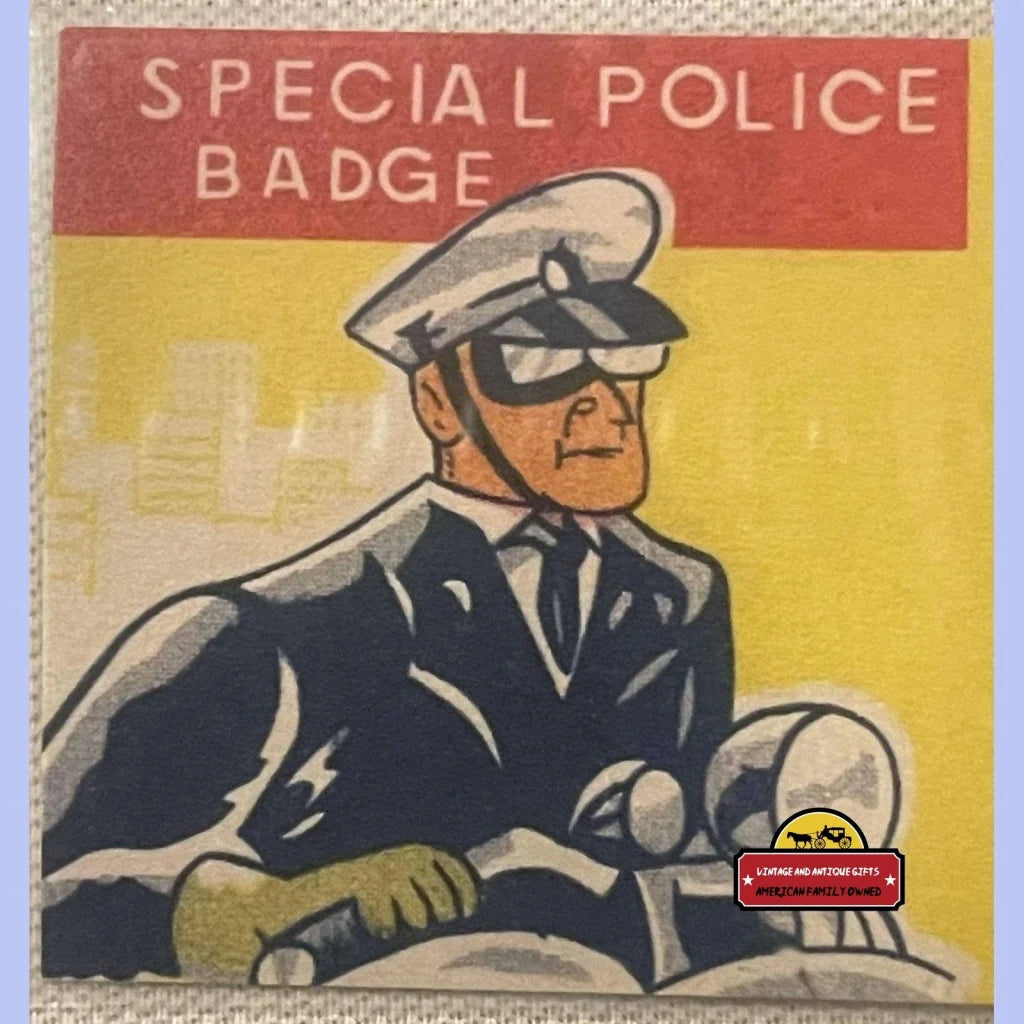
This is a genuine vintage tin lithograph Special Police Badge, produced in Japan in the 1950s and sold through American dime stores on its original illustrated display card — intact, sealed, and as vivid today as the afternoon it left the rack. The badge itself measures approximately 1.5 inches — a proper, palm-sized shield form rendered in the bright, clean colors that tin lithography did better than almost any other printing process of the era. The card measures 4 inches by 2.25 inches and features a bold red header reading SPECIAL POLICE BADGE above a golden-yellow illustrated scene: a square-jawed, masked officer hunched low over a motorcycle, sunglasses firmly on, expression all business. That officer is going somewhere important, and he is not slowing down for questions.

The card is marked JAPAN in small type near the lower right corner. The badge itself is identified to Laurens County Sheriff's Department, making this a named, place-specific piece — not a generic "police" badge, but one tied to a real county, a real department, and a real moment in American popular culture when dime-store toys carried the genuine romance of authority and civic pride. This is a New Old Stock (NOS) piece: never removed from its card, never played with, never separated from its original presentation. It arrived from that dime store display rack, and it has waited — patiently, colorfully — ever since.


🏭 The Art and Industry Behind the Tin Litho Badge

To understand what you're holding, you have to understand what tin lithography was — and what it meant at mid-century.

Tin lithography is a printing and forming process in which color is applied directly to sheet metal before the metal is cut and shaped into its final form. The result is artwork that is part of the object — not a label glued on top, not a decal applied after the fact, but color and image pressed directly into the tin itself. When it's done well, as it is here, the result is extraordinarily durable. The colors don't peel. The image doesn't separate. Decades later, a well-stored piece looks almost exactly as it did on the day it was made, which is precisely why serious collectors seek these out.

The tin litho toy and novelty industry had deep roots in both Europe and America before the war, but the postwar period — roughly 1945 through the early 1960s — produced some of the most collectible tin lithography ever made. Japanese manufacturers, working under the supervision of the Allied occupation and later under the general guidance of American import buyers, became extraordinarily skilled at producing tin novelties, toys, and accessories that met American taste and American price points. The small type reading JAPAN on this card is not a footnote — it is a timestamp on one of the most significant industrial revivals of the twentieth century.

The badges moved through Woolworth's, Kresge's, Ben Franklin stores, and dozens of regional five-and-dime chains on spinning wire racks, priced for the allowance market. A child could be the Sheriff of Laurens County for the price of a candy bar.


🏛️ Laurens County: A County That Goes All the Way Back

Laurens County, South Carolina — and yes, there is also a Laurens County in Georgia, a point that collectors sometimes debate when they encounter these badges — has a history that stretches back to the colonial period. The South Carolina county was established in 1785, named for Henry Laurens, a Charleston merchant, statesman, and President of the Continental Congress during the American Revolution. He was, by any measure, one of the more consequential figures of the founding era, and the county that bears his name has carried that heritage forward through more than two centuries of American life.

The county seat of Laurens, South Carolina is a small city with an outsized sense of its own past. It sits in the Piedmont region of the state, surrounded by the textile history that defined so much of upland South Carolina in the nineteenth and twentieth centuries. By the 1950s — the decade this badge was made — Laurens County was a working community of mill towns and courthouse squares, of Saturday afternoons and radio serials, of children who grew up knowing their sheriff's name and what his badge looked like.

What is known is that these county-specific badges are significantly harder to find than generic examples — and that a badge tied to a county with as much history as Laurens County carries an additional layer of meaning for anyone with roots there.


🌏 The MacArthur Connection and the Postwar Miracle

No conversation about 1950s Japanese tin litho is complete without acknowledging the larger story it belongs to.

General Douglas MacArthur's occupation of Japan, which ran from 1945 to 1952, oversaw one of the most deliberate and successful industrial rebuilding programs in modern history. Among the many industries that were encouraged, organized, and ultimately exported to American markets was the toy and novelty trade. Japanese craftsmen who had spent the war years producing military equipment found themselves retooling for peacetime — and the American consumer market, hungry for affordable goods after years of wartime rationing, was an almost perfectly receptive audience.

Whether that specific administrative machinery touched this particular badge or this particular manufacturer is impossible to say with certainty. But the badge in your hand — marked JAPAN, sold in an American dime store, riding on a card that celebrates American law enforcement — is a physical artifact of that larger story. It is a small piece of the postwar world remaking itself, one tin-litho press run at a time.


🖼️ Display Ideas

  • 🪞 Frame it as found — a shadow box with the badge on its original card, positioned beside a vintage map of Laurens County, makes a striking piece of hyper-local Americana.
  • 🗂️ Pair it with dime-store ephemera — display alongside vintage Woolworth's receipts, a period toy catalog page, or other 1950s tin litho novelties for a curated mid-century vignette.
  • 🎖️ Collector's badge display board — mounted with other county-specific or state-specific tin litho badges of the era, this piece anchors a compelling regional law enforcement theme.
  • 🏡 A Laurens County homecoming gift — displayed in a den, office, or family room alongside family photographs from the county, this badge becomes an instant conversation piece and heirloom touchstone.
  • 🧒 Children's room or playroom nostalgia corner — paired with other 1950s childhood artifacts, it speaks directly to the era's irresistible sense of play and civic imagination.
  • 📚 South Carolina history or law enforcement collection — alongside period photographs of the Laurens County Sheriff's Department, vintage postcards of the courthouse square, or other SC Piedmont memorabilia, this badge functions as primary-source Americana.

🎁 Who Collects These

The audience for a piece like this is wonderfully wide — and the people who fall in love with it tend to fall hard.

Laurens County natives and South Carolina Piedmont families are the most emotionally immediate buyers. For someone who grew up in Laurens, or whose grandparents did, or who has family buried in the county, this badge isn't just a collectible — it's a piece of home. It has a pull that no generic antique can replicate.

Tin litho and dime-store toy collectors pursue these badges with serious intent. The combination of NOS condition, original card, and named county affiliation puts this piece near the top of the category. Collectors who focus on postwar Japanese tin litho know exactly what they're looking at and know how rarely they find it in this condition.

Law enforcement and Americana collectors — particularly those who focus on the mid-century period — find these badges irresistible as examples of how American civic identity was marketed, romanticized, and sold to children in the postwar years. A badge like this one tells a story about American culture that a real badge simply cannot.

Gift-givers — and buyer experience bears this out emphatically — have discovered that this badge makes an exceptional, meaningful present. It works beautifully for the father or grandfather with Upstate South Carolina roots, for the retiring lawman who grew up in the county, for the history teacher who needs a primary-source conversation starter, or for the son or daughter who inherits a love of the era. It is the kind of gift that people remember.

Mid-century Americana enthusiasts who collect the material culture of the 1950s — the colors, the optimism, the dime-store aesthetic — will find everything they love about the era compressed into 1.5 inches of tin and a 4-inch card.


❓ Frequently Asked Questions

Is this badge still on its original card, or has it been separated?

This badge is New Old Stock (NOS) — it is on its original illustrated display card, exactly as it left the dime store. The card and badge have never been separated. The card measures 4 inches by 2.25 inches and retains its original printed artwork, header, and Japan marking. When collectors use the term NOS, they mean something specific: this piece was never used, never played with, and never removed from its original point-of-sale presentation. That is exactly what you have here.

Is the "Laurens County Sheriff's Department" name on the badge itself, or only on the card?

The Laurens County Sheriff's Department identification is on the badge itself — this is a named, county-specific piece, not a generic police badge with a generic card. That named affiliation is a significant part of what makes this piece collectible and meaningful. Generic badges exist in much larger numbers; county-specific named badges are substantially harder to find, and ones tied to historically significant counties with deep American roots are rarer still.

Which Laurens County is this — South Carolina or Georgia?

This is one of the genuinely interesting questions in this niche of collecting, and collectors have debated it thoughtfully. There is a Laurens County in South Carolina (county seat: Laurens, established 1785, named for Continental Congress president Henry Laurens) and a Laurens County in Georgia (county seat: Dublin, established 1807, also named for Henry Laurens). The badge itself does not specify the state. Given the distribution patterns of dime-store novelties in the 1950s, both attributions are historically plausible. Many collectors who have strong connections to either county have claimed this badge with equal enthusiasm — and that ambiguity, honestly, only adds to its appeal as a conversation piece.

How is the condition on both the badge and the card?

The condition is exceptional for a piece of this age — a genuine NOS survivor from the 1950s. The badge retains its original tin litho colors with the brightness and clarity that characterizes well-preserved examples of this era's production. The card retains its original printed artwork. For a seventy-year-old dime-store item that was designed to be sold affordably and played with by children, finding an example in this state of preservation is a real discovery. Condition is, of course, the single most important factor in the desirability of tin litho pieces, and this one delivers.

Is this an appropriate gift for someone who isn't a collector?

Absolutely — and this is worth saying plainly, because the answer is a strong yes. The combination of a specific place name, a vivid mid-century illustration, NOS condition, and a compelling historical backstory makes this badge an excellent gift for a wide range of people who may never have considered themselves "collectors" at all. It is a perfect present for someone with Laurens County or Upstate South Carolina roots, for a history enthusiast, for a law enforcement officer or retiree, for a parent or grandparent who grew up in the 1950s and remembers dime store racks exactly like the one this came from. The original card does the presentation work for you — this piece arrives ready to be understood and appreciated, no explanation required.

Can I display this without removing it from the card?

Yes — and that is exactly the recommended approach. The card is a significant part of the piece's historical and aesthetic value. Removing the badge from the card would reduce both its collectibility and its visual impact. Shadow box framing with the badge on its original card is the most popular display method among serious collectors, and it allows the full illustrated scene — the motorcycle officer, the golden background, the bold red header — to remain visible alongside the badge itself. The piece was designed to be seen as a unit, and it rewards that presentation.

What makes this different from other vintage badge reproductions or novelty items?

This is an original 1950s production piece, not a reproduction, not a licensed replica, and not a later-manufacture novelty. The Japan marking, the tin litho process, the original card, the NOS condition, and the specific county affiliation all authenticate it as a genuine artifact of its era. Experienced collectors of tin litho and dime-store Americana will recognize immediately what they're looking at. The piece is old enough to carry genuine historical significance, well-preserved enough to display with pride, and specific enough — county-named, original card, NOS — to occupy a meaningful place in any serious collection of mid-century Americana.

👮 Junior Deputies, Safety Patrols, and the World This Badge Lived In

There is a real history standing behind every mid-century toy badge. This was the era of the junior deputy and the school safety patrol: sheriffs' offices swore children in as honorary junior deputies at fairs and school assemblies, safety patrol programs — running strong since the 1920s — pinned badges on generations of schoolchildren, and a visit from an officer with badges to hand out was a fixture of American civic childhood. A Laurens County Sheriff's Department badge belonged to that world. When a child pinned one on, the game borrowed its seriousness from programs that were entirely real — and that is part of the history a survivor like this one still carries.

Shipping

🚚 Shipping & Handling

  • Shipping costs and timing are calculated at checkout.
  • Items curated and shipped directly by me include U.S. shipping at no additional cost, professionally packed to ensure safe arrival of your artifact.

Items from Vetted Pro Collectors
Shipping for items offered by vetted Pro Collectors is determined at checkout. All Pro Collector listings are reviewed to ensure fair, reasonable shipping practices.

For full details, please refer to our Shipping Policy.

Returns & Exchange

Take your time — you've got a full six months. If a piece isn't right for you, send it back the way it reached you and we're good.

In the first 30 days your money goes straight back the way you paid. After that it's store credit, so you can put it toward something you'd rather have.

Return shipping we sort out between us, case by case. I don't make this difficult.

If something arrives damaged, or it isn't what I said it was, send me a photo within 48 hours and I'll make it right.

Email info@vintageantiquesgifts.com or call 802-356-9872 — that's me answering, not a call center.

The only things I can't take back are custom or special-order pieces and gift cards.

View full details