Skip to product information
1 of 3

Vintage and Antique Gifts

Vintage 1950s-60s Phoenix Arizona Special Police Badge 🔥 Tin Litho Pinback Button, Japan NOS

Regular price 17.00 USD
Regular price Sale price 17.00 USD
Sale Sold out
Shipping calculated at checkout.

Description

Does a Single Dime Still Buy Adventure? 🌟

Every collector who has spent a Saturday morning hunting flea market tables or prying open a musty tin box knows the moment I mean. An object reaches back through the decades and grabs you — not metaphorically, physically. The cool weight of pressed tin settles into your palm, a domed lithographed face catches the light at an angle, and suddenly you're not standing in a garage sale or an antique mall anymore. You're somewhere else entirely: a five-and-dime on a Saturday morning, a wire spinner rack turning slowly under fluorescent light, rows of carded badges waiting for a kid with a dime clutched in a sweaty fist, and the whole magnificent mythology of American law-and-order heroism available for pocket change. That's exactly the feeling this little card still carries, decades later, still sealed to its purpose, still riding its original illustrated backing, still waiting for someone to notice it.

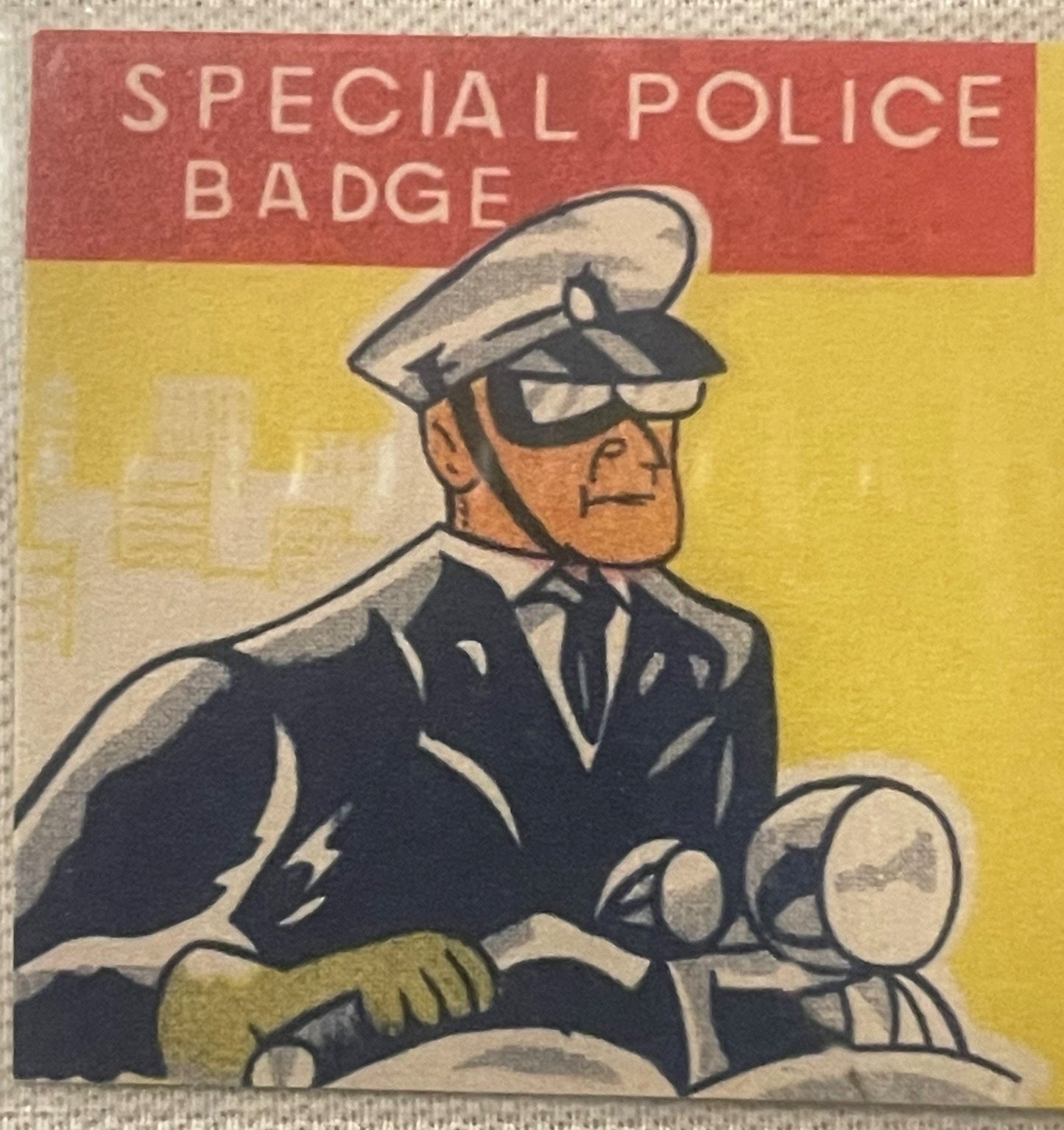
This is a New Old Stock Special Police Badge issued in the name of the Phoenix, Arizona Police Department — a tin litho pinback button roughly 1.5 inches across, mounted on its original illustrated cardboard card measuring roughly 4 by 2.25 inches. The card is printed in offset lithography, its artwork a bold, comic-strip-style motorcycle patrolman in cap and goggles rendered in navy, gray, yellow, and flesh tones against a golden-yellow field, with a red banner proclaiming "SPECIAL POLICE BADGE" across the top. The button itself is a domed tin lithograph in deep navy-black, ringed in bold yellow, centered on a stylized phoenix bird spreading wings of layered red and orange, with "POLICE" arcing above in red and "PHOENIX" and "ARIZONA" lettered in gold below. The card is marked "JAPAN" in its lower corner, identifying it as an import piece of the mid-century American toy trade — dating it, by that mark alone, to the years after April 1952, since it carries no "Occupied Japan" designation. This example is NOS: it never left the card to be pinned to a cowboy shirt or tucked into a dress-up box. It survived exactly as it left the five-and-dime rack, card and badge together, a small survivor of a retail moment that has otherwise almost entirely vanished.


🎏 A Firebird Made in Japan — The Postwar Toy Trade Behind This Badge

To understand this badge, you have to understand the extraordinary industry that produced it. In the years following the end of the Allied occupation of Japan in 1952, Japanese toy manufacturers — freed from the "Occupied Japan" mark that had labeled their exports for the previous seven years — became the engine of a genuinely astonishing postwar toy boom. For roughly a decade, from the early 1950s until tin began giving way to plastic around 1962, Japan was the world's dominant toymaker, producing by some measures the overwhelming majority of the world's tin and battery-operated novelties. American children's play — cowboys, spacemen, G-men, and beat cops alike — was, quite literally, made in Japan.

These badges were sold by the millions through the great five-and-dime chains that anchored small-town and city Main Streets alike: F.W. Woolworth, W.T. Grant, Ben Franklin, J.J. Newberry, G.C. Murphy, McCrory's. A tin litho badge like this one typically retailed for somewhere between about $1.95 and $3.95 — real money to a child in the 1950s, but well within reach of birthday cash or a summer's worth of saved allowance. Dealers who have handled comparable "Special Police" badges describe them arriving in old warehouse stock still nested in rice-paper-lined master cases, a small manufacturing detail that speaks to just how far these little tin treasures traveled to reach a spinner rack in Phoenix, Peoria, or points beyond.

What makes this particular badge distinctive within that flood of tin novelties is its city-specific branding. Japanese toy exporters of the era were savvy about customizing generic designs — police badges, toy cars, ray guns — with regional and civic identities to widen their appeal across the American market, the same way toy cars of the period were lithographed with popular characters to catch a child's eye on a store shelf. A Phoenix-branded badge, carrying the actual insignia language of a real American police department, was one small piece of that vast, decentralized production run — made for the dime-store trade, not for any police supply house, and carrying no confirmed maker's mark beyond that simple "JAPAN" stamp. No specific toy company can be named as its producer; the badge, like so many of its kind, was built to sell fast and cheap under no brand but the city's own.

🌵 Phoenix Rising — A City Named for Its Own Legend

The choice of a phoenix bird rising on the badge's face is no accident of design — it's the city's own founding legend, rendered right there in red and gold tin. Phoenix, Arizona takes its name from the mythological firebird that dies in flame and rises again from its own ashes, a name chosen by the area's earliest English-speaking settlers because their young town was quite literally built atop the ruins of a vanished Hohokam civilization that had farmed the Salt River Valley centuries before. A city built on the bones of one that came before it, reborn — the phoenix wasn't just a pretty emblem for a lithographer to fill space with. It was, and remains, the whole civic self-image of the place, and this little badge — however humble its dime-store origins — inherits that legend honestly.

Phoenix incorporated as a city on February 5, 1881, and its earliest law enforcement was handled by an elected city marshal — Henry Garfias, chosen by residents that same year, before the department as such existed in any modern form. By the 1950s, the era this badge belongs to, the Phoenix Police Department had reorganized into a genuinely modern municipal force, structured into four divisions — Traffic, Detectives, Patrol, and Service — with officers working 44-hour weeks for roughly $288 a month. That's the real department whose insignia language this novelty badge borrows: a working, modernizing mid-century city police force, not a fictional invention, growing right alongside a city that was itself rocketing upward. Metro Phoenix in these postwar years was transforming from a farming and citrus town into one of the great manufacturing and population booms of the American Sunbelt — the very kind of civic growth that made a city's name worth stamping onto a child's toy badge in the first place.

👮 The Badge on the Card — When Phoenix Police Made Real History

The genuine Phoenix Police Department this badge honors would go on, just a few years past this toy's own era, to write itself into American constitutional law. On March 13, 1963, Phoenix officers Carroll Cooley and Wilfred Young arrested a man named Ernesto Miranda. The written confession the department obtained from him — given without his having been told he had the right to remain silent or the right to an attorney — became the basis of the U.S. Supreme Court's landmark 1966 ruling in Miranda v. Arizona, the case that gave the country the now-famous "Miranda Rights" recited by every police officer on every arrest since. It's a striking thing to hold a child's dime-store badge stamped with the same department's name and realize that, within a few short years of its manufacture, that real department would reshape how policing itself is practiced across the entire country. Today the Phoenix Police Museum, housed in the Historical Old Phoenix City Hall, keeps that institutional memory alive, tracing the department's story back across more than 140 years to Marshal Garfias — real badges, real uniforms, real case files, the serious counterpart to this playful tin tribute.

It's worth being honest, in the collector's spirit, about what this badge is and isn't. No record confirms that the Phoenix Police Department ever licensed, endorsed, or issued this badge — it was an unofficial novelty, born of the same impulse that put a sheriff's star or a G-man shield on the same spinner racks, borrowing a real city's civic pride for a child's imaginative play rather than any formal partnership. That unofficial, borrowed-glory quality is part of the charm of the whole genre; it's exactly why so many American cities and states have their own version of this same badge floating around collector circles today, each one a tiny lithographed love letter to a hometown police force, made an ocean away by hands that likely never set foot in Arizona.

🕰️ From Spinner Rack to Display Case — Why It Still Matters

Tin lithography of this quality and detail belongs to a manufacturing moment that simply doesn't exist anymore. Once plastic toys took over the American market in the early 1960s, the fine, hand-finished color separations and domed convex printing seen on a badge like this one largely disappeared from children's novelties. What's left behind is a genuine artifact of mid-century American design sensibility — bold primary color, confident illustration, a phoenix rendered with real linework and shading rather than a simple stamped outline — produced during the very years that Japan's export toy trade briefly became the largest and most inventive toymaking industry on earth. Collectors today prize city- and state-named examples of these badges precisely because they capture two vanished worlds at once: the golden age of the American five-and-dime, and the golden age of Japanese tin toy export craftsmanship, meeting on a single small piece of pressed metal.


🖼️ Display Ideas

  • 🌟 Pin it, card and all, inside a small shadow box alongside other mid-century tin-litho novelties for a dime-store nostalgia grouping.
  • 🏜️ Pair it with Arizona or Southwestern collectibles for a themed display honoring the city's own rise-from-the-ashes legend.
  • 👮 Group it with other vintage "Special Police" or "Junior G-Man" badges from different cities and states to build a growing collection of mid-century civic novelties.
  • 📌 Frame the card face-out on its own, letting the illustrated motorcycle officer artwork stand as a small piece of vintage graphic art.
  • 🎄 Tuck it into a nostalgic gift for a Phoenix native, a retired officer, or a collector of Arizona memorabilia — a small, surprising piece of hometown history.
  • 🗄️ Store it in an archival sleeve inside a collector's binder of carded tin toys, kept exactly as it survived, undisturbed on its original backing.

🎁 Who Collects These

This little badge sits at the crossroads of several serious collecting worlds, which is part of why examples like it move quickly once discovered. Tin toy and tin litho collectors chase these for the craftsmanship and the vanished manufacturing era they represent. Police and law enforcement memorabilia collectors — including working and retired officers themselves — seek out badges bearing real department names and insignia, even novelty ones, as affectionate curiosities alongside their genuine collections. Arizona and Phoenix local history collectors want anything carrying the city's name and its phoenix emblem, especially pieces this old and this well preserved. And a wide field of general vintage advertising and five-and-dime ephemera collectors simply love the carded, never-played-with survival of a piece like this — NOS examples still on their original illustrated backing are a genuinely different, more complete collectible than a loose button alone, and they're the ones that tend to anchor a real collection rather than just fill a drawer.


❓ FAQ

Is this an official Phoenix Police Department badge?
No — this is a children's novelty toy badge from the mid-20th-century dime-store trade, made in Japan and lithographed with the Phoenix Police insignia language for the toy market. No record confirms any formal licensing or connection between this novelty and the actual department.

What does the "JAPAN" mark tell us about its age?
Because it reads simply "JAPAN" rather than "Made in Occupied Japan," it was produced after the Allied occupation of Japan ended in April 1952, placing it generally within the 1950s-to-early-1960s heyday of Japanese tin litho toy export before plastic largely replaced tin in this category.

What does "NOS" mean here?
New Old Stock — this badge remained on its original illustrated card, never removed for play or wear, surviving intact from its original retail distribution rather than being separated and reunited later.

Why is there a phoenix bird on the badge instead of a standard star or shield?
The mythological firebird is the city of Phoenix's own namesake and civic legend, and the badge's designers built the phoenix directly into the department's stylized emblem — a nod to the city's identity as much as its police force.

Who made this badge?
No specific manufacturer or Japanese toy company can be confirmed from available records — like most badges of this type, it carries only the country-of-origin mark, a common trait among unbranded mid-century Japanese export novelties sold through American five-and-dime chains.

Was this sold as a souvenir or a toy?
It falls squarely into the "cops-and-robbers" toy badge genre sold through dime stores and variety chains for imaginative play, rather than being marketed specifically as a tourist souvenir, though its city branding would have appealed to both local children and visitors alike.

👮 Junior Deputies, Safety Patrols, and the World This Badge Lived In

There is a real history standing behind every mid-century toy badge. This was the era of the junior deputy and the school safety patrol: sheriffs' offices swore children in as honorary junior deputies at fairs and school assemblies, safety patrol programs — running strong since the 1920s — pinned badges on generations of schoolchildren, and a visit from an officer with badges to hand out was a fixture of American civic childhood. A Phoenix Special Police badge belonged to that world. When a child pinned one on, the game borrowed its seriousness from programs that were entirely real — and that is part of the history a survivor like this one still carries.

Shipping

🚚 Shipping & Handling

  • Shipping costs and timing are calculated at checkout.
  • Items curated and shipped directly by me include U.S. shipping at no additional cost, professionally packed to ensure safe arrival of your artifact.

Items from Vetted Pro Collectors
Shipping for items offered by vetted Pro Collectors is determined at checkout. All Pro Collector listings are reviewed to ensure fair, reasonable shipping practices.

For full details, please refer to our Shipping Policy.

Returns & Exchange

Product Page Return Policy

  • 60-Day Returns – Items must be in original condition.
  • Refunds – Issued after inspection (excluding shipping costs).
  • Return Shipping – Customer is responsible unless item is damaged or incorrect.
  • Damaged/Incorrect Items – Contact us within 48 hours for a replacement or refund.
  • Easy Returns – Email [email protected] or call 802-356-9872 to initiate a return.

For full details, visit our Refund Policy.

View full details