Skip to product information
1 of 3

Vintage and Antique Gifts

Vintage 1950s Sheridan Wyoming Chief Special Police 🦅 Tin Litho Badge Original NOS Card Japan

Regular price 29.00 USD
Regular price Sale price 29.00 USD
Sale Sold out
Shipping calculated at checkout.

Description

What Do You Do When You Find a Piece of Postwar America Still Sealed in Its Original Card? 🦅

You slow down. You hold it carefully. And you recognize that what you're looking at was never supposed to survive this long — not in this condition, not on its original card, not with every color still blazing the way it blazed the first morning it sat under the glass of a five-and-dime counter somewhere in Wyoming. That's the quiet miracle of New Old Stock. Nobody planned for it. Nobody saved it on purpose. It simply endured, the way the best things do — by being small enough to be overlooked, tucked away in a drawer or a stockroom, waiting for exactly the right person to find it decades later.

This is that piece. A mid-century Sheridan Police Chief Special Police tin lithography badge, still mounted on its original illustrated display card, marked JAPAN on the card back — and representing one of the most collectible categories in all of American toy and Americana nostalgia: the classic dime-store novelty police badge of the postwar years. New Old Stock condition. The badge measures approximately 1.5 inches in diameter. The card measures approximately 4 × 2.25 inches. The printing is full-color lithography — a process that demanded real craft, real tooling, and real care — executed in red, yellow, blue, silver, gold, black, and orange. Every color is still present and speaking clearly.


🔍 What You Are Actually Looking At

Let's start with the badge itself, because it rewards a close look. The face is a domed tin lithography disc, and the design is dense with period symbolism. The background field burns in a deep, saturated red — the kind of red that commands attention at a distance, exactly as a badge should. Radiating outward from the center is a starburst medallion, its silvery points fanning in every direction with an almost ceremonial formality. It gives the piece a visual weight and authority that belies its size.

Nested inside that starburst is a bold yellow ring — that clean mid-century yellow that shows up everywhere in the design vocabulary of the 1950s, on patrol cars, on highway signs, on the most confident graphic design of the era. The ring carries the words SHERIDAN across the top and POLICE across the bottom in confident black lettering. Above the yellow ring, arching like a crown, the word CHIEF. Inside the yellow band, a dark navy inner circle carries the words STATE OF WYOMING in clean capitals, encircling what reads clearly as a small rendition of the Wyoming state seal — rendered with remarkable fidelity at this scale, the kind of detail that separates the better Japanese export lithography work from lesser toy production of the same period.

And then, crowning the whole composition, perched exactly where a real police chief's badge would carry its eagle topper: a spread-winged American eagle in warm gold and brown tones, wings fully extended, head turned with authority, every primary feather suggested with the kind of graphic precision that makes you stop and look twice. The eagle sits on a small pedestal connector that gives the overall silhouette the precise formal shape of an actual chief's badge. This was not careless design. Someone — a craftsman in a lithography studio in occupied or early postwar Japan — drew this eagle carefully. It shows.

The backing construction combines a tin lithography front face with a thick plastic back — a characteristic feature of the better-quality Japanese export novelty badge production of the mid-century period, distinguishing these pieces from the flimsier pressed-tin-only examples. The pin mechanism is intact and original to the piece.


🟡 The Card — An Illustration Worth Framing on Its Own

The display card is, in many ways, the heart of this piece. Without it, you have a charming toy badge. With it, you have a complete artifact — a window into exactly how this object was presented, sold, and experienced by a child standing at a five-and-dime counter in the 1950s.

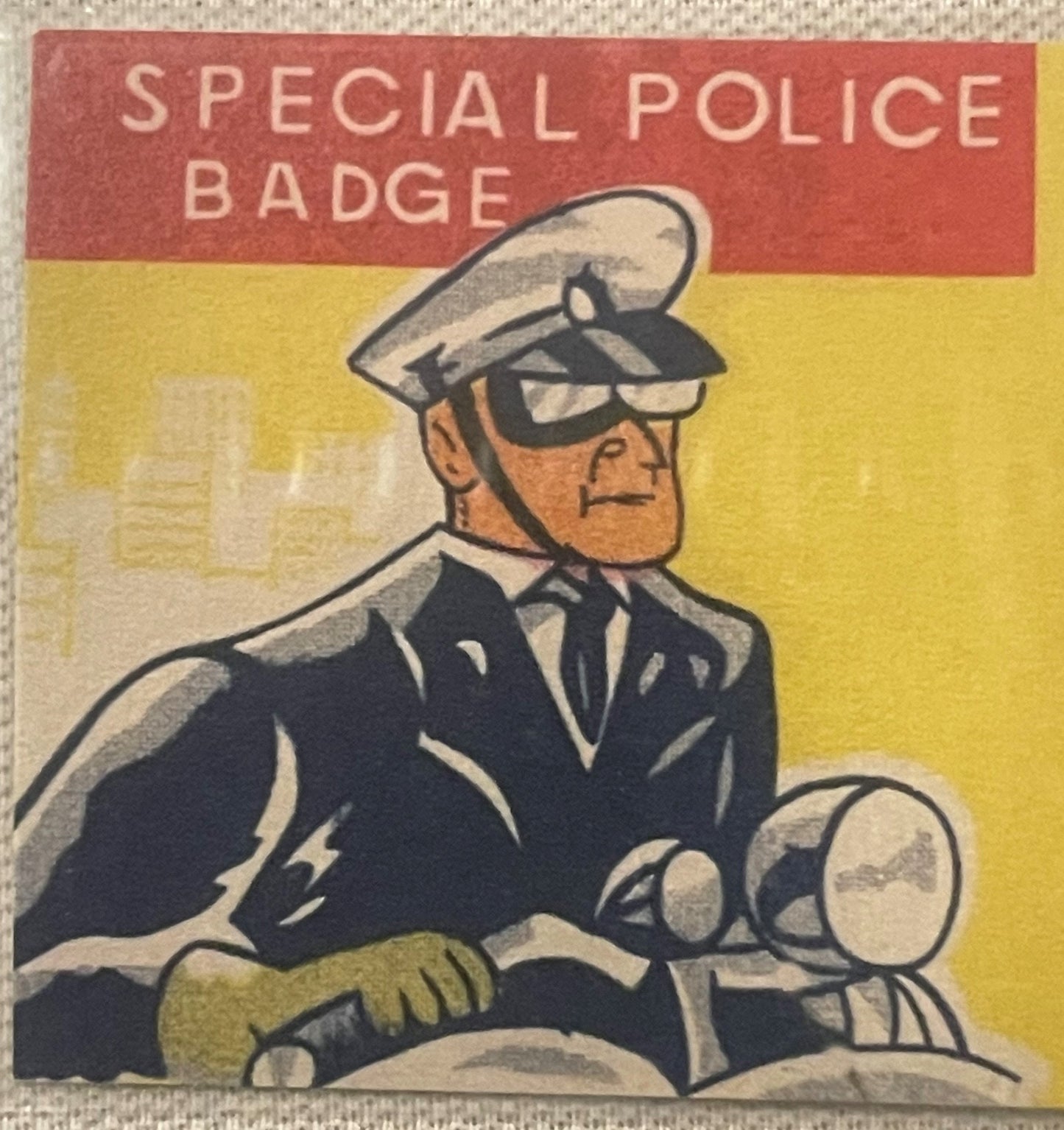
The card's ground is that warm, optimistic mid-century yellow. Across the top, a bold red banner declares SPECIAL POLICE BADGE in clean white letters. Simple. Direct. Irresistible to any ten-year-old with a nickel or a dime burning in a pocket.

To the left of the mounted badge, the card carries a wonderful period illustration: a masked figure in a dark uniform and white officer's cap, seated at the handlebars of a motorcycle or patrol vehicle, gauntleted hands gripping forward, jaw set with absolute purpose. The figure wears a black domino mask — not a criminal's disguise, but the mask of the hero, the kind worn by the Saturday-serial lawmen and radio drama defenders of justice who populated every corner of mid-century American popular culture. The Lone Ranger. The Green Hornet. The masked rider of justice who always arrived in time.

This illustration is not incidental. It was deliberately chosen to connect this badge to the deepest imaginative current of its moment — the idea that a badge conferred not just authority but identity, transformation, heroism. Pin this on and you became someone. The card understood that perfectly. It sold not a toy but a self.

In the lower right corner of the card, in small clean type: JAPAN. That single word is a dating clue and a historical document in itself.


🏭 The Industry Behind the Badge — Japan, Tin Litho, and the Great Postwar Dime-Store Era

To fully understand what this piece is and why it matters, you have to go back to 1945 — and to one of the most dramatic industrial revivals in modern economic history.

When World War II ended, Japan's manufacturing infrastructure was devastated. The Allied occupation, which ran from 1945 through April 1952, brought with it both reconstruction aid and a deliberate economic strategy: rebuild Japanese manufacturing capacity through export. American occupying authorities actively encouraged Japanese factories to produce goods for the American consumer market — inexpensive, cheerful, decorative, and playful goods that would earn foreign exchange, rebuild industrial skills, and give American consumers something to buy.

Tin lithography was a natural fit. Japan had a prewar tradition of tin toy manufacture that was already sophisticated. The tooling was adaptable. The materials were available. And the American market in the late 1940s and throughout the 1950s had an apparently bottomless appetite for exactly the kind of colorful, carded novelty items that Japanese factories could produce: toy badges, play sets, party favors, carnival prizes, dime-store counter items sold for a nickel, a dime, a quarter.

Items made during the occupation itself carry the mark MADE IN OCCUPIED JAPAN — a designation that was mandatory under occupation regulations and that now makes those pieces among the most eagerly sought by collectors. When the occupation ended in 1952, the designation shifted to simply MADE IN JAPAN or, as on this card, simply JAPAN. That transition in marking language is one of the most reliable dating tools available to collectors of mid-century Japanese export novelties, and it places this piece clearly in the post-occupation mid-century period — the heart of the dime-store golden age.

These "Special Police," "Deputy Sheriff," "Private Detective," and "Texas Ranger" tin badges were produced by the thousands, shipped in bulk cartons to American importers and wholesalers, and distributed to five-and-dime chains, variety stores, costume counters, and carnival suppliers across the country. They were never meant to be permanent. They were meant to be played with, lost under furniture, forgotten in toy boxes, worn once on Halloween and dropped into a kitchen drawer. The ones that survive today — especially on their original cards, especially as New Old Stock — are survivors of a very low-odds game. Most didn't make it.


🏔️ Sheridan, Wyoming — The Town on the Badge

Sheridan, Wyoming sits in the northeastern corner of the state, tucked against the eastern face of the Bighorn Mountains in some of the most dramatically beautiful high-plains-meets-mountain country in the American West. It is a real town with a real history — a genuine cattle and ranching community that grew up around the railhead, that hosted Theodore Roosevelt on his hunting expeditions through the region, and that carries an authentic Western identity that no amount of time or tourism has managed to dilute.

The Sheridan Police Department is a real agency, and a proud one — serving a community with deep roots in Wyoming civic life. Its presence on this badge is a marker of local identity, the way that so many of these mid-century novelty badges were customized or marketed to reflect specific towns and departments rather than generic anonymous "Anytown, USA" designations. The choice to put SHERIDAN and STATE OF WYOMING on this badge — rather than a generic "Metro" or "City Police" — gives the piece a geographic specificity that makes it particularly meaningful to Wyoming collectors, to Sheridan locals, and to anyone drawn to the authentic regional character of the American West.

Lore passed down among collectors of Western Americana novelties holds that certain dime-store badge designs were customized at the request of regional distributors or local variety-store buyers — a wholesaler in Billings or Cheyenne placing an order and specifying that a run carry local department designations rather than the standard generic text. Whether that is precisely what happened with this Sheridan badge cannot be confirmed from the piece alone, but the specificity of the geographic text — CHIEF / SHERIDAN / POLICE / STATE OF WYOMING — is striking, and collectors who have handled wide varieties of these mid-century novelty badges note that state-seal and named-city versions are considerably less common than the plain generic examples.

Local legend among Wyoming nostalgia collectors holds that small batches of these regionally-marked badge cards occasionally turned up in estate sales from old hardware stores and variety shops throughout northern Wyoming — the kind of establishment that ordered a few dozen on a seasonal basis for the Halloween and Christmas trade and sometimes simply never sold through the last ones, leaving them in a stockroom drawer for decades. That provenance story, passed down rather than documented, is exactly the kind of origin tale that gives a piece like this its resonance. It arrived here by surviving, which is its own form of credential.


🦅 The Eagle and the Seal — Symbolism Packed Into 1.5 Inches

There is something genuinely interesting happening in the design of this badge when you think about what was packed into a disc barely larger than a silver dollar. The Wyoming state seal rendered at miniature scale. The eagle — America's national bird and the traditional topper of a police chief's badge — executed with real graphic care. The starburst, which in American civic iconography carries associations stretching back through marshal's badges and sheriff's stars to the very roots of Western law enforcement symbolism.

The lithographer who designed this — working in a Japanese studio, probably from reference materials supplied by an American importer — was working within a specific and well-understood visual grammar. The spread eagle says authority. The starburst says law. The state seal says legitimacy. The word CHIEF says command. Every element reinforces every other element, and the result is a tiny object that reads, at a glance, with complete clarity: this is a badge of power. That it was a child's toy badge makes the graphic achievement no less real.

The color palette — that deep red field, the yellow band, the silver starburst, the gold and brown eagle — is pure mid-century American civic design, the same palette you'd find on real police badges of the era, on city seals, on municipal vehicles. Whoever specified these colors for the lithography run knew exactly what they were doing.


🖼️ Display Ideas

  • 🗺️ Western Americana shadow box — pair it with other Wyoming or Northern Plains ephemera: a vintage Bighorn Mountains postcard, a small stock certificate from a Wyoming ranching operation, a period road map of the state, all matted in a deep-set shadow box frame for a compelling regional display.
  • 🚔 Law enforcement history collection — displayed alongside authentic mid-century police badges, patches, and department photographs, this piece illustrates the visual language of the era and how that language translated into popular culture for children.
  • 🎪 Five-and-dime nostalgia grouping — curate a display of original-card dime-store novelties from the postwar years: tin badges, paper party favors, carded prize items, all presented on a vintage wooden shelf or in a small display case that evokes the feeling of a mid-century variety-store counter.
  • 🏔️ Sheridan or Wyoming pride display — for a local collector, framed on its original card alongside a vintage photograph of downtown Sheridan, this becomes a genuine piece of community identity — the kind of hyperlocal artifact that no amount of searching will easily duplicate.
  • 🦅 Tin lithography art study — for collectors focused on the graphic arts and printing history of the postwar Japanese export industry, this badge represents an excellent and highly displayable example of the craft at its most confident and colorful.
  • 🎃 Halloween and Americana tableau — the masked motorcycle officer on the card is pure October magic; displayed in a vintage Halloween or costume-era grouping, this piece anchors the mood of mid-century dress-up culture perfectly.

🎁 Who Collects These

The collectors who find their way to a piece like this are a wonderfully varied group, and what they share is a quality of attention — a willingness to look closely at small things and recognize the history compressed inside them.

Wyoming and Sheridan locals collect these with a particular passion, because a piece bearing your hometown's name and your state's seal is a form of local identity that no mass-market reproduction can replicate. For a Sheridan native, this badge is a piece of home.

Toy and dime-store nostalgia collectors pursue original-card examples of mid-century novelty badges with real dedication. The category is well-established, the reference materials exist, and the best examples — especially NOS on original cards — are genuinely scarce. A badge still on its illustrated card is a fundamentally different collectible from a loose badge, and serious collectors of this category know it.

Japanese export tin lithography collectors appreciate this piece for its printing quality, its intact original card, and its place in the broader story of postwar Japanese manufacturing — one of the most consequential industrial stories of the twentieth century, told here in miniature.

Law enforcement memorabilia collectors are drawn to the visual language of the badge itself — the eagle, the starburst, the chief designation, the state seal — and to the way these pieces reflect the popular imagination surrounding American policing in its mid-century golden age.

Western Americana collectors recognize Sheridan as a genuine place with a genuine history, and they understand that a piece of printed ephemera bearing a specific Western town's name is a primary document of regional identity, as real in its way as a newspaper or a postcard.

Pop culture and Saturday-serial enthusiasts are captivated by that masked motorcycle figure on the card — an image that sits squarely in the visual tradition of the Lone Ranger, the Green Hornet, and every other masked hero of mid-century American popular entertainment.


❓ Frequently Asked Questions

Is this a genuine law enforcement badge from the Sheridan, Wyoming Police Department?

This is a mid-century novelty badge — a piece of dime-store Americana produced in Japan during the postwar period and sold through variety stores and five-and-dime chains as a children's costume and play accessory. It is not a sworn officer's service badge. Real police chief's badges from mid-century American departments were manufactured by domestic badge makers — firms like Blackinton, Sun Badge, or Ed Jones — in solid metals, never marked "JAPAN" on a retail display card. What this piece is, however, is something many collectors find equally fascinating: a primary artifact of mid-century American popular culture, bearing specific geographic text — CHIEF / SHERIDAN / POLICE / STATE OF WYOMING — that gives it a documentary character and a regional specificity far beyond the generic "Special Police" examples. For the purposes of collecting, display, and historical interest, it stands entirely on its own considerable merits.

What does the "JAPAN" marking on the card tell us about when this was made?

Quite a lot, actually. Items produced in Japan during the Allied occupation of 1945–1952 were required to carry the designation "MADE IN OCCUPIED JAPAN" — and those pieces are now among the most actively sought by collectors. Once the occupation ended in April 1952, that designation was dropped, and Japanese exports carried simply "MADE IN JAPAN" or, as on this card, simply "JAPAN." That shift in marking language is one of the most reliable dating tools available to collectors of this category, placing plain "JAPAN"-marked examples firmly in the post-occupation mid-century period. For a piece like this, that means the heart of the dime-store golden age — the era of five-cent counters, Halloween costume sets, and Saturday-morning adventure culture.

What makes this NOS — New Old Stock — and why does that matter?

New Old Stock means this piece was never removed from its original retail card for use or display. It sat in original commercial packaging from the time it left the factory — or the importer's warehouse, or the storeroom of a variety shop — until it entered a collector's hands. For a mid-century novelty badge, that is an extraordinary survival. These items were cheap, cheerful, and fully intended to be used up — pinned to a Halloween costume, played with in the backyard, lost in a toy box. The ones that reached the present day still on their original illustrated cards, still in unplayed condition, did so entirely by accident, through the particular alchemy of a forgotten storeroom drawer and the passage of time. NOS condition transforms a toy into a document — complete, unaltered, exactly as it was offered for sale in its original moment. That is what you are acquiring here.

Is the Wyoming state seal actually depicted on the badge, and how accurate is it?

Yes — the inner circle of the badge carries what reads clearly as a small rendition of the Wyoming state seal, surrounded by the text STATE OF WYOMING. At the scale of a 1.5-inch badge, fine lithography detail is working at its absolute limits, and the Japanese craftsmen who designed this piece appear to have worked from genuine reference materials. The Wyoming state seal features a draped female figure representing the state, flanked by pillars bearing the words "Livestock" and "Grain," with an eagle above — elements that are suggested, at this miniature scale, in the central medallion of the badge. The fidelity is a testament to the care taken in the design of what was, commercially speaking, an inexpensive novelty item. That care is part of what makes the better examples of mid-century Japanese export lithography genuinely collectible today.

Why does the card show a masked policeman? What's the cultural reference?

The masked motorcycle officer on the card illustration is a deliberate visual reference to the heroic archetypes that dominated mid-century American popular culture — radio serials, early television, Saturday-matinee films, and comic books all featured masked or disguised heroes who operated on the side of law and justice. The Lone Ranger was the most famous of these, but the Green Hornet, Zorro, and a dozen lesser-known characters shared the same essential iconography: the mask, the dark uniform, the vehicle, the jaw set with purpose. By placing this figure on a badge card, the designers were connecting the act of pinning on the badge to that entire imaginative tradition. You weren't just buying a toy. You were buying a role, a transformation, an identity. The graphic design of this card understood child psychology with real sophistication, and the illustration is a genuine piece of mid-century commercial art worth appreciating on its own terms.

How scarce are Sheridan, Wyoming-specific examples compared to generic versions?

Among collectors of mid-century novelty police badges, the generic "Special Police" plain-text versions are the most commonly encountered — they were produced in the largest quantities and distributed most widely. Examples carrying specific city names, department designations, and state seals are considerably less frequently encountered, particularly for smaller Western cities like Sheridan. Collector lore in the Western Americana and dime-store novelty communities holds that regionally-marked badge runs were produced in smaller quantities, often at the request of regional distributors or local buyers, and that their geographic specificity makes them far more interesting as collecting targets than anonymous generic versions. Whether any given example with Sheridan markings was part of a small regional run or a wider distribution cannot be determined from the piece alone — but the specificity of CHIEF / SHERIDAN / POLICE / STATE OF WYOMING is unambiguous, and it is exactly that specificity that drives collector interest.

What is the best way to preserve and store this piece?

The combination of an original illustrated card and a tin lithography badge makes thoughtful storage worth considering. The card is period paper-stock printing, and the badge is tin with a lithographed face — both are best kept away from prolonged direct light exposure, which can affect the vibrancy of period lithography inks over time. A rigid clear archival sleeve or a UV-protective display frame allows the piece to be fully enjoyed while providing appropriate protection. For display, a shadow box or a small archival frame allows the full card art to be appreciated — the illustrated motorcycle officer, the red SPECIAL POLICE BADGE banner, and the mounted badge itself all contribute to the visual impact of the complete piece, and displaying it as a unit rather than removing the badge from the card preserves both its historical integrity and its collector value.

⭐ When Kids Really Did Get Badges from the Law

The mid-century American childhood this badge comes from was full of real badges given by real officers. Junior deputy programs let sheriffs swear in schoolkids as honorary deputies; school safety patrol programs, organized since the 1920s, put badges and belts on millions of children; police departments handed out badges at parades, fairs, and classroom visits as a matter of civic routine. A Sheridan, Wyoming Chief Special Police badge was the dime-store cousin of all that — the badge a kid could buy with pocket change. That documented world of junior programs is the backdrop this little survivor belongs to.

Shipping

🚚 Shipping & Handling

  • Shipping costs and timing are calculated at checkout.
  • Items curated and shipped directly by me include U.S. shipping at no additional cost, professionally packed to ensure safe arrival of your artifact.

Items from Vetted Pro Collectors
Shipping for items offered by vetted Pro Collectors is determined at checkout. All Pro Collector listings are reviewed to ensure fair, reasonable shipping practices.

For full details, please refer to our Shipping Policy.

Returns & Exchange

Product Page Return Policy

  • 60-Day Returns – Items must be in original condition.
  • Refunds – Issued after inspection (excluding shipping costs).
  • Return Shipping – Customer is responsible unless item is damaged or incorrect.
  • Damaged/Incorrect Items – Contact us within 48 hours for a replacement or refund.
  • Easy Returns – Email [email protected] or call 802-356-9872 to initiate a return.

For full details, visit our Refund Policy.

View full details