Skip to product information
1 of 3

Vintage and Antique Gifts

Vintage Tin Litho Special Police Toy Badge 🚔 Department of Defense DOD Eagle Seal Pinback Made in Japan 1960s-1970s

Vintage Tin Litho Special Police Toy Badge 🚔 Department of Defense DOD Eagle Seal Pinback Made in Japan 1960s-1970s

Regular price 18.00 USD
Regular price Sale price 18.00 USD
Sale Sold out
Shipping calculated at checkout.
Quantity

What Does a 1.5-Inch Tin Badge Have to Do With the Rebirth of a Nation? 🚔

There is something about holding one of these that stops you cold. The weight of it in your palm, that satisfying tin-litho gloss, the bold shield face staring back at you — Police, Department of Defense, United States of America — and the quiet knowledge that this little piece made the long crossing from Japan to America more than seventy years ago as part of one of the most unusual and undersung chapters in modern industrial history. Most people who pick one up see a toy. Collectors see a time capsule. And once you understand the story behind it, you'll never look at a dime-store badge the same way again.

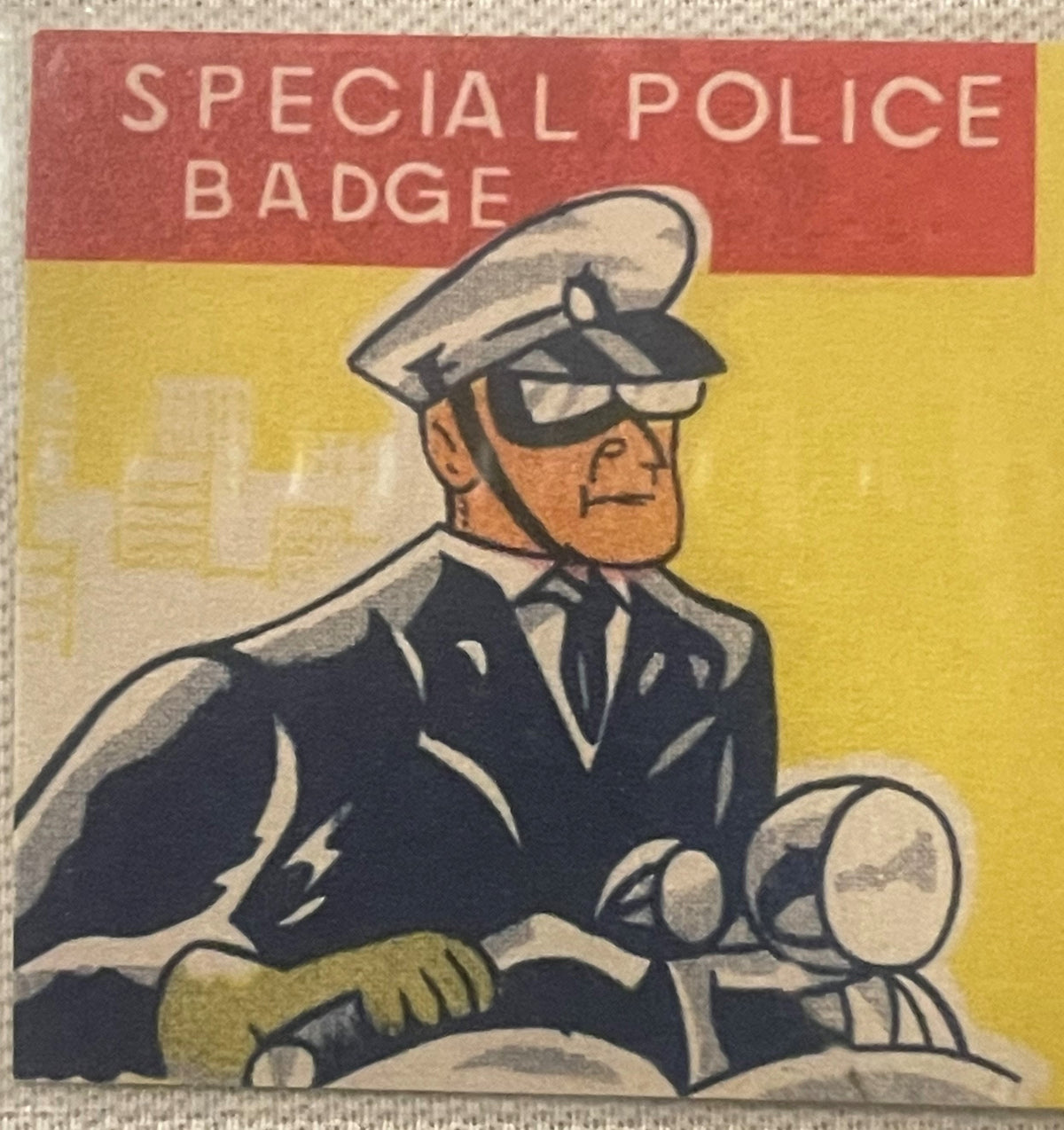
This is a piece that rewards the person who slows down. The shield catches the light a certain way. The eagle seal at its center — wings spread wide, laurel branches curving below, a starburst radiating above the bald eagle's proud head — is rendered with the kind of confident, unself-conscious draftsmanship that belongs to an era when craftsmen took even the smallest novelty item seriously. The red border pops against black and white with a graphic boldness that feels more like mid-century poster art than children's merchandise. And mounted on its original yellow-and-red display card — with that lean, masked motorcycle officer looking sideways into the distance like he owns every road between here and the horizon — the whole composition is just right in that way only original mid-century design can be.


🔍 What Exactly Is This Piece?

What you are looking at is a vintage tin lithograph "Special Police" novelty badge, mid-century in origin, manufactured in Japan for the American dime-store and five-and-ten market and retailed in the postwar boom years when Japanese-made novelties were flooding American variety stores with a kind of joyful, colorful energy the market had never quite seen before. The badge itself is a round pinback approximately 1.5 inches in diameter, set within a vivid red border that frames a shield-shaped lithographed face rendered in crisp black and white. Across the top of the shield, "POLICE" arches boldly in heavy block lettering. Beneath it, "Department of Defense" curves along the upper interior arc, and "United States of America" runs along the lower. At the center sits the American eagle seal — authoritative, heraldic, unmistakably American in every line — pressed and printed by hands in a Japanese workshop and destined for the chest pocket of a child in Akron or Albuquerque or Atlanta.

The badge arrives on its original display card, measuring approximately 4 x 2.25 inches, printed in yellow and red with an illustrated motorcycle officer at the wheel — helmeted, masked, jaw set — and the header text "SPECIAL POLICE BADGE" in clean white lettering on a red ground. The card back is marked simply JAPAN, the only clue to its origins. This is New Old Stock (NOS) — meaning it has come to you exactly as it left the era that made it, still on its original card, a remarkable survival for an item that was never meant to be preserved, only played with. That it exists in this form is its own small miracle of American collecting culture.


🌏 The Occupation, the Order, and the Industry That Built This Badge

To understand what you're holding, you have to go back to a specific moment in postwar history — one that changed the shape of American toy store shelves for a generation and whose ripple effects collectors are still sorting through today.

In 1947, General Douglas MacArthur — then Supreme Commander of Allied Powers, overseeing the reconstruction of a devastated Japan — quietly authorized the resumption of Japan's tinplate manufacturing industry. The policy was deliberate and strategically pragmatic: assign Japan's recovering factory floor the kind of high-labor, low-capital, small-item work that could put hundreds of thousands of workers back on production lines without posing any competitive threat to American heavy industry. Cheap novelties, toy badges, clicker toys, cap guns, small tin vehicles — these were the foot soldiers of the Japanese economic recovery program. By 1948 the first export crates were moving across the Pacific, and by the early 1950s the volume had grown into a genuine and thriving industry.

The formula was simple and it worked: make it look like it belongs on Main Street, print the country of origin only on the card, and let an American child's imagination do the rest. The "JAPAN" stamp was the only tell. Everything else — the Department of Defense eagle, the United States of America lettering, the motorcycle cop on the card art — was crafted to land on an American chest as naturally as if it had rolled off a press in Cincinnati.

The story the collector community has carried for decades is that this was MacArthur's plan working exactly as designed: a recovering Japan finding its footing by making the things America wanted to buy, at a price point America was happy to pay, through a distribution channel — the five-and-dime — that reached every Main Street in the country. By the early 1950s, Japan had become the world's dominant source for battery-operated toys and tin novelties alike. One figure cited among longtime toy historians: at the height of the boom, Japan accounted for ninety-five percent of the world's battery-operated toy production. The tin-litho novelty badge market was a humbler corner of the same extraordinary industrial story.

The great Japanese tin manufacturers active during this era — Marusan, Bandai, Yonezawa, Alps — were all producing and exporting through this window, and their names appear on the larger, more elaborate pieces. But workshop production of small novelty items like this badge was often spread across smaller, unbranded operations that left their products stamped with nothing more identifying than the country name. The mystery of exactly which workshop cut this shield, printed this eagle, and mounted it on this card is part of what makes the piece a genuine time capsule rather than just a trinket. No single factory name has ever been confirmed for this badge type. That ambiguity is itself historically accurate — and it is part of the honest character of this category of collecting.

What we do know is the cultural context that made this badge's text resonate so powerfully with its intended audience. The Department of Defense was a freshly minted institution in the early postwar years — the National Security Act of 1947 had reorganized the American military establishment, creating the DoD as a unified civilian authority over the armed services. The term was new, official-sounding, and carried the full weight of Cold War seriousness. For a Japanese novelty maker trying to put something on the chest of an American child that felt genuinely authoritative — not a made-up "Eagle County Sheriff" or a generic "Deputy" — reaching for the DoD eagle seal was a masterstroke of marketing instinct. It was the most powerful badge text available, and they used it without hesitation.


🎨 The Lithography — A Craft Worth Appreciating

The printing method here is tin lithography, and it is worth pausing on that for a moment, because it is a craft that reached genuine heights in mid-century Japan and is now essentially gone from commercial production. In tin lithography, the design is printed directly onto a flat sheet of tinplate using oil-based inks in successive color passes — each pass a separate plate, each color carefully registered — before the sheet is cut and formed into its final shape. The result, when done well, is a surface that is simultaneously graphic and dimensional, the colors locked into the metal itself rather than applied on top of it as a label or decal might be.

Look at the eagle seal on this badge with any magnification and you will see that quality of line: the feather detail in the spread wings, the precision of the shield on the eagle's chest, the clean white arcs of lettering against the deep black ground. This is not a casual piece of work. The craftsmen who laid out these plates and ran these presses were working in a tradition that stretched back to the late nineteenth century, and they brought genuine skill to even the smallest novelty items. The fact that this badge was destined for a child's Halloween costume or a Saturday afternoon of backyard play did not make it any less seriously made.

The display card is lithographed as well — the yellow ground, the red header bar, the confident illustration of the motorcycle officer with his masked face and his gloved hands on the handlebars. That officer illustration is one of the small pleasures of this piece. He has the look of a comic-panel character who knows he is the authority in every frame he appears in — a mid-century archetype of American law enforcement confidence, drawn by a Japanese illustrator working from American visual references and getting it exactly right.


🖼️ Display Ideas

  • 🚔 Frame it as a standalone graphic piece — the card and badge together, under glass with a simple black mat, read as pure mid-century Americana poster art on any gallery wall.
  • 🎖️ Group it with other tin-litho novelty badges — a "Deputy Sheriff" star, a "Junior G-Man" shield, a "Fire Chief" disc — for a dime-store law-and-order vignette that tells the whole story of the era at a glance.
  • 🏪 Display it in a vintage shadow box alongside other Japan-export tin novelties — cap guns, clicker frogs, small tin vehicles — to represent the postwar Japanese toy industry in its full colorful breadth.
  • 📚 Pair it with ephemera from the same era — a five-and-dime store receipt, a period Life Magazine page, a bubble gum card — for a curated vignette of 1950s American childhood commerce.
  • 🦅 Feature it in a DoD or military history collection as a fascinating piece of soft cultural history — the way official government iconography filtered down into popular culture and children's play in the early Cold War years.
  • 🎨 Pin it on an antique corkboard or display panel among other period pinback buttons and badges for a collector's wall installation that rewards close looking.

🎁 Who Collects These

This badge sits at the intersection of several passionate and serious collecting communities, which is part of what gives it such enduring appeal. Tin-litho toy collectors prize Japanese-export novelties of this era for the quality of their lithography, the graphic boldness of their design, and the increasingly difficult challenge of finding examples that have survived on their original cards — as this one has. Americana collectors are drawn to the patriotic iconography: the eagle, the DoD seal, the red-white-and-black color scheme that feels as American as a campaign button. Dime-store and five-and-ten enthusiasts — a growing community of collectors devoted to preserving the material culture of Woolworth's, Kresge's, and their regional counterparts — recognize this card-mounted badge as exactly the kind of small, affordable, joyful item that made those stores the beating heart of mid-century American retail life.

There is also a growing community of Cold War Americana collectors for whom the Department of Defense imagery carries specific historical resonance — a reminder of how deeply the new postwar national security apparatus had embedded itself in American popular culture within just a few years of its creation. And then there are the people who simply remember. Who held one of these as a child, or watched a sibling or a neighborhood kid wearing one, and for whom this badge is a direct line back to a very specific texture of American childhood that is now genuinely historical. Those collectors are perhaps the most reliable of all — because what they are buying is not just an object but a recovered piece of their own past.


❓ Frequently Asked Questions

Is this an officially issued law enforcement or government badge?

It is not, and I want to be completely straightforward about that because it matters. The "Department of Defense / United States of America" text on this badge is decorative and aspirational — it was printed by a Japanese novelty workshop to give the badge maximum official-looking authority for the children's play market. It was never issued, authorized, or connected to any actual U.S. government agency, military branch, or law enforcement body. What it is, genuinely and without any diminishment, is a remarkable piece of mid-century popular culture: a document of how the new American national security establishment had already, within just a few years of its founding, become powerful enough as an idea that a Japanese toy maker was stamping its name on novelty badges for export. That is a historically interesting thing in its own right, and it is the honest identity of this piece.

Why does it say "JAPAN" and not "Made in Japan"?

The specific marking convention on Japanese export goods shifted over time and was governed by U.S. customs regulations. Items marked simply "JAPAN" — without the word "Made" — are generally associated with the post-Occupation export period, typically after formal occupation ended in 1952, when Japanese manufacturers were producing freely for export under their own commercial relationships with American importers. The single-word "JAPAN" stamp is a reliable period indicator for collectors dating these items, and it places this badge squarely within the mid-century tin-litho export boom.

Who made this badge? Can you identify the manufacturer?

Honestly, and I say this as someone who has dug deeply into the research: no specific manufacturer has been documented for this badge type. The great named Japanese tin-toy firms of the era — Alps, Marusan, Bandai, Yonezawa, among others — were all active during this window, but small novelty badge production was frequently handled by smaller, unnamed workshop operations that left no identifying mark beyond the country stamp. The absence of a maker's name is not unusual for this category; it is, in fact, historically typical. If there is any additional marking on the card back that isn't visible in the photos, that would be the best place to look for an importer code or distributor mark — but even those are often absent on items from this production tier.

Is this piece NOS? What does that mean for a badge like this?

Yes, this is New Old Stock (NOS) — it has come to you still on its original display card, exactly as it would have been presented on a dime-store rack or display counter in the mid-century era. For a category of object that was designed to be removed from its card, pinned on a shirt, and played with until it was lost in the backyard or handed down to a younger sibling, a carded, unremoved example is a genuine rarity. The card itself is as much a part of the historical document as the badge: the motorcycle officer illustration, the header typography, the yellow-and-red color scheme — all of it together is the complete artifact. Separating them would diminish both.

How does this fit into a broader tin-litho or dime-store collection?

Exceptionally well, and in more than one direction. Within a tin-litho collection, it represents the small-novelty end of the Japanese export spectrum — a complement to the larger, more mechanically elaborate tin toys that command higher prices and more display space. Within a dime-store collection, it is an ideal example of the card-mounted novelty category: small, graphically bold, priced for impulse purchase, and now genuinely scarce in carded form. Collectors of law enforcement memorabilia find it a fascinating footnote — the way police and government iconography filtered into children's play culture. And for students of the postwar Japanese export industry, it is a primary document: modest in scale, honest in its origins, and entirely characteristic of the era that made it.

Are there companion pieces — other badges that were sold alongside this one?

Yes — and this is one of the appealing aspects of this collecting category. The lore among dime-store and tin-litho collectors holds that these "Special Police" badges were frequently sold alongside companion pieces, most commonly a diecut star-shaped "Deputy Sheriff" badge on a similar or identical card format. Some dealers and collectors have described finding them together in original master-case lots, still in their rice-paper packing material, suggesting they were produced and retailed as coordinated lines rather than isolated items. Finding a matched pair on original cards — "Special Police" and "Deputy Sheriff" together — is a recognized collecting goal in this category, and either piece is more contextually meaningful in the company of the other.

What is the significance of the eagle seal design specifically?

The central design element on this badge — the spread-winged eagle with heraldic shield, laurel branches, and radiating starburst — is derived from the seal of the Department of Defense, which was established when the DoD itself was created by the National Security Act of 1947. The DoD seal incorporates elements of the Great Seal of the United States with additional military symbolic elements, and its use here — on a Japanese-made novelty badge — is a vivid illustration of how quickly and thoroughly the new postwar American national security architecture had become part of the country's popular visual vocabulary. Within just a few years of the DoD's founding, its eagle was already appearing on toy badges being manufactured overseas for American children. That is a remarkable fact about mid-century American cultural influence, and it is baked right into the design of this 1.5-inch piece of tin.

🚔 The Real Junior Programs Behind Badges Like This

Dime-store tin badges did not live in a vacuum. Across mid-century America, real law enforcement agencies ran junior deputy and junior police programs: sheriffs swore in wide-eyed honorary junior deputies at county fairs and school assemblies, police departments sponsored school safety patrols — a movement that began in the 1920s and put belts and badges on millions of schoolchildren — and an officer handing a kid a badge at a parade or classroom visit was a familiar piece of civic life. A Department of Defense Special Police badge in a child's hand belonged to that same world, the era when a badge from a trusted grown-up could make a kid stand a little straighter. That is the history a carded survivor like this carries beyond its tin and ink.

Shipping

🚚 Shipping & Handling

  • Shipping costs and timing are calculated at checkout.
  • Items curated and shipped directly by me include U.S. shipping at no additional cost, professionally packed to ensure safe arrival of your artifact.

Items from Vetted Pro Collectors
Shipping for items offered by vetted Pro Collectors is determined at checkout. All Pro Collector listings are reviewed to ensure fair, reasonable shipping practices.

For full details, please refer to our Shipping Policy.

Returns & Exchange

Take your time — you've got a full six months. If a piece isn't right for you, send it back the way it reached you and we're good.

In the first 30 days your money goes straight back the way you paid. After that it's store credit, so you can put it toward something you'd rather have.

Return shipping we sort out between us, case by case. I don't make this difficult.

If something arrives damaged, or it isn't what I said it was, send me a photo within 48 hours and I'll make it right.

Email info@vintageantiquesgifts.com or call 802-356-9872 — that's me answering, not a call center.

The only things I can't take back are custom or special-order pieces and gift cards.

View full details