Skip to product information
1 of 10

Rugistan

Vintage Caucasian Hand-Knotted Wool Runner Azerbaijan Natural Dyes 1930s

Vintage Caucasian Hand-Knotted Wool Runner Azerbaijan Natural Dyes 1930s

Regular price 4,500.00 USD
Regular price 6,500.00 USD Sale price 4,500.00 USD
Sale Sold out
Shipping calculated at checkout.

Description

🏔️ The Long Runners of the Caucasus: A 1930s Azerbaijani Wool Runner with Natural Dyes

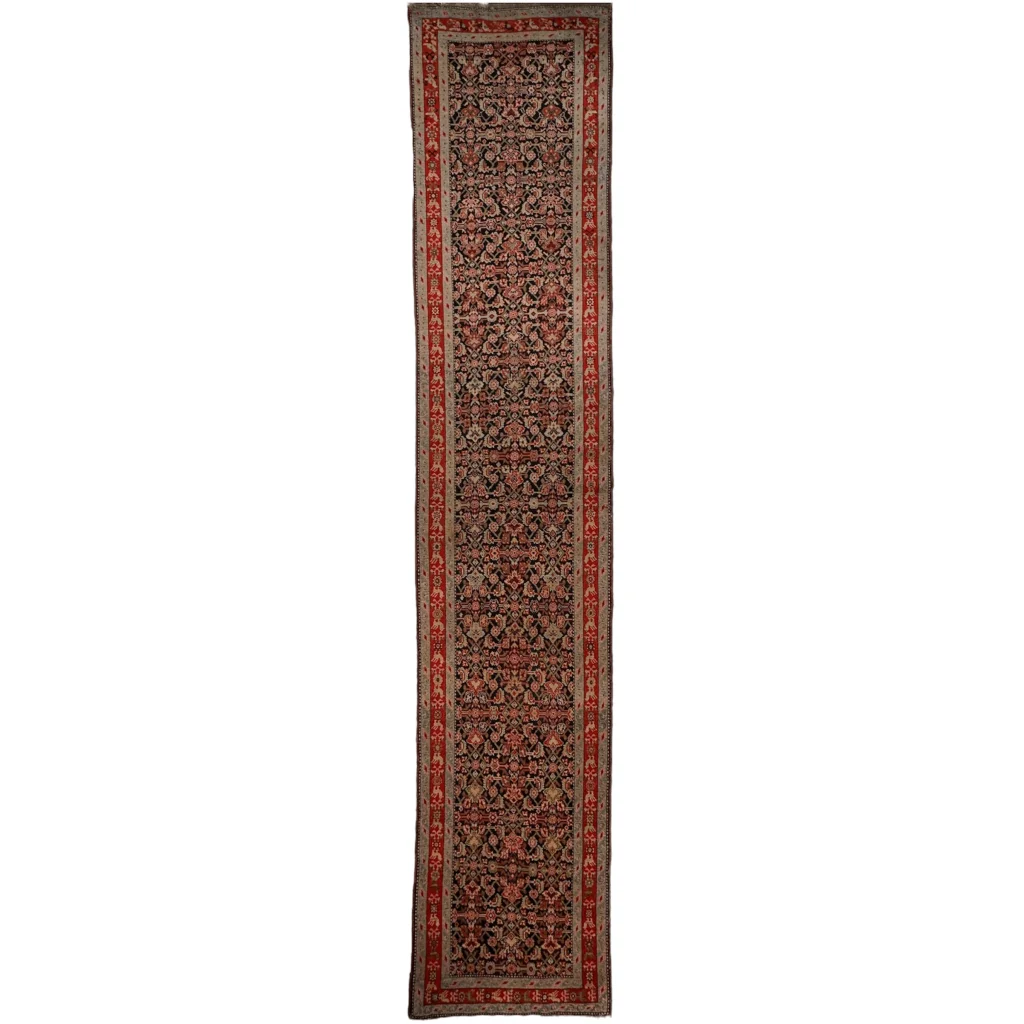
The long runner rugs of the Caucasus occupy a specific and deeply valued place in the textile world — long, narrow pieces made for the corridors and formal spaces of Caucasian towns, decorated with the same density of detail and commitment to pattern quality as room-size pieces from the same workshops. 🎋 This vintage Caucasian hand-knotted wool runner, made in Azerbaijan in the 1930s from natural wool with natural dyes, measuring approximately 3 ft 3 in by 17 ft, is one of those pieces. Its deep red ground, decorated with floral and geometric patterns in gold and ivory tones, brings nearly a century of Caucasian weaving tradition to your floor. Item ID: K1844.

🌍 Azerbaijan and the Caucasian Rug Tradition

Azerbaijan — situated at the crossroads of the Caucasus, between the Caspian Sea to the east and the high mountain passes to the west — has been a center of carpet and textile production for centuries. 🗺️ The region's weaving tradition draws from multiple cultural streams: Persian influences from the south, Turkic and tribal design from the Azerbaijani interior, and the bold geometric visual language that the Caucasus as a whole developed and maintained across its diverse weaving communities.

The 1930s represent an interesting transitional moment in Azerbaijani rug production. 📜 The region had come fully under Soviet control by this point, and the commercial rug industry was being absorbed into state-organized production systems — but traditional hand-knotting on natural wool continued, the weavers maintaining the material practices and design vocabularies that had defined Caucasian weaving for generations. Pieces from this era carry the specific combination of traditional technique and early Soviet period production context that makes them historically distinct from both the 19th century peak of Caucasian tribal weaving and the more fully industrialized production that came later.

The natural dyes used in this runner — the deep reds from madder and its derivatives, the golds from local plant and mineral sources — had been the standard of Caucasian dyeing for generations. 🌿 After nearly a century, those dyes have mellowed into the specific warm richness that distinguishes aged natural color from any synthetic alternative.

🏃 The Runner Format: A Design with Purpose

The long narrow runner format was a utilitarian proposition — a rug designed specifically for corridors, hallways, and stairs where a room-scale rug would be impractical. 🏠 But in the Caucasian tradition, utilitarian purpose never came at the expense of visual ambition. A 17-foot runner is a significant piece — long enough to run the full length of a formal entry hall, to line a wide corridor, or to make a dramatic statement along the approach to a principal room.

In contemporary use, a runner of this length works in hallways, along the length of a dining room adjacent to a table, at the base of a staircase extending across a landing, or as a dramatic wall hanging in a space with sufficient ceiling height. 🖼️ The horizontal rhythm of the Caucasian geometric border adds visual energy to the long axis in any configuration.

🎨 Color and Pattern: The Caucasian Vocabulary

The deep red ground of this runner is the signature base color of the Caucasian palette — madder-root red in various formulations has been the defining ground color of the finest Caucasian production for centuries. 🟥 Against that ground, floral and geometric patterns unfold in gold, ivory, and the secondary colors that define the Caucasian aesthetic: a layered composition that reads as dense and detailed from close range but holds visual coherence from across the room.

The floral elements in Caucasian runners of this period often feature highly stylized rose, lotus, and botanical motifs that reflect the long-standing dialogue between Caucasian and Persian weaving traditions — organic curvilinear forms translated into the angular, geometric idiom that the Caucasian tradition preferred. 🌸 The result is a distinctive hybrid: floral imagery made geometric, botanical forms given tribal structure, naturalism interpreted through the logic of the loom.

🧶 Construction and Condition

This runner is hand-knotted in natural wool on a wool foundation — the material choices that define authentic traditional Caucasian production of the era. ✋ The natural dyes have proven their lightfastness across nearly a century of existence.

Condition: great for its age, with low pile — a natural characteristic of any antique textile that has been in active service across decades. 🛡️ Low pile on a genuine 1930s piece indicates use rather than damage. The pattern reads clearly, the structural integrity is sound, and a subtle professionally executed edge repair from the back is present — evidence of attentive care that has kept this piece displayable across nearly a century. As is typical with antique runners, slight width variation may occur along the approximately 3 ft 3 in to 3 ft 6 in width. Length: 17 ft.

🎁 Collector Value: Why 1930s Caucasian Runners Matter

Long vintage Caucasian runners from the early Soviet period are among the more sought-after pieces in the vintage rug market. 💎 Their scarcity compared to shorter rugs, combined with the specific historical context of early 20th century Caucasian production and the rarity of good-condition examples at 17-foot length, makes pieces like K1844 meaningful acquisitions for serious collectors and thoughtful decorators alike.

Nearly a century of history is woven into this runner. 🕰️ The hands that made it, the natural dyes that color it, the wool that has proven its durability across all these years — these are the physical record of a weaving tradition doing what it has always done: creating durable, beautiful objects that outlast their makers and speak to their era long after that era has passed.

Item ID: K1844 🏷️

Shipping

🚚 Shipping & Handling

  • Shipping costs and timing are calculated at checkout.
  • Items curated and shipped directly by me include U.S. shipping at no additional cost, professionally packed to ensure safe arrival of your artifact.

Items from Vetted Pro Collectors
Shipping for items offered by vetted Pro Collectors is determined at checkout. All Pro Collector listings are reviewed to ensure fair, reasonable shipping practices.

For full details, please refer to our Shipping Policy.

Returns & Exchange

Product Page Return Policy

  • 60-Day Returns – Items must be in original condition.
  • Refunds – Issued after inspection (excluding shipping costs).
  • Return Shipping – Customer is responsible unless item is damaged or incorrect.
  • Damaged/Incorrect Items – Contact us within 48 hours for a replacement or refund.
  • Easy Returns – Email info@vintageantiquesgifts.com or call 802-356-9872 to initiate a return.

For full details, visit our Refund Policy.

View full details