Skip to product information
1 of 6

Vintage and Antique Gifts

1895 Tennessee Supreme Court Writ of Fieri Facias 📜 Goodpasture-Signed, Nashville Legal History, Lanier v. Turner No. 17030, Davidson County Document

1895 Tennessee Supreme Court Writ of Fieri Facias 📜 Goodpasture-Signed, Nashville Legal History, Lanier v. Turner No. 17030, Davidson County Document

Regular price 36.00 USD
Regular price Sale price 36.00 USD
Sale Sold out
Shipping calculated at checkout.
Quantity

Size: 14 x 8.5 inches

📜 The Writ That Outlived Everyone Who Signed It

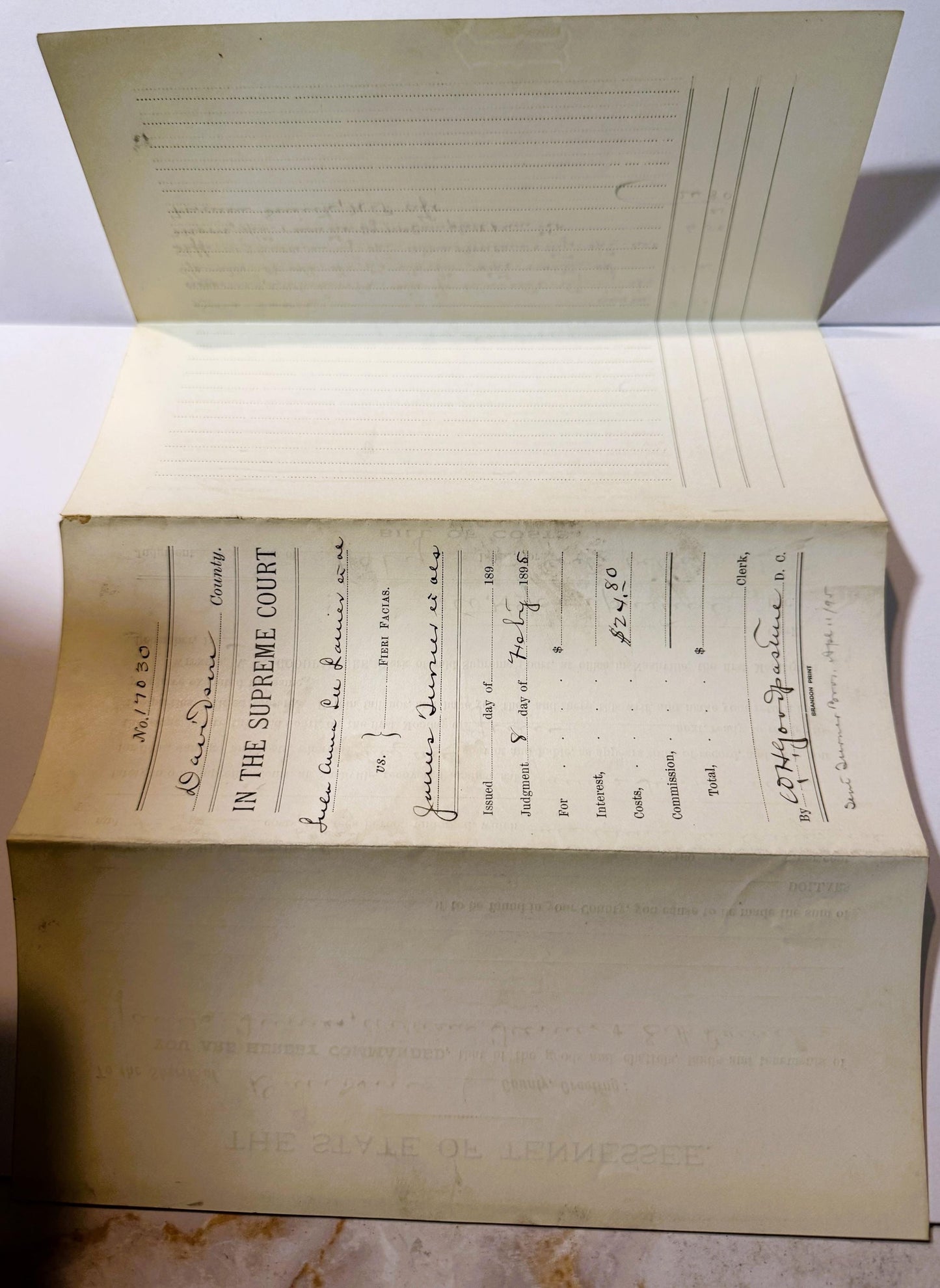
In the winter of 1895, a single sheet of paper left the office of the Clerk of the Supreme Court of Tennessee, in Nashville, and went to work. It was a writ of fieri facias — an order of execution — and its whole purpose was to make a judgment real: to send an officer of the county out to collect what a court had decided was owed. It did its job, it was returned, and then, like nearly all such paperwork, it should have been filed into oblivion and lost. It was not. It survived, complete and legible, and it is the exact document photographed here. What you are looking at is not a copy, a reproduction, or a facsimile printed to show you the "type" of thing. It is the writ itself, the one that traveled, the one the officers handled, the one the clerks signed by hand.

Everything in this description is drawn from the document itself: the printed form it was struck on, the case it names, the judgment it enforces, the officers it lists, the signatures at its foot, and the small note on its back recording where it went. Where the historical record only takes us so far, this listing stops there honestly rather than guessing. And the single most remarkable thing about it — the reason this ordinary square of legal paper is anything but ordinary — is the name of the man who certified it. But we will come to him. First, what this writ actually is.


⚖️ What a "Writ of Fieri Facias" Actually Is

The phrase is Latin, and it is wonderful. Fieri facias means, roughly, "that you cause to be made" — "cause it to be done." Lawyers shortened it centuries ago to two friendly syllables: a fi. fa. It is one of the oldest instruments in the common law, and its function is beautifully concrete. A court reaches a judgment; someone owes money under it. The judgment by itself is only words. The writ of fieri facias is the muscle behind the words: it is a command, addressed to the sheriff, to go and make that money out of the debtor's goods and property — to levy on chattels, and if need be seize and sell them, until the sum and the costs are satisfied.

So a writ like this one belongs to the enforcement phase of a case — the very end, after the arguing is over and the decision is made, when the abstract authority of a court becomes a real officer walking up a real road with a paper in his hand. That is why these documents are such vivid artifacts of how justice actually functioned in the nineteenth century. There was no wire transfer, no electronic lien, no automated garnishment. There was a printed order, a handwritten name, and a man on horseback. This sheet is one of those orders. It directed the machinery of Davidson County to collect a Supreme Court judgment, down to the last itemized cost, and to answer for having done so.


🏛️ Nashville, February 1895: The Court in Its Own Handwriting

The writ issues out of the Supreme Court of Tennessee at Nashville, on a judgment dated the 8th of February, 1895. It carries a case that had come up to the high court on appeal from the Chancery side in Davidson County — the county Nashville sits in — which is exactly the path a hard-fought civil matter took in that era: decided below in chancery, carried up to the Supreme Court, and, once settled there, sent back down as an executable order with costs attached.

What makes it feel alive is that it is a printed form finished by hand. The blank itself was a piece of standardized legal stationery, struck by a Nashville printing house so the court could issue writs by the hundred; the specifics — the names, the sums, the dates, the officers — were entered in period ink by the people who worked the court. That combination is the signature of authentic nineteenth-century officialdom: the impersonal printed scaffold of the state, filled in by individual human hands. You are seeing both at once here, the institution and the clerk, on the same sheet.


✍️ The Moat: The Man Who Certified This Paper Later Wrote the State's History

Here is where an unassuming legal document becomes something a serious collector sits up for. The writ is issued and attested in the name of the Clerk of the Supreme Court of Tennessee — and in 1895 that clerk was Albert Virgil Goodpasture.

If that name means nothing yet, it should, because A. V. Goodpasture (1855–1942) is not a minor courthouse functionary lost to time. He is one of the canonical historians of the State of Tennessee. He held the clerkship of the Supreme Court from 1891 to 1897 — the exact window this writ falls in — and around that public office he built a scholarly life that shaped how generations of Tennesseans learned their own past. He co-authored the standard school text History of Tennessee, the book adopted by the state's textbook commission to teach the commonwealth's history to its children. He edited the American Historical Magazine, the direct predecessor of what is today the Tennessee Historical Quarterly. He was a founding force in the state's historical institutions and wrote county histories and biographies that scholars still cite.

Sit with the irony of that for a moment. The clerk whose office authenticated this piece of everyday legal enforcement — this small, functional, forgettable writ — was the very man who would go on to write the history of Tennessee itself. The person responsible for certifying the record was, in the most literal sense, the person who curated the record. To hold a document from Goodpasture's clerkship is to hold a primary source that passed through the hands of the man who taught the state to remember. There is almost no better provenance a piece of Tennessee legal paper can have, and it is stamped into this one by the office it issues from.


👥 Two Brothers on One Sheet

And it gets better, because the Goodpasture name appears on this writ twice over. The document carries the ink signature of W. H. Goodpasture, D.C. — Deputy Clerk — Albert's brother, William. The two Goodpasture brothers worked the clerk's office together, and their partnership did not end at the courthouse door. In 1897, the year Albert's clerkship closed, the brothers opened the Goodpasture Book Company in downtown Nashville, a bookshop they ran together until 1914 that was famous less as a store than as a gathering place — a kind of club for the city's book lovers and readers of Tennessee history.

So this single sheet of 1895 legal paper holds both Goodpasture brothers: the elder as the certifying Clerk-historian whose office it issues from, and the younger as the deputy whose living pen actually signed it. It is, quietly, a Goodpasture family document as much as a court document — a paper that connects a routine Davidson County execution to two of the men who, a few years later, would sit at the center of Nashville's literary and historical life. For a collector of Tennessee history, of legal Americana, or of the Goodpasture name itself, that double presence is the heart of the object.


💵 The $24.80 Bill: A Line-Item Portrait of a Nashville Courthouse

Turn to the costs and the writ opens like a little window onto the working machinery of the 1890s courthouse. The sum this writ went out to collect in costs was $24.80 — and it is not a round abstraction but an itemized bill, broken out fee by fee among the officers who had earned them. That is the detail I love most about it: you can read, in period ink, the names of the actual men of the Davidson County court system whose small charges added up to that total.

The clerk's own fees are entered under the name W. K. Whitworth. The service and mileage of the sheriff's office are booked to a roll call of deputies and officers — Sullivan, Milam, Moore, and McCampbell — the men who would have carried and executed orders like this one across the county. A notary's fee is entered for Furman Smith. None of these are famous names, and that is precisely the point: they are the ordinary, real, working texture of a Nashville courthouse in 1895, each preserved here in a single line of a single bill, all of it public record. A document like this is social history disguised as paperwork. It is a payroll, a route map, and a roster of a vanished county office, all on one page — and the whole apparatus was set in motion to collect twenty-four dollars and eighty cents.


📨 "Sent Turner Bros. Apl 11/95" — Its Own Paper Trail

One of the small joys of a genuine served writ is that it often carries the record of its own errand, and this one does. On it is the notation "Sent Turner Bros. Apl 11/95" — a working endorsement recording that the writ was sent on the 11th of April, 1895. It is the document telling you, in a clerk's shorthand, what happened to it: issued on a February judgment, and by mid-April, out and moving toward the parties on the Turner side of the case.

That little line matters because it is the difference between a blank form and a used instrument of the court. This is not unfilled stationery that never did anything. It is a writ that was completed, signed, docketed, sent, and answered for — a piece of paper that actually performed the work the law asked of it, and then kept the memo of having done so. The endorsement is part of what makes it feel less like an antique and more like a survivor with a biography.


🗂️ The Case It Names: No. 17030

The writ arises from a specific, named cause: Case No. 17030, Lula Anna Lee Lanier and others v. James Turner and others — a matter that reached the Supreme Court at Nashville on appeal from the Davidson County Chancery Court. I want to be scrupulously honest about the limits of what the document itself tells us. The substance of the underlying dispute — what the Laniers and the Turners were actually fighting over — is not something the writ spells out, and it is the kind of detail that lives in specialized legal archives rather than on the face of an execution order. I will not invent it for you or dress a guess up as fact.

There is, however, one genuine curiosity that the caption itself hands us, and it is fair game to point out and then leave alone: the surname Lanier appears on both sides of the naming — plaintiffs "and others" against defendants "and others" — the kind of configuration that often marks a suit among connected parties, an estate, or a family matter carried up to the high court. I note it because it is right there in the record; I stop there because that is where honest reading of this single sheet ends. What the writ does establish beyond doubt is the enforcement: a 1895 Supreme Court judgment in that cause, and the order sent out to satisfy its costs.


🖋️ Printed in Nashville, Finished by Hand

The physical object rewards a close look. It was struck as a printed legal blank by the Brandon Printing Company of Nashville — a real, working Nashville printing house of the 1890s that produced official Tennessee documents and court stationery — and then completed in manuscript by the court's own hands. The imprint of a known period Nashville printer is itself a quiet authenticity marker: it ties the paper firmly to the place and the decade, and to the specific ecosystem of court blanks that the Supreme Court clerk's office actually used.

The result is a handsome piece of nineteenth-century officialdom: the formal printed language of the writ, the elegant period penmanship of the entries, the names and figures set down in iron-gall-era ink, and the overall balance of a document made to be authoritative and permanent. It reads exactly as what it is — a formal order of the highest court in the state — and it looks the part.


🔎 An Honest Condition Report

I would always rather you know precisely what is coming than be charmed by adjectives, so here is the plain state of the sheet, read from the same photographs you can see.

The writ is complete and fully legible. The printed text and the handwritten entries alike read clearly; nothing essential is lost. It carries its original folds — the creases from having been folded for filing and carrying, exactly as a served writ of this age should be, and part of its honest character rather than a fault. There is light toning to the paper, the gentle, even mellowing that 130-year-old rag stock earns with time. And there is one specific thing I want to flag rather than hide: a small spot in the lower-left costs panel, a minor mark in the area of the itemized fees. I point it out plainly so there are no surprises. None of this compromises the document; it reads, it displays beautifully, and every name and figure discussed above is present and legible. What you see in the photographs is the whole and honest state of it.


💠 One Document on Earth

Now the plainest fact of all, and the one that frames everything else: this is a true one-of-a-kind. A served writ of fieri facias is, by its nature, unique. It was issued once, in one cause, on one judgment, completed by hand for that single case, signed by those particular clerks, sent on that one errand, and endorsed with the memo of its own service. There was never an edition of it. There is no second copy sitting in a drawer, no reprint, no reissue. This exact sheet is the only one of itself in the world — the sole surviving physical record of this particular act of the Tennessee Supreme Court in this particular case.

I state that as a simple fact, not as a sales tactic, and there is no need to dress it up with any countdown or scarcity theatre. The point is quieter and stronger than that: what makes this document rare is not that few were made and many sold, but that only one ever existed at all, and here it is. And because it is one of one, there is no ambiguity about what you are buying. You receive the exact document photographed — the very writ shown in every image, folds and toning and all. Not one like it. This one.


🖼️ Living With It

A document like this deserves to be seen, and it slips into a room in several handsome ways.

  • 🖼️ Float-frame it between glass so both the printed writ and the handwritten costs bill on it can be read, and hang it where the ink and the folds catch a raking light — it becomes genuine wall history, not decoration.
  • 📚 Stand it in a law office, a judge's or attorney's study, or a library as a real artifact of how judgments were once enforced — a conversation piece with a story that runs from Latin to a Nashville sheriff.
  • 🏛️ Place it in a Tennessee history collection or a Nashville-themed room, where the Goodpasture connection gives it a depth few pieces of local ephemera can match.
  • 🎁 Or give it to the historian, the lawyer, the genealogist, or the collector of Americana in your life who would rather have one real, singular thing than a shelf of ordinary ones.

🧭 Who It Is For

Some people will read this far and already know it is theirs. The collector of Tennessee history, who understands exactly what the Goodpasture name means and how rarely a document ties to it so directly. The collector of legal Americana and court ephemera, who prizes a genuine served writ of execution with its officers named and its errand endorsed. The lawyer or judge who wants the real thing — an authentic fieri facias, the ancestor of every writ of execution filed today — for the wall of a chambers or firm. The genealogist or local historian chasing Davidson County names. And the person who simply loves a singular object with a true, deep, documented story. For any of them, this is a primary source with a moat around it, offered exactly as pictured.


❓ Questions Worth Answering

Is this the actual document, or a reproduction?

It is the actual, original 1895 document — the one and only physical writ from this case. You receive the exact sheet shown in the photographs, folds, toning and all. There is no reproduction involved and, because it is a served one-of-a-kind writ, no other copy exists.

What is a writ of fieri facias?

It is a court's order of execution — Latin for "that you cause to be made" — commanding the sheriff to collect a money judgment out of the debtor's goods and property. It is the enforcement step that turns a court's decision into actual collection, and this one enforced a Tennessee Supreme Court judgment.

Who is Goodpasture, and why does it matter?

Albert Virgil Goodpasture was Clerk of the Tennessee Supreme Court from 1891 to 1897 and one of the state's most important historians — co-author of the standard school textbook History of Tennessee and editor of the American Historical Magazine. This writ issues from his clerkship, and it is ink-signed by his brother and deputy, W. H. Goodpasture, who later ran the Goodpasture Book Company in Nashville with him. Both brothers are present on the sheet.

What was the case about?

The writ names Case No. 17030, Lanier and others v. Turner and others, a Davidson County chancery matter decided by the Supreme Court in February 1895. The document does not state the substance of the dispute, and I will not guess at it; what it establishes is the judgment and its enforcement. As a small curiosity, the Lanier name appears on both sides of the caption.

What condition is it in?

Complete and fully legible, with its original filing folds, light overall toning, and one small spot in the lower-left costs panel. It displays beautifully and reads clearly throughout. Offered exactly as pictured.


✨ Why It Matters

Some objects are worth having because they are decorative; this one is worth having because it is real, singular, and connected. It is a genuine 1895 writ of fieri facias from the Supreme Court of Tennessee — the ancient enforcement order that made a judgment real — struck on a Nashville printer's form and finished by hand. It issues from the clerkship of A. V. Goodpasture, the man who would write the state's history, and it is signed by his brother W. H. Goodpasture, his partner in the Goodpasture Book Company. It names the real officers of a Davidson County courthouse in a $24.80 costs bill, carries the memo of its own service, and has survived complete and legible for well over a century. And there is exactly one of it in the world. Bring it home and you are not buying a picture of Tennessee legal history. You are keeping a piece of it — the only piece of this piece there is.

Shipping

🚚 Shipping & Handling

  • Shipping costs and timing are calculated at checkout.
  • Items curated and shipped directly by me include U.S. shipping at no additional cost, professionally packed to ensure safe arrival of your artifact.

Items from Vetted Pro Collectors
Shipping for items offered by vetted Pro Collectors is determined at checkout. All Pro Collector listings are reviewed to ensure fair, reasonable shipping practices.

For full details, please refer to our Shipping Policy.

Returns & Exchange

Take your time — you've got a full six months. If a piece isn't right for you, send it back the way it reached you and we're good.

In the first 30 days your money goes straight back the way you paid. After that it's store credit, so you can put it toward something you'd rather have.

Return shipping we sort out between us, case by case. I don't make this difficult.

If something arrives damaged, or it isn't what I said it was, send me a photo within 48 hours and I'll make it right.

Email info@vintageantiquesgifts.com or call 802-356-9872 — that's me answering, not a call center.

The only things I can't take back are custom or special-order pieces and gift cards.

View full details