Skip to product information
1 of 7

Vintage and Antique Gifts

Vintage Chinese Bronze Pendant 🔔 Braided Foxtail Chain with Bell Drops

Vintage Chinese Bronze Pendant 🔔 Braided Foxtail Chain with Bell Drops

Regular price 30.00 USD
Regular price Sale price 30.00 USD
Sale Sold out
Shipping calculated at checkout.
Quantity

🔔 What Stories Does a Braided Chain and a Row of Tiny Bells Still Have to Tell?

There's a particular sound old jewelry boxes used to make — a soft metallic clink when a chain shifted, a bell-drop knocking gently against its neighbor. Grandmothers kept things like this tucked into velvet-lined drawers, pulled out only on special occasions or passed quietly to a granddaughter "for luck." This little bronze pendant has that exact energy: a short length of tightly braided chain, capped in ribbed metal ferrules, ending in a rounded, dome-shaped drop on one end and open jump rings on the other. It's the kind of piece that doesn't announce itself loudly — it just sits in the hand with real weight and real history, the kind of object that makes you want to know who wore it, and why.

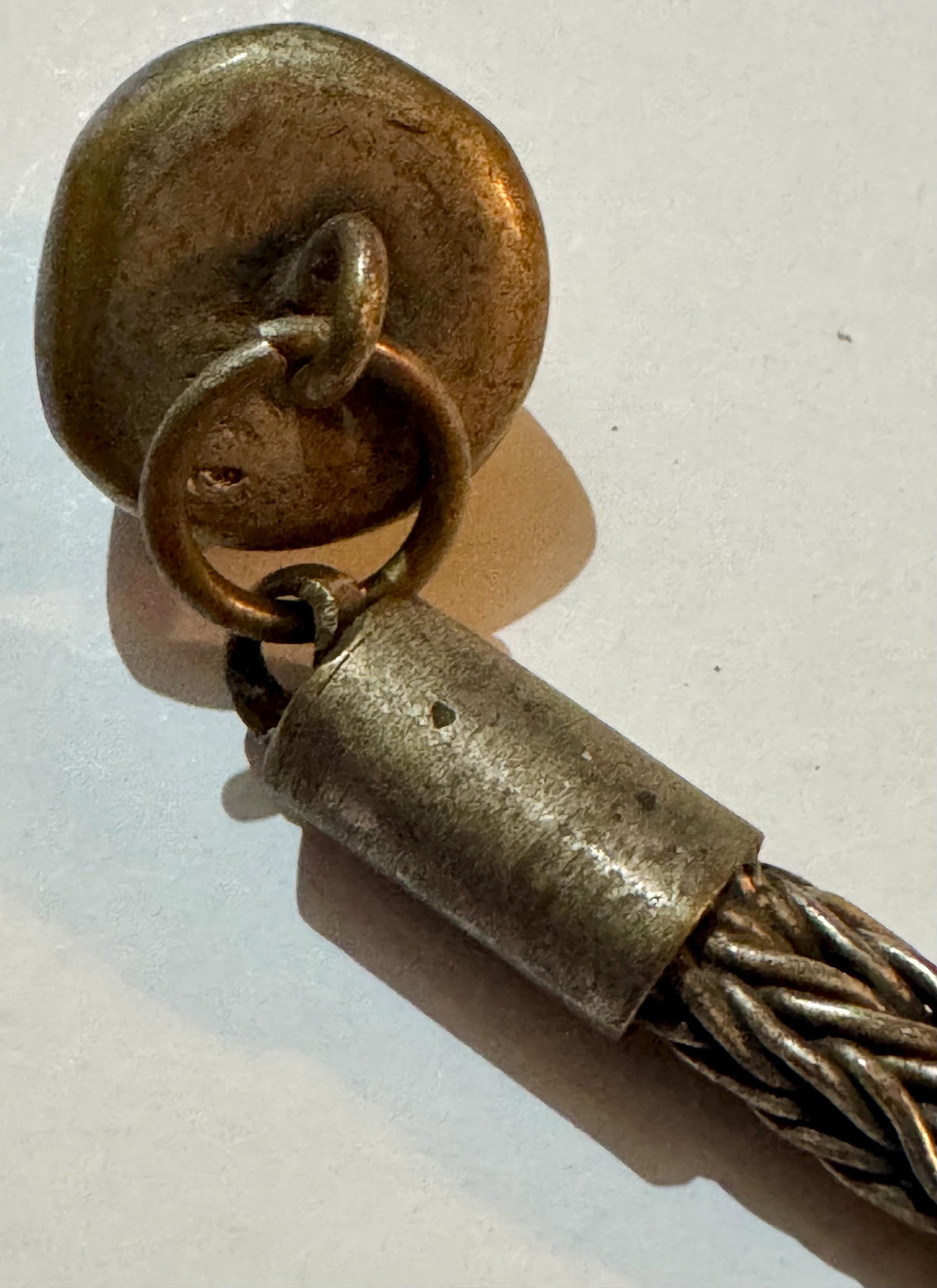
What you're looking at is an old, one-of-a-kind Chinese bronze pendant measuring 4.25 inches long — a compact, sculptural piece built around a tightly woven foxtail-style chain, finished at both ends with ribbed metal caps and small jump rings, and anchored by a smooth, rounded bell-shaped drop at one end. The metal reads in warm, layered tones of bronze, silver-gray, brown, and gold — the kind of shifting color you only get from real age on real metal, never from a fresh casting. There's no maker's mark legible anywhere on the piece, and honestly, that's part of its charm rather than a mystery to apologize for — it puts this pendant squarely in the great, mostly-unsigned tradition of Chinese folk metalwork, made by hand, for a person, not for a label. This is an old piece of later-20th-century manufacture — vintage is the honest word for it, not antique, and that's exactly how we're presenting it. It is a single, one-of-a-kind original — there is only one of this exact piece, and once it's gone, it's gone.


⚒️ A Craft Built Strand by Strand, Not Stamped From a Die

Look closely at that chain and you can see it isn't a machine-stamped novelty link — it's woven. Fine strands of metal have been braided over and over into a tight, rope-like foxtail pattern, the same over-under-over rhythm you'd use plaiting hair, except done in metal wire, strand by strand, by a pair of hands and a lot of patience. This braided-wire construction is a real and documented technique in Chinese metalworking — craftsmen who specialize in it describe it as one of the most demanding stages in the whole process, requiring the wire to be drawn out to a uniform thinness before it can even be braided, then finished at the ends with soldered or crimped caps like the ribbed ferrules you see holding this chain together. It's slow work. It's also exactly the kind of work that doesn't survive mass production — which is part of why a piece like this, built this way, carries weight in the hand that a stamped modern chain never will.

The dome-shaped drop at one end and the small jump rings at both ends complete the piece's logic: this was clearly built to hang, to swing, to be worn — a pendant meant to move with the body and catch the light off that rounded bronze cap every time it did.

🏔️ The Mountain Villages Where This Visual Language Was Born

Braided wire chains finished with dome-shaped drops and small hanging bells are not a generic motif — they belong to a specific, living regional tradition in China, one worth understanding even if we can't prove this exact pendant walked out of one particular workshop. In the mountainous southeast of Guizhou Province, the Miao people have practiced a distinctive form of ornamental metalwork for centuries, and braided or woven chain-work is one of its signature techniques — described by artisans there as "chain weaving," right alongside wire-drawing and engraving, as core skills passed down inside families rather than taught in a classroom.

Local records name specific villages built almost entirely around this trade — Kongbai, tucked into a mountainside in Xijiang, Leishan County, is remembered as having once been home to as many as 275 working silversmiths at its peak, earning it the description of "the only silversmith village in Guizhou." Nearby Maliao carries the same reputation, and together these villages are spoken of as the true "hometown" of this kind of Chinese ornamental metalwork, with a craft heritage recorded at well over four hundred years old. In these villages, the craft moved from father to son inside individual households — no factories, no assembly lines, just family workshops turning out wire-drawn, hand-braided pieces one at a time, exactly the kind of construction you can trace with your fingers on this pendant's own chain.

We can't tell you this particular piece was forged in Kongbai, or Maliao, or any single named village — there's no mark to prove it, and we won't pretend otherwise. What we can tell you is that this pendant speaks the same visual dialect: the same braided chain, the same rounded drop, the same folk sensibility built by hand rather than stamped by machine. Whether it came from a mountain workshop in Guizhou or from another corner of China's rich folk-jewelry trade, it was clearly made inside that same tradition of hand-worked, wearable metal ornament.

🔔 Why the Bells? The Old Belief Behind the Sound

The bell-shaped drop isn't just decorative flourish — in this tradition, bells and small hanging chimes carry real cultural weight. Miao lore holds that silver and silver-toned metal ornaments carry protective power: worn on the body, they were believed to ward off evil spirits, prevent illness, and bring good fortune to the wearer. The bells specifically had a second, more practical job tied into that same belief — their sound let families keep track of children and each other across the terraced mountain villages, a literal thread of sound tying a person back to home. In the broader Han Chinese tradition, this same protective instinct produced the beloved "longevity lock" pendant — a piece hung from a child's neck on a chain, often finished with small bells, worn from early childhood with the hope of a long, peaceful life, and traditionally only removed once the wearer married. That custom was especially beloved across Chinese households during earlier centuries, and its visual grammar — chain, drop, bell — is unmistakably the same grammar at work in this pendant.

There's a second layer of meaning too, less about spirits and more about survival: in these mountain communities, ornamental metal wasn't just beautiful, it was portable savings. A family's wealth could be worn on the body, carried across a migration, or passed to a daughter as part of her dowry — silver and silver-toned jewelry held real value in Miao wedding customs, functioning as both adornment and inheritance in the same object. A pendant like this one, small enough to slip into a pocket or wear quietly under a collar, fits neatly into that same old habit of wearing one's security rather than storing it.

👪 The Human Story — Family Workshops, and a Trade That Thinned With Time

The story of these silversmithing villages is a real one, and like a lot of hand-craft trades, it has a bittersweet arc. At its height, a village like Kongbai supported hundreds of working silversmiths, and the trade was so central to daily life that outsiders came to know the village by that identity alone. But as generations passed, and as young people increasingly left mountain villages for cities and other work, the number of active craftsmen thinned dramatically — from the hundreds once recorded down to only a small handful of practicing smiths in recent memory, with at least one named craftsman, born in the mid-1970s, remembered as continuing to carry the tradition largely on his own. It's the same story a lot of hand-trades tell: a skill passed father to son for generations, deeply respected, and then, quietly, harder and harder to find someone willing to spend a lifetime learning it.

That thinning-out is exactly why pieces made in this tradition — hand-braided chains, dome drops, ribbed ferrule caps — matter to collectors today. Every one of them represents actual hours of a real person's hands at work, not a mold and a stamping press. When a piece like this survives, with its braid still tight and its drop still smooth after decades of handling, it's a small monument to a trade that fewer and fewer people still practice by hand.

🥉 The Warmth of the Metal — Bronze, Age, and an Honest Patina

The metal on this piece reads in exactly the tones you'd want from a genuine, well-loved survivor — bronze and gold at the dome, softening into silver-gray and brown along the braided chain. That layered, uneven coloring is patina, and it's worth treasuring rather than apologizing for: it's the natural result of metal aging honestly over real decades, handled, worn, tucked away, and taken back out again. It's worth noting, too, that the broader Chinese folk-metalwork tradition this piece belongs to has long used copper-family alloys — including a metal historically called "white copper," a copper-nickel blend that was mined and worked in China for a very long time — right alongside true silver, depending on the maker and the era. A bronze piece with this kind of warm, coppery undertone sits comfortably in that same material family. Either way, what you're seeing is a finish earned honestly over time — not something a reproduction or a freshly cast piece could ever fake.

🏮 A Craft With Formal National Recognition

The chain-weaving and silverwork tradition this pendant echoes isn't just informal village lore — it has been formally recognized at the national level in China. In 2006, the Miao silver ornament forging technique, jointly put forward by craft communities in Guizhou and neighboring Hunan Province, was inscribed onto China's First Batch of National Intangible Cultural Heritage — an official acknowledgment that this way of drawing wire, braiding chain, and shaping ornamental drops is a skill worth actively preserving, not letting quietly disappear. That recognition belongs to the tradition and the region — not to this individual pendant's own date — but it tells you something real about the seriousness with which this style of hand-worked metal ornament is regarded in its home country today.


🖼️ Display Ideas

  • 🕯️ Hang it from a small brass hook or pushpin against a shadow box lined in dark velvet, letting the braided chain and dome drop cast a bit of shadow of their own.
  • 📿 Lay it in an open jewelry tray or antique dish alongside other small folk-metal pieces, letting the bronze and silver-gray tones play off one another.
  • 🪞 Prop it against a small standing mirror or picture-frame easel so both the braid detail and the rounded drop catch the light from different angles.
  • 🧵 Coil the chain gently into a small glass cloche or curio dome, the way old collectors once displayed miniature curiosities on a mantel.
  • 🗝️ Group it with other small vintage hardware or chain fragments in a divided collector's drawer, each piece labeled with its own quiet story.
  • 🎋 Hang it near other Asian folk-art pieces or textiles as a single accent note, letting its warm bronze tone tie the grouping together.

🎁 Who Collects These

This is a piece that speaks to several kinds of collectors at once. Folk-jewelry and ethnographic collectors are drawn to hand-braided chain-work like this because it represents a real, hands-on craft technique rather than a factory casting — the kind of piece study collections of Chinese and Southeast Asian metal ornament are built around. Collectors of Asian antiques and vintage Chinese decorative arts will appreciate it as an honest, unsigned example of a folk tradition that rarely gets documented piece by piece. Small-object and curio collectors — the type who love miniature hardware, old fobs, and pocket-sized metalwork — will see in it a satisfying weight and tactile charm that's rare in anything this compact. And anyone drawn to protective or ceremonial jewelry traditions — longevity locks, bell-drop pendants, dowry silver — will recognize this piece as sitting comfortably inside that same old lineage of wearable, meaningful metal.


❓ FAQ

Is this pendant antique?

No — we describe it honestly as vintage, an old piece of later-20th-century manufacture. There's no dynasty, no early-period claim, and no maker's mark to date it more precisely, so "vintage" is the accurate ceiling here.

Is the metal solid bronze?

The piece presents as bronze, with warm gold, brown, and silver-gray tones throughout. Chinese folk-metal traditions in this same braided-chain style have historically also used copper-family alloys like white copper alongside true silver, so the warm coppery coloring here fits comfortably within that broader material family.

Was this made by the Miao people of Guizhou?

We can't confirm that as a specific fact — there's no mark tying it to any named village or workshop. What we can say is that its construction, a hand-braided foxtail chain finished with ribbed caps and a dome-shaped drop, matches the visual language of that well-documented Chinese folk-metalwork tradition very closely, whether or not this particular piece was made there.

Does the bell drop actually ring?

The rounded end is shaped as a bell/dome drop in the classic style of this tradition. We're not asserting a sound function here — only describing its form, which follows the bell-and-chain design seen across Chinese protective pendants and longevity locks.

What would this have originally been used for?

With jump rings at both ends, it was clearly built to attach — either worn as its own pendant on a longer cord or chain, or used as a decorative drop hanging from a larger piece, in keeping with old Chinese traditions of protective, bell-finished jewelry worn on the body.

Is this a one-of-a-kind piece?

Yes — this is a single, one-of-a-kind original. There is only the one pendant pictured, and once it sells, there isn't another exact copy behind it.

How should I care for a piece like this?

Handle it gently and store it away from harsh moisture. The layered coloring across the metal is natural patina built up honestly over decades — it's part of the piece's character and history, not something that needs to be polished away.

Shipping

🚚 Shipping & Handling

  • Shipping costs and timing are calculated at checkout.
  • Items curated and shipped directly by me include U.S. shipping at no additional cost, professionally packed to ensure safe arrival of your artifact.

Items from Vetted Pro Collectors
Shipping for items offered by vetted Pro Collectors is determined at checkout. All Pro Collector listings are reviewed to ensure fair, reasonable shipping practices.

For full details, please refer to our Shipping Policy.

Returns & Exchange

Take your time — you've got a full six months. If a piece isn't right for you, send it back the way it reached you and we're good.

In the first 30 days your money goes straight back the way you paid. After that it's store credit, so you can put it toward something you'd rather have.

Return shipping we sort out between us, case by case. I don't make this difficult.

If something arrives damaged, or it isn't what I said it was, send me a photo within 48 hours and I'll make it right.

Email info@vintageantiquesgifts.com or call 802-356-9872 — that's me answering, not a call center.

The only things I can't take back are custom or special-order pieces and gift cards.

View full details