Skip to product information
1 of 4

Vintage and Antique Gifts

Vintage 1970s Chakra Necklace ✨ Glass Vial Gemstone Chips Made in India NOS

Vintage 1970s Chakra Necklace ✨ Glass Vial Gemstone Chips Made in India NOS

Regular price 8.00 USD
Regular price Sale price 8.00 USD
Sale Sold out
Shipping calculated at checkout.
Quantity

✨ Before the Rainbow Chakra Was Everywhere: A Sealed 1970s Gemstone Vial from India

Every chakra necklace sold today seems to come in the same seven colors, red at the base of the spine climbing to violet at the crown. That color chart is not ancient. It is a Western idea, and it took hold in the 1970s. This little necklace comes from that same decade: a glass vial packed with mixed gemstone chips, hung on a braided cord, marked Made in India, and still sealed in the plastic bag it was packed in. Nobody has ever opened it. You get to be the first.


🔍 What You Get

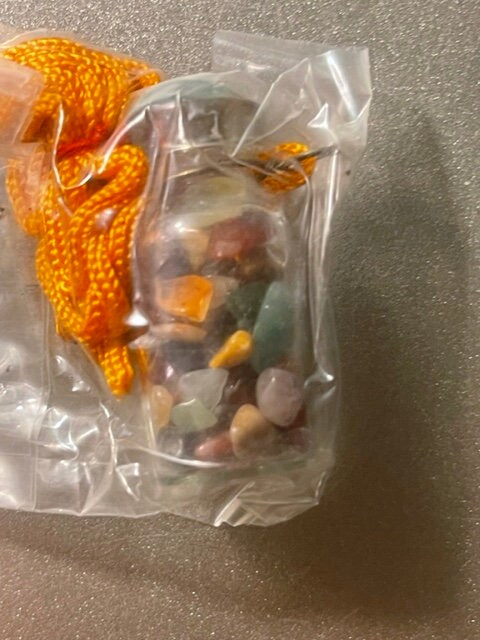
  • Pendant: a clear glass vial, just under 1½" tall, filled to the neck with tumbled gemstone chips
  • The stones: a hand-sized rainbow of chips in pale sea green, milky white, water-clear, rose pink, mustard yellow, rust red and near-black
  • The top: a stopper at the neck, ringed by a thin wire with an eye on each side that the cord runs through
  • Cord: soft braided cord; cord colors vary from piece to piece (red, orange and black are shown in the photos)
  • Marked: Made in India, on a small blue label packed with the vial
  • Era: 1970s
  • Condition: new old stock, sealed in its original plastic bag

Hold it to a window and the chips do what loose stones do in glass: the clear and white pieces light up, the green goes watery, and the dark chips sink to the bottom like pebbles in a creek. No two vials were filled alike.


🌈 How the Chakras Got Their Colors

Chakra is the Sanskrit word for "wheel," the name yogic and tantric texts gave to the centers of energy said to run up the body along the spine. For most of history those texts stayed in India. Two books carried them West.

The first was The Serpent Power, published in 1919 under the pen name Arthur Avalon by Sir John Woodroffe, a British judge in Calcutta. It was the first scholarly treatment of the chakras in English, and its long Sanskrit translations were hard going. The second was far easier to read. Charles Webster Leadbeater, an English priest who left the Anglican church around 1883 to study the occult and Eastern religion, published The Chakras in 1927. It was printed in Adyar, India, by the Theosophical Publishing House, with ten full-page plates, and it became the classic. Leadbeater described what he said he saw clairvoyantly, and his chakras did not match the old Indian texts.

Over the following decades the Western system slowly picked up links to colors and to the glands of the body. The step that finished the job came from Christopher Hills, who proposed in his book Nuclear Evolution that each of the seven chakras corresponds to one of the seven colors of the spectrum. The 1977 edition, Nuclear Evolution: Discovery of the Rainbow Body, came out of the University of the Trees Press in Boulder Creek, California. His personality theory never caught on. His rainbow did. Just about every chakra book written since draws the chakras in rainbow colors, and that picture became the one the whole world now recognizes.

A vial of many-colored stones worn over the heart sits right in the middle of that new way of seeing.


🧘 The Beatles, the Hippie Trail and a Country Selling Its Stones

In February 1968 the Beatles went to Rishikesh, on the banks of the Ganges, to study meditation at the ashram of Maharishi Mahesh Yogi. Their trip put a mainstream spotlight on Westerners looking East for something their suburbs did not give them. Thousands were already going. The overland Hippie Trail ran from London to Kathmandu, with many travelers stopping in India, and it lasted into the late 1970s. For a generation it worked as a pilgrimage, and the road later inspired the Lonely Planet guidebooks.

India was ready to sell to them. In 1966 the Ministry of Commerce set up the Gem & Jewellery Export Promotion Council in Jaipur. In its first year, Indian exports of gems and jewelry came to about US$28 million. By 2014 the figure had passed US$35 billion. Jaipur itself had been a stone town from its founding in 1727, when Maharaja Sawai Jai Singh II drew jewelers and stonecutters to his new city and commissioned the Johari Bazaar, a market that still houses small gem workshops today.


🪨 The Legend of the Bead Saint

India's stone trade is older than almost anything else it makes. In Khambhat, the old port of Cambay in Gujarat, craftsmen still cut agate and carnelian the way it was done at nearby Lothal, a Harappan town of the Indus Valley civilization that flourished about 4,000 years ago. Khambhat has no stone of its own. The raw pebbles come from the Rajpipla hills, roughly 200 kilometers away. They are dried in the sun and fired to drive the moisture out, knocked into shape with a shingadi, a hammer headed with buffalo horn, and smoothed on an emery wheel the workers call kurund.

The bead-makers tell a legend about how the trade came back to life. Baba Ghor, a Sufi from Abyssinia, is said to have come to India's west coast and set up a stone works at Limodra near Rajpipla, where the raw agate lay thick on the ground, and to have sent his brother Baba Abbas to open a larger workshop in Khambhat. His shrine at Ratanpur, the "Village of Gems," honors him as the patron saint of bead-makers, and the Sidi families who trace their line to his followers are still the ones who bring the rough stone in. Cambay's stones went to Mesopotamia in the ancient world and to the Middle East and the African coast for centuries after.

A little bottle of chips with "Made in India" on the label belongs to that long story, told small enough to wear on a cord.


💎 From Pocket Talisman to the Crystal Boom

What started as a handful of cheap stones on a string turned into an industry. In 1985 Katrina Raphaell published Crystal Enlightenment, the first of her best-selling Crystal Trilogy, and brought "crystal layouts" into the mainstream; in 1986 she founded the Crystal Academy of Advanced Healing Arts. On August 16 and 17, 1987, the Harmonic Convergence sent people to more than 250 sacred sites around the world to meditate at the same moment, and at its height the New Age movement had millions of Americans using crystals as healing tools. Today, small stoppered vials worn on a cord are sold everywhere as "wish bottles."

This one comes from before all of that. It is the kind of piece the boom grew out of, and it has been waiting in its bag the whole time.


❓ Questions People Ask

What stones are inside?
The packaging does not name them, only the mix of colors you can see through the glass, so you are free to give the vial your own meanings.

How old is it?
It is 1970s new old stock, never sold and never opened.

Which cord color will I get?
Each one differs. The photos show three of them side by side.

How big is the vial?
Just under 1½" tall.

What does "chakra" mean?
It is Sanskrit for "wheel," the name for the energy centers described in yoga and tantra.

Should I open it?
That is your call. Sealed is how it lasted this long. Opened, it is ready to wear.

Who is it good for?
Anyone who practices yoga or meditation, collects 1970s jewelry or New Age pieces, loves India export jewelry, or wants a small, affordable talisman with a real past.

Shipping

🚚 Shipping & Handling

  • Shipping costs and timing are calculated at checkout.
  • Items curated and shipped directly by me include U.S. shipping at no additional cost, professionally packed to ensure safe arrival of your artifact.

Items from Vetted Pro Collectors
Shipping for items offered by vetted Pro Collectors is determined at checkout. All Pro Collector listings are reviewed to ensure fair, reasonable shipping practices.

For full details, please refer to our Shipping Policy.

Returns & Exchange

Take your time — you've got a full six months. If a piece isn't right for you, send it back the way it reached you and we're good.

In the first 30 days your money goes straight back the way you paid. After that it's store credit, so you can put it toward something you'd rather have.

Return shipping we sort out between us, case by case. I don't make this difficult.

If something arrives damaged, or it isn't what I said it was, send me a photo within 48 hours and I'll make it right.

Email info@vintageantiquesgifts.com or call 802-356-9872 — that's me answering, not a call center.

The only things I can't take back are custom or special-order pieces and gift cards.

View full details