Skip to product information
1 of 2

Vintage and Antique Gifts

Antique 1920s-1930s La Vera All Havana Cigar Label 🎨 Embossed Chromolithograph, New Old Stock

Antique 1920s-1930s La Vera All Havana Cigar Label 🎨 Embossed Chromolithograph, New Old Stock

Regular price $7.00 USD
Regular price Sale price $7.00 USD
Sale Sold out
Shipping calculated at checkout.

Size: 5 1/4" x 2 3/4"

🚚 Free US Shipping — ships within one business day. International shipping calculated at checkout.

Quantity

What Was La Vera All Havana? 🎨 Two Words and a Face: ALL HAVANA, LA VERA

Size: 5 1/4" x 2 3/4"

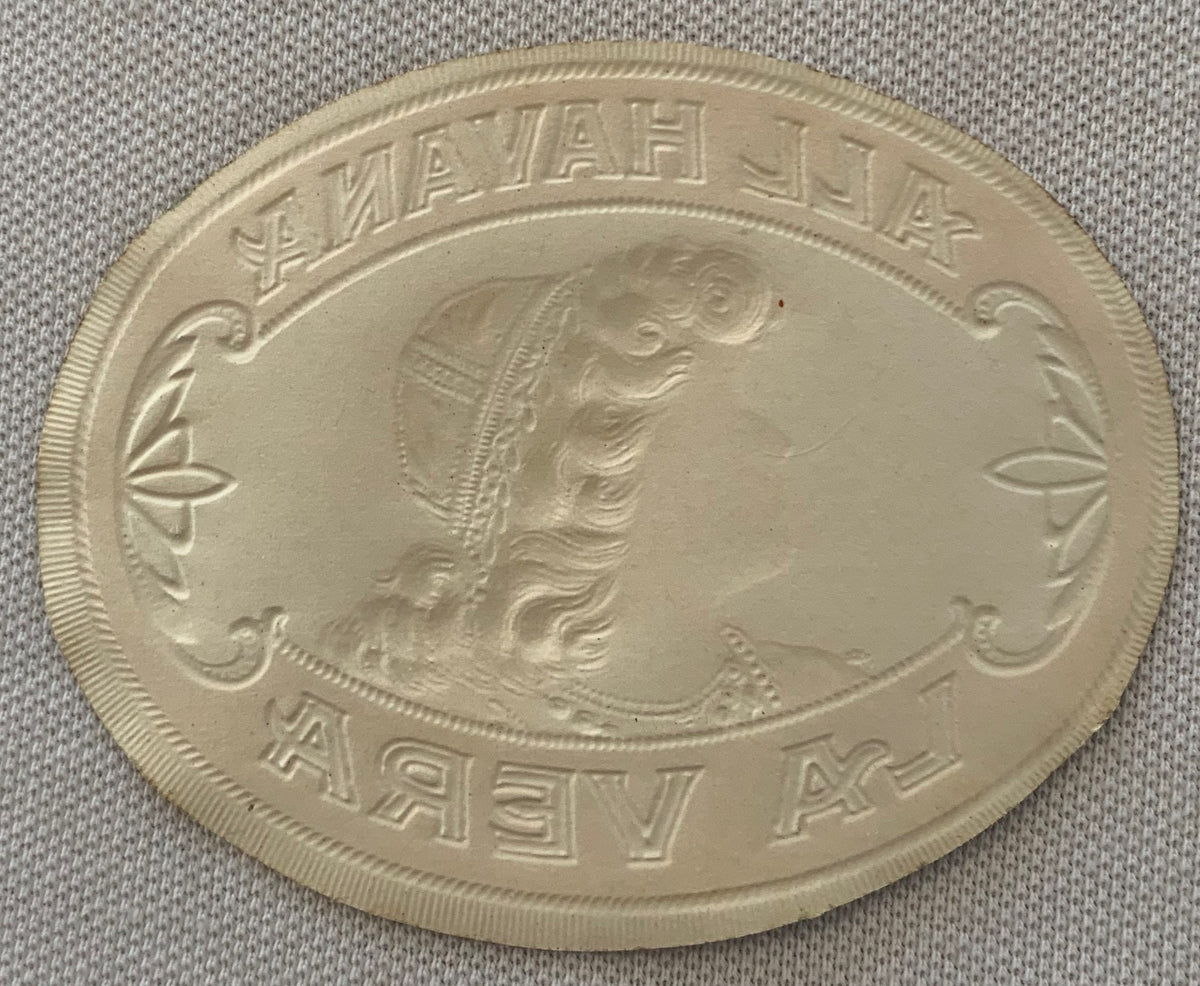
A cigar label had one job: sell the smoke at a glance. This one makes its pitch in gold-shaded capitals. ALL HAVANA arches across the top, LA VERA sweeps across the bottom, and between them a dark-haired woman in a jeweled red-and-gold cap turns her face up and away, as if something finer than the cigar had just gone by. It is an antique embossed chromolithograph cigar label from the 1920s or 1930s, New Old Stock, never glued to a box, with the whole design still standing up in relief from the paper.

🔎 What Is on It

  • The words: ALL HAVANA across the top of a red band and LA VERA across the bottom, in white capitals shaded in gold
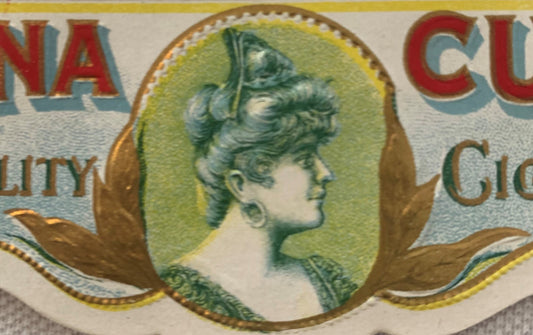
  • The portrait: a woman facing left with her eyes raised, dark curls spilling from a red-and-gold cap edged with beads, a gold necklace at her throat and a red garment at her shoulders
  • The frame: a pale gold-to-green sky behind her, gold scrollwork, and a blue-and-gold fan ornament at each side
  • The rim: a milled, ridged gold border around the whole oval
  • The embossing: lettering, portrait, scrolls and rim are all pressed up from behind; the plain cream back carries the entire design in reverse relief
  • Size: 5.25" x 2.75"

🌿 "All Havana": The Promise in Gold Letters

In the cigar trade Havana was the benchmark leaf, and a label that claimed it was making the strongest promise a box could carry. The most prized Havana leaf of all came from the Vuelta Abajo, in Pinar del Río province in western Cuba, long counted the finest cigar tobacco land in the world and the standard every other cigar leaf was measured against. The American trade had its own term for a cigar made in the United States with nothing but Cuban tobacco: a "clear Havana." ALL HAVANA says the same thing in bigger letters. Then look at the name under it. The La Vera Cigar Co. was a Chicago outfit, but LA VERA under ALL HAVANA reads like it came off a boat from Cuba, and it would not have looked out of place next to the names of the houses in Havana itself. La Gloria Cubana, for one, was created in 1885 by the Sociedad Cabañas y Castro, and from 1905 José F. Rocha made it at his own factory in Havana.

The trade's great American capital grew up in Tampa, Florida: in 1886 Vicente Martinez Ybor moved his cigar factory there from Key West, and his three-story brick factory was the largest cigar factory in the world at the time. The neighborhood that grew around it became Ybor City.

It was also the claim most worth faking. A royal decree of the Spanish crown created a warranty seal for Havana cigar boxes in 1889, and in 1912 the young Republic of Cuba passed a law for a new guarantee seal to fight counterfeits, the green-and-white stamp whose design still marks genuine Havana boxes today. A label could print the words. The seal was meant to prove them.

🏭 A Million and a Half Brands

The trade that printed labels like this one was enormous. Between 1870 and 1920 more than 1.5 million brands of U.S. cigars appeared and disappeared, some 150,000 cigar factories opened and closed, and more than 250 billion cigars were made. At the peak, in 1895, around 42,000 cigar factories were running in the United States at once. Today there might be 50 that still roll cigars.

With that many brands fighting for the same tobacconist's counter, the label was the advertisement, and makers paid printers for faces, gold and relief that stopped the eye. Label printers also sold stock picture labels with no brand on them, ready for any cigar maker to add his own name, so the same pretty face could sell a different cigar in every town. LA VERA's red band, gold rim and upturned profile are exactly that kind of money on paper.

🖨️ Stones, Dies and Gold

Chromolithography built a picture one color at a time. Each color was drawn on its own slab of Bavarian limestone and printed in its own pass through the press, so top-quality labels used somewhere between 12 and 25 stones, and the most elaborate as many as 40. After 1870 New York was full of German-run lithographic firms turning out cigar label art, among them George Schlegel, F. Heppenheimer, Witsch & Schmitt and Schumacher & Ettlinger. After 1890 the best cigar labels took extra runs for embossing and gilding. By 1892 lithographers were working 38-ton presses and precision-machined dies to emboss their labels, and the raised parts were picked out in 22-karat gold or bronze leaf.

Turn this label over and you can see the die's work without any ink at all: the mirrored letters of ALL HAVANA and LA VERA, every curl of the woman's hair, the beads on her cap, the scrolls and the ridged rim all push up through the cream stock. Collectors of stone lithography like to say that the commercial printing of its golden age, from 1870 to 1920, has never been duplicated. Machine-made cigars and photomechanical printing ended it, and the limestone went quiet.

📦 The Label Hunters

Most of the handsomest cigar labels that survive were never used, and the hobby has its legend about how they came out of hiding. In the 1970s one enterprising collector, Mark Trout, became famous for a city-by-city, block-by-block search for old cigar factories and the stock they had left behind. The story told among label collectors is that he saved millions of labels that would otherwise have been thrown away. Unused labels in the collector market still carry that kind of history: printed, stacked, forgotten, and found.

🧭 What Became of the Trade

The world these labels were made for changed in stages. Machines replaced hand-rolling until most factories offered only machine-made cigars. The Great Depression of the early 1930s cut the demand for cigars and shuttered factories. The Cuban embargo of 1962 cut American makers off from the very leaf a label like this one promised. What was once a lid-sized advertisement for a nickel habit is now a small, embossed survivor of the golden age of American commercial printing.

🖼️ Living With It

  • Float it in an oval gilt frame so the milled rim reads as a frame within the frame.
  • Group it with other portrait cigar labels in matching frames for a salon wall.
  • Set it in a bar, den or study beside a humidor, a cigar cutter or old tobacco tins.
  • Give it to a cigar smoker, a collector of tobacciana, or anyone who loves antique printing.
  • Keep it out of strong sunlight, and frame it without glue, so the gold and the relief stay crisp.

❓ Questions People Ask

How old is it? It is a 1920s or 1930s label, an embossed and gilded chromolithograph of the kind the trade printed on stone before photomechanical printing took over. Nothing on the oval itself is dated — no printer, no town, no factory number — but the same portrait turns up on other La Vera labels whose foot line reads COPYRIGHT 1921 BY LA VERA CIGAR CO., CHICAGO, ILL., and those printings carry the imprint of the Consolidated Lithographing Corporation, a house formed around 1925. So the artwork cannot be older than 1921, whatever year this particular oval came off the stone.

Was it ever on a cigar box? No. It is New Old Stock: never applied, with a clean back and its embossing intact.

Who made La Vera cigars? The label prints only the brand, LA VERA, and the claim, ALL HAVANA. No maker, printer or town appears on it.

What does "All Havana" mean on a label? That the cigar was made entirely from Havana leaf, the most prized tobacco of the day, the same promise the trade called "clear Havana."

Is the gold printed or raised? Both. The gold shading and rim are printed, and the design is embossed, so the rim, letters and portrait stand up from the surface and show in reverse on the back.

Shipping

🚚 Shipping & Handling

  • Shipping costs and timing are calculated at checkout.
  • Items curated and shipped directly by me include U.S. shipping at no additional cost, professionally packed to ensure safe arrival of your artifact.

Items from Vetted Pro Collectors
Shipping for items offered by vetted Pro Collectors is determined at checkout. All Pro Collector listings are reviewed to ensure fair, reasonable shipping practices.

For full details, please refer to our Shipping Policy.

Returns & Exchange

Take your time — you've got a full six months. If a piece isn't right for you, send it back the way it reached you and we're good.

In the first 30 days your money goes straight back the way you paid. After that it's store credit, so you can put it toward something you'd rather have.

Return shipping we sort out between us, case by case. I don't make this difficult.

If something arrives damaged, or it isn't what I said it was, send me a photo within 48 hours and I'll make it right.

Email info@vintageantiquesgifts.com or call 802-356-9872 — that's me answering, not a call center.

The only things I can't take back are custom or special-order pieces and gift cards.

View full details

Preserving History: Authentic Objects Across Eras

— Curated by Travis Weigel