
Skip to product information
1 of 8

Vintage and Antique Gifts

Vintage 60s 70s Raleigh Tobacco Coupons ๐Ÿšฌ Brown and Williamson Collectible Ephemera Premium Plan B and W Set

Vintage 60s 70s Raleigh Tobacco Coupons ๐Ÿšฌ Brown and Williamson Collectible Ephemera Premium Plan B and W Set

Regular price $6.00 USD
Regular price Sale price $6.00 USD
Sale Sold out
Shipping calculated at checkout.

Size: 2 1/4" x 1 3/4"

๐Ÿšš Free US Shipping โ€” ships within one business day. International shipping calculated at checkout.

Quantity

Remember Raleigh Cigarette Coupons? The King of Coupons ๐ŸŽด Raleigh, Brown & Williamson and the Paper Americans Tore Off Their Cigarette Packs

Size: 2 1/4" x 1 3/4"

Raleigh was remembered as the king of coupons. In September 1932, in the worst stretch of the Great Depression, Brown & Williamson began printing a coupon on every pack of Raleigh cigarettes, and for the next several decades smokers tore them off, saved them up, and mailed them to Louisville, Kentucky for merchandise out of a free catalog. This set holds three pieces of that habit, four coupons in all: a B&W coupon, a Raleigh coupon with Sir Walter Raleigh's face printed behind the words, and an uncut pair of B&W coupons still joined at the perforation.

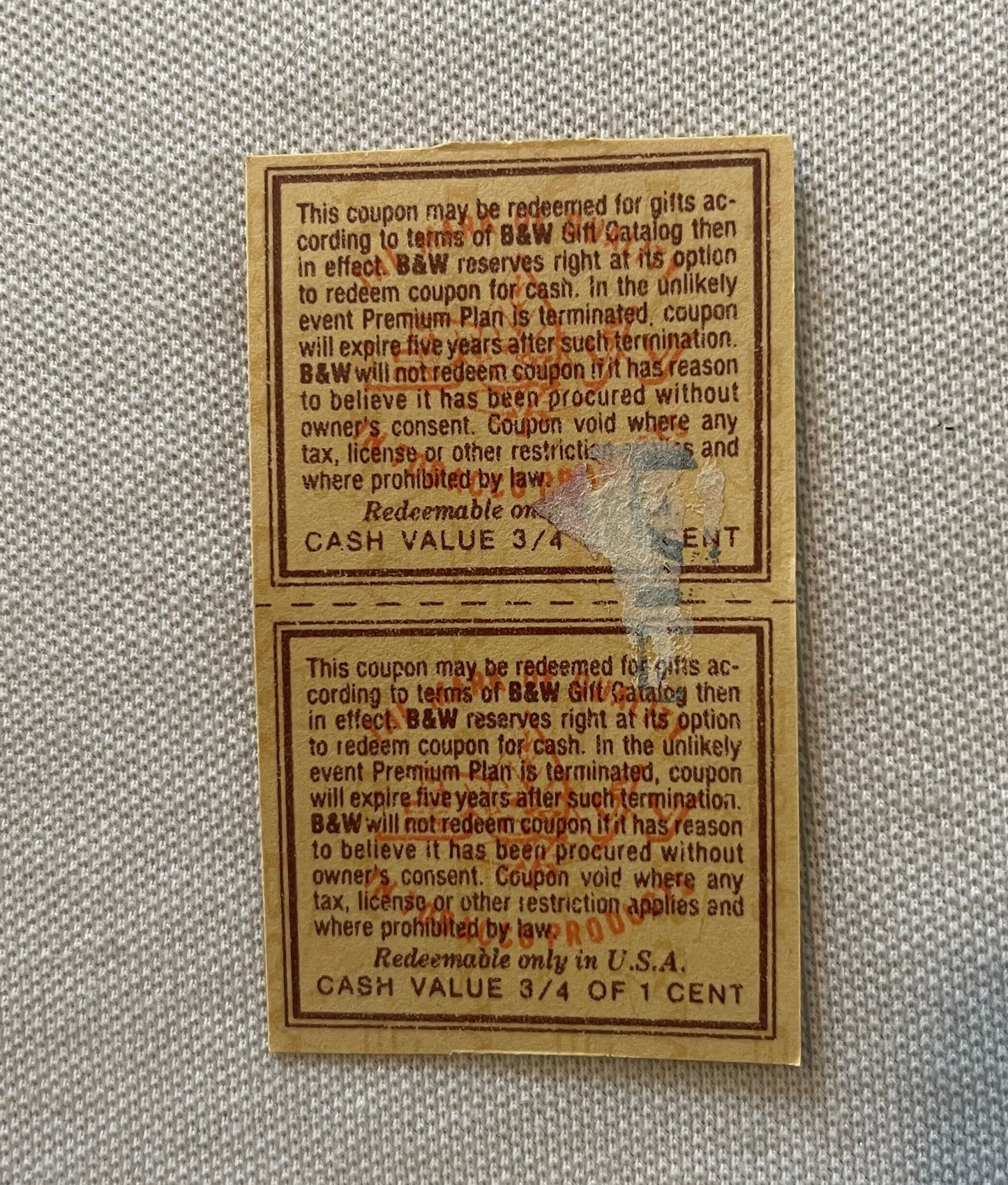
Look at the backs and you can see how they were collected. In his own words: "Might have some minor edge wear and paper stuck to the back, see pictures and video, as these were ripped off of cigarette packs." That paper is the pack itself, still clinging to the coupon it once held.

Size: 2 1/4 x 1 3/4" ~ larger 2 3/4" x 1 3/4" ~


๐Ÿ” What Is Printed on Each Piece

The B&W coupon, Series 23

Across the top: ONE, a large orange 1, ONE, then B&W COUPON. The text reads: "Redeem B&W Coupons for valuable gifts through the Brown & Williamson Premium Plan. You get famous B&W coupons on every package of RALEIGH and BELAIR cigarettesโ€”plus four extra coupons in every carton. Send for new free catalog. BROWN & WILLIAMSON TOBACCO CORP. BOX 903 LOUISVILLE, KENTUCKY 40201." The back carries the redemption terms over the company's orange leaf emblem, lettered THE MARK OF QUALITY IN TOBACCO PRODUCTS, and gives a cash value of 1/4 of 1 cent.

The Raleigh coupon, Series 17

This one says RALEIGH COUPON in heavy brown capitals, and behind the text, printed in pale orange, is the bearded portrait of Sir Walter Raleigh in his plumed hat. Its wording is slightly different: coupons came "on every package of RALEIGH and light menthol BELAIR cigarettes." The back refers to "the terms of the RALEIGH gift catalog," adds that "In the unlikely event this Premium Plan is terminated, this coupon will expire five years after such termination," and states a cash value of 3/4 of 1 cent.

The uncut Series HH pair

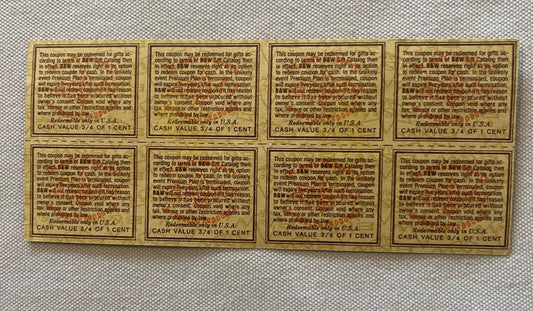
Two B&W coupons in a later, tighter layout, still joined along a dashed perforation. Each adds a line the singles do not have: "OR CALL TOLL FREE 1-800-626-5510 EXCLUDING ALASKA AND HAWAII (KY. RESIDENTS CALL 1-800-752-6010)." The backs speak of the "B&W Gift Catalog," warn that "B&W will not redeem coupon if it has reason to believe it has been procured without owner's consent," and again give the cash value as 3/4 of 1 cent.


๐Ÿ“ฎ Dating Them From Their Own Small Type

The coupons date themselves better than any style guess could. All three pieces print the Louisville ZIP code 40201, and ZIP codes did not exist until the Post Office introduced them on July 1, 1963. So none of these was printed earlier than that.

The Series HH pair goes a step further. AT&T's automated toll-free 800 service arrived for calls inside a state in 1966 and for calls across state lines in 1967. Under the rules of the day a business needed one number for out-of-state callers and a separate number for callers inside its own state, which is exactly why Kentucky residents were sent to a different 800 number than everyone else. The coupon itself notes that the number could not be dialed from Alaska or Hawaii. That pair comes from the toll-free years, after 1967.

Belair gives one more anchor. Brown & Williamson launched it in 1959 as a mild, filtered king-size menthol, and brought out Belair 100s in 1968. Taken together, the small type puts this set squarely in the 1960s and 1970s.


๐Ÿญ The Company: From a Leased Building in Winston to a Louisville Giant

Brown & Williamson began in Winston, North Carolina, the town that later became Winston-Salem. George T. Brown and his brother-in-law Robert Lynn Williamson began manufacturing in a leased facility in February 1894. In 1927 the two families sold the business to London-based British American Tobacco, which reorganized it, built a new factory in Louisville, and ran its American operation from that city for the rest of the century. That is the Louisville address printed on every coupon here: Box 903, Louisville, Kentucky.

From Louisville came Raleigh, Kool (1933), Viceroy (1936) and Belair (1959). Kool and Viceroy both carried coupons when they were introduced, so the premium habit was built into the company's brands from the start.

The company's later history is darker and far better known. Jeffrey Wigand, hired as vice president of research and development in 1989, was fired in 1993 and later told CBS's 60 Minutes what he had learned inside the company; his story became the 1999 film The Insider. On July 30, 2004, Brown & Williamson's U.S. operations merged with R.J. Reynolds to form Reynolds American, and Brown & Williamson ceased to exist as an independent company. The Louisville box number these coupons point to has no one left to answer it.


๐ŸŽ The Premium Plan: How a Coupon Worth Three-Quarters of a Cent Held a Customer

The best early record of the plan is a 1951 U.S. Tax Court decision, Brown & Williamson Tobacco Corp. v. Commissioner, which laid the program out in plain numbers. Coupons started with Raleigh in September 1932. One coupon went on each pack, with bonus coupons packed into cartons to reward dealers and customers. The company gave each coupon a cash redemption value of 3/4 of one cent, and the Raleigh coupon and the uncut pair in this set, printed thirty-odd years later, still carry that same 3/4-cent figure. The B&W Series 23 single is the odd one out: turn it over and it says 1/4 of 1 cent.

The Second World War reshaped the plan. From 1941 smokers could turn coupons into defense stamps, war savings stamps and bonds. Merchandise redemptions stopped around December 1, 1943, when goods were scarce, and from November 1944 coupons could be redeemed for cigarettes. The court also recorded that although coupons generally expired within 36 months, the company ignored those dates and redeemed every coupon presented until it finally enforced a cutoff of February 28, 1946.

After the war the catalog came back, and the pieces in this set show what it looked like by the 1960s and 1970s: one coupon on every pack, "four extra coupons in every carton," a free catalog by mail, and eventually a toll-free number to call. Raleigh kept incentives on the pack into the 1990s. The saving never really stopped either; lots of five thousand and more saved B&W and Raleigh coupons still turn up, the leftovers of households that were working toward something in that catalog and never got there.


๐Ÿ“ป Raleigh on the Radio: Red Skelton and "I Dood It!"

Before the coupons became the thing people remember, Raleigh bought a comedian. The Raleigh Cigarette Program premiered on NBC on October 7, 1941, on Tuesday nights at 10:30, right after Bob Hope's Pepsodent Show. Red Skelton headlined, with Ozzie Nelson leading the orchestra and Harriet Nelson singing and playing his comic foil. Skelton introduced Clem Kadiddlehopper, the country bumpkin, and Junior, "the mean widdle kid," whose catchphrase "I dood it!" became so popular it titled Skelton's 1943 film. The show ended June 6, 1944, when Skelton was drafted, and returned under Raleigh's name after the war.


๐ŸŒซ๏ธ The Legend of Sir Walter Raleigh and the Bucket of Water

The face printed behind the text of the Raleigh coupon belongs to the brand's namesake, the Elizabethan courtier and explorer long credited with making tobacco fashionable in England. He never went to Roanoke himself, but he sent out the Roanoke voyages of the 1580s, his two tries at founding the first permanent English settlement in North America, and when the first Roanoke colonists got back to England in July 1586 they brought tobacco with them. Old tradition says it was Ralph Lane, the colony's governor, who carried the first of it into England. Raleigh's name has been tied to tobacco ever since, and B&W came by it honestly: in 1925 the company bought the J. G. Flynt Tobacco Company, which had been selling Sir Walter Raleigh pipe tobacco around its region since 1884, took the brand national, and brought out Raleigh cigarettes in 1928. The best-loved story about him is a legend: a new servant, seeing clouds of smoke rising from behind his master's chair the first time Raleigh lit a pipe, assumed he was on fire, fetched a bucket of water, and soaked him. Victorian illustrators drew the scene again and again, and the tale has outlived any evidence for it. Brown & Williamson put that same Raleigh on the coupon that promised smokers a reward for every pack.


๐Ÿ™๏ธ Louisville, Kentucky

For most of the twentieth century Brown & Williamson was a Louisville institution, and the city's name was printed millions of times over on its packs and coupons. The Premium Plan lived there too. By the time these were printed, saved coupons went to Box 903, Louisville; back in the war years the coupon sent you to Box 599 instead, and it was packed with Kool and Viceroy as well as Raleigh. The separate toll-free number for Kentucky residents on the Series HH pair is a small reminder that the plan's home state was treated differently from every other state on the telephone map.

Louisville is where the cigarettes got made, too. When B&W's new factory at 16th and Hill Streets was nearly finished in September 1929, a small sign near the back of the building already read "The Home of Raleigh Cigarettes." I love that. By the 1970s Louisville and Petersburg, Virginia were the company's two big cigarette plants, and both were full. In January 1977 B&W opened a new plant in Macon, Georgia, starting it up with a core crew of workers moved down from Louisville and Petersburg. The Louisville factory closed in 1982 and the building came down around 1986, though the head office stayed in Louisville until the 2004 merger.


๐Ÿ–ผ๏ธ Ways to Display Them

  • ๐Ÿ—‚๏ธ In a small shadow box beside a Raleigh or Belair pack of the same period, fronts and backs both visible.
  • ๐Ÿ“š Sleeved in a collector's page, with the uncut pair kept whole to show the perforation.
  • ๐ŸŽ As a gift for anyone whose parents or grandparents saved Raleigh coupons toward something in the catalog.
  • ๐Ÿ›๏ธ As a teaching piece on dating paper by its own printing: ZIP code, toll-free numbers, brand names.

๐ŸŽด About these

They can't be redeemed anymore - the Premium Plan is long gone, and Brown & Williamson itself merged into Reynolds American on July 30, 2004 - so today they're tobacco advertising history, a little paper from the days when a pack of Raleighs came with a coupon for the gift catalog. The paper on the backs is from being torn straight off the packs. The supply is finite - nobody's printing Raleigh coupons again, and once these last sets are gone, they'll be very difficult to acquire.

Shipping

๐Ÿšš Shipping & Handling

  • Shipping costs and timing are calculated at checkout.
  • Items curated and shipped directly by me include U.S. shipping at no additional cost, professionally packed to ensure safe arrival of your artifact.

Items from Vetted Pro Collectors
Shipping for items offered by vetted Pro Collectors is determined at checkout. All Pro Collector listings are reviewed to ensure fair, reasonable shipping practices.

For full details, please refer to our Shipping Policy.

Returns & Exchange

Take your time โ€” you've got a full six months. If a piece isn't right for you, send it back the way it reached you and we're good.

In the first 30 days your money goes straight back the way you paid. After that it's store credit, so you can put it toward something you'd rather have.

Return shipping we sort out between us, case by case. I don't make this difficult.

If something arrives damaged, or it isn't what I said it was, send me a photo within 48 hours and I'll make it right.

Email info@vintageantiquesgifts.com or call 802-356-9872 โ€” that's me answering, not a call center.

The only things I can't take back are custom or special-order pieces and gift cards.

View full details

Preserving History: Authentic Objects Across Eras

โ€” Curated by Travis Weigel