Skip to product information
1 of 4

Vintage and Antique Gifts

Vintage Gumby & Pokey Figurine Sets 1970s–1980s 🐴 NOS Bendable Toy Characters 🟢 Classic Claymation Collectibles 🎬

Vintage Gumby & Pokey Figurine Sets 1970s–1980s 🐴 NOS Bendable Toy Characters 🟢 Classic Claymation Collectibles 🎬

Regular price 10.00 USD
Regular price Sale price 10.00 USD
Sale Sold out
Shipping calculated at checkout.
Size

Description

🟢 Vintage Gumby & Pokey Figurine Sets — Molded Plastic, 1970s–1980s, New Old Stock (NOS)

Some toys outlast their era. They sit in a drawer, a display case, or a collector's shelf and keep right on meaning something — not because they were expensive or complicated, but because they carried a whole world inside them. That is exactly what these tiny molded plastic figures do. Green Gumby with his arm raised in that unmistakable wave. Orange Pokey standing steady. Teal Pokey in two slightly different molds, each with those wide cartoon eyes and the goofy grin that defined Saturday mornings for an entire generation. These are New Old Stock (NOS) Gumby and Pokey figurines from the 1970s–1980s production era — approximately 2 inches tall, molded in hard plastic, and carrying every bit of the charm Art Clokey put into the original clay animation characters back when television was still young.

What you are looking at here is a genuine piece of American pop culture manufacturing history — small enough to hold in your palm, big enough to take you straight back.


📐 The Figures Themselves

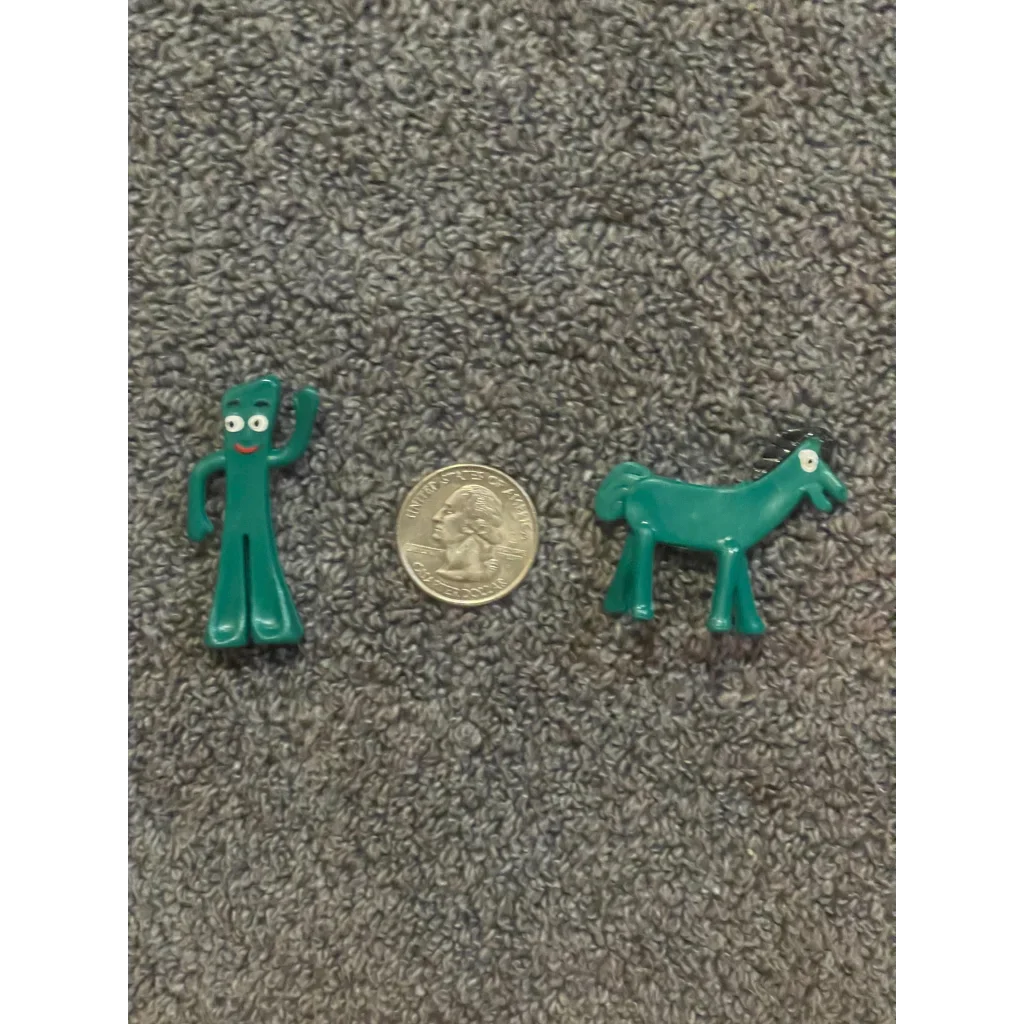
The set includes five figures total: one green Gumby character with painted facial features — eyes, a small smile, the signature lopsided peak of his head — and his right arm raised in a wave; two orange figures, one with full painted facial detail including eyes and a more expressive face, the other showing a plainer molded form consistent with period variation; and two teal-green Pokey horse figures, each with black-painted mane and tail detail, wide white-and-black eyes, and the open-mouth grin Pokey always wore.

The green Gumby figure has his characteristic asymmetric head shape — that famous diagonal peak — and the two-tone body that registers cleanly in person. 🐴 The Pokey figures show subtle mold differences between the two: one sits slightly squarer in the body, the other with legs that splay just a touch differently — period manufacturing variation that collectors recognize immediately and appreciate as part of the charm. The orange figures similarly show that same hand-of-the-era quality: slightly imprecise painted features that read as genuine production artifacts, not modern reproductions.

All five figures are molded hard plastic, not the bendable rubber Prema Toy Co. PVC versions that came slightly later. These are the rigid 2-inch format — a distinct, smaller product variant from the bendable line, confirmed by competing NOS listings for this exact mold type. The teal color on the Gumby figure and both Pokey figures is consistent with the production palette of the Lakeside and early Jesco manufacturing years.

  • 🟢 1 green Gumby figure — arm raised, painted face, signature peak head
  • 🟠 2 orange Pokey-style figures — one with full painted facial detail, one plainer mold variant
  • 🐴 2 teal-green Pokey horse figures — black-painted mane and tail, white-and-black eyes, open-mouth expression
  • 📏 Approximately 2 inches tall — molded hard plastic, not bendable rubber

📺 Where Gumby Came From — And Why It Matters

Gumby was born in 1953, the creation of Art Clokey, a filmmaker and animator who had studied at USC and developed an obsession with the expressive possibilities of clay. His graduate short film — a wild, rhythmic piece of clay animation set to jazz — caught the attention of Sam Goodman at the Howdy Doody production company, and from that introduction, Gumby got his first television slot in 1956 as a segment on the Howdy Doody Show. By 1957, Gumby had his own program.

🎨 The character was deceptively simple: a green humanoid shape with a lopsided head, arms that could reach anywhere, and a best friend — Pokey, the orange pony — who kept him grounded. Clokey used stop-motion clay animation, photographing each tiny movement frame by frame, and the resulting films had a dreamlike, slightly wobbly quality that felt unlike anything else on television. Children responded to it immediately. Adults who saw it years later often described it as hypnotic.

Clokey famously resisted merchandising Gumby through the late 1950s and early 1960s. He wanted the character to remain an artistic project, not a product. But the letters kept coming — thousands of them, from children across the country asking where they could get a Gumby of their own. By 1964 he relented, and in 1965 the first Gumby toys entered the market under the name Gumby Super-Flex, manufactured by Lakeside Toys. Those early figures were modeled after the puppets used in the 1962–1968 television episodes and made to bend and pose just like the on-screen character.

Lakeside held the manufacturing rights through the 1970s, and it is from this era that the molded plastic 2-inch format emerged alongside the bendable versions — a smaller, more affordable collectible format aimed at a younger market and the gumball-machine and prize-pack distribution channels that were booming during the decade. 🏪 By the 1980s, Lakeside transitioned the rights to Jesco, which operated in conjunction with Prema Toy Co., Inc. — a name that appears consistently on period product from this era. Jesco's packaging moved toward more rectangular formats and the figures continued under the simplified Gumby brand name. These NOS figures sit squarely across that Lakeside-to-Jesco window, carrying the manufacturing character of both decades.


🌿 The Color, the Head, and the Lore

Among collectors and Gumby enthusiasts, a handful of stories about the character's origins have been passed down for decades — some verified, some slipping into the comfortable territory of legend, all worth knowing.

Art Clokey spoke publicly about his choice of green for Gumby on more than one occasion. He described green as a color he saw as racially neutral — a living, natural hue that belonged to no single human group — and as a symbol of life itself. Whether that explanation was the whole story or a piece of it, green became inseparable from Gumby's identity. 💚 The teal-green of these figures sits in exactly that tradition: not a bright crayon green, but a deep, slightly blue-tinged green that photographs as rich and distinctive.

The peak of Gumby's head — that diagonal rise on the left side — carries its own quiet legend. The story passed down among Clokey fans holds that the shape was based on his father's distinctive haircut, a wave that rose on one side and that Clokey remembered from childhood photographs. Whether that is biography or affectionate mythology at this point is hard to say, but it is the kind of detail that makes the character feel personal rather than corporate — designed by a son who missed someone, not by a committee.

Then there are the orange figures. 🟠 Among collectors, the orange color variation in Gumby-universe figurines carries particular weight. The story circulating in collector communities holds that the color variations — especially orange figures — reflect the broader, more experimental merchandising strategies of the 1970s and early 1980s, when manufacturers were testing different colorways for different retail channels. Orange Gumby figures show up less consistently than green ones, and their appearance in NOS sets alongside the standard green variants is exactly the kind of dual-colorway survival that makes a set like this feel like a complete period document rather than a single leftover piece.

And then there is the ghost variant story that floats around collector circles: the lore of a special Bicentennial Gumby figure said to have been mailed directly to fans in 1976 as part of a limited commemorative release tied to the American Bicentennial. Whether this figure genuinely exists in the wild, whether it was a regional promotion, or whether it grew from a single misremembered childhood memory amplified over decades — no one has definitively settled it. But it gets mentioned every time serious Gumby collectors gather, and it speaks to something real: Gumby merchandise from this era was distributed through enough different channels, in enough different formats, that surprises still turn up.


🏭 Lakeside, Jesco, and the Manufacturing Chain

Lakeside Toys was a Minneapolis-based toy manufacturer that had been producing games and novelties since the 1950s. By the time they acquired the Gumby toy license in the mid-1960s, they were a well-established mid-tier manufacturer — not the size of Mattel or Hasbro, but with real distribution reach and a track record of producing durable, affordable plastic toys for the mass market. The Gumby line fit their model perfectly: simple forms, low material cost, broad appeal, and the television promotional engine already running in the background.

🔧 Through the 1970s, Lakeside continued producing both the bendable rubber figures and the smaller rigid plastic formats. The 2-inch molded figures from this era have a slightly thicker, more solid feel than the later Jesco versions — a product of the tooling choices and plastic compounds Lakeside favored. Collectors who handle both generations often note the difference in hand: the Lakeside-era pieces feel heavier for their size.

When Jesco acquired the rights in the 1980s, the production moved but the essential character of the figures stayed consistent. Jesco's releases were simply titled Gumby, stripped of the Super-Flex branding, and the packaging evolved. The Prema Toy Co. name appears on period product from this Jesco collaboration — a detail that surfaces reliably in collector documentation and confirms the manufacturing partnership that kept Gumby figures in circulation through the decade. The figures in these sets carry the visual and material character of that entire Lakeside-to-Jesco window, making them authentic representatives of both production eras.


🎠 Art Clokey and the World He Built

Art Clokey was not a typical toy licensor. He came to Gumby through fine art, through film theory, through a genuine interest in what animation could express that live action could not. He studied at the Chouinard Art Institute before transferring to USC, and his influences ranged from Norman McLaren's abstract animation to his own spiritual development — Clokey was deeply influenced by Vedanta philosophy and later by his involvement in the Episcopal Church, and both threads ran through the themes he embedded in the Gumby films.

📽️ The television series that ran from 1957 into the 1960s was genuinely strange in the best way: Gumby and Pokey could walk into books and find themselves inside the stories, travel through time, encounter characters from history and mythology. The plots were loose and imaginative, driven more by visual possibility than narrative logic. Children loved it. Film scholars who revisited it decades later noted how ahead of its time the premise was — the idea of a character who could enter any narrative world is practically a theory of media literacy built for a six-year-old.

Clokey revived the series in the 1980s with new episodes, which coincided exactly with the Jesco manufacturing era. 📺 The revival brought a new generation of children to the character and drove renewed interest in the merchandise. NOS stock from this period — figures that were produced for that revival market and survived unopened — carries the specific weight of a moment when Gumby was genuinely current again, not nostalgic, not retro, just present and beloved.


🔍 What Collectors Look For

Gumby collecting has its own established language and its own hierarchy of desirability. The earliest Lakeside Super-Flex bendable figures from the mid-1960s sit at the top — those are the ones that show up in display cases at serious collector shows. But the 1970s and 1980s rigid plastic figures occupy a distinct and appreciated tier: they are old enough to carry genuine period character, produced in sufficient variety that complete sets are genuinely satisfying to assemble, and small enough that displaying a full grouping requires almost no space.

🟢 The green Gumby with full painted facial detail — eyes, smile, the raised arm — is the anchor of any set. The two teal Pokey horse figures with black mane and tail paint represent the consistent companion character across both production eras. And the orange figures — particularly the one with full painted facial features — are the variables that collectors track, because color variants from this era appear less predictably and anchor a set as representative of the full manufacturing range rather than a single standardized production run.

Five-piece NOS sets with this specific combination of green Gumby, dual orange variants, and dual teal Pokey horses are a complete cross-section of the color and character range from the period. Finding all five in NOS condition — no play wear, no bending stress on the plastic, paint details intact — is exactly the kind of survivorship that makes a set worth adding to a collection rather than just an interesting individual piece.

  • 🟢 Green Gumby — painted face, raised arm, signature asymmetric peak head
  • 🟠 Orange variant figures — one with full painted detail, one plainer production variant
  • 🐴 Dual teal Pokey horse figures — black mane/tail paint, white-and-black eyes
  • 📏 Approximately 2 inches tall — confirmed hard molded plastic format
  • ✨ New Old Stock (NOS) — production paint and molded detail intact

🕰️ Preserving the Era

Toy lines from the 1970s and 1980s are disappearing from the collector market in a specific way: not because fewer people want them, but because the NOS stock that survived the decades is slowly being absorbed into collections and not re-entering circulation. Figures that spent forty years in a warehouse, a toy store back room, or an estate sale box represent the last clean survivors of their production run — pieces that never saw the rough handling of a child's afternoon, never sat in a car's back seat through a summer, never got bent or chipped or lost behind a couch cushion.

🏛️ Gumby occupies a specific place in American cultural memory that very few television characters share. He predates the modern licensing machine. He was created by an artist who resisted commodification and then relented to it — and that ambivalence shows in the merchandise: simple, honest, not over-engineered, made to be held and recognized rather than to dazzle. These figures carry that same quality. They are not elaborate. They are not trying to do too much. They are Gumby and Pokey in molded plastic at 2 inches tall, and they are immediately, completely recognizable to anyone who grew up with a television in the 1970s or 1980s.

That recognition is what collecting preserves. Not just the object — though the object matters — but the moment of seeing it and knowing it instantly. These figures carry that moment intact.


📦 NOS Condition — What That Means Here

New Old Stock (NOS) is the collecting term for items that were manufactured, distributed to the retail or wholesale chain, and then survived without being sold through — sitting in storage for decades, arriving today in the condition they left the factory. For small plastic figures like these, NOS survival means the paint details are present and legible, the molded forms are clean, and the plastic carries its original color rather than the yellowing or stress-whitening that play-worn pieces show.

✅ These figures are NOS. The painted facial features on the green Gumby and the detailed orange figure are intact. The black mane and tail paint on both Pokey figures reads cleanly against the teal body color. The molded forms show the crisp edge definition of figures that were never flexed or dropped. This is period manufacturing quality preserved across four-plus decades — the same condition these figures were in when they came off the production line during the Lakeside-to-Jesco era of Gumby merchandise.


🌟 A Note on the Character's Legacy

Gumby never entirely went away. The 1980s revival introduced him to a new audience. Eddie Murphy's famous Gumby sketch on Saturday Night Live in the early 1980s — played entirely straight as a parody of celebrity ego — brought the character to an adult audience who found the absurdity of a green clay figure demanding respect genuinely funny. It also kept Gumby culturally present through a decade that might otherwise have moved on.

🎭 Art Clokey continued to be involved with his creation until his death in 2010 at the age of 88. He spoke in later interviews about the spiritual dimensions of the character — the idea that Gumby's ability to enter any world, to belong anywhere, was meant to represent the soul's freedom from limitation. Whether viewers caught that subtext or simply loved the wobbly green figure for his own sake, the result was the same: a character who lasted sixty-plus years and is still immediately recognizable to anyone who encounters him.

These figures are a physical record of that lasting quality — manufactured during the character's second major cultural moment, surviving intact into the present, carrying the visual shorthand of an entire era of American children's television in approximately 2 inches of molded teal and orange plastic. 🟢🟠🐴

Shipping

🚚 Shipping & Handling

  • Shipping costs and timing are calculated at checkout.
  • Items curated and shipped directly by me include U.S. shipping at no additional cost, professionally packed to ensure safe arrival of your artifact.

Items from Vetted Pro Collectors
Shipping for items offered by vetted Pro Collectors is determined at checkout. All Pro Collector listings are reviewed to ensure fair, reasonable shipping practices.

For full details, please refer to our Shipping Policy.

Returns & Exchange

Product Page Return Policy

  • 60-Day Returns – Items must be in original condition.
  • Refunds – Issued after inspection (excluding shipping costs).
  • Return Shipping – Customer is responsible unless item is damaged or incorrect.
  • Damaged/Incorrect Items – Contact us within 48 hours for a replacement or refund.
  • Easy Returns – Email info@vintageantiquesgifts.com or call 802-356-9872 to initiate a return.

For full details, visit our Refund Policy.

View full details