Skip to product information
1 of 3

Vintage and Antique Gifts

Antique Rudolph Valentino Cigar Band Quality Cigar Label 1900s - 1920s New Old Stock Collectible Silent Film Era Tobacco 🚬

Antique Rudolph Valentino Cigar Band Quality Cigar Label 1900s - 1920s New Old Stock Collectible Silent Film Era Tobacco 🚬

Regular price 5.50 USD
Regular price Sale price 5.50 USD
Sale Sold out
Shipping calculated at checkout.
Quantity

Was There Ever a Star Who Made the World Forget to Breathe? 🎬

There is a particular kind of fame that belongs only to a handful of human beings across all of recorded history — the kind that doesn't just fill a theater or top a chart, but rewires the collective nervous system of an entire civilization. Rudolph Valentino had that kind of fame. He didn't earn it slowly or build it carefully. He arrived, and the world simply stopped what it was doing and stared. The sheik. The tango dancer. The Latin Lover with the smoldering eyes and the impossible cheekbones. He was the first global movie idol in the modern sense — a man so thoroughly magnetizing that even his name, spoken aloud, conjured something close to fever. When he died in August of 1926 at just 31 years old, the grief was not metaphorical. It was a physical, public, overwhelming thing. Women collapsed in the streets outside the funeral home. Newspapers ran front-page headlines for days. And in a moment that speaks to the almost frightening depth of his cultural imprint, by some accounts more than a dozen people in cities across the country chose to follow him into death rather than live in a world without him. That is not celebrity. That is mythology wearing a suit.

What you hold in this listing is a small, extraordinary relic of that mythology — a surviving fragment of the commercial culture that rose up around Valentino's name while he was still alive and at the absolute zenith of his fame. And it has survived, pristine and unplaced, for a hundred years.


✨ What This Is — The Object Itself

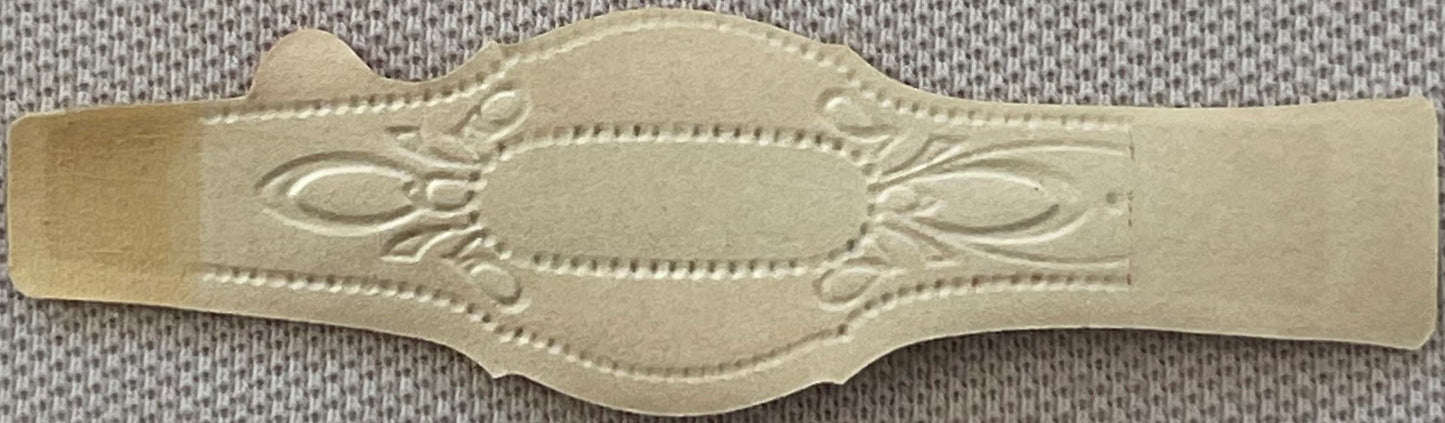
This is an authentic antique cigar band label from the Rudolph Valentino cigar brand, dating to the 1920s during the height of the silent film era. It is New Old Stock — NOS in the collector's shorthand — meaning it was never applied to a cigar. It survived the century not on a smoked stogie in someone's ashtray, but in a printer's flat or a tobacconist's stock room, untouched, waiting. That distinction matters enormously to collectors, and it shows in the condition: this band presents with the crispness and clarity that only an unplaced label can offer.

The band measures approximately 2¾ inches by ½ inch and takes the distinctive butterfly silhouette of classic cigar ring labels — that elegant, two-flanged form with end tabs engineered to wrap and lock snugly around the body of a cigar. The face is embossed gold, a production technique that required a separate die-stamping process beyond ordinary color printing, pressing the design up from the paper itself to create a three-dimensional surface that catches light and signals quality. This was not a budget production. Someone — a manufacturer, a licensor, an agent acting on Valentino's behalf or on the commercial momentum of his name — invested in premium printing to associate this brand with the glamour of the man himself. The label is American made, produced during an era when domestic tobacco printing was a serious, skilled trade executed by specialty lithography houses that served the cigar industry with extraordinary craft. The result is a piece of paper ephemera that reads less like a label and more like a tiny portrait — a miniature monument to the most famous face on earth in 1923.


🏭 The Tobacco Industry and the Celebrity Cigar Phenomenon of the 1920s

To understand why a cigar band bearing Rudolph Valentino's name exists at all, you have to understand the peculiar and deeply American marriage between tobacco culture and celebrity that flourished in the first decades of the twentieth century. Cigars in the 1920s were not a niche pleasure. They were ubiquitous — in hotel lobbies, in barbershops, in the back rooms of city politics, in the offices of factory owners and film producers alike. The cigar was a democratic luxury, affordable enough for a working man to enjoy on a Saturday and aspirational enough that premium brands carried genuine social weight. A man's choice of cigar communicated something about who he was and who he aspired to be.

The tobacco industry understood this perfectly, and it understood equally well the power of a famous name on a band. Celebrity cigar lines proliferated throughout the late nineteenth and early twentieth centuries — prizefighters, politicians, and presidents all lent their names and likenesses to tobacco products. But the rise of motion pictures created an entirely new category of celebrity, one defined not by achievement in a traditional field but by pure, manufactured glamour. Film stars were icons of aspiration in a way that even senators and heavyweight champions were not. They were larger than life, literally — projected thirty feet tall on a silver screen in a darkened room, their faces filling the entire field of vision of thousands of viewers at once. The emotional intimacy that the close-up created between actor and audience was unprecedented in human experience, and the tobacco industry moved quickly to monetize it.

By the early 1920s, celebrity endorsements and licensed name products were a recognized commercial strategy, and Valentino — at the absolute peak of his fame following The Sheik in 1921 and Blood and Sand in 1922 — was the single most recognizable face in the world. Lore passed down among tobacciana collectors holds that Valentino cigar products were marketed specifically to capitalize on his masculine image, a counterpoint to the constant journalistic debate of the era about whether his brand of romantic, expressive, foreign-born masculinity was threatening or aspirational to American men. The cigar, in that context, was a statement — here is something a real man smokes, wearing the name of the most talked-about man in the country. Whether Valentino himself was closely involved in the licensing arrangement or simply lent his name commercially is a question that serious collectors debate, and local legend in the tobacciana world has it that these bands were produced in relatively small quantities compared to standard cigar label runs, making survivors — and especially NOS survivors — genuinely uncommon.


🎞️ The Silent Film Era and the World That Made This Label Possible

The 1920s were a decade that believed, with complete sincerity, that the movies had changed everything — and they were right. Between approximately 1920 and 1927, before synchronized sound arrived and reshuffled the entire deck, silent cinema was the dominant popular art form in the Western world, and its stars existed in a peculiar dreamlike space between reality and pure image. Audiences could project anything onto them. They were gorgeous and silent and flickering and perfect. Valentino was the apotheosis of this phenomenon. His looks were extraordinary by any standard — the dark eyes, the angular jaw, the precise movements of a trained dancer — and the silence of the medium meant that every emotion had to be communicated through the body, which suited him perfectly. He was physical in a way that American audiences found both thrilling and slightly destabilizing.

The cultural anxiety around Valentino is as much a part of his story as his films. He was Italian-born, arriving in New York in 1913 with little money and no connections, working as a gardener, a taxi dancer, a bit-part actor before the movies found him and found in him something they couldn't manufacture. He was genuinely, almost defiantly Other in a decade that was simultaneously obsessed with and suspicious of foreignness. The immigration restriction acts of the early 1920s reflected a deep national ambivalence about who belonged in America, and into that charged atmosphere walked this magnetic Italian immigrant who made American women lose their minds and American men argue nervously in barbershops. He was a Rorschach test for the decade, and the decade couldn't stop looking at him.

When he died — suddenly, shockingly, from a perforated ulcer that led to peritonitis and pleuritis, conditions that in 1926 were still often fatal even with medical care — the grief was real and it was enormous. The scenes outside Campbell's Funeral Home in New York, where his body lay in state, were genuinely chaotic. Tens of thousands of people lined up in the rain. Windows were broken. Police struggled to maintain order. The New York Times covered it like a national emergency. And in the days that followed, the reports of suicides among fans filtered in from cities across the country — London, New York, Chicago — young women, mostly, who had built their interior lives in part around the image of this man and could not recalibrate when the image was gone. It was one of the most extraordinary public grief events in American history, and it has never been fully explained, only described.

A cigar band from this era, bearing his name, embossed in gold, is not merely tobacciana. It is a primary source document from one of the strangest and most genuinely romantic episodes in the history of American popular culture.


📜 Collector Context — NOS Labels and the Art of Survival

Among paper ephemera collectors, New Old Stock occupies a special and clearly understood category. A label that was applied — that went onto a cigar, sat in a humidor, passed through hands, maybe ended up in an ashtray or a scrapbook — is a survivor of use. It carries the patina of lived experience, and there is genuine charm in that. But an NOS label is something different: it is a survivor of non-use, of accidental preservation, of the particular luck that keeps things from being touched. It came off the printing press, went into a flat or a case, and simply stayed there while the world moved on. The cigar brand may have been discontinued. The licensing arrangement may have ended. The tobacconist may have closed. But the labels remained, in a drawer, in a box, in a warehouse, until someone found them decades later and recognized what they had.

For this reason, NOS cigar labels — especially those tied to specific celebrities or cultural moments — tend to present in condition that their applied counterparts simply cannot match. The embossing is uncompressed. The gold is unscuffed. The paper has not been stretched or torn by the mechanics of wrapping. You can read the full face of the design as the printer intended it to be read. For a Valentino piece, in an era when his name on any object is actively sought by multiple collecting communities simultaneously, that condition premium is significant and real.

Lore among label collectors holds that celebrity-name cigar brands of the silent film era were often produced in shorter runs than standard house brands, partly because the licensing costs were higher and partly because the market for them was tied to the specific window of a star's peak fame. When Valentino died in 1926, demand for products bearing his name would have shifted immediately from commercial to memorial — and production, if it hadn't already ceased, would have stopped. What survived from the original print run became the entire surviving supply. That is the supply you are looking at.


🖼️ Display Ideas

  • 🎞️ Silent Film Shadow Box: Frame this band alongside a reproduction lobby card or film still from The Sheik or The Four Horsemen of the Apocalypse, a small vintage comb or pomade tin, and a printed timeline of Valentino's career — a curated shadow box that tells the whole story.
  • 📚 Collector's Library Shelf: Lay this flat in an archival sleeve, propped against a spine, between books on silent film history, 1920s Hollywood, or tobacciana — a conversation piece that rewards the curious visitor who leans in for a closer look.
  • 🏛️ Ephemera Collector's Display Frame: Pair with other 1920s paper ephemera — a dance card, a cigarette card, a theater program from the era — in a single large mat frame for a cohesive document of the decade.
  • 🎭 Hollywood Memorabilia Gallery Wall: Mount in a small museum-quality frame with UV-protective glass and hang in a dedicated vintage Hollywood gallery wall alongside portrait prints, event programs, and signed photograph reproductions from the silent era.
  • 🗃️ Archival Preservation Sleeve: For the serious paper ephemera collector, store in a Mylar sleeve within a labeled archival box, catalogued by date and provenance — this is the kind of piece that anchors a tobacciana or Hollywood collection and gives it historical depth.
  • 🎁 Gift-Ready Framing: Have it professionally matted and framed before giving — this makes an extraordinary and deeply personal gift for the film history enthusiast, the 1920s devotee, or the collector who thinks they've seen everything.

🎁 Who Collects These

The collector base for a Rudolph Valentino cigar band is broader and more varied than you might expect, and that breadth is itself a testament to how many different worlds this single small object touches simultaneously.

Tobacciana and cigar label collectors pursue this piece for its place in the classic celebrity-brand tradition, its embossed gold production quality, its NOS condition, and its rarity as a survivor from a specific and historically bounded commercial moment. Cigar label collecting is a serious and well-organized field with dedicated reference libraries, and a Valentino NOS band occupies a premium position within it.

Silent film and Hollywood memorabilia collectors seek anything that can be dated with confidence to Valentino's lifetime and peak period — which runs approximately 1921 through 1926. Objects from after his death, however touching, carry a different character. This label was produced while he was alive, working, and at the absolute center of world attention. That provenance distinction matters deeply to serious Hollywood collectors.

1920s Americana and Roaring Twenties collectors are drawn to any object that authentically documents the texture of daily life in the decade — and a celebrity cigar band that you could have purchased in a tobacconist's shop in 1924 does exactly that. It is not a reproduction, not a later tribute. It is the real thing from the real moment.

Paper ephemera specialists — a growing and increasingly sophisticated collecting community — value this for its printing technique, its format, its survival condition, and its cross-category appeal. NOS ephemera in this condition is a serious find, full stop.

Italian-American heritage collectors take particular pride in Valentino artifacts, and with good reason. He was one of the first Italian immigrants to achieve international superstardom, and his story — the young man from Puglia who arrived in New York with nothing and became the most famous person on earth — is a genuine American immigrant triumph narrative of the first order.

Gift buyers searching for something genuinely singular for the history lover, the film buff, the 1920s enthusiast, or the collector who is impossible to shop for find in this piece exactly what they need: an authentic, datable, documented relic of a specific and irreplaceable cultural moment, presented in extraordinary condition, that will be unlike anything else under the tree.


❓ Frequently Asked Questions

Is this an original 1920s cigar band, or a reproduction?

This is an original antique cigar band label from the 1900s - 1920s — not a reproduction, not a reprint, not a later tribute or commemorative issue. It is New Old Stock from the original commercial printing run, meaning it was produced during the decade when Rudolph Valentino was alive and at the peak of his fame, and it survived unplaced and unsmoked. The embossed gold production technique, the paper stock, the butterfly silhouette format, and the printing style are all consistent with American cigar label manufacturing of the early 1920s. Collectors and dealers with experience in antique tobacciana will immediately recognize this as period-correct. The condition — the crispness, the clarity of the embossing, the absence of application wear — is precisely what you expect from NOS stock, and it distinguishes this piece unmistakably from labels that were actually applied and later removed.

What does "NOS" mean, and why does it matter for this piece?

NOS stands for New Old Stock — a collecting term for items that were manufactured during their original period of production but were never sold, used, applied, or distributed before reaching the collector market. For a cigar band, this means the label was printed as part of the original commercial run, placed in a flat or inventory stock, and stored there — sometimes for a century — without ever being wrapped around a cigar. The practical effect is condition that simply cannot be achieved through any other path: the embossed gold surface is uncompressed and unscuffed, the paper has not been stretched by the mechanics of wrapping, the edges are clean, and the design reads exactly as the printer intended. For a piece tied to as significant a cultural figure as Valentino, NOS condition elevates it from a surviving relic to a pristine primary document. It is the difference between a copy of a book that was read and reread and one that was never opened.

What size is this band, and how is it shaped?

The band measures approximately 2¾ inches in length by ½ inch in height and takes the classic butterfly shape of antique cigar ring labels — a horizontally elongated rectangle with two extended end tabs, or flanges, that were designed to wrap around the circumference of a cigar and lock together. This format was the industry standard for premium cigar bands throughout the late nineteenth and early twentieth centuries, and it is immediately recognizable to anyone familiar with vintage tobacciana. The butterfly shape is also, incidentally, ideal for display: when laid flat, the full face design is visible in its entirety, and the flanged ends give the piece a pleasing sculptural quality that a simple flat rectangle would lack.

Is Rudolph Valentino memorabilia actively collected, or is this a niche interest?

Valentino memorabilia is actively and seriously collected across multiple intersecting communities, and demand for authentic period pieces has been consistent for decades. He occupies a unique position in the memorabilia world because his death at 31 — sudden, young, at the absolute peak of his fame — froze his image at its most powerful and created an immediate and lasting cult of preservation around his name and likeness. There was no long decline, no faded later career to complicate the mythology. He is, in the collector's world, pure icon from first piece to last. Objects that can be dated with confidence to his lifetime and peak commercial period — roughly 1921 to 1926 — carry the strongest collector interest, and this band, as NOS stock from the original print run, falls squarely in that window. The cross-category appeal — tobacciana collectors, Hollywood memorabilia collectors, 1920s Americana collectors, Italian-American heritage collectors, paper ephemera specialists — means that competition for pieces like this comes from several directions at once.

How should I store or preserve this band to protect it long-term?

Paper ephemera from this era is best preserved in archival-quality materials that buffer against humidity, light, and acid migration. The standard collector approach is a Mylar or polyester sleeve (not ordinary plastic, which can off-gas acids over time) stored in a cool, dark, stable environment away from direct sunlight and significant temperature fluctuations. If you plan to display this piece rather than store it, UV-protective museum glass in a sealed frame will protect the embossed gold surface and the paper from light degradation while keeping it fully visible. Because this is NOS stock in exceptional condition, thoughtful preservation from the moment of acquisition will maintain that condition for future generations. Many collectors choose to keep NOS labels in archival sleeves even when displayed, slipping the sleeve into a frame mount so the label itself never requires handling after initial placement.

What makes the embossed gold significant from a production standpoint?

Embossing in cigar label production required a separate manufacturing step beyond the standard color lithography process. A steel or brass die was engraved with the design elements intended to be raised — lettering, borders, decorative elements — and then pressed against the paper with sufficient force and precision to physically deform the surface, creating a three-dimensional relief. For gold embossing specifically, gold foil or gold ink was often applied in conjunction with the die-pressing, resulting in a surface that both catches light differently from flat printing and signals a premium product to anyone who picks it up. Cigar manufacturers used embossed gold labels deliberately to communicate quality and status — this was not the band on a five-cent smoke. The investment in embossed production meant that the band itself was part of the sales pitch, and for a celebrity-name brand built on the glamour of Rudolph Valentino, that alignment between production quality and brand image was entirely intentional. Holding this band, you are holding exactly the impression a 1920s tobacconist intended you to have.

Is this the kind of piece that would be appropriate to give as a gift, or is it primarily for serious collectors?

It is genuinely both, and that dual appeal is one of the things that makes it such a satisfying object to own or give. For the serious collector — the tobacciana specialist, the Hollywood memorabilia curator, the paper ephemera archivist — this band offers verifiable period authenticity, NOS condition, cross-category significance, and the specific rarity of a celebrity-licensed product from a commercially bounded window of time. It belongs in a serious collection and will be recognized as such by anyone who knows the field. For the gift buyer seeking something singular for a film history lover, a 1920s enthusiast, or a Valentino admirer, it offers a different but equally powerful appeal: this is a real object from the real moment, small enough to hold in one hand and large enough in meaning to anchor a conversation, a display, or a shelf for decades to come. It does not require expertise to appreciate — it requires only curiosity and a feeling for the romance of things that have survived.

Shipping

🚚 Shipping & Handling

  • Shipping costs and timing are calculated at checkout.
  • Items curated and shipped directly by me include U.S. shipping at no additional cost, professionally packed to ensure safe arrival of your artifact.

Items from Vetted Pro Collectors
Shipping for items offered by vetted Pro Collectors is determined at checkout. All Pro Collector listings are reviewed to ensure fair, reasonable shipping practices.

For full details, please refer to our Shipping Policy.

Returns & Exchange

Take your time — you've got a full six months. If a piece isn't right for you, send it back the way it reached you and we're good.

In the first 30 days your money goes straight back the way you paid. After that it's store credit, so you can put it toward something you'd rather have.

Return shipping we sort out between us, case by case. I don't make this difficult.

If something arrives damaged, or it isn't what I said it was, send me a photo within 48 hours and I'll make it right.

Email info@vintageantiquesgifts.com or call 802-356-9872 — that's me answering, not a call center.

The only things I can't take back are custom or special-order pieces and gift cards.

View full details
  • 5 stars: 1 (100%)
  • 4 stars: 0 (0%)
  • 3 stars: 0 (0%)
  • 2 stars: 0 (0%)
  • 1 star: 0 (0%)
s
superstud-21

Very nice items. Prompt delivery.

Thank you so much for your support!