Skip to product information
1 of 3

Vintage and Antique Gifts

Antique White Tip Extra Mild Cigar Band 🏅 Embossed Paper Label 1910s–1930s Tobacciana Collectible NOS

Antique White Tip Extra Mild Cigar Band 🏅 Embossed Paper Label 1910s–1930s Tobacciana Collectible NOS

Regular price 5.50 USD
Regular price Sale price 5.50 USD
Sale Sold out
Shipping calculated at checkout.
Quantity

What Does a Piece of Paper the Size of Your Thumb Tell You About an Entire Era? 🏅

Hold this band between two fingers for just a moment before you do anything else with it. Feel the slight ridge of the embossing — those raised gold scrollwork borders pressed into the paper under enormous mechanical force by craftsmen who took tremendous pride in the smallest details of their trade. Think about what was happening in America the day this little label was printed: corner drugstores selling five-cent cigars, gentlemen in vested suits reading broadsheets, the air in tobacconist shops thick and warm and fragrant in a way that entire generations now only know from old photographs and the stories their grandfathers half-remembered to tell. This cigar band did not survive nearly a century by accident. It survived because someone recognized — even then — that these small, gorgeous, embossed paper rings were worth keeping. And now here it is. In your hands. Unsmoked, unfolded, and every bit as vivid as the day it rolled off the press.

That is the quiet miracle of NOS tobacciana. And this piece is one of the finest examples of it you will find at any price point in the current market.


🍂 What You Are Holding — The White Tip Extra Mild Band, Exactly as It Was Made

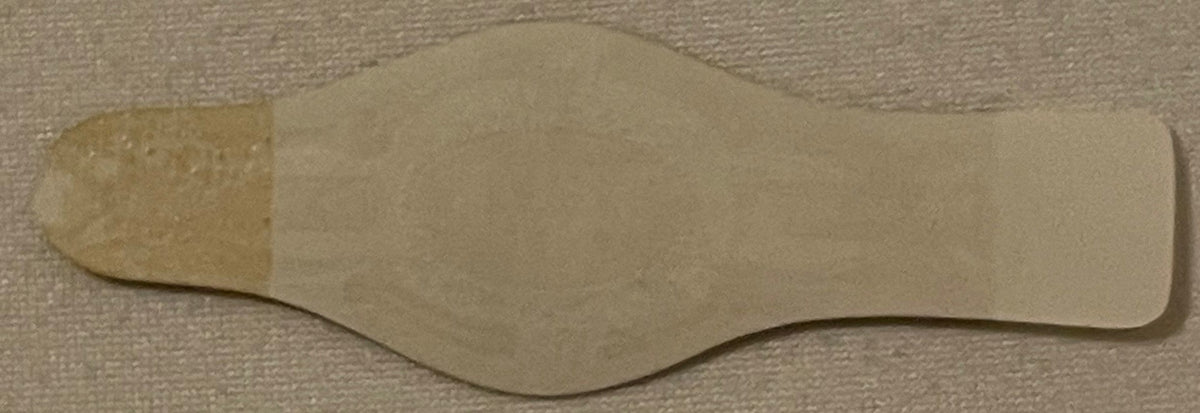
This is a genuine antique cigar band from the White Tip Extra Mild brand, produced somewhere in the window between the 1910s and 1930s — one of the most visually and commercially dynamic periods in American tobacco history. The band measures a classic 2¾ inches wide by ¾ inch tall, and it carries the distinctive hourglass silhouette that fit snugly around the girth of an American-made cigar with that satisfying, almost architectural precision. Wide at the center, gently pinched at the waist, and spreading again at the lobed terminal ends — it is a shape so specific to this era that experienced collectors identify the period at a glance.

The construction is embossed paper stock, printed and pressed using the lithographic and relief-embossing methods that American label manufacturers perfected during the Gilded Age and continued refining straight through the Jazz Era. The central medallion is a deep crimson red oval, edged in raised gold, and the brand name WHITE TIP appears in clean, confident white lettering that commands the center of the design without shouting. To the left and right, EXTRA MILD is printed in matching white-on-red cartouches — a period descriptor that told the purchaser exactly what he was getting: a smooth, approachable smoke rather than a robust full-bodied cigar. The surrounding decorative field is gold throughout, alive with embossed scrollwork, interlocking ribbon motifs, and a fine repeated border treatment that catches light the way only genuine period embossed paper can. Reproduction cannot replicate that quality of relief. The technology, the time, the sheer intent — it simply cannot be faked convincingly.

This band is New Old Stock (NOS) — meaning it was never applied to a cigar, never handled in commerce, never soaked, creased, or torn in the ordinary course of its working life. It survived in a cache, in a stock room, in a collector's envelope, in somebody's careful keeping — and it arrived here essentially as-made. That is the designation that separates a display-worthy collectible from a damaged relic, and this one qualifies fully.


🎨 The Golden Age of the American Cigar Band — Industry, Art, and Miniature Ambition

To understand why collectors pursue these bands with such genuine enthusiasm — why entire organizations, auction houses, and specialized dealers exist solely around cigar label and band collecting — you have to understand what the American cigar industry was at its peak. Between roughly 1880 and 1940, the United States supported thousands of independent cigar manufacturers, ranging from enormous factory operations producing millions of cigars annually down to neighborhood shops rolling product for purely local distribution. At the industry's apex, there were more registered cigar brands in the United States than there were towns of any substantial size — a staggering proliferation of names, images, promises, and personalities, each fighting for shelf space at the tobacconist, the general store, the hotel lobby newsstand.

The cigar band was the brand's ambassador. It was the first thing a customer saw when he reached into the humidor box and drew a cigar out. It was, in every meaningful sense, a miniature billboard — and American manufacturers treated it exactly that way. They employed the finest commercial lithographers and label printers in the country. They competed ferociously on design quality, on the richness of their gold embossing, on the complexity of their scrollwork, on the vividness of their color palette. The White Tip band is a perfect ambassador for that competitive excellence: the gold is generous, the crimson is saturated and clean, the white lettering is crisp, and the embossing has presence and depth. Somebody made a deliberate, skilled choice about every element of this design.

The five-cent cigar — the populist, democratic staple of American working and middle-class life — was practically a cultural institution during exactly this period. It crossed class lines in a way few consumer products did. A factory worker and a bank president might well smoke cigars of different quality, but they both smoked cigars, and the band on each was a point of pride for the manufacturer. Local legend among cigar label collectors holds that certain printers' salesmen carried sample books of band designs the way fabric merchants carried swatches — visiting tobacco manufacturers county by county across the Midwest and South, selling them on the idea that a better-looking band meant a better-selling cigar. Whether or not that exact scene played out precisely that way, the underlying truth it encodes is real: design was a sales argument, and these paper bands were the arena in which that argument was made.


🏭 The Printing Craft Behind the Band — American Label Making at Its Peak

What most people who encounter antique cigar bands for the first time do not immediately appreciate is how technically demanding these objects were to produce. Chromolithography — the multi-stone, multi-pass color printing process that gave late 19th and early 20th century commercial labels their characteristic jewel-like richness — required enormous skill, specialized equipment, and painstaking registration of each color layer. A band like this White Tip piece, with its crimson, white, and layered gold palette plus relief embossing, would have required multiple passes through press and embossing equipment. Errors accumulated. Waste rates were significant. The ones that came out right — vivid, sharp, properly registered, embossed without cracking or distortion — were genuinely the product of craft knowledge passed down through print shop apprenticeships.

The embossing itself deserves a separate moment of attention. That raised gold border, those scrollwork reliefs — they were created by pressing the printed paper between matched male and female dies under controlled pressure. The dies were cut by skilled craftsmen, and the register between the printed image and the embossed relief had to be precise or the effect collapsed entirely. When you run a fingertip across the surface of this band and feel those ridges, you are feeling the result of a die-cutter's art that has largely passed out of commercial practice. Modern label production does not work this way. The machinery is different, the economics are different, and the visual result — for all the technical sophistication of contemporary printing — is different in ways that experienced eyes read immediately.

Lore passed down among serious tobacciana collectors holds that the very best American cigar band printers of the early 20th century kept their embossing die sets as closely guarded proprietary assets — that a print shop's die library was considered as valuable as its presses, and that talented die engravers were actively recruited and sometimes quietly poached between competing firms. Whether every detail of that story survives intact, the competitive intensity it describes was real, and this band carries its evidence in every raised millimeter of its gold border.


📜 White Tip, Extra Mild, and What a Brand Name Promised in the Era

The name White Tip is itself a period artifact worth a few moments of attention. In the cigar trade of the early twentieth century, brand names were chosen with considerable commercial deliberation. They evoked quality, origin, process, or sensory experience — and Extra Mild as a brand descriptor was a specific market positioning. The smoking public of this era ranged from the dedicated full-bodied cigar devotee who wanted bold, complex, assertive tobacco to the occasional or social smoker who preferred something lighter, smoother, less demanding. "Extra Mild" spoke directly to the latter — the gentleman who wanted the social ritual of the cigar without an overwhelming experience, the occasional smoker treating himself at a holiday dinner, the customer who was perhaps new to cigars and wanted a welcoming entry point.

That positioning also explains the visual clarity of the design. The White Tip band does not crowd its typography or attempt to impress through complexity alone. The central medallion reads at a glance. The color relationship — red, gold, white — is high contrast and immediately legible even under the dim lighting of a period tobacconist cabinet. The brand was legible. The promise was legible. And the design still reads with authority over a century later, which is a measure of how well-considered it was at the time of its creation.


🖼️ Display Ideas for Your White Tip Cigar Band

  • 🖼️ Frame it in a shadow box with a period cigar cutter, a vintage match safe, and a small sepia photograph of a 1920s tobacconist's shop — an instant vignette that tells a complete story on any wall.
  • 📚 Mount it in an archival collector's album alongside other NOS cigar bands of the era, organized by decade or by color palette — a presentation that reads like a visual history of American commercial printing.
  • 🗂️ Feature it as a centerpiece label in a curated tobacciana display alongside a vintage humidor, a period tin, and antique match strikes — the band bridges the decorative objects and anchors the theme.
  • 🎁 Present it as a framed gift for a tobacco history enthusiast, a cigar collector, or a lover of Americana — matted on archival linen in a simple gold or dark walnut frame, it becomes something genuinely displayable.
  • 🔬 Study it under a loupe or magnifying glass as a document of period printing craft — the fine detail in the scrollwork and border embossing rewards close examination and reveals layers of technical sophistication invisible at normal viewing distance.
  • 🏛️ Incorporate it into an Americana or folk art collection as an example of commercial vernacular art — cigar labels and bands are increasingly recognized by folk art scholars and decorative arts institutions as significant examples of popular visual culture.

🎁 Who Collects Antique Cigar Bands — and Why This One Belongs in a Serious Collection

The world of vitolphilia — the formal name for cigar band and label collecting — is broader, more serious, and more globally connected than most outside observers realize. Collectors in the United States, Europe, and South America have pursued these tiny paper artifacts since the late 19th century, when the hobby was already well established enough to have its own networks and periodicals. Today, dedicated collectors range from casual accumulators who simply love the visual richness of the objects to advanced specialists who focus on specific brands, specific manufacturers, specific print shops, or specific eras — and who bring the same documentary rigor to their pursuit that coin or stamp collectors bring to theirs.

The White Tip Extra Mild band appeals to multiple collecting communities simultaneously. Tobacciana collectors want it for its place in the American cigar brand history. Paper ephemera collectors want it for its embossing quality and its NOS condition. Americana and commercial art collectors want it for what it represents about the visual culture of the 1910s–1930s. Graphic design enthusiasts — a growing force in the vintage ephemera market — are drawn to these pieces as examples of pre-digital commercial art at its most skillful and most constrained: extraordinary visual impact achieved within a space barely larger than a postage stamp. And gift-givers who want something genuinely unusual, historically grounded, and personally meaningful for the collector in their life return to antique cigar bands again and again precisely because the objects are so easy to display, so easy to love, and so impossible to find anywhere but through dedicated vintage and antique sources.

NOS condition, as this band offers, is the threshold that transforms a curiosity into a proper collectible. Experienced collectors will tell you flatly: condition is not merely a factor, it is the factor. A band in the state this one presents — unfaded, unsoiled, embossing fully intact, no application residue, no tears, crisp and vivid as originally printed — is the version worth acquiring and worth keeping.


❓ Frequently Asked Questions — White Tip Extra Mild Cigar Band

What does NOS mean for a cigar band, and why does it matter so much to collectors?

NOS stands for New Old Stock — meaning this band was manufactured in the period but was never applied to a cigar and placed in commerce. It came from a printer's surplus, a manufacturer's leftover inventory, a collector's cache, or a similar source that kept it unhandled and unused. In the cigar band and tobacciana market, the difference between NOS and a used example of the same band is the difference between a displayable collectible and a reference specimen. Serious collectors price and pursue NOS examples at significant premiums over equivalent applied bands, and they are correct to do so — NOS material of this age is genuinely finite and does not increase.

How can I be confident this band actually dates to the 1910s–1930s and is not a later reprint?

The authentication indicators on a genuine period cigar band of this type are physical, not merely visual. The paper stock, the embossing technique, the chromolithographic printing method, and the specific chemical composition of the inks used in this era all produce characteristics that are identifiable to experienced collectors and examiners. The relief embossing on genuine period bands has a specific quality of depth and edge definition that reflects the die-cutting technology of the era. The design vocabulary, typeface choices, and color palette are also period-specific: the hourglass form factor, the crimson-and-gold medallion structure, and the particular style of scrollwork border are all characteristic of American cigar band design within this precise window. Taken together, these characteristics make confident period attribution entirely reasonable.

Is the embossing on this band fragile, and how should I handle or store it?

Embossed paper of this age is best handled minimally and with clean, dry hands — the oils in fingertips can transfer to paper stock over time, and repeated handling creates micro-abrasion on the raised embossed surfaces that gradually dulls the relief. For storage, archival-quality materials are the appropriate choice: acid-free paper envelopes or polyester sleeves in standard collector dimensions protect the band from atmospheric acid while allowing visual inspection without removal. If you are framing the band for display, UV-filtering glazing dramatically extends the life of the color at light exposure levels typical of a home interior. For a collector intending to hold this piece long-term as an investment or inheritance-quality object, proper archival housing is the single most valuable thing you can do for it. The band has survived nearly a century in whatever conditions it encountered before reaching you — proper archival care going forward ensures it survives the next century in equal or better condition.

What is the cigar band collecting hobby like today, and is there an active community?

Vitolphilia — the formal name for the collecting of cigar bands and labels — has an organized, genuinely international community with dedicated clubs, online forums, periodic publications, and active trading networks across the United States, Spain, the Netherlands, Belgium, and South America, where the hobby has deep roots. The International Label, Seal and Cigar Band Society is one of several organizations that has historically supported collectors of these paper artifacts, and online communities have expanded access to information, trading partners, and reference material enormously over the past two decades. Auction houses that specialize in paper ephemera and tobacciana regularly feature cigar band collections, and price realized data from those sales documents a genuine and sustained collector market. For a new collector, antique cigar bands represent one of the most accessible entry points into serious paper ephemera collecting: individual pieces remain affordable relative to their rarity, the objects are easily stored and displayed, and the research rabbit hole — the brands, the printers, the manufacturers, the eras — is genuinely deep and rewarding.

Could this band have historical or genealogical research value for someone tracing a family business or regional tobacco history?

Absolutely, and this is an angle that serious researchers and genealogists have come to appreciate in the tobacciana market. The cigar industry of the 1910s–1930s was deeply localized — brands were often family enterprises tied to specific towns, specific immigrant communities, specific regional agricultural traditions. A band like this White Tip Extra Mild piece, with its specific design, its specific period attribution, and its NOS provenance, can serve as a documentary artifact for anyone researching the commercial tobacco history of a region, the branding practices of a specific manufacturer, or the printing history of a label house. Researchers working on family histories connected to the tobacco trade have used bands, labels, and box art as primary source materials — evidence of what a family business looked like, how it presented itself to the public, what its design sensibility was at a specific moment in time. In that context, this is not merely a decorative object; it is a small but genuine historical document.

How does this band fit into a broader antique ephemera or Americana collection?

Antique cigar bands occupy a specific and well-regarded niche within the larger world of paper ephemera collecting — a category that also encompasses trade cards, stock certificates, seed packets, almanac covers, broadside advertisements, and similar printed artifacts of American commercial life. Within that world, cigar bands are prized for their combination of miniature scale, technical printing sophistication, and extraordinary subject matter range — you can build a collection that covers sporting imagery, political figures, landscape art, portraiture, allegorical subjects, and purely ornamental design, all within the format of objects smaller than a business card.

The White Tip Extra Mild band, with its clean, bold, commercial-art aesthetic, pairs beautifully with both decorative Americana collections and more specialized tobacciana assemblages. It works as a standalone display piece in a small frame, as one element of a curated wall grouping, or as part of an organized album collection.

Its scale is one of its genuine virtues: it requires almost no space, costs almost no infrastructure to display properly, and delivers a visual and historical impact entirely disproportionate to its size.

What makes embossed cigar bands from this specific era particularly desirable compared to later printed examples?

The 1910s–1930s represent the mature peak of American relief-embossed cigar band production — the moment when chromolithographic printing technology, die-cutting craft, and commercial design ambition all reached their highest simultaneous expression in this specific format. The embossing process used in this era required hand-finished dies and significant press tonnage applied to paper stock that had to be conditioned precisely to accept the relief without tearing.

The result was a quality of tactile presence — that raised gold border you can feel with a fingertip — that later, cost-reduced production methods progressively simplified away. By the mid-20th century, many cigar bands had moved to flat-printed foil or simplified lithography that reproduced the look of embossing without the physical reality of it.

The bands that predate that simplification — genuine die-embossed examples like this White Tip piece — carry in their physical structure the evidence of craft standards that were already beginning to give way to industrial efficiency when this band was made. That is part of what makes surviving NOS examples from this window so genuinely valuable to collectors who understand the history of the craft.

Shipping

🚚 Shipping & Handling

  • Shipping costs and timing are calculated at checkout.
  • Items curated and shipped directly by me include U.S. shipping at no additional cost, professionally packed to ensure safe arrival of your artifact.

Items from Vetted Pro Collectors
Shipping for items offered by vetted Pro Collectors is determined at checkout. All Pro Collector listings are reviewed to ensure fair, reasonable shipping practices.

For full details, please refer to our Shipping Policy.

Returns & Exchange

Take your time — you've got a full six months. If a piece isn't right for you, send it back the way it reached you and we're good.

In the first 30 days your money goes straight back the way you paid. After that it's store credit, so you can put it toward something you'd rather have.

Return shipping we sort out between us, case by case. I don't make this difficult.

If something arrives damaged, or it isn't what I said it was, send me a photo within 48 hours and I'll make it right.

Email info@vintageantiquesgifts.com or call 802-356-9872 — that's me answering, not a call center.

The only things I can't take back are custom or special-order pieces and gift cards.

View full details