Skip to product information
1 of 3

Vintage and Antique Gifts

Antique Texas Longhorn Smokers Cigar Band 🤠 NOS 1910s–1930s Tobacciana Western Americana Paper Ephemera

Antique Texas Longhorn Smokers Cigar Band 🤠 NOS 1910s–1930s Tobacciana Western Americana Paper Ephemera

Regular price 9.00 USD
Regular price Sale price 9.00 USD
Sale Sold out
Shipping calculated at checkout.
Quantity

When Did a Cigar Band Become a Piece of Texas History? 🤠

There is a particular kind of silence that lives inside old paper. Not the silence of something forgotten — more like the silence of something waiting. You pick up a piece of ephemera this old, this specific, this vivid in color and intention, and you feel it: someone designed this. Someone printed this. Someone tucked it away in a drawer or a box or a back room of a dry goods store somewhere in Texas, and the decades just rolled on past without ever disturbing it. That is what you are holding when you hold this antique Texas Longhorn Smokers cigar band — a tiny, eloquent, amber-and-red piece of the American West, as crisp and confident today as it was when it came off the press sometime between the 1910s and the 1930s. It has been waiting for you, specifically, for the better part of a century.

There is nothing fragile about the feeling this piece gives you. It is bold. It is Western. It is unapologetically, proudly Texan in that way that only artifacts from that particular era of Texas mythology can be — when the state was still actively writing its own legend, and every brand name, every label, every scrap of printed commerce was another line in that ongoing story.


🐂 What It Is — The Object, the Brand, the Era

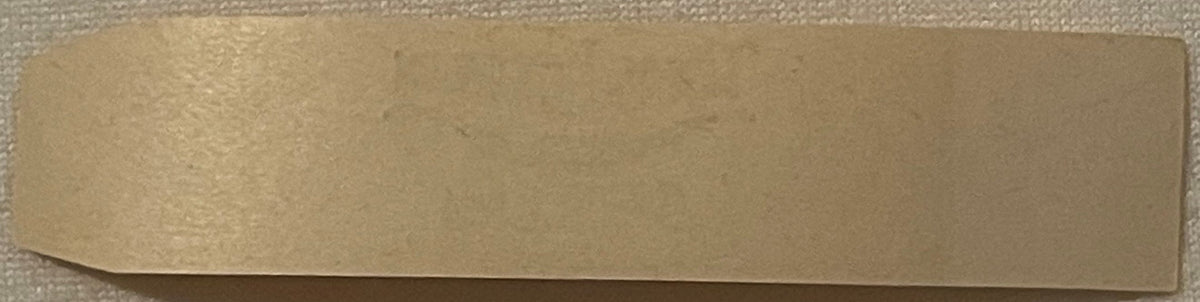
This is an antique cigar band from the Texas Longhorn Smokers brand, a New Old Stock (NOS) paper band measuring 2.75 x 0.75 inches — the long, narrow strip format that wrapped the body of the cigar. The band is printed in a warm golden amber-orange ground with all primary design elements rendered in deep brick red: a bold, Western-style arch of lettering reading "Texas Longhorn" across the top, a graceful and well-drafted illustration of longhorn horns sweeping beneath it, and "Smokers" anchoring the lower portion in confident matching serif capitals. The typography is era-perfect — the kind of confident, deliberate lettering that commercial print shops of the 1910s through 1930s executed with real craft, set by hand or by Linotype, inked and pressed onto paper stock that has, remarkably, survived in vivid, unfaded condition.

New Old Stock means exactly what it sounds like: this band was produced during its original era of manufacture, stored undisturbed — never put into circulation as a wrapped band on a sold cigar, never handled into deterioration — and has simply existed in that suspended state of potential ever since. The color is vivid. The printing is crisp. The face is clean. This is not a piece that has been rescued from damage; it is a piece that was never damaged to begin with. Someone, somewhere, had the good instinct — or perhaps just the good luck — to keep it still.


🌵 The Golden Age of American Cigar Culture — and Where Texas Fit Into It

To understand why a cigar band like this exists, and why it matters, you have to step back into the broader sweep of American tobacco culture at the turn of the twentieth century. The late 1800s through the 1930s represent what historians of tobacciana consistently describe as the golden age of the American cigar industry. At its 1920 peak, the United States was home to more than fifteen thousand registered cigar manufacturers — an extraordinary number, scattered across every region of the country, each producing its own blends, its own brands, its own labels and bands and box art. This was a decentralized, fiercely competitive, intensely regional industry. A cigar from Texas was not simply a cigar; it was a statement of regional identity, a small commercial flag planted in the American marketplace.

Texas, in this period, was doing something culturally specific and fascinating: it was actively manufacturing its own mythology. The cattle drives of the Chisholm Trail era were recent memory. The imagery of longhorns, open range, cowboys, and frontier swagger was not yet nostalgia — it was living brand equity, something that Texas-based businessmen and manufacturers understood intuitively and leaned into hard. A brand called Texas Longhorn Smokers is not an accident of naming. It is a deliberate, commercially sophisticated appeal to everything that the word "Texas" conjured in the American imagination of that era: size, strength, independence, authenticity. The longhorn cattle breed itself had become symbolic — not just of Texas ranching, but of a particular strain of American identity that was already being romanticized by the 1910s.

Cigar band design in this window was a serious commercial art form. The printing houses — many of them operating out of lithographic centers in Ohio, Pennsylvania, New York, and the Midwest, though regional printers served regional clients throughout the South and Southwest — competed vigorously on the quality and visual impact of their label work. The amber-and-brick-red palette of the Texas Longhorn Smokers band is characteristic of the period's preference for warm, saturated, masculine color stories. This was not accidental chromatic choice; this was deliberate visual rhetoric, designed to communicate quality, Western authenticity, and premium positioning on a retailer's shelf or in a humidor display.


🔍 The Brand Nobody Has Found Twice — A Collector's Discovery

Here is where this piece becomes genuinely extraordinary for any serious tobacciana or Texas ephemera collector: the Texas Longhorn Smokers brand is essentially undocumented. It does not appear in surviving trade registries from the era. It has not been indexed in any manufacturer's record that has come to light through the Texas State Historical Association. No competing band under this exact brand name has surfaced in any public marketplace search — not on the major ephemera platforms, not in the auction records that serious collectors track. This is, by the working definition that tobacciana specialists apply, a ghost brand — a label that existed in commerce, that was clearly produced with professional craft and commercial intent, but that has left almost no documentary footprint behind it.

Ghost brands fascinate collectors precisely because they represent the vast, mostly unrecorded middle tier of American commercial production. The famous cigar brands of the era — the nationally distributed names, the ones that appeared in magazine advertisements and railroad depot displays — those are documented. But the regional brands, the local manufacturers, the small-batch operations that served a county or a city or a particular clientele? Most of them vanished without leaving a paper trail beyond the labels themselves. Which means the label is the record. The band you hold right now may be among the only surviving physical evidence that the Texas Longhorn Smokers brand existed at all.

Lore passed down among tobacciana and paper ephemera collectors holds that some of the most compelling NOS cigar band discoveries come not from former tobacco warehouses or manufacturer archives, but from the back rooms and estate contents of small-town general stores and dry goods merchants — places where a box of unsold stock simply got pushed to a shelf and forgotten across decades of changing ownership. Whether that is the provenance story of this particular band, we cannot say with certainty. But it has the feel of exactly that kind of survival: quiet, accidental, and complete.

Local legend among Texas ephemera hunters has it that the cross-cultural appeal of longhorn imagery in the 1910s–1920s made it a favorite of cigar brands looking to tap into the growing tourist and visitor market along the Gulf Coast rail corridor — travelers coming through Texas on their way between New Orleans and the Southwest who wanted to bring back something that said Texas without requiring any explanation. A cigar called Texas Longhorn Smokers would have done exactly that job. Whether this band was destined for a Houston tobacconist, a San Antonio hotel lobby counter, or a general store somewhere in the Hill Country, it carries that same freight of intentional regional identity.


📜 Paper Ephemera, Tobacciana, and the Western Americana Collecting World

Cigar bands occupy a fascinating niche in the collecting universe — one that sits at the intersection of several overlapping communities. Tobacciana collectors pursue the full material culture of American tobacco commerce: tins, boxes, labels, bands, advertising cards, silks, and trade items. Paper ephemera collectors are drawn to the printing craft, the chromolithographic and letterpress artistry, and the documentary value of commercial print as historical record. Western Americana and Texas ephemera collectors are hunting something more specific: objects that carry the visual and commercial DNA of a particular time and place in American regional identity.

This Texas Longhorn Smokers band sits squarely at the center of all three communities. It is tobacciana — a genuine artifact of American cigar culture at its most prolific. It is paper ephemera — a beautifully preserved example of era commercial print design with vivid color and crisp execution. And it is Texas Western Americana — branded with one of the most powerful symbols of Texas identity, the longhorn, and produced in a window of time when that symbolism carried its full original weight.

What makes NOS paper ephemera particularly prized in all of these collecting communities is precisely the condition factor. Paper is fragile. Ink fades. Humidity, light, and handling all take their toll over a century. A piece that has survived in the kind of condition this band presents — vivid color, clean face, crisp printing — is not merely old; it is old and intact, which is an entirely different category of rarity. The age of this piece is a given. The condition is the achievement.


🖼️ Display Ideas

  • 🪵 Mounted in a deep shadow box alongside other Texas or Western Americana ephemera — trade cards, cabinet photos of cattlemen, an old Texas map fragment — for a curated regional history vignette that stops visitors cold.
  • 🖼️ Framed under UV-protective glass with a simple linen mat in warm cream or tobacco brown, letting the amber-and-red palette speak entirely for itself as a piece of graphic art.
  • 🐂 Displayed in a cigar and spirits bar, smoking room, or study as an anchor piece of tobacciana décor — paired with vintage humidors, antique match safes, or a period-appropriate ashtray.
  • 📚 Incorporated into a Texas history or ranch heritage display — particularly compelling alongside longhorn-related items: old brand irons, ranching photographs, period maps of cattle trail routes.
  • 🗂️ Housed in an archival sleeve in a flat file as part of a serious paper ephemera or tobacciana collection, catalogued as a documented ghost brand — a primary source for future Texas commercial history research.
  • 🎨 Used as a reference piece and display item in a graphic design or commercial art context — the Western letterpress typography and warm palette make this a genuinely instructive example of early twentieth century regional commercial print design.

🎁 Who Collects These

The community of collectors drawn to a piece like this Texas Longhorn Smokers cigar band is wider and more varied than you might expect, and each group brings its own vocabulary of appreciation to the same object.

Tobacciana collectors are the natural first audience — people who have been quietly building collections of American cigar, pipe, and cigarette culture for decades, who understand the hierarchy of rarity that makes a documented ghost brand NOS band in this condition something genuinely worth stopping for. These collectors know that most of the easy finds are long gone; the pieces that remain to be discovered are exactly this kind of quiet, specific, undocumented survival.

Texas history and Texas ephemera collectors will feel the pull of this piece immediately. Texas has one of the most active and passionate regional collector communities in the country — people who are building archives, both personal and institutional, of the material culture of Texas commerce, ranching, frontier life, and regional identity. For a Texas collector, a branded item this specific and this undocumented is not just decorative; it is documentary. It adds a line to the record.

Western Americana collectors — the broader community that pursues the visual and material culture of the American West — will recognize the longhorn brand imagery immediately as squarely within their field of passion. The overlap between tobacciana and Western Americana is particularly rich in this period, because so many cigar and tobacco brands of the 1910s–1930s used Western imagery as their primary commercial vocabulary.

Paper ephemera and printed Americana collectors are drawn by the printing craft and survival condition. For this community, a piece does not need to be famous to be important; it needs to be well-made, well-preserved, and genuinely old. This band is all three.

Interior designers and decorators working in Western, ranch, study, or bar aesthetics find that authentic period pieces anchor a room in a way that reproductions simply cannot replicate. The color palette of this band — amber-orange and brick red — translates beautifully into warm, masculine interior settings.

And finally: gift givers who are looking for something genuinely one-of-a-kind for the Texas history lover, the cigar aficionado, the Western Americana enthusiast, or the collector who seems to have everything. There is no other gift quite like an artifact nobody else has — and by the evidence of the market record, that is precisely what this piece is.


❓ Frequently Asked Questions

Is this band really as rare as the listing suggests, or is "ghost brand" just a collector expression?

It is a genuine collector term with a specific meaning, and in this case it is applied accurately. A ghost brand in tobacciana and paper ephemera collecting refers to a commercial brand that is verifiably real — it was produced, it was in commerce, it exists as a physical artifact — but for which no documentary record survives in trade registries, manufacturer indices, historical association records, or the secondary market. The Texas Longhorn Smokers brand meets every criterion: no trade registration has been located, no entry appears in Texas State Historical Association records, and no competing band under this exact brand name has surfaced in public marketplace searches. The rarity claim here is not marketing language; it is a careful, honest statement of the research record as it currently stands. It is entirely possible that future archival discoveries could add to the documented record of this brand — which would only increase the historical significance of a piece like this that predates those discoveries.

What does NOS mean, and how does it affect value for paper ephemera?

NOS stands for New Old Stock — a term that originally comes from the automotive and manufacturing parts world but has been adopted broadly by antique and vintage collectors to describe original-era items that were never put into use or circulation and have survived in essentially unhandled condition. For paper ephemera specifically, NOS status is enormously significant because paper is among the most vulnerable of all antique materials. A band that was stored in its original stock — in a box, a drawer, a back-room inventory — and simply never used has a completely different survival profile. The condition premium for NOS paper ephemera is substantial and well-established among serious collectors. The vivid color and crisp printing you see in this piece are direct results of its NOS status.

How should I store or display this band to preserve it long-term?

Archival best practice for paper ephemera of this age and type begins with keeping it away from three primary enemies: UV light, humidity fluctuation, and acidic materials. If you are storing it flat in a collection, an acid-free archival sleeve or mylar envelope inside an acid-free flat file or box is the gold standard. If you are displaying it, framing behind UV-protective museum glass — not standard glass, which transmits a significant portion of the UV spectrum — will protect the color vibrancy that makes this piece so visually striking. Avoid displaying it in direct sunlight or in rooms with significant humidity variation, such as kitchens or bathrooms. The amber-orange and brick-red palette has survived remarkably intact over a century of storage; with appropriate care, it can remain this vivid for another century.

Can you tell me more about the printing technique used to produce this band?

Cigar bands of the 1910s through 1930s were produced using a combination of letterpress printing — for the typographic elements, set in metal type — and, in more elaborate examples, lithographic or chromolithographic processes for color imagery. The warm amber-orange ground color and the deep brick-red overprint on this band are consistent with the two-color commercial printing that was standard for mid-range cigar label production in this era. The longhorn horn illustration would have been produced as a line cut or engraved block, inked and pressed with the same registration pass as the typographic elements, or as a separate lithographic plate depending on the specific shop's workflow. The quality of the result — the crispness of the impression, the consistency of the color — reflects genuine craft. Commercial print shops serving the tobacco industry in this period competed aggressively on label quality, and the surviving evidence suggests that whoever produced the Texas Longhorn Smokers band was working at a competent professional level.

Does the size of this band — 2.75 x 0.75 inches — tell us anything about the cigar it was made for?

It does, and it is an interesting detail. Standard cigar bands of the era were generally sized to fit around the cigar itself — which means that a band of this dimension points toward a fairly substantial gauge cigar, likely in the Churchill, Double Corona, or comparable large-format range. Large-format cigars occupied the premium end of the market in this period; they required more tobacco, more labor, and more time to produce and smoke, and they were priced accordingly. A brand that produced a generously sized cigar and commissioned a full-format band of this size was positioning itself in the better-quality tier of the regional market — not a cheap working-man's smoke, but something a buyer would have felt good about presenting or receiving. This is consistent with the confident, premium-register design of the band itself.

Is there any way to narrow down where in Texas this brand might have been based?

Honestly, the documentary record does not currently support a specific city attribution, and intellectual honesty with collectors matters more than a satisfying but unverifiable answer. What we can say is that Texas had active tobacco retail and distribution networks centered in its major commercial cities — San Antonio, Houston, Dallas, Galveston, and Fort Worth all had established tobacconists and wholesale tobacco distributors by the 1910s. The longhorn imagery and the specifically Texan brand identity suggest a manufacturer or distributor who was deliberately marketing to Texas regional pride and, quite possibly, to the tourist and visitor trade that moved through the state via the rail networks of the era. Local legend among Texas ephemera collectors suggests the Gulf Coast rail corridor as particularly fertile ground for this kind of regionally branded tobacco product. But that remains in the category of informed collector lore rather than documented fact — which is part of what makes pieces like this genuinely interesting. The research is still open.

Is this appropriate as a gift for someone who doesn't "collect" in a formal sense?

Absolutely — and in some ways, a non-collector recipient may be even more delighted by a piece like this than a seasoned collector, precisely because they will not already have one. What this band offers any recipient is something genuinely irreplaceable: a tangible, beautiful, well-preserved object with a real story that connects directly to Texas history, American commercial culture, and the visual language of the Western frontier era. It requires no specialized knowledge to appreciate the amber-and-red graphic beauty of this piece, or the quiet thrill of holding paper this old in such extraordinary condition. For anyone who loves Texas, loves the history of the American West, loves cigars and the culture around them, or simply loves the idea of owning something that nobody else in the world has — this is a gift that delivers on every level. Frame it, display it, talk about it. It will earn its place.

Shipping

🚚 Shipping & Handling

  • Shipping costs and timing are calculated at checkout.
  • Items curated and shipped directly by me include U.S. shipping at no additional cost, professionally packed to ensure safe arrival of your artifact.

Items from Vetted Pro Collectors
Shipping for items offered by vetted Pro Collectors is determined at checkout. All Pro Collector listings are reviewed to ensure fair, reasonable shipping practices.

For full details, please refer to our Shipping Policy.

Returns & Exchange

Take your time — you've got a full six months. If a piece isn't right for you, send it back the way it reached you and we're good.

In the first 30 days your money goes straight back the way you paid. After that it's store credit, so you can put it toward something you'd rather have.

Return shipping we sort out between us, case by case. I don't make this difficult.

If something arrives damaged, or it isn't what I said it was, send me a photo within 48 hours and I'll make it right.

Email info@vintageantiquesgifts.com or call 802-356-9872 — that's me answering, not a call center.

The only things I can't take back are custom or special-order pieces and gift cards.

View full details