Skip to product information
1 of 3

Vintage and Antique Gifts

Antique Tom Wilson Cigar Band 🎩 1910s–1930s New Old Stock Tobacco Label Collectible

Antique Tom Wilson Cigar Band 🎩 1910s–1930s New Old Stock Tobacco Label Collectible

Regular price 8.00 USD
Regular price Sale price 8.00 USD
Sale Sold out
Shipping calculated at checkout.
Quantity

What Does a Name on a Band Really Tell Us? 🎩 The Quiet Power of the American Cigar Band and the Man Called Tom Wilson

There is a particular kind of silence that surrounds the small things. Not the silence of absence — the silence of patience. A cigar band, folded neatly into a stock drawer sometime in the 1910s or 1920s, does not announce itself. It does not wave its arms. It simply waits, its crimson ground still vivid, its gold scrollwork still catching the afternoon light exactly as it did when it rolled off the lithographer's press, and it holds its story with the quiet confidence of something that knows it has earned its place in the world. This Tom Wilson cigar band has been waiting for the right hands for a hundred years. It is, without exaggeration, a small miracle of survival — and the moment you hold it, you will feel what I mean.

I have handled a great many pieces of paper ephemera in my years of collecting, and I will tell you plainly: New Old Stock tobacco labels and cigar bands occupy a category of their own. They were made to be used, not preserved. They were designed to be slipped onto a cigar, admired for the length of a smoke, and discarded. The fact that this one never made that journey — that it survived, colors undiminished, embossing crisp and dimensional, the name Tom Wilson still set in clean white lettering inside its pressed laurel wreath — means that somewhere along the line, someone understood that these little rectangles of printed paper were worth keeping. They were right. And now that understanding passes to you.


🏷️ What This Piece Actually Is — Brand, Format, Era, and the Art of Getting It Right

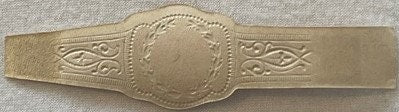
Let's ground ourselves in the object first, because every good collection starts with honest looking. This is an antique cigar band — a paper label designed to wrap around the belly of a premium cigar, measuring approximately 2.75 inches wide by 0.75 inches tall. That is the classic standard cigar band format: wide enough to carry a full decorative composition, narrow enough to sit elegantly against the leaf wrapper without overwhelming it. The format itself is a design discipline. Every element — the central oval medallion, the laurel wreath border, the typeface, the color hierarchy — had to work within that narrow horizontal band, and the lithographers who produced these labels were genuinely masters of compression.

The ground color here is a deep, rich crimson, and against that field rises the centerpiece of the entire composition: an embossed oval medallion bearing the name Tom Wilson in clean white lettering, pressed into the paper in relief so that the design has actual physical dimension. Run a fingertip across the surface and you feel the rise and fall of the design — the letters themselves, the surrounding laurel wreath, the gold scrollwork framing the composition. That embossing is not a printed effect; it is a physical impression made under pressure, a craft technique that elevated the cigar band above mere advertising and into the territory of miniature decorative art. The gold catches light the way gold leaf does — with warmth, not flash.

The dating range — 1910s to 1930s — places this band squarely in what historians of the American tobacco trade recognize as the industry's most elaborate period of brand identity. This was the era when thousands of independent cigar makers, small manufacturers, and regional producers competed for shelf space in tobacconists, hotel lobbies, drug stores, and gentlemen's clubs across the country. The band was your brand. It was the first thing a customer saw, the last thing he looked at before he lit up, and the small luxury that signaled to anyone in the room that he had made a considered choice. And this band, critically, is New Old Stock — it was never applied to a cigar. It came to me from old stock, pristine, unfolded, and it carries no evidence of use. The colors you see are the colors as they left the press.


🏭 The American Cigar Industry at Its Peak — A World You Can Hold in Your Hand

To understand why this band matters, you have to understand the world that made it. The American cigar industry in the early twentieth century was not a single consolidated enterprise — it was an extraordinary, almost bewildering ecosystem of thousands of manufacturers, ranging from massive trust-affiliated factories producing tens of millions of cigars annually, down to small shops where a handful of skilled rollers produced a few thousand cigars a week under a proprietary brand name that existed nowhere else on earth. The name Tom Wilson belongs to that second world — the world of the regional brand, the local reputation, the tobacconist who stocked a particular label because his customers asked for it by name.

By 1910, the United States was producing somewhere in the neighborhood of eight billion cigars per year. That is not a typo. Eight billion. The cigar was not a luxury item in the way we think of cigars today — it was an everyday pleasure for working men, professionals, politicians, and shopkeepers alike. A nickel cigar was an honest smoke; a dime cigar was a small indulgence; anything above that was a statement. The bands that wrapped those cigars were produced by a network of specialized lithography firms — printers who did nothing but tobacco labels, cigar bands, and related trade printing — and they were extraordinarily good at their craft. The chromolithographic and embossing techniques they used were among the most sophisticated commercial printing applications of the era.

The laurel wreath that frames the Tom Wilson name on this band is not decorative filler — it is a deliberate signal of quality and classical authority. Laurel is the ancient symbol of honor and achievement, and its presence on cigar bands was nearly universal among premium-positioned products. It told the buyer, without a word of copy, that this was a brand that took itself seriously. The crimson and gold color palette reinforces that message — red for confidence and appetite, gold for value and finish. These choices were not accidental. The small manufacturers who commissioned their bands from the lithographers understood exactly what they were buying.


🌍 Local Legend and the Lore of Tom Wilson — Recording What Might Otherwise Be Lost

Here is where I want to slow down and speak carefully, because this is the part of ephemera collecting that matters most to me personally — the act of recording what is at risk of being forgotten entirely. The name Tom Wilson, as it appears on this band, has not surfaced in the major tobacco industry directories I have consulted, which tells us something important: this was almost certainly a small, regional, or even hyper-local brand, the kind that existed in the tens of thousands during the golden age of American cigar manufacturing and left almost no paper trail beyond the labels themselves.

Lore passed down among collectors of tobacco ephemera holds that many of the small personal-name cigar brands of this era — "Tom Wilson," "John Harris," "Captain Morgan" types of labels — were produced for individual tobacconists, hotel cigar stands, or gentlemen's clubs who wanted a proprietary house brand to offer their regulars. Under this model, a tobacconist with a good local reputation would commission a few thousand bands bearing a name — sometimes his own, sometimes a house name he invented — and have his cigars banded accordingly. The label became a mark of the establishment, not of the factory. If that is the history of this band, then Tom Wilson may have been a real man — a shop owner, a hotel steward, a club manager — whose name graced the cigars that defined his particular corner of American social life for a decade or two, and then faded from all record except these small rectangles of crimson and gold.

Local legend within the cigar label collecting community also holds that bands which survive in New Old Stock condition — having never been applied to a cigar — typically did so because a print run was overordered, a brand was discontinued before the stock was exhausted, or a shop closed and its supplies were folded into a larger lot and forgotten in a stockroom. The survival of any individual band in this condition is a minor accident of fate, and that accidental quality is precisely what makes New Old Stock tobacco ephemera so compelling to serious collectors. You are not holding a reproduction or a curated archive piece — you are holding something that simply outlasted its intended moment and arrived here, a century later, still doing its job of looking beautiful.


🖨️ The Craft of the Lithographer — Understanding What You're Actually Looking At

The embossing on this band deserves a paragraph of its own, because it is the detail that elevates this piece above a simple printed label into something genuinely tactile and dimensional. Embossed cigar bands were produced using a two-step process: first, the chromolithographic printing laid down the colors — in this case, that deep crimson ground, the white lettering, the gold scrollwork — and then the embossing die pressed the design into physical relief, creating the raised texture you can feel with your fingertip. This was not an inexpensive process. Brands that invested in embossed bands were signaling, clearly and at real cost, that they intended to be taken seriously.

The gold scrollwork framing the Tom Wilson medallion is typical of the highest-quality band production of this period. The scrollwork serves as a visual border that draws the eye inward toward the central name, creating a hierarchy of attention that works whether the band is sitting in a display case or wrapped around a cigar in a man's coat pocket. The lithographers who designed these compositions understood visual grammar in a way that most modern packaging designers would recognize immediately — these were professionals working at the top of their craft, producing commercial art for an industry that demanded nothing less.


🖼️ Display Ideas — Giving This Band a Home It Deserves

  • 🪞 Frame it as miniature art. A deep shadowbox frame with a mat in black or ivory sets off the crimson and gold beautifully and gives the embossing room to cast its own subtle shadow — turning the band into a piece of wall-worthy decorative art that holds up to close inspection.
  • 📚 Mount it in a collector's ephemera album. Archival-quality sleeves designed for cigarette cards and cigar bands are perfect — this label sits alongside other tobacco paper, trade cards, or advertising ephemera to build a narrative page that tells a whole story of the era.
  • 🪵 Display it in a vintage tobacciana vignette. Paired with a period cigar cutter, a match safe, a small humidor, or other tobacco accessories of the 1910s–1930s, this band anchors a tabletop or shelf arrangement that reads as a coherent, curated period moment.
  • 🔬 Display under glass as a study piece. A magnifying glass display dome or a small museum-style glass case allows visitors to examine the embossing and printing detail up close — this band genuinely rewards close looking, and a display that invites that kind of attention does it justice.
  • 🎨 Incorporate it into an Americana or social history display. Alongside images of period cigar shops, tobacconists' trade cards, or photographs of the era, this band becomes a primary source document in a visual essay about early twentieth-century American commercial culture.
  • 💼 Pair it with other Tom Wilson ephemera if you're building a name-specific collection. Personal-name cigar brands occasionally surface across multiple label formats — inner box labels, outer box labels, additional band variants — and building a complete Tom Wilson paper archive, however small, is a genuinely satisfying collector's project.

🎁 Who Collects These — and Why They Know Something the Rest of Us Are Still Learning

Cigar band collectors — vitolphiles, to use the proper term — have been at this longer than almost any other category of paper ephemera collecting. The hobby has deep roots in Europe, where cigar bands were collected as a matter of course from the mid-nineteenth century onward, and a serious American collecting tradition developed alongside the industry itself. Collectors of Americana and social history ephemera are drawn to cigar bands as primary source documents of commercial culture. Students of printing history and chromolithographic craft find in these labels some of the finest surviving examples of the technique at its peak. Decorators working in the aesthetic of the Arts and Crafts period, the Gilded Age, or the early twentieth century find that cigar bands sit naturally alongside other paper goods of the era. And there is a growing category of collector who simply loves beautiful small objects — who understands that a piece of paper this old, this vivid, and this carefully made is a genuine artifact of human skill and intention, and who wants to give it a home where it will be properly appreciated.

If you are building a tobacciana collection, a paper ephemera collection, a social history archive, or simply a curated cabinet of beautiful things from the American past, this Tom Wilson band belongs in your hands.


❓ Collector FAQ — Everything You Want to Know About This Tom Wilson Cigar Band

What does "New Old Stock" mean for a cigar band, and why does it matter?

New Old Stock — commonly abbreviated NOS in the collector community — means that this band was produced during the period indicated (1910s–1930s) but was never actually used for its intended purpose. It was never applied to a cigar, never handled in the normal course of the tobacco trade, and never exposed to the oils, heat, or humidity that would have accompanied actual use. It survived in storage, almost certainly as part of an overrun or a discontinued brand's remaining supplies, and it comes to you today in essentially the same condition it left the printer. For paper ephemera of this age, NOS condition is about as good as it gets — and it is precisely that preserved condition that makes the colors, embossing, and gold scrollwork so vivid and dimensional today. A used band, even a carefully removed one, will show glue residue, handling creases, and color loss at the fold lines. This one shows none of that.

Can I identify where Tom Wilson cigars were made or sold?

This is one of the genuinely intriguing open questions that this band presents to a collector willing to dig. Tom Wilson does not appear prominently in the major national tobacco trade directories of the period, which strongly suggests a regional or local brand rather than a nationally distributed product. The name-brand cigar model of the era — where a tobacconist, hotel, or club commissioned bands under a proprietary name — was extremely common, and many such brands exist today only in their surviving paper. If you have a particular interest in tracking down the provenance of this specific label, the best research avenues are state-level tobacco trade records, city directories from the 1910s–1930s, and the archives of specialized tobacco history organizations. Lore within the collector community suggests that personal-name brands of this type were often hyper-local — a single city, sometimes a single establishment — which makes the research both challenging and deeply rewarding when it yields results.

How should I store or preserve this band after I receive it?

Paper ephemera of this age is best stored in archival-quality, acid-free sleeves or enclosures — the kind designed specifically for cigarette cards, cigar bands, or similar small paper collectibles. Keep it away from direct sunlight, which will fade the crimson ground and the gold over time even on NOS material. Stable, moderate humidity is ideal; avoid storing it anywhere that experiences significant humidity swings, which can cause paper to cockle and embossing to lose its crispness. If you intend to frame it, use UV-filtering glazing and acid-free matting. These are simple, inexpensive measures that will keep this band looking exactly as it does today for another century without difficulty.

What printing technique was used to produce this band, and how does embossing work on paper this thin?

Cigar bands of this era were typically produced using chromolithography — a multi-stone or multi-plate printing process that laid down each color separately, building up the final image through successive passes through the press. The embossing was then applied using a die — a metal plate cut in the negative of the desired relief design — pressed against the printed paper under significant hydraulic or mechanical pressure. The paper, slightly dampened to accept the impression, was forced into the die and retained the raised relief pattern after drying. On a band as small as this one, the registration required to align the embossing precisely with the printed design underneath was a genuine feat of craft — misregistration was common in lesser work, but on a well-produced band like this one, the embossed elements sit exactly where the printed design places them. The result is a label that reads as three-dimensional even in flat display.

Is this band appropriate for a beginner collector, or is it more suited to an advanced collection?

Honestly, it is suited to both — but for different reasons. A beginner collector will find in this band a superb introduction to what makes antique tobacco ephemera worth collecting: the NOS condition makes the quality of the printing and embossing immediately legible, the crimson and gold palette is visually striking enough to generate genuine enthusiasm, and the open research question around the Tom Wilson name gives the piece a narrative hook that makes it more than just a pretty object. An advanced collector will appreciate the rarity of NOS material in this condition, the quality of the embossing execution, and the potential value of this band as documentation of a local or regional brand that has left almost no other surviving record. At every level of collecting, a piece that is this well-preserved and this visually strong earns its place.

How do cigar bands fit into the broader world of paper ephemera collecting?

Cigar bands occupy a fascinatingly specific niche within paper ephemera. They are smaller than most trade cards, more durable in their original NOS form than most advertising paper, and they were produced in such extraordinary variety — thousands of distinct designs across dozens of regional print shops — that a focused collection can go very deep without repetition. They connect directly to the social and commercial history of the period: who smoked, what brands they preferred, how tobacconists positioned their offerings, how lithographers solved design problems within extreme spatial constraints. Within a broader ephemera collection, a strong cigar band is a conversation piece — something small enough to hold in two fingers but rich enough to anchor a display or a discussion. Collectors of trade cards, Victorian advertising, and Americana paper generally find that cigar bands integrate naturally and enrich the surrounding context.

What makes the laurel wreath motif on this band historically significant?

The laurel wreath is one of the oldest symbols of honor and merit in Western visual culture, running from ancient Greek athletic prizes through Roman imperial iconography and into the heraldic vocabulary of the early modern period. By the time the American cigar industry adopted it as a standard decorative element in the nineteenth century, it carried centuries of accumulated meaning: quality, achievement, worthiness of recognition. Its presence on a cigar band was a deliberate appeal to those associations — a way of telling a buyer, without explicit claims, that this was a brand that had earned its reputation. On the Tom Wilson band, the wreath frames the central name directly, making it an honorific: not just a name, but a name worth surrounding with laurel. For collectors interested in the iconography of commercial art and the visual language of quality signaling in American industry, the wreath is a rich subject in its own right, and this band provides a beautifully preserved example of how it was deployed at the height of that tradition.

Shipping

🚚 Shipping & Handling

  • Shipping costs and timing are calculated at checkout.
  • Items curated and shipped directly by me include U.S. shipping at no additional cost, professionally packed to ensure safe arrival of your artifact.

Items from Vetted Pro Collectors
Shipping for items offered by vetted Pro Collectors is determined at checkout. All Pro Collector listings are reviewed to ensure fair, reasonable shipping practices.

For full details, please refer to our Shipping Policy.

Returns & Exchange

Take your time — you've got a full six months. If a piece isn't right for you, send it back the way it reached you and we're good.

In the first 30 days your money goes straight back the way you paid. After that it's store credit, so you can put it toward something you'd rather have.

Return shipping we sort out between us, case by case. I don't make this difficult.

If something arrives damaged, or it isn't what I said it was, send me a photo within 48 hours and I'll make it right.

Email info@vintageantiquesgifts.com or call 802-356-9872 — that's me answering, not a call center.

The only things I can't take back are custom or special-order pieces and gift cards.

View full details