Skip to product information
1 of 5

Vintage and Antique Gifts

Antique Exposition Lemon Crate Label 🍋 Alaska–Yukon–Pacific Fair 1909, Santa Barbara CA

Antique Exposition Lemon Crate Label 🍋 Alaska–Yukon–Pacific Fair 1909, Santa Barbara CA

Regular price 6.00 USD
Regular price Sale price 6.00 USD
Sale Sold out
Shipping calculated at checkout.

Description

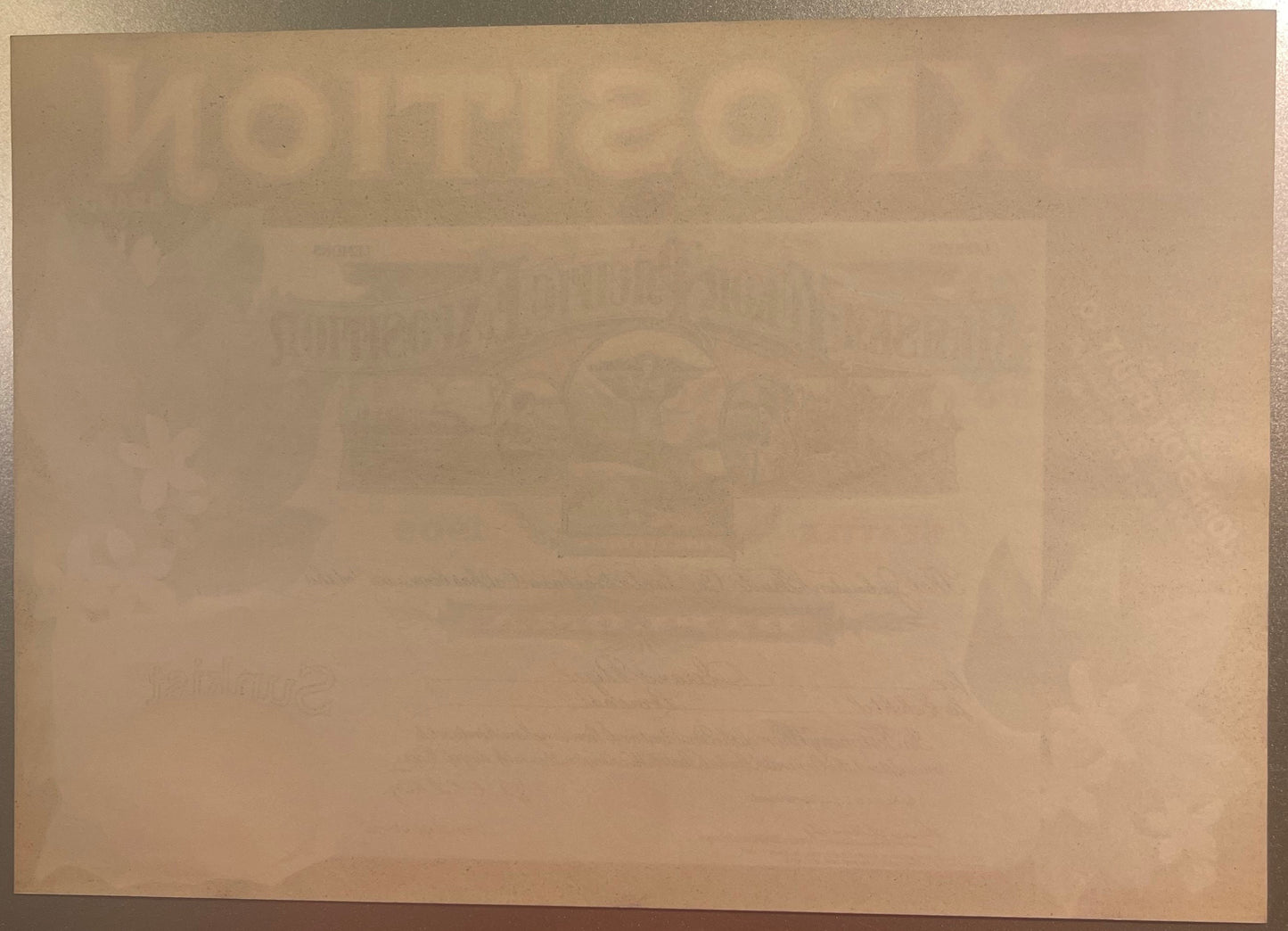
If you like your history bold, colorful, and a little bit unbelievable, this Antique Exposition Brand lemon crate label from Johnston Fruit Co., Santa Barbara, California is exactly the kind of piece you want on your wall 🍋

Printed after the “Exposition Brand” trademark registrations in 1911–1912 and used through the booming citrus decades that followed, this large label (about 12½" x 9") turns a simple box of lemons into a giant poster for a world’s fair. Across the top, “EXPOSITION” shouts in red and yellow. In the center, you get a full reproduction of the Grand Prize diploma Johnston received at the Alaska–Yukon–Pacific Exposition (AYPE) in Seattle in 1909, complete with ornate lettering and little scenes of railroads, industry, and Pacific landscapes. Lemon blossoms and a wrapped Sunkist lemon tie it back to California groves, so the person unloading crates in some distant market knew these were award‑winning Santa Barbara lemons.

🏛️ In museums, not just markets

This isn’t just a pretty label somebody found in a shed. MOHAI (the Museum of History & Industry in Seattle) holds this exact Exposition Brand design in its collection, describing it as a Sunkist lemon crate label featuring the Grand Prize certificate that the Johnson/Johnston Fruit Co. won at the AYPE. Google‑indexed museum platforms also list it as “Exposition Brand Lemons – Johnston Fruit Co., c. 1910s, Santa Barbara, CA”, treating it as a textbook example of early 20th‑century crate art.

When you frame this label, you’re hanging the same image museums file away as visual evidence of how growers bragged about world’s‑fair medals and how citrus advertising looked when California was selling itself to the rest of the country.

🌎 The world’s fair behind the lemons

The Alaska–Yukon–Pacific Exposition ran in Seattle in 1909 on what’s now the University of Washington campus. It was a full‑on world’s fair, meant to promote the Pacific Northwest, Alaska, the Yukon, and Pacific trade routes, and it drew more than three million visitors. The layout of today’s UW campus—fountains, long vistas aimed at Mount Rainier—comes straight out of the fair’s master plan.

California sent growers north to show off what they could do, and the official report lists Johnston Fruits Co., Santa Barbara – lemons among the exhibitors. This label is the afterglow of that moment: year after year, crates leaving Santa Barbara carried a printed diploma that said, in effect, “We went to Seattle, we took the prize, and you’re holding the proof in your hands.”

👶 Incubator babies, cafés, and an orphan raffle

The fair itself was a mix of wonder and “what were they thinking?” energy, and this label is connected to both.

  • On the midway “Pay Streak,” there was a Baby Incubator Exhibit—a two‑story pavilion with Ionic columns where real infants were displayed in glass incubators as a hybrid medical demonstration and sideshow. Ads promised “Baby Incubators with Living Infants,” and there was even a Baby Incubator Café and an hourly child‑check service where parents could literally leave their babies with the staff while they walked the fair.

  • Newspapers and later retrospectives also describe an orphan raffle in which a month‑old boy named Ernest—“the property of the Washington Children’s Home Society”—was listed as one of the prizes. A winning ticket was drawn, but no one came forward to claim him, which sent his fate into the hands of social workers and, a century later, modern researchers.

Writers tracing Ernest’s story have since confirmed that he survived and built a life long after the fair was gone, which is comforting in the middle of such a bizarre episode. Put together, the incubator pavilion and the orphan raffle say everything about how different ideas of “progress” and “entertainment” looked in 1909—and this lemon label quietly carries that history forward.

🎨 Why the art still hits

Like other great crate labels, this one was printed using multi‑color stone lithography. Each color meant another drawing on another stone, carefully registered over the last. That’s why you see:

  • Smooth color gradients in the sky behind the diploma and in the Pacific scenes.

  • Clean, stacked lettering on “EXPOSITION,” “DIPLOMA,” and the citrus‑company imprint.

  • Deep greens in the lemon leaves and a rich, buttery yellow in the Sunkist fruit.

Crate labels were workaday advertising pieces, but they were designed big and bold to stand out from across a rail platform—exactly the kind of graphic punch that looks incredible framed today. Museums and regional archives call them “pocket posters,” and collecting them has become a way to preserve the visual history of agriculture, shipping, and everyday branding.

🖼️ New old stock, ready to hang

This example is new old stock—no staple holes, no crate wear, just clean, unused paper with bright ink. You’re seeing it more or less the way a produce buyer would have seen it in the 1920s–30s, before the crates were broken down and thrown away. Once these NOS bundles are gone into private collections and gallery frames, they’re not coming back on the market.

Frame it in a simple black or warm‑wood frame and it becomes:

  • A conversation‑starting kitchen or dining‑room centerpiece.

  • A perfect anchor for a Seattle, Santa Barbara, or world’s‑fair themed wall.

  • A way to keep Ernest, the incubator babies, and California’s lemon boom from slipping completely out of living memory.

You’re not just buying wall art—you’re rescuing a weird, beautiful little chapter of history that was supposed to be torn off and thrown away 🍋

Shipping

🚚 Shipping & Handling

  • Shipping costs and timing are calculated at checkout.
  • Items curated and shipped directly by me include U.S. shipping at no additional cost, professionally packed to ensure safe arrival of your artifact.

Items from Vetted Pro Collectors
Shipping for items offered by vetted Pro Collectors is determined at checkout. All Pro Collector listings are reviewed to ensure fair, reasonable shipping practices.

For full details, please refer to our Shipping Policy.

Returns & Exchange

Product Page Return Policy

  • 60-Day Returns – Items must be in original condition.
  • Refunds – Issued after inspection (excluding shipping costs).
  • Return Shipping – Customer is responsible unless item is damaged or incorrect.
  • Damaged/Incorrect Items – Contact us within 48 hours for a replacement or refund.
  • Easy Returns – Email info@vintageantiquesgifts.com or call 802-356-9872 to initiate a return.

For full details, visit our Refund Policy.

View full details