Skip to product information
1 of 3

Vintage and Antique Gifts

Antique Festival Brand Lemon Crate Label 🍎 Johnston Fruit Co, Santa Barbara California, Red Ball, Schmidt Litho, Victorian Ladies

Antique Festival Brand Lemon Crate Label 🍎 Johnston Fruit Co, Santa Barbara California, Red Ball, Schmidt Litho, Victorian Ladies

Regular price 9.00 USD
Regular price Sale price 9.00 USD
Sale Sold out
Shipping calculated at checkout.
Quantity

🍋 Can You Hear the Hoofbeats on the Old Santa Barbara Coastal Road — and Smell the Lemon Blossoms Drifting Through the Morning Air?

Close your eyes for just a moment. Picture a warm California morning somewhere in the early-to-mid twentieth century. Two elegant ladies are settled into a flower-draped carriage, their wide-brimmed Victorian hats catching the coastal breeze, a smartly liveried driver holding the reins of two fine dark horses. Behind them, the Santa Barbara mountains rise in soft purples and pinks against an open sky. In the foreground, heavy golden lemons glow beneath a spray of white citrus blossoms. That entire world — a world of American abundance, civic pride, seasonal pageantry, and breathtaking lithographic craft — is captured on this single crate label. It didn't hang in a gallery. It rode in wooden boxes stacked floor to ceiling in a Santa Barbara packing house, traveled by rail across the continent, and announced to grocers and consumers coast to coast that something truly remarkable was grown and packed right here in Santa Barbara, California.

That label is here now — new old stock, never applied to a crate — waiting for someone who understands exactly what it represents.


🖼️ What You Are Looking At

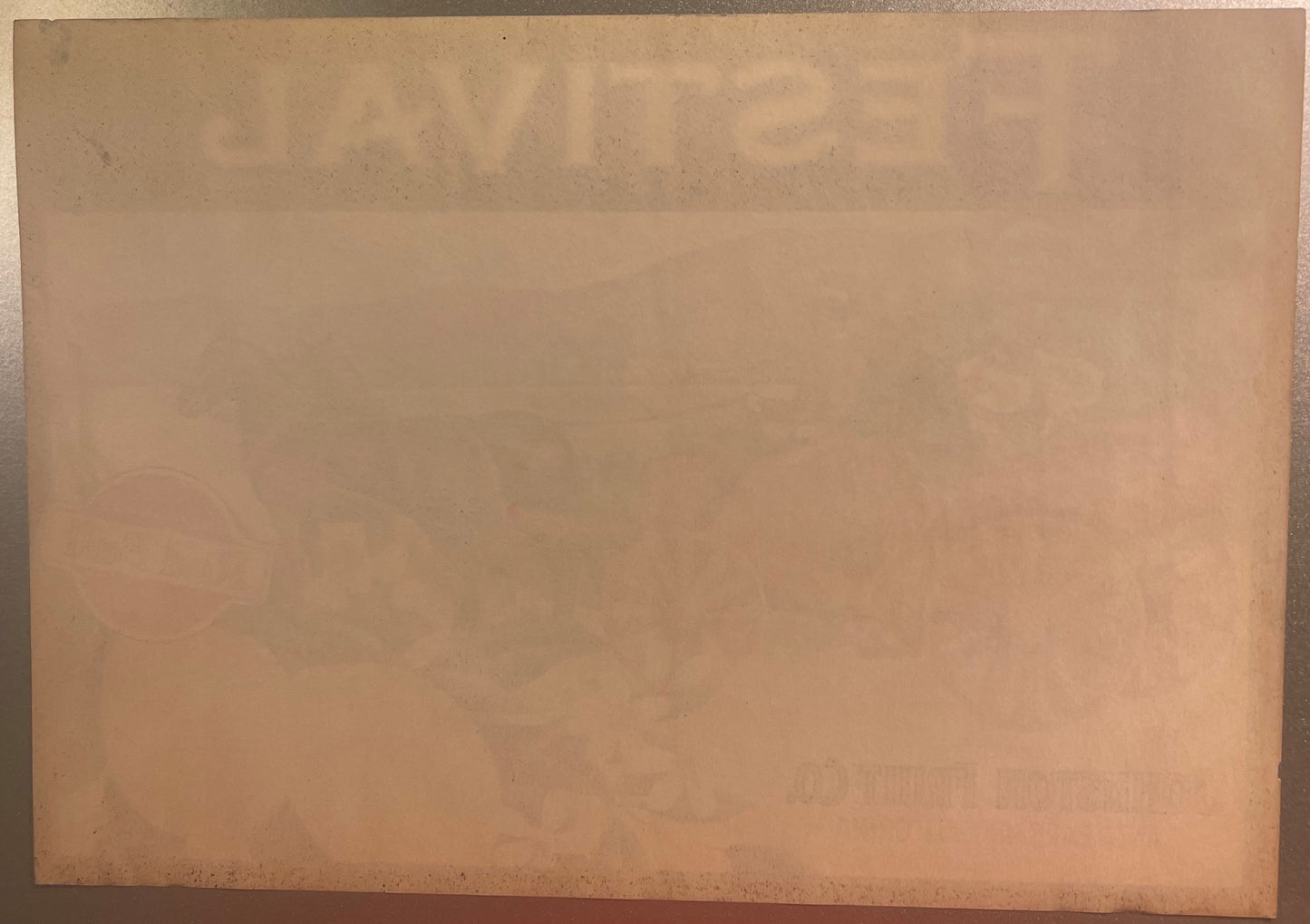
This is a genuine antique chromolithograph crate label for Festival Brand, packed by Johnston Fruit Co. of Santa Barbara, California. The text reads exactly as it left the press: FESTIVAL BRAND — PACKED BY JOHNSTON FRUIT CO. — SANTA BARBARA, CALIFORNIA — CALIFORNIA Red Ball. It measures approximately 12½ inches by 8¾ inches — the standard full-panel size for a California lemon crate of this era — and it was printed by Schmidt Lithograph Co., one of the most respected trade lithographers serving California's citrus industry, with a documented relationship with Johnston Fruit Co. across multiple label designs.

The manufacture marking on this sheet IS legible: SCHMIDT LITHO. CO. L.A. is printed in the lower-left corner of the illustration panel. The Festival trademark was in use from as early as 1897 and formally registered in 1924, and the label's artwork style, printing technique, and the known activity of the Johnston operation all point confidently to that era. This is new old stock — it left the press and went into storage, never glued to a crate — and it is an excellent early example of California citrus Americana and the golden age of American commercial lithography.

The colors are extraordinary. A rich carnival red covers the flower-festooned parade carriage. Deep golden yellow fills the lemons. Lush tropical greens animate the palm fronds. Warm rich browns define the horses' coats. Delicate whites open in the citrus blossoms. And soft mountain purples fade into the background sky behind the Santa Barbara range. This is not a photograph and not a digital print. Every shade was laid down separately — by hand-drawn stone or plate, layer by layer — in a process that demanded extraordinary skill, patience, and multiple press passes from a team of trained craftsmen. The result is a piece of printed Americana that no modern reproduction process has ever fully equaled.


🌸 The Festival Brand — and the Parade It Was Born to Celebrate

The name "Festival" was not chosen at random, and the carriage scene on this label is not generic Victorian decoration. Collectors who know Santa Barbara history recognize it immediately: that flower-smothered carriage, those elegantly dressed passengers, that liveried driver — it is a direct evocation of Santa Barbara's annual Flower Festival, a civic celebration that began in 1892 in honor of President Benjamin Harrison's visit to the city. For years, the festival was one of the most photographed and widely reported civic events on the California coast, drawing visitors from across the state and generating the kind of local pride that a fruit company would naturally want to put its name next to.

The Festival brand name itself was reportedly in use by the Johnston operation from as early as 1897, making it one of the older continuously used brand identities in the Santa Barbara citrus trade before the trademark was formally registered in 1924. Lore passed down among crate label collectors holds that the Johnston family chose the Festival name deliberately as a piece of community storytelling — a way of telling buyers in Chicago, New York, or Boston that these lemons came from a place worth celebrating, a sun-warmed coastal paradise where people dressed in their finest and rode flower-covered carriages through the streets. Whether or not a buyer in 1910 or 1920 could place Santa Barbara on a map, that label told them everything they needed to feel about what was inside that crate.

The Flower Festival itself faded in the early years of the twentieth century, but the label kept its spirit alive in packing houses and on railroad freight cars for decades afterward. In that sense, this piece of paper is one of the few surviving records of what that civic celebration looked, felt, and meant to the people who lived it.


🏡 Johnston Fruit Co. — From a Montecito Citrus Ranch to a Santa Barbara Institution

The story of Johnston Fruit Co. begins not in a packing house but on a hillside ranch. In 1883, the San Ysidro property in Montecito — later to become the celebrated San Ysidro Ranch — was sold to Harleigh Johnston and Taylor Goodrich. The Johnstons developed the property into one of the most productive citrus ranches on the California coast, with the San Ysidro Citrus Ranch — then home of the Johnston Fruit Company operation — harvesting an average of 300,000 oranges and 100,000 lemons annually at its productive peak. In 1889, a large sandstone packing house was built on the property to handle the volume, a structure so well built that it still stands today as the Stonehouse restaurant at the San Ysidro Ranch.

That packing house, those orchards, and the Johnston name became woven into the fabric of Santa Barbara citrus culture. The company packed under several brand identities over the years — Festival, Pacific, King Tut, and Mission among them — each label a small work of commercial art telling a story about California abundance and the people who harvested it. The King Tut label, for example, featured a glass of lemonade, sugar bowl, lemon halves, and blossoms — a domestic scene designed to make a grocery buyer feel the cold, tart refreshment of a California lemon on a summer afternoon. The Pacific label carried the Schmidt Litho Co. imprint in its margin, and a copyright by Johnston Fruit Co. has been documented to 1917 on that design, giving us a meaningful window into the active period of Johnston's label commissioning.

The Huntington Library's Lemon Men's Club Collection — one of the great archival resources for California citrus history — documents the Johnston operation continuing in full force well into the mid-twentieth century. Photographs from 1950 show Santa Barbara washing equipment and color-sorting lines with Johnston Fruit Company wooden crates still in use. A 1963 aerial view of the Johnston Fruit Co. facility appears in the same collection, confirming the company as a durable, multi-generational Santa Barbara institution that outlasted the wooden crate era and adapted as the industry evolved.

Old-timers in the Santa Barbara citrus trade recalled the Johnston operation as one of the handful of independent packers that maintained their own brand identity through the consolidation pressures of the mid-century, when cooperative marketing under the Sunkist umbrella absorbed much of the regional competition. Whether Johnston held out of loyalty to its own brands, its own customers, or simply its own pride in the Santa Barbara name, the result was a body of label art — of which this Festival piece is among the finest examples — that stands today as some of the most collectible California citrus ephemera in the market.

The Johnston family's Montecito ranch eventually passed out of citrus production entirely. During the Great Depression, the property was sold and transformed by actor Ronald Colman and former Senator Alvin Carl Weingand into a celebrity retreat and luxury hotel. The sandstone packing house that Harleigh Johnston built in 1889 became a restaurant. The orchards gave way to gardens. But the labels those orchards produced — including this one — survived in flat storage, and they carry the whole arc of that story in their ink.


🍊 Schmidt Lithograph Co. — The Craftsmen Behind the Color

The printing of this label is credited to Schmidt Lithograph Co., documented as the printer for the Festival Brand by the Ephemera Society of America and confirmed through archival records as Johnston's lithographer on related label designs. Schmidt was among the elite commercial lithographers serving California's agricultural industry, producing work for citrus, apple, and vegetable packers across the state with a level of color fidelity and artistic ambition that set the California crate label apart from utilitarian packaging worldwide.

Chromolithography — the process that produced this label — is a technique that demands the design be separated into individual color layers, each drawn or photographed onto its own stone or metal plate, inked in a specific color, and pressed onto the paper in sequence. A label with the color complexity of Festival Brand — those layered mountain purples, the carriage red over a floral texture, the graduated sky, the warm highlights in the horses' coats — might require a dozen or more press passes, each precisely registered to the last. A misalignment of even a fraction of an inch would ruin the image. The craftsmen who executed this work were among the most skilled print workers of their generation, and their names are almost entirely lost to history.

What they left behind, though, is very much present. Hold this label at an angle in good light and you can see the slight texture of the ink layers, the way the color builds dimensionally rather than lying flat. That is the physical signature of genuine lithographic printing — something a modern offset or digital reproduction cannot replicate and that collectors learn to recognize and prize.


🌴 Santa Barbara, California — The Town That Made This Label Possible

Santa Barbara and its neighboring Goleta Valley are not incidental to this label — they are the reason it exists. The Goleta Valley Historical Society records that on the Stow family's La Patera land, the first commercial planting of lemon trees in California took place in 1875, when 3,000 lemon trees were set out in what became the foundation of an entire regional industry. The combination of coastal marine influence, mild winters, and reliable summer fog made the Santa Barbara–Goleta corridor one of the most productive lemon-growing districts in the world, and that agricultural identity shaped everything about the town's economy, culture, and self-image for generations.

By the time the Johnston family was commissioning Festival Brand labels from Schmidt Litho, Santa Barbara had grown into a city that understood its own beauty and was not shy about putting it on display. The mountains visible in the label's background are the Santa Ynez range — unmistakably local to anyone who has driven through the area — and the palm trees framing the carriage scene were as much a symbol of California's Mediterranean identity as they were honest representations of the local landscape. The label was, in a very real sense, a piece of destination marketing a century before that phrase existed.

Santa Barbara County remains a meaningful lemon-producing region to this day, accounting for a significant share of summer lemons grown in California. That continuity is part of what makes a piece like this feel alive rather than merely antique — the land that produced those lemons on the label is still producing lemons, and the mountains behind that carriage look much the same as they did when this design was first drawn.


🚂 The Red Ball — Grade, Trade, and the Language of the Crate Label

The "California Red Ball" designation that appears on this label is not just a decorative device — it is the coded language of the California citrus grading system. In the crate label trade, background colors and grade marks communicated the quality and size of the fruit inside to buyers, brokers, and wholesale handlers who might be looking at hundreds of crates in a rail car or warehouse. The general convention held that blue-background labels indicated the top grade, with red marking a solid medium grade — well-sized, well-colored fruit that commanded a reliable price in competitive markets. The Red Ball mark on a Johnston label told a trained buyer exactly where this fruit stood in the hierarchy without requiring a single word of explanation.

Collectors say the Red Ball designation appears across multiple Johnston brand labels from this period, suggesting it was a consistent grade-mark the company used across its product line rather than a device unique to the Festival brand. The oval red badge with its white lettering is one of the more visually confident grade marks in the California citrus label canon — bold enough to read from across a warehouse floor, elegant enough to complement the festival scene rather than compete with it.


🖼️ Display Ideas

  • 🖼️ Float-mount in a deep shadow box with a linen or kraft paper mat — the full color range of the label reads beautifully against natural tones, and the slight dimensionality of the lithographic ink becomes visible at an angle.
  • 🍋 Group with other California citrus crate labels from the same era in a horizontal gallery wall arrangement — the Festival Brand's warm color palette anchors a collection beautifully.
  • 🏡 Frame for a kitchen, breakfast room, or farmhouse dining room — the lemon and blossom imagery is timeless in food-adjacent spaces, and the Victorian carriage scene gives it a narrative richness that generic fruit prints lack.
  • 📚 Display unframed in a flat-top archival sleeve on a library shelf or collector's display easel alongside regional California history books — this is as much a primary historical document as it is decorative art.
  • 🏨 For hospitality or bed-and-breakfast interiors in California wine country or the Central Coast, this label reads as authentic regional provenance — a piece of the actual agricultural story of the landscape outside the window.
  • 🎁 Present in an archival sleeve with a hand-written note on the Santa Barbara Flower Festival history — this label tells a story that most recipients will find genuinely surprising, and the story is the gift.

🎁 Who Collects These

Crate label collectors are a devoted and knowledgeable community, and the California citrus label — particularly from well-documented packers like Johnston Fruit Co. — occupies a respected place in that world. But the audience for a piece like this runs considerably wider than dedicated label collectors.

California history enthusiasts — particularly those with connections to Santa Barbara, Goleta, Montecito, or the broader citrus belt — seek these labels as primary documents of a regional past that is increasingly hard to find in physical form. The San Ysidro Ranch, the Flower Festival, the Goleta Valley orchards — these are not abstract history for people with family roots in the area. They are living memory, one generation removed.

Americana collectors who focus on early-twentieth-century commercial art recognize the Festival Brand label as an example of lithographic craft at its most ambitious — a piece that rewards close looking in the way that fine illustration always does. Interior designers working in farmhouse, California casual, or vintage American aesthetics find that original crate labels carry an authenticity that reproduction art simply cannot deliver. Culinary history enthusiasts, food writers, and citrus growers with an appreciation for their own industry's past all find their way to pieces like this. And increasingly, collectors of Victorian and Edwardian decorative imagery — drawn by the carriage, the costuming, the mountain landscape — discover the crate label world through pieces exactly like this one.


❓ Frequently Asked Questions

❓ Is this an original label or a reproduction?
This is a genuine original chromolithograph crate label — new old stock, meaning it was printed for use on wooden shipping crates, stored flat, and never applied. It is not a reprint, a reproduction, or a digital facsimile. The printing process, ink texture, and paper stock are all consistent with original early-to-mid-twentieth-century commercial lithography.

❓ Who printed this label, and does that matter to collectors?
Schmidt Lithograph Co. printed this label — documented both by the Ephemera Society of America for the Festival Brand specifically and through archival records connecting Schmidt to other Johnston Fruit Co. label designs. Yes, it matters: Schmidt was among the elite commercial lithographers serving California's agricultural industry, and a confirmed printer attribution adds historical specificity and collector context that an anonymous label lacks.

❓ Can you give me a more specific date for this label?
Honestly, no — and we won't invent one. The manufacture marking on this sheet IS legible: SCHMIDT LITHO. CO. L.A. is printed in the lower-left corner of the illustration panel. What we can tell you with confidence: the Festival brand name was in use from as early as 1897 and formally trademarked in 1924; the Schmidt–Johnston printing relationship is documented to the 1910s–1920s period; and the label's design, printing technique, and paper are all consistent with that era. A defensible range is more useful to a serious collector than a precise date we cannot prove.

❓ What was the "California Red Ball" designation — is it a separate brand?
It is not a separate brand. "California Red Ball" is a grade designation — part of the citrus industry's color-coded grading language that told wholesale buyers the size and quality of the fruit inside without requiring detailed inspection. Red generally indicated a solid medium grade. Johnston used the Red Ball mark across multiple brand labels from this period. The oval red badge is a design element of the label itself, not a competing brand name.

❓ What size is this label, and how should I frame it?
The label measures approximately 12½ by 8¾ inches — the standard full-panel size for California lemon crates of this era. Standard frame sizes closest to this are 9×12.5 and 9×12.5; most framers can cut a custom mat to float the label with an archival border. We recommend UV-protective glazing and acid-free matting to preserve the lithographic inks long-term.

❓ Is this label connected to the San Ysidro Ranch in Montecito?
Yes — directly. The Johnston family acquired the San Ysidro property in 1883 and developed it as the base of their citrus operation. The sandstone packing house Harleigh Johnston built in 1889 to handle orange and lemon production still stands on that property today as the Stonehouse restaurant. The ranch later passed to actor Ronald Colman and Senator Alvin Carl Weingand, who transformed it into the celebrated luxury retreat it remains. This label was produced by the same family and the same company whose packing house became one of Santa Barbara's most beloved buildings.

❓ Is the Flower Festival depicted on this label a real historical event?
It is. Santa Barbara's Flower Festival began in 1892 to honor President Benjamin Harrison's visit to the city and was one of the most widely covered civic celebrations on the California coast during its active years. The flower-draped carriage, Victorian passengers, and liveried driver on this label are understood by collectors to be a direct visual reference to that festival — which had already faded from regular practice by the time many versions of this label were printed. The label preserved the image of the festival long after the festival itself had ended, which gives this piece a poignant documentary quality on top of its considerable visual appeal.

📋 What Is Printed On This Label

Every line of type on the sheet, transcribed from the label itself rather than paraphrased:

  • FESTIVAL
  • BRAND
  • CALIFORNIA
  • Red Ball
  • PACKED BY
  • JOHNSTON FRUIT CO.
  • SANTA BARBARA, CALIFORNIA
  • SCHMIDT LITHO. CO. L.A.

Printer: the lithographer is named on the sheet — SCHMIDT LITHO. CO. L.A., set in microtype in the margin.

The imprint IS legible, and it is Schmidt. SCHMIDT LITHO. CO. L.A. is set in microtype in the lower-left corner of the illustration panel, directly under the SANTA BARBARA, CALIFORNIA line. The attribution does not rest on trade record — the sheet signs itself.

No fruit is named in type. Lemons and citrus blossom are painted into the foreground, but no fruit word is printed anywhere. CALIFORNIA / Red Ball on the oval badge is a pack device, not a product name. BRAND is set as its own small line under FESTIVAL.

Shipping

🚚 Shipping & Handling

  • Shipping costs and timing are calculated at checkout.
  • Items curated and shipped directly by me include U.S. shipping at no additional cost, professionally packed to ensure safe arrival of your artifact.

Items from Vetted Pro Collectors
Shipping for items offered by vetted Pro Collectors is determined at checkout. All Pro Collector listings are reviewed to ensure fair, reasonable shipping practices.

For full details, please refer to our Shipping Policy.

Returns & Exchange

Take your time — you've got a full six months. If a piece isn't right for you, send it back the way it reached you and we're good.

In the first 30 days your money goes straight back the way you paid. After that it's store credit, so you can put it toward something you'd rather have.

Return shipping we sort out between us, case by case. I don't make this difficult.

If something arrives damaged, or it isn't what I said it was, send me a photo within 48 hours and I'll make it right.

Email info@vintageantiquesgifts.com or call 802-356-9872 — that's me answering, not a call center.

The only things I can't take back are custom or special-order pieces and gift cards.

View full details
  • 5 stars: 1 (100%)
  • 4 stars: 0 (0%)
  • 3 stars: 0 (0%)
  • 2 stars: 0 (0%)
  • 1 star: 0 (0%)
C
Constance

While I know that the label reads and print says California - silly me was not paying attention to the verbiage because I was so impressed with the driving horses, in the back of my mind said Florida. Inanyevent, I am so happy with the work etc etc. I don't have any photos yet, but I will post soon. Customer service excellence care is terrific. The vendor follow-up is pure excellence. I recommend this vendor before you start buying - thank you. Connie

Hi Constance, your fantastic 5-star rating takes our breath away! It seems our 1930s Vintage Santa Barbara Label lived up to your expectations and we couldn't be more thrilled! If there's ever anything more you need or that we can do to enhance your shopping experience, please feel free to add it to our wish box! Thanks for being an amazing member of our vintage community .