Skip to product information
1 of 3

Vintage and Antique Gifts

Antique Town Talk Cigar Band 🎨 Lancaster PA 1910s–1930s W.M. Applegate Art New Old Stock Tobacciana

Antique Town Talk Cigar Band 🎨 Lancaster PA 1910s–1930s W.M. Applegate Art New Old Stock Tobacciana

Regular price 5.50 USD
Regular price Sale price 5.50 USD
Sale Sold out
Shipping calculated at checkout.
Quantity

What Does a Tiny Paper Band Know That the History Books Don't? 🎨

There's a particular kind of quiet that settles over you when you hold a piece of paper that has survived a century without being asked to prove itself. No museum tag. No velvet rope. Just the object itself — still vivid, still crisp, still carrying the full weight of the world that made it. That's exactly what this antique Town Talk cigar band is. A survivor. A witness. A direct, unbroken thread back to the humming, tobacco-scented factory floors of Lancaster, Pennsylvania, where skilled hands rolled thousands of cigars a day and little bands like this one were pressed into place with a kind of casual, everyday artistry that neither the rollers nor the lithographers probably gave a second thought. They should have. Because a hundred years later, collectors are paying attention to every last detail — the red, the cream, the scrollwork, the lettering — and marveling at what these small paper artifacts actually got right.

I've handled a lot of tobacciana over the years. Tins, labels, trade cards, jars, cutters, match safes, humidors. But cigar bands occupy their own particular corner of my heart, and Lancaster bands occupy a corner within that corner. When something from this region shows up in truly original, unhandled, New Old Stock condition — colors still singing, paper still firm, no fading, no creasing, no evidence that anyone has touched it since it came off the lithography press — it stops me in my tracks every single time. This one stopped me.


🏷️ What This Piece Actually Is

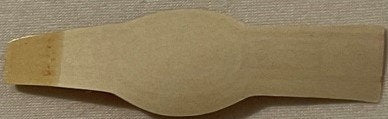
Let's be precise, because precision is what tobacciana collectors deserve. This is an original antique Town Talk cigar band, produced somewhere in the window of the 1910s through the 1930s, associated with W.M. Applegate — either as manufacturer, distributor, or brand proprietor operating out of Lancaster, Pennsylvania. The band measures 2¾ inches wide by ¾ inch tall, which places it squarely in the standard domestic cigar band format of the era, sized to wrap a respectable, well-made American stogie without overwhelming the tobacco underneath.

The printing is chromolithography — the commercial printing method that defined this entire category of collectible. A deep, rich crimson red anchors the design against a cream-white background, and the execution is sharp enough, even after a century, that you can still read the fine dot-ring border encircling the central oval medallion. Inside that oval, in clean white block lettering: TOWN TALK. Two words that once meant something specific to Lancaster's cigar-buying public. Flanking the medallion are symmetrical panels of ornate decorative scrollwork — the kind of graphic detail that required a skilled lithography artist to design and a skilled pressman to reproduce consistently across thousands of impressions. The band tapers at each end in the classic cigar band profile: wide at center, narrowing toward the tips, creating that elegant hourglass silhouette that collectors have recognized and loved for generations.

This is New Old Stock. It has never been wrapped around a cigar. It came out of old inventory — a store room, a factory drawer, an estate — and it has spent the decades since in essentially the same condition it left the press. That is increasingly rare. Most bands of this era were used, discarded, lost to time, humidity, or simply the indifference of a world that didn't yet know it should care. This one made it through.


🌿 Lancaster, Pennsylvania and the Tobacco That Built It

To understand this little band, you have to understand the ground it came from. And that means understanding Lancaster County in a way that most casual visitors never do.

Long before the Pennsylvania Dutch quilts and the Amish buggies became the county's most exported images, Lancaster was tobacco country — and I mean that in the most serious agricultural and industrial sense of the phrase. The broad, flat bottomlands of the Lancaster Plain, enriched by centuries of careful farming, turned out to be nearly perfect for growing a broad-leaf tobacco that prized itself as ideal binder leaf for premium domestic cigars. After the Civil War, when the American cigar industry began its long, spectacular expansion, Lancaster was positioned to become one of its most important suppliers — and it delivered.

By the late nineteenth century and into the early twentieth, tobacco was the most valuable crop on a per-acre basis across the Lancaster Plain. Entire family farms rotated around it. Tobacco sheds — those distinctive louvered wooden structures that still dot the rural Lancaster landscape today — were as common as barns. The harvest each autumn was a community event, and the crop moved from those sheds into the factories of Lancaster city and its surrounding towns through a well-worn network of dealers, buyers, and brokers who all knew each other by first name.

The cigar factories that rose to meet this supply were numerous and often small by today's standards — tight operations employing dozens to a few hundred workers, mostly women and children in the early decades, who could roll cigars with remarkable speed and consistency. Lancaster city alone supported scores of these operations at various points in the industry's peak years. The air in certain neighborhoods genuinely smelled of tobacco. Former factory buildings still stand in Lancaster today, their brick facades giving no obvious indication of the industry that once hummed inside them.

This is the world that produced the Town Talk band. A world where W.M. Applegate — whether as a cigar maker, a tobacco dealer, or a brand principal — was a real Lancaster name attached to a real Lancaster product that real Lancaster people bought and smoked. The name Town Talk itself tells you something about the era's marketing sensibility: confident, community-rooted, slightly boastful in that particular American small-city way. The talk of the town. Worth talking about. There was real pride in the local product, and the branding reflected it.


✍️ W.M. Applegate and the Art of the Band

What sets this particular band apart — and what the seller's notes flag specifically — is the designation of W.M. Applegate Artwork. In the world of tobacciana collecting, attribution to a named artist or designer is genuinely significant. Most cigar bands from this era were produced anonymously, turned out by commercial lithography houses on contract, with the brand proprietor specifying a general look and the press house executing it as efficiently as possible. The appearance of a designer's name — even one as lightly documented as Applegate's in the broader historical record — suggests a different relationship between the brand and its visual identity.

Whether W.M. Applegate was the cigar man himself who also had a hand in the design, a commercial artist working in Lancaster during the teens and twenties, or a lithography shop principal whose name attached to the printing contract, we may never know with complete certainty. But the band itself argues for someone who cared. Look at that scrollwork. Look at the precision of the dot-ring border around the medallion. Look at the balance of the two flanking decorative panels — they are symmetrical and precise, achieved in an era when that precision meant hand-drawing every element before any printing plate was ever made. That level of care doesn't happen by accident. It happens when someone with real skill and real pride puts their name on the work.

Local legend has it that certain Lancaster cigar manufacturers of the 1910s and 1920s competed as seriously on the elegance of their bands as they did on the quality of their tobacco — that the salesmen who called on tobacconists across Pennsylvania and into neighboring states would fan out a selection of bands on the counter like playing cards, letting the design do the talking before a single cigar was unwrapped. Whether that's documented history or accumulated collector lore, it rings true when you look at a band like this one. Somebody was trying to win that fan-out.

Lore passed down among tobacciana collectors holds that the bands produced in Lancaster's peak years — roughly 1890 through the mid-1930s — represent the highest point of American cigar band lithography as a practical art form, distinct from the more elaborately decorative souvenir bands produced for display, because they had to be beautiful and functional. They had to survive the rolling table, the humidor, the tobacconist's case, and still look sharp in a customer's fingers. That constraint, collectors argue, produced a particular kind of disciplined elegance that later, less pressured production never quite recaptured. The Town Talk band sits comfortably within that tradition.


📜 The Broader Tobacciana Story — Why These Survive at All

Here's something that strikes me every time I think carefully about New Old Stock tobacciana from this era: the sheer improbability of survival. Cigar bands were consumables. They were printed by the thousands, used once, discarded. The ones that weren't discarded were collected — and American cigar band collecting has a surprisingly deep history, stretching back to at least the 1880s, when children and adults alike gathered bands the way a later generation would gather baseball cards. Albums were sold specifically for mounting them. Victorian parlor games were built around them.

But New Old Stock bands — bands that were printed, stored, and never used — survived through an entirely different mechanism: the accidental preservation of old inventory. A factory closes. A drawer is never emptied. An estate is settled decades later and someone discovers a flat paper bundle, still tied, still crisp. That's how pieces like this Town Talk band make it to us today in the condition they're in. Not through deliberate preservation, but through the beautiful accident of being forgotten in exactly the right place.

The window of 1910s through 1930s carries its own particular historical weight. The earlier end of that range sits in the full confidence of Lancaster's cigar industry peak — production is high, competition is fierce, lithography is at its most refined. The later end approaches the disruption of Prohibition (which affected the hospitality contexts in which cigars were often consumed), the Great Depression (which squeezed luxury spending across the board), and the early rumblings of the consolidation that would eventually reduce hundreds of small regional cigar brands to a handful of national ones. A band from this window is a band from the last fully vital chapter of the classic American small-cigar-maker story. There's genuine poignancy in that if you let yourself feel it.


🖼️ Display Ideas

  • 🪵 Frame it in a shadow box alongside other Lancaster or Pennsylvania tobacciana — a tobacco tin, a trade card, a small sample label — for a regional collection vignette that tells a real geographic story.
  • 📚 Mount it in a collector's album in the Victorian tradition, paired with other chromolithography cigar bands from the same era to show the full range of the art form at its peak.
  • 🪑 Display it on a writing desk under glass as a single artifact with a small hand-written provenance card — the kind of minimal, confident presentation that lets the object speak entirely for itself.
  • 🏛️ Incorporate it into a Lancaster history display — local historical societies, heritage museums, and tobacco-industry-focused collections frequently build interpretation around exactly this kind of printed ephemera.
  • 🎨 Use it as graphic inspiration — graphic designers and brand historians working with vintage typography and chromolithography motifs find period cigar bands invaluable as authentic reference material.
  • 🎁 Gift it presented on archival black card stock inside a clear sleeve — the crimson-and-cream palette against black makes a striking visual impression that rewards the recipient before they even know what they're looking at.

🎁 Who Collects These

The collecting community around antique cigar bands and tobacciana is broader and more varied than casual observers tend to expect. At one end, you have dedicated tobacciana specialists — collectors who focus entirely on cigar- and tobacco-related material, who can tell you the difference between a Lancaster-origin band and a Tampa-origin band at a glance, and who actively seek out New Old Stock precisely because it represents the object in its intended, uncompromised state. For these collectors, a named-artwork attribution like W.M. Applegate adds a specific research thread that makes the piece genuinely more interesting.

Lancaster County history enthusiasts represent another natural home for this band. The region has a particularly engaged local history community — people who care deeply about the specific story of the Lancaster Plain, the tobacco economy, the cigar factory culture, the families whose names appeared on brands and products for three or four generations. A Town Talk band from the Applegate connection is a tangible piece of that story, not a reproduction or an illustration but the actual artifact.

Chromolithography and printed ephemera collectors prize cigar bands as one of the most concentrated expressions of the lithographer's art — small canvases that demanded the same precision as a full-sized trade card or poster but in a format barely three inches wide. The technical achievement represented in a well-executed band is something this collecting community recognizes and values independently of the tobacco content.

Antique dealers and prop stylists working in period interiors, film and television production design, and editorial photography regularly seek out authentic small ephemera from defined eras. A 1910s–1930s cigar band in NOS condition is exactly the kind of detail that makes a styled period scene feel genuinely inhabited rather than assembled.

And then there are the gift buyers — people looking for something genuinely old, genuinely beautiful, and genuinely connected to a specific place and time for a grandfather who smoked cigars, a grandmother who grew up in Lancaster County, a historian friend who will immediately understand exactly what they're holding. This band works beautifully in that context because it carries its meaning visibly, in its crimson and cream and scrollwork, without requiring the recipient to do any research at all.


❓ Frequently Asked Questions

What exactly does "New Old Stock" mean for a cigar band like this one?

New Old Stock — NOS — means that this band was produced for commercial use, stored as inventory, and never actually used for its intended purpose. It was never wrapped around a cigar, never handled in a rolling room, never sat in a humidor or on a tobacconist's counter. It went from the lithography press into storage, and it has remained essentially in that original condition ever since. For paper ephemera from the 1910s–1930s, NOS status is genuinely significant because paper from this era is vulnerable to humidity, light, handling oils, and simple mechanical wear. A NOS band retains the color saturation, the crispness of the paper stock, and the sharpness of the printed detail that used bands simply cannot offer. This Town Talk band's deep crimson is still vivid because it has never been asked to endure anything since it was printed.

Is W.M. Applegate a documented historical figure in Lancaster tobacciana?

The name W.M. Applegate appears in connection with this band's artwork attribution, and Lancaster's tobacco industry of the 1910s–1930s was populated by dozens of proprietors, dealers, and brand principals whose names appear in period city directories, trade publications, and county records but who were not necessarily prominent enough to enter the broader historical literature. The honest answer is that dedicated research in Lancaster County historical archives — the Lancaster County Historical Society holds substantial material on the local tobacco industry — would likely surface more specific documentation. What the band itself tells us is that the Applegate name was associated with a real product, real artwork, and real commercial pride. For collectors, that attribution on the band itself is the primary artifact; the historical research is the rewarding next step.

How should I store or handle this band to preserve its condition?

For NOS paper ephemera of this age, the priorities are consistent: keep it away from direct light (UV exposure is the primary enemy of chromolithography color over time), maintain a stable humidity environment (neither very dry nor damp — relative humidity in the 40–55% range is ideal for most paper), and handle it as infrequently as possible with clean, dry hands or cotton gloves. Archival-quality Mylar or polypropylene sleeves, or acid-free mounting materials if you're framing it, are the appropriate housing choices. The band has survived a century in good condition, which tells you it's been in a reasonable environment. Continuing to give it a reasonable environment is really all it asks.

Can you tell me more about what chromolithography actually involved?

Chromolithography was the dominant commercial color printing technology from roughly the 1870s through the early decades of the twentieth century. It worked by printing multiple layers of color ink, each from a separate hand-prepared stone (and later zinc plate), with precise registration between layers to build up the full design. A piece with several colors — like this Town Talk band with its crimson, cream, and white with black detail — required a separate stone for each color, meaning the design was drawn multiple times in decomposed form and then reassembled through the printing process. The skill required at both the design stage and the pressroom stage was substantial, and the craft knowledge that made it possible was passed through apprenticeship traditions that began disappearing as photomechanical offset printing took over in the 1920s and 1930s. This band sits right at the tail end of chromolithography's commercial reign, which gives it a particular art-historical position.

Was "Town Talk" a well-known Lancaster cigar brand in its time?

Lancaster's cigar industry at its peak supported a remarkable number of local and regional brands, the majority of which circulated within Pennsylvania and neighboring states rather than achieving national distribution. Town Talk fits the profile of a strong regional brand — one with a name designed for local resonance and trust, professional-quality branding that competed comfortably on any tobacconist's counter, and enough production to require lithographed bands rather than hand-stamped or plain paper wrappers. Whether it was a household name across Lancaster County in the way that some larger operations were, or a respected but smaller specialty brand, is the kind of granular question that tobacciana collectors love to research precisely because the answers are still out there in old newspapers, city directories, and estate papers — waiting for someone to find them.

What makes Lancaster cigar bands specifically sought after versus bands from other regions?

Lancaster's position as the most concentrated domestic cigar-producing region outside of Tampa and the Connecticut River Valley gives Lancaster-origin material a particular geographic authority in tobacciana collecting. The sheer volume and variety of brands that operated out of Lancaster County means that Lancaster bands represent one of the deepest and most varied collecting categories within the broader cigar band world. Beyond volume, there's the quality argument: Lancaster manufacturers in the peak decades were competing hard for regional market share, and that competition extended to packaging and branding. The bands that came out of this environment tend to reflect real investment in lithographic quality. Add to that the strong local history community that gives Lancaster ephemera contextual depth — you can research these pieces in ways that are harder with material from less well-documented regions — and you have a collecting category with both aesthetic and intellectual rewards.

Is a single cigar band a meaningful collectible, or is this the kind of thing that's only valuable in quantity?

This is a question worth taking seriously. Cigar bands certainly have a long tradition of being collected in albums and in quantity — the Victorian collecting culture around them was explicitly about accumulation, variety, and the pleasure of the full spread. But a single band in NOS condition, with specific regional origin, a named artwork attribution, and a well-defined historical context, is a genuinely meaningful individual collectible — and in some ways more focused and satisfying than a bulk lot. You're not managing a collection; you're holding a single artifact with a specific story. For the right collector or gift recipient, that singularity is exactly the point. It sits on a desk, in a frame, in an album with a provenance note, and it says something specific and true about a place and a time. That has real value independent of quantity.

Shipping

🚚 Shipping & Handling

  • Shipping costs and timing are calculated at checkout.
  • Items curated and shipped directly by me include U.S. shipping at no additional cost, professionally packed to ensure safe arrival of your artifact.

Items from Vetted Pro Collectors
Shipping for items offered by vetted Pro Collectors is determined at checkout. All Pro Collector listings are reviewed to ensure fair, reasonable shipping practices.

For full details, please refer to our Shipping Policy.

Returns & Exchange

Take your time — you've got a full six months. If a piece isn't right for you, send it back the way it reached you and we're good.

In the first 30 days your money goes straight back the way you paid. After that it's store credit, so you can put it toward something you'd rather have.

Return shipping we sort out between us, case by case. I don't make this difficult.

If something arrives damaged, or it isn't what I said it was, send me a photo within 48 hours and I'll make it right.

Email info@vintageantiquesgifts.com or call 802-356-9872 — that's me answering, not a call center.

The only things I can't take back are custom or special-order pieces and gift cards.

View full details