Skip to product information
1 of 6

Vintage and Antique Gifts

1950s Delaware, Lackawanna & Western Railroad Stock Certificate 🚂 Scranton PA DL&W Antique Scripophily

1950s Delaware, Lackawanna & Western Railroad Stock Certificate 🚂 Scranton PA DL&W Antique Scripophily

Regular price 9.00 USD
Regular price Sale price 9.00 USD
Sale Sold out
Shipping calculated at checkout.
Quantity

🚂 What Did It Take to Haul the Nation's Hardest Coal to Market? ❄️

There's a particular kind of magic in holding a stock certificate from a railroad that no longer exists — a company whose locomotives are gone, whose corporate name has been folded into history, but whose tracks (in some stretches, at least) still carry commuters home every evening without anyone giving it a second thought. That's the pull of the Delaware, Lackawanna & Western. This wasn't a scrappy short line or a speculative venture that flamed out — it was one of the steadiest, best-run railroads in American history, a company that connected the anthracite coal seams of northeastern Pennsylvania to the hungry furnaces and parlor stoves of New York City, and did it so well that it never once slipped into bankruptcy in over a century of independent operation. Holding one of these certificates is holding a small, engraved piece of that unbroken run.

What This Is

This is an original stock certificate issued by The Delaware, Lackawanna and Western Railroad Company, chartered in the State of Pennsylvania and headquartered, in its later years, in Scranton, Pennsylvania and New York City. Certificates of this design — with its ornate lettered banner title, its central engraved vignette of a steam locomotive alongside a scene of coal miners at work and a coal breaker in operation, and its "State of Pennsylvania" heading — were printed by the American Bank Note Company of New York, the premier security engraver of the era, and were issued across the 1930s through the company's final year of independent operation in 1959.

Each certificate measures roughly 11 1/4" x 7 1/2", denominated in shares of $50 par value, and carries the printed hallmarks of that era's finest bank-note engraving: hand-cut lettering, filigree borderwork, a guilloché-style security pattern, and a genuine steel-engraved scene rather than a simple printed illustration.

This is a genuine issued share certificate from the anthracite road's own paperwork — fully executed, countersigned by the transfer agent and registrar, and punch-cancelled at the end of its working life. The artistry alone puts it in a class with the finest of American financial engraving from the mid-20th century.


⛏️ An Anthracite Empire Built on Coal and Steel

The Delaware, Lackawanna & Western's story begins long before its final name was ever engraved on a certificate. It traces back to April 7, 1832, when Pennsylvania incorporated a small, dormant charter called the Liggett's Gap Railroad Company. Nothing happened with it for years — it sat on paper while the anthracite fields of northeastern Pennsylvania waited to be connected to a market. That changed through the 1840s and early 1850s as coal and iron interests realized what a rail line running north from Scranton could mean. On April 14, 1851, the company was renamed the Lackawanna & Western Railroad Company, and on March 11, 1853 — after absorbing the Delaware & Cobb's Gap Railroad Company, which was chartered to push east toward the Delaware River — it took the name that would stick for the next 107 years: the Delaware, Lackawanna and Western Railroad Company.

The purpose was simple and lucrative: link the anthracite coal fields of Pennsylvania's Coal Region to the enormous coal-hungry markets of New York City. Anthracite — the hard, clean-burning "black diamond" coal unique to this corner of Pennsylvania — heated homes and fired industry up and down the Eastern Seaboard, and whoever could move it efficiently stood to make a fortune. The DL&W did exactly that, gradually stretching its rails both east and west until it linked Buffalo, New York, all the way to Hoboken, New Jersey, and by ferry across the Hudson to Manhattan itself — a run of 395 miles.

What set the Lackawanna apart from so many of its coal-hauling contemporaries — the Lehigh Valley, the New York, Ontario & Western, the Lehigh & New England — was its remarkable stability. Collectors and rail historians alike point to the same fact: the DL&W never went bankrupt from its formation in the early 1850s all the way until its merger over a century later. That kind of staying power was rare in an industry littered with receiverships and reorganizations. Part of the credit goes to engineering ambition as much as financial discipline — the railroad was a genuine pioneer of reinforced concrete construction, and its Tunkhannock Viaduct (also called the Nicholson Viaduct), standing 240 feet high, was for decades the largest concrete arch bridge in the world. That kind of infrastructure wasn't built by a company cutting corners; it was built by one planning to be around for a very long time.

Of course, no anthracite railroad could outrun the slow decline of the anthracite trade itself. As oil and natural gas heating displaced coal furnaces after the Second World War, and as the expanding interstate highway system handed short-haul freight to trucks, the DL&W's core business steadily eroded. The 1959 Knox Mine Disaster — a catastrophic mine flooding near Pittston, Pennsylvania that effectively ended large-scale anthracite mining in the region almost overnight — delivered a symbolic and practical blow to the entire industry the railroad had been built to serve. Add to that the physical devastation of Hurricane Diane in 1955, which battered the DL&W's main lines so severely the railroad was knocked out of operation for 29 days, and the pressure toward consolidation became unavoidable. On October 17, 1960, the Delaware, Lackawanna & Western merged with its longtime rival, the Erie Railroad, to form the Erie Lackawanna Railroad — meaning that any certificate from this company's final decade captures the Lackawanna in the last years it stood on its own, still solvent, still proud, right up until the very end.


🏙️ Scranton, Pennsylvania: The City the Railroad Built

You cannot tell the story of the Delaware, Lackawanna & Western without telling the story of Scranton, because the two grew up together, practically inseparable. Long before there was a city here, this was Slocum's Hollow — a modest settlement in the Lackawanna Valley. It was iron and coal that drew George W. Scranton and his brother Selden T. Scranton from Oxford, New Jersey, to stake their future in this valley, and it was their ironworks and the coal-carrying railroad that followed which transformed Slocum's Hollow into the booming industrial city that would eventually bear their name. Scranton wasn't just a stop on the DL&W's route — it was the operational heart of the entire railroad, home to its locomotive shops and the geographic hinge between the coal fields to the north and west and the markets to the east.

The eastern terminus of the line was Hoboken, New Jersey, where the DL&W's magnificent Hoboken Terminal still stands today as the last active railroad terminal on the Hudson River — a nationally recognized historic landmark and a direct physical descendant of the ferry connection that once carried Lackawanna passengers the final stretch into Manhattan. By the 1950s, the railroad's executive offices had moved to 140 Cedar Street in lower Manhattan, and it's a detail worth savoring: the company's own president commuted to that office each morning the same way any Lackawanna rider did — by Lackawanna electric train and Hudson River ferry from his home in Summit, New Jersey. The railroad wasn't just something its executives ran from a distance; they rode it themselves.


👔 The Men Behind the Lackawanna

A company that avoided bankruptcy for over a century didn't do it by accident, and a handful of names come up again and again in the Lackawanna's history. Moses Taylor, president of the National City Bank of New York and a man who had sunk deep personal investment into the coal lands of the Lackawanna Valley, joined the railroad's board in 1854. When the depression of the 1870s threatened to leave the company vulnerable to a hostile takeover by none other than the notorious Jay Gould — already circling from his perch at the Erie Railroad — it was Taylor who bought up enough stock to keep the Lackawanna independent. It's a delicious irony of railroad history that the very rival the DL&W fought off in the 1870s was the same Erie Railroad it would voluntarily merge with nearly ninety years later, on far more equal terms.

The certificate era itself opens with William White at the helm, the president who pushed the DL&W into the diesel age and, in 1949, inaugurated the railroad's most glamorous train — the streamlined Phoebe Snow — before departing in 1952 to take the presidency of the New York Central. His successor, Perry M. Shoemaker, was something of a departure for the old Lackawanna: a Yale graduate, he was the first college-educated man to run the company, having worked his way up from superintendent (hired in 1941) through general superintendent, general manager, and vice president of operations before being named president in 1952. It was Shoemaker who was steering the railroad through the very years — the mid-to-late 1950s — that produced certificates like this one, guiding the company through the Hurricane Diane recovery and, ultimately, into the negotiations that would end the Lackawanna's independent existence.


❄️ Phoebe Snow and the Legend of "Clean Coal"

No discussion of the Lackawanna is complete without its most famous piece of advertising folklore — Phoebe Snow. Collectors and rail historians alike still repeat the story: to demonstrate just how clean-burning anthracite coal was compared to the sooty bituminous coal used by other railroads, the DL&W invented a fictional passenger, a proper young woman always dressed head to toe in immaculate white, gloves and all, who rode the Lackawanna's trains without ever soiling her gown. Period advertising jingles built around her — playful little verses rhyming her name with "road of anthracite" — became genuinely famous, and by 1949 the railroad had gone so far as to name its flagship streamlined passenger train after her: the Phoebe Snow. Old-timers along the line still remember that train as the pride of the Lackawanna fleet, the physical embodiment of a marketing character born purely to sell the virtues of a particular kind of coal.

The visual identity carried onto certificates like this one tells the same story in engraved form — the locomotive belching its plume, the miners working the seam, the breaker processing the coal — three chapters of the same anthracite story bound together in a single vignette by the American Bank Note Company's engravers.


🛤️ What Remains of the Lackawanna Today

The Erie Lackawanna Railroad, born of the 1960 merger, itself passed into Conrail in 1976, and the DL&W name faded from active railroading — but its physical legacy is still very much alive. The Lackawanna's old Scranton locomotive shops survive today, beautifully restored, as the centerpiece of Steamtown National Historic Site, drawing rail enthusiasts to Scranton to this day. Meanwhile, New Jersey Transit still runs commuter service over former DL&W trackage, including the Montclair-Boonton and Morris & Essex lines running into that same historic Hoboken Terminal — meaning that, in a very real sense, the daily commute Perry Shoemaker once made by Lackawanna electric train is still happening on the same rails today. There's even fine art tied to the railroad's earliest days: George Inness's 1855 painting "The Lackawanna Valley," depicting the young railroad threading through Scranton, hangs today in the National Gallery of Art in Washington, D.C. — a reminder that this company was already considered worth painting less than three years after it took its final name.


🖼️ Display Ideas

  • 🖋️ Framed alongside a magnifying glass to let the engraved miner and locomotive vignette be studied up close
  • 🚂 Paired with a piece of anthracite coal or a small model steam locomotive for a railroad-themed shadow box
  • 🏠 Hung in a home office or den as a conversation-starting piece of American industrial history
  • 🎓 Given as a milestone gift to a railroad enthusiast, a Pennsylvania native, or anyone with roots in Scranton or the Lackawanna Valley
  • 📚 Displayed alongside vintage railroad timetables, postcards, or Phoebe Snow advertising ephemera for a themed collection
  • 💼 Matted simply and professionally for an office or library wall, letting the engraving speak for itself

🎁 Who Collects These

Scripophily — the collecting of antique stock and bond certificates — draws a wonderfully specific crowd: railroad historians and rail fans tracking the lineage of American lines from charter to merger; Pennsylvania and New Jersey collectors with a personal or family tie to Scranton, the coal region, or the old Lackawanna commute into Hoboken; engraving and printing enthusiasts drawn to the American Bank Note Company's craftsmanship; and gift-givers looking for something with genuine depth for the retired executive, the train buff, or the history-minded reader in their life. It's also a favorite starter category for new collectors, since a single certificate opens up an entire, well-documented corporate history to explore — and more than one collector has found that one Lackawanna certificate quickly turns into several.


❓ FAQ

Is this a real, physically issued stock certificate, or a reproduction?
This is a genuine, original certificate printed by the American Bank Note Company for the Delaware, Lackawanna and Western Railroad Company — not a reprint or modern reproduction.

What should I expect on a certificate like this?
Expect a fully executed document from the era it was printed: ink entries, transfer-agent and registrar signatures and stamps, and the cancellation punches struck when it was retired. It's original period printing that was put into service and carries the record of it.

Does this certificate still hold any value as a stock, and can I redeem it?
No — the Delaware, Lackawanna & Western merged into the Erie Lackawanna Railroad in 1960 and no longer exists as a company. Certificates like this are collected purely for their history and craftsmanship, not for any financial redemption value.

What's shown in the engraved vignette?
The central artwork depicts a steam locomotive alongside a scene of coal miners at work and a coal breaker in operation — a direct visual reference to the anthracite coal trade the railroad was built to serve.

How old is this certificate?
Certificates of this design were issued across the 1930s through 1959, the railroad's final year of independent operation before its merger with the Erie Railroad.

Why is a Pennsylvania coal railroad's certificate interesting to collectors outside of Pennsylvania?
Because the Lackawanna's reach went well beyond the coal fields — its rails ran all the way to Buffalo and, via Hoboken and ferry, into New York City itself, making it a fixture of daily commuter life across northern New Jersey as much as it was an industrial workhorse in Pennsylvania.

Are these good gifts for someone with a family connection to Scranton or the railroad?
Very much so — for anyone with roots in the Lackawanna Valley, a family member who worked the mines or the rails, or simply a love of classic American railroading, a certificate like this makes a meaningful, conversation-worthy keepsake.

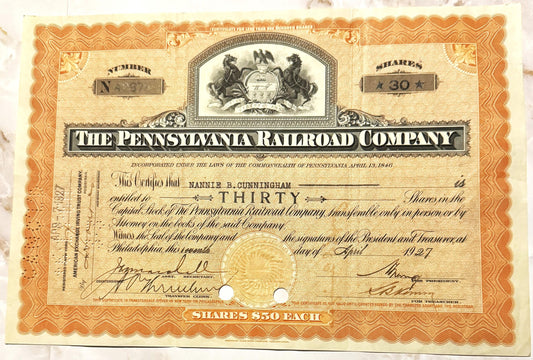
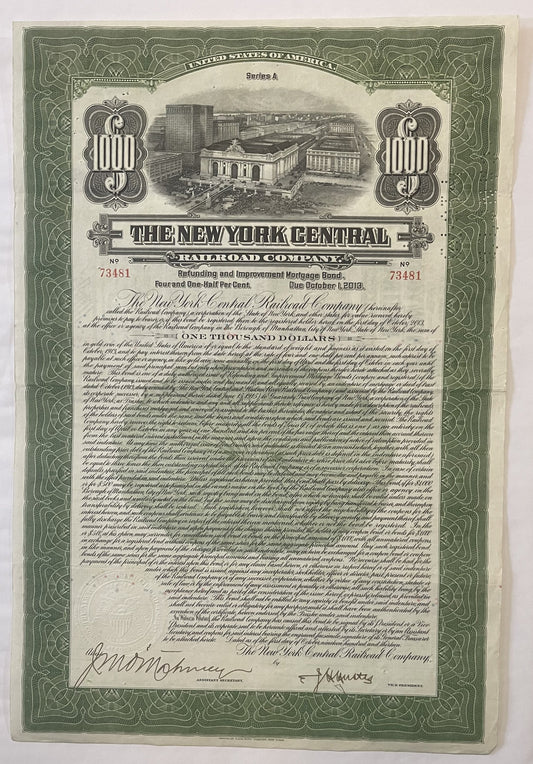
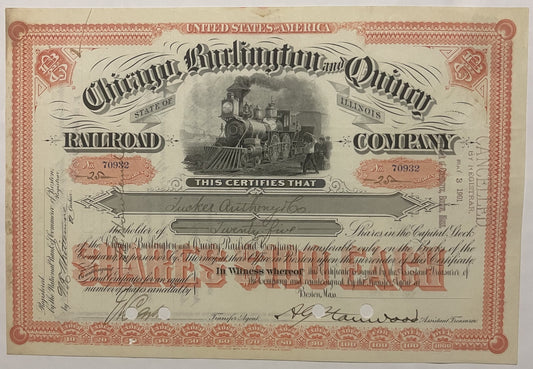
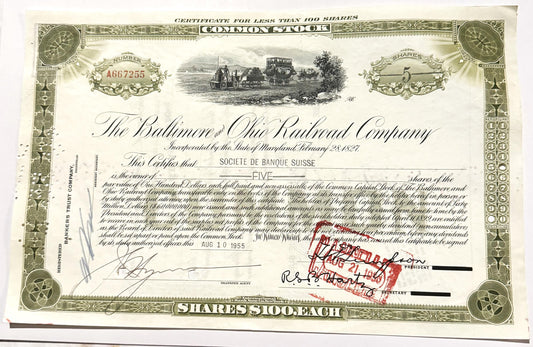
These are issued instruments rather than blanks. Certificates of this type were filled in for a holder in ink, countersigned by the transfer agent and registered by the registrar, then punch- or cut-cancelled when they were redeemed and retired. Expect financial writings, markings, stamps, hole punches and staple holes as part of the life of the instrument: endorsements and signatures, transfer-agent and registrar stamps, revenue or documentary tax stamps, cancellation punches, staple holes from being bound into a transfer book, pencil ledger notations. That is the paper trail of a security that actually did its job, and it is what separates a document that lived from a blank that never did. No two are alike: holder details, serial numbers, dates, signatures, stamps and punch patterns vary from example to example, so the photographs show the type rather than the exact sheet that ships.

Shipping

🚚 Shipping & Handling

  • Shipping costs and timing are calculated at checkout.
  • Items curated and shipped directly by me include U.S. shipping at no additional cost, professionally packed to ensure safe arrival of your artifact.

Items from Vetted Pro Collectors
Shipping for items offered by vetted Pro Collectors is determined at checkout. All Pro Collector listings are reviewed to ensure fair, reasonable shipping practices.

For full details, please refer to our Shipping Policy.

Returns & Exchange

Take your time — you've got a full six months. If a piece isn't right for you, send it back the way it reached you and we're good.

In the first 30 days your money goes straight back the way you paid. After that it's store credit, so you can put it toward something you'd rather have.

Return shipping we sort out between us, case by case. I don't make this difficult.

If something arrives damaged, or it isn't what I said it was, send me a photo within 48 hours and I'll make it right.

Email info@vintageantiquesgifts.com or call 802-356-9872 — that's me answering, not a call center.

The only things I can't take back are custom or special-order pieces and gift cards.

View full details
  • 5 stars: 5 (100%)
  • 4 stars: 0 (0%)
  • 3 stars: 0 (0%)
  • 2 stars: 0 (0%)
  • 1 star: 0 (0%)
_
_***6 (4)

Altamente satisfecho llegó el producto que pedí muchas gracias a Travis y los niños exelente vendedor y atención al vendedor y atención al cliente súper recomendado

8
8***s (3705)

awesome !! Thank you 5 STARS !!

c
c***t (879)

Perfect. Thank you.

h
h***h (1776)

Excellent Five stars !

A
April Frost (Chicopee, US)
Stock Certificate

Great piece of history! Glad I found this site and great people to work with!

Thank you for your kind words and for choosing our site! We're so happy to hear that you found a piece of history that you love! Our team is always here to help and we're glad to have you as a customer.