Skip to product information
1 of 6

Vintage and Antique Gifts

Antique 1930s-1950s Pennsylvania Railroad Stock Certificate 📜 Pennsy Green Monopoly Icon Engraved Scripophily

Antique 1930s-1950s Pennsylvania Railroad Stock Certificate 📜 Pennsy Green Monopoly Icon Engraved Scripophily

Regular price $5.50 USD
Regular price Sale price $5.50 USD
Sale Sold out
Shipping calculated at checkout.

Size: 12" x 8"

🚚 Free US Shipping — ships within one business day. International shipping calculated at checkout.

Quantity

Is This the Railroad on Your Monopoly Board? 📜 An Antique 1930s-1950s Pennsylvania Railroad 100-Share Stock Certificate, Green

Size: 12" x 8"

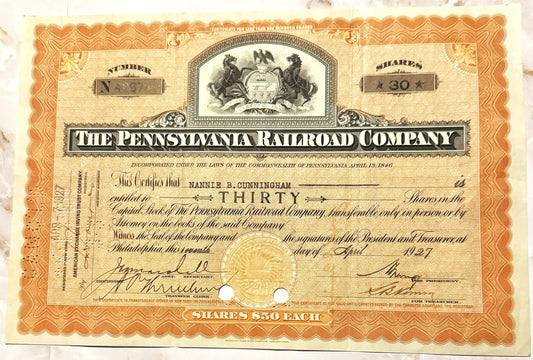
A real, issued 100-share certificate of THE PENNSYLVANIA RAILROAD COMPANY, engraved in green and black by the AMERICAN BANK NOTE COMPANY, PHILADELPHIA. At the top is the Pennsylvania state arms - two rearing horses, an eagle, and the motto VIRTUE, LIBERTY AND INDEPENDENCE - and the company seal shows an early locomotive and tender. It reads INCORPORATED UNDER THE LAWS OF THE COMMONWEALTH OF PENNSYLVANIA APRIL 13, 1846, ONE HUNDRED shares at $50 each, registered in New York with Irving Trust Company, transferable in Philadelphia, New York, Boston, Chicago and London. Each one was filled in by hand, signed, and punch-cancelled when the shares changed hands.

🚂 The Pennsy

If you ever rolled the dice past its name on a Monopoly board - it's one of the four railroads, with the Reading, the B&O and the Short Line - this is the real thing. Chartered in 1846 to build a line from Harrisburg over the Allegheny Mountains to Pittsburgh, so Philadelphia wouldn't lose the western trade to New York's Erie Canal and Baltimore's B&O, the Pennsylvania Railroad grew into the Standard Railroad of the World, the biggest railroad in the country by traffic and revenue, and at one time the largest publicly traded corporation in the world. Old railroad hands still swap stories about the size of it - that it had hundreds of thousands of people on the payroll at its peak - and the deep green on this certificate is the same Brunswick green the Pennsy painted its engines, right down to the streamlined GG1 electrics Raymond Loewy styled. Its keystone herald came straight from Pennsylvania's nickname, the Keystone State.

Its home was Philadelphia's Broad Street Station, fed by a long stone viaduct the city called the Chinese Wall that cut Center City in two. The station and the wall came down in 1953, and local legend among old Philadelphians holds that people who had never seen those blocks without the wall lined up just to watch the sunlight hit the streets. In the wall's place came Penn Center. The railroad owned the ground and wanted to sell it off in lots, but Edmund Bacon, who ran the City Planning Commission, drew up a master plan for the blocks and gave it the name Penn Center in 1952. He didn't get everything he drew, but the office towers went up right where the wall had stood. Out west, Horseshoe Curve near Altoona was the wonder of the line, and old-timers still talk about it the same way. It opened in 1854, a 220-degree bend that let trains climb the Alleghenies on a grade they could manage.

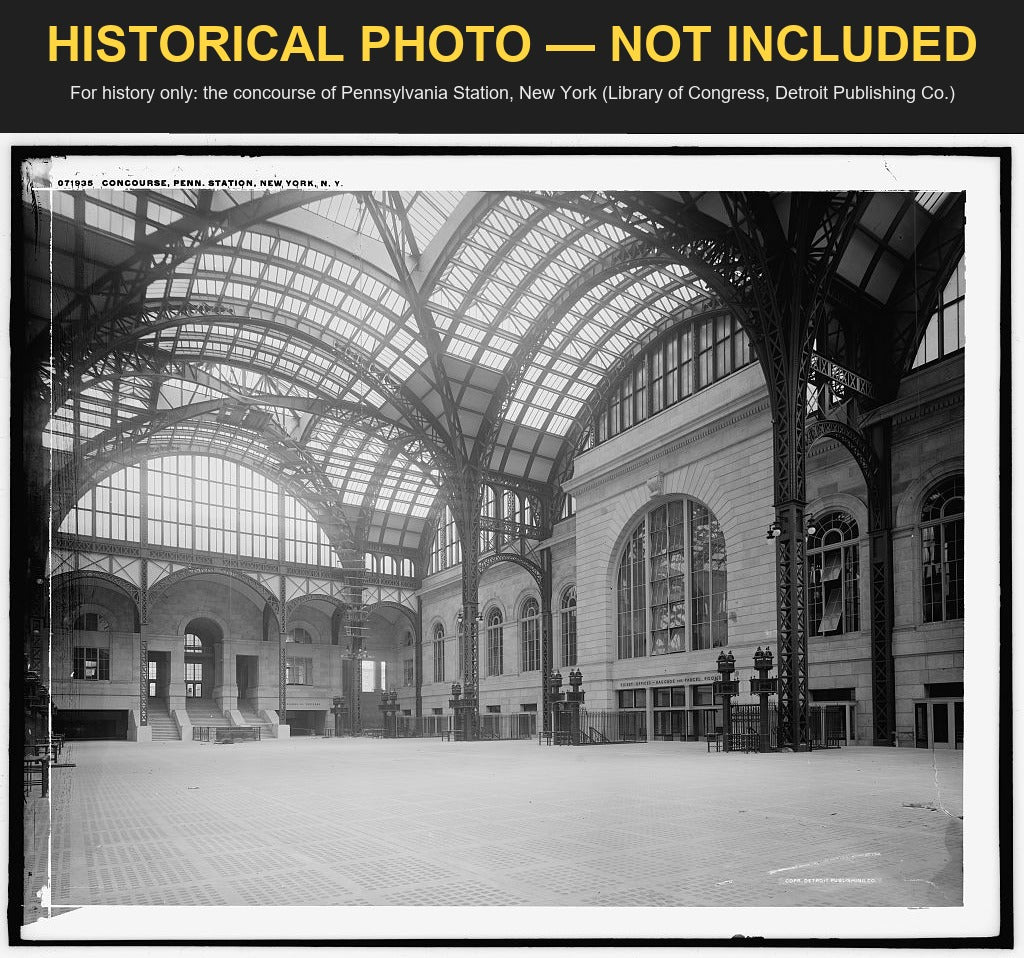
Up in New York, the Pennsy's great front door was the old Pennsylvania Station, the McKim, Mead & White palace that opened in 1910 with a waiting room modeled on the public baths of ancient Rome. The wrecking crews went to work on it on October 28, 1963, and it came down to make way for the Madison Square Garden we have today. The outcry helped push New York to pass its Landmarks Law in 1965, and the country passed the National Historic Preservation Act the year after. That's the part of the Pennsy story that gets me: the railroad built one of the grandest train stations America ever saw, and losing it taught the country to hold on to what it still had.

In 1968 the Pennsy merged with its old rival the New York Central into the Penn Central Transportation Company, the biggest corporate merger in American history up to then. Two years later, in 1970, Penn Central went bankrupt - the biggest bankruptcy the country had ever seen - and its lines went into the government-created Conrail in 1976.

📅 How old are they?

The registrar line dates the plate: the bank only took the name Irving Trust Company in 1929, so these were printed after that - the bank went back to a New York bank chartered in 1851 and by then sat at One Wall Street - and dated copies of this green state-arms certificate run through the 1950s. The one you get will carry its own date, number, owner and signatures, and may look a little different from the one in my pictures. The Penn Station concourse photo at the end is there for history only and isn't included.

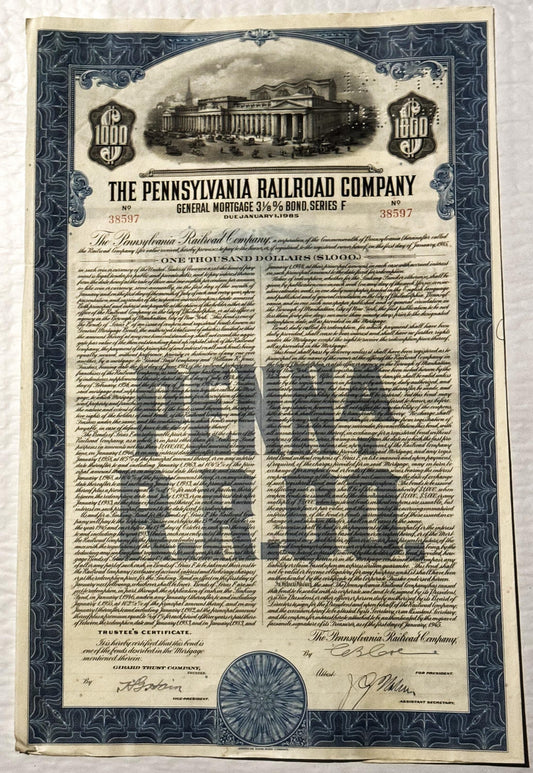
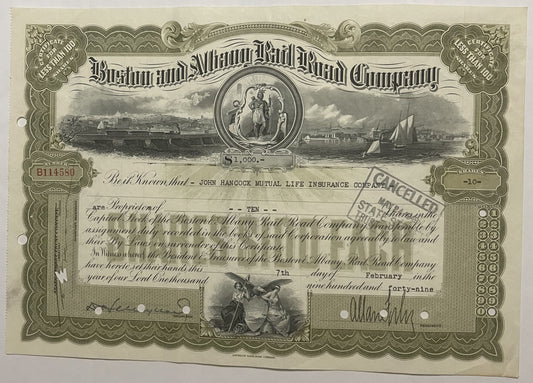
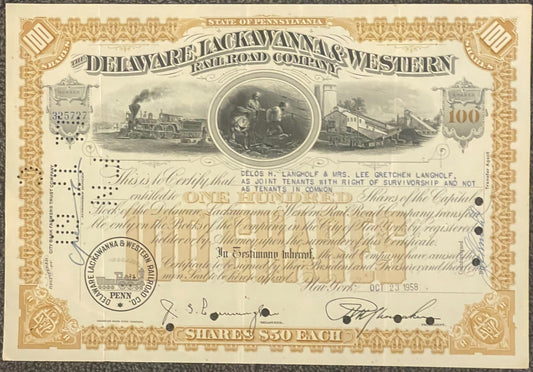
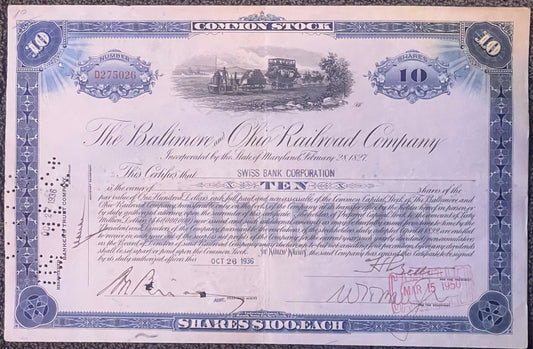
📜 Every one of these certificates had a working life, and it can show. Depending on the sheet, you may find staples or staple holes, cancellation punch holes (often right through the signatures), hand stamps from banks, brokers and transfer agents, real federal or state stock transfer tax stamps, handwriting or a filled-in transfer on the back, papers still attached, seals (a corporate seal pressed into the paper, a foil wafer seal, or a bank's signature-guarantee stamp signed across an endorsement), or a silver strip pasted over an officer's signature with the new officer's signature printed on top. That last one is what collectors call silvering: when the officers changed, the new signature could be pasted right over the old one on certificates already printed. None of that is damage. Each mark is part of the paper's own history, and they vary sheet to sheet, so no two are quite alike.

📜 About these certificates

The American Bank Note Company that engraved it was formed in 1858 by a merger of bank-note engravers and printed currency and stamps as well as stock. They're 12 by 8 inches, engraved on heavy banknote paper, with the folds, cancellation punches and handwriting that come with real use. It's a natural for a train room, an office, a Philadelphia or Pittsburgh history wall, a Monopoly fan, or anybody whose grandfather worked for the Pennsy. The supply is finite - the Pennsylvania Railroad has been gone since 1968, nobody's issuing its stock again, and once these last ones are framed, they'll be very difficult to acquire.

Shipping

🚚 Shipping & Handling

  • Shipping costs and timing are calculated at checkout.
  • Items curated and shipped directly by me include U.S. shipping at no additional cost, professionally packed to ensure safe arrival of your artifact.

Items from Vetted Pro Collectors
Shipping for items offered by vetted Pro Collectors is determined at checkout. All Pro Collector listings are reviewed to ensure fair, reasonable shipping practices.

For full details, please refer to our Shipping Policy.

Returns & Exchange

Take your time — you've got a full six months. If a piece isn't right for you, send it back the way it reached you and we're good.

In the first 30 days your money goes straight back the way you paid. After that it's store credit, so you can put it toward something you'd rather have.

Return shipping we sort out between us, case by case. I don't make this difficult.

If something arrives damaged, or it isn't what I said it was, send me a photo within 48 hours and I'll make it right.

Email info@vintageantiquesgifts.com or call 802-356-9872 — that's me answering, not a call center.

The only things I can't take back are custom or special-order pieces and gift cards.

View full details
  • 5 stars: 1 (100%)
  • 4 stars: 0 (0%)
  • 3 stars: 0 (0%)
  • 2 stars: 0 (0%)
  • 1 star: 0 (0%)
T
Tiffany

Product as described and quick shipping.

Rescuing American History Since 2007

— Travis & the Kids