
Skip to product information
1 of 3

Vintage and Antique Gifts

Vintage 1970s-80s Sterling Beer Schnitzelbank Song Sheet 🍺 German Sing-Along on Weaved Paper

Vintage 1970s-80s Sterling Beer Schnitzelbank Song Sheet 🍺 German Sing-Along on Weaved Paper

Regular price $9.00 USD
Regular price Sale price $9.00 USD
Sale Sold out
Shipping calculated at checkout.

Size: 11" x 8 1/2"

🚚 Free US Shipping — ships within one business day. International shipping calculated at checkout.

Quantity

"Ist das nicht ein Schnitzelbank?" Sterling Beer's Sing-Along Chart

Size: 11" x 8 1/2"

Somebody holds up the chart and points at a picture. The whole room shouts the answer back: "Ja, das ist ein Schnitzelbank!" For more than a hundred years that call and answer has rung through German-American taverns, church halls and Volksfest tents, usually with a glass in every hand. This sheet is the chart itself, printed for Sterling Beer, the brand of Evansville, Indiana. The brewery that made Sterling went dark in 1997 and was razed in December 1998.

11" x 8 1/2" ~

What the Sheet Prints

Across the top, in blue: "For the fun times... This song sings best when DRINKING..." Two Sterling marks flank the slogan. On the left is the Pure Sterling Beer shield, a red shield crossed by a blue banner. On the right is Light Sterling Premium Pilsner Beer, its red bar set against lines of a music staff. Below them a long, rolling staff carries the tune in 2/4 time, treble clef, one flat, with the words set under the notes: "Ist das nicht ein Schnitzel Bank? Ja das ist ein Schnitzel Bank! O die Schoenheit an der Wand, Ja das ist ein Schnitzel Bank."

Then come the pictures, eighteen of them, printed in blue, red and yellow and captioned in German the way the singers call them:

  • Schnitzel Bank: the shaving horse, on a yellow panel, with the answer printed beneath it: "Ja, das ist eine Schnitzel Bank"
  • Kurz und Lang: short and long, drawn as a short bar and a long one
  • Lichtputzher: the candle trimmer, drawn as a candle in its holder
  • Hin und Her: back and forth, a child on a tree swing
  • Kreuz und Quer: every which way, drawn as crossed X's
  • Schies Gewehr: a rifle
  • Wagen Rad: a wagon wheel
  • Krum und Grad: crooked and straight
  • Grosses Glas: a big glass
  • Oxen Blas: an ox bladder
  • Hauffen Mist: a pile of manure, pitchfork stuck in the top
  • Schnickel Fritz: the little rascal, a boy in red holding up a mug
  • Dicke Frau: the stout woman, in a yellow dress and apron
  • Fette Sau: the fat sow
  • Langer Mann: the tall man, a lanky gent in top hat and tailcoat
  • Tannenbaum: the fir tree
  • Hochzeit Ring: the wedding ring, shining
  • Gefährliches Ding: the dangerous thing, drawn as a red dragon

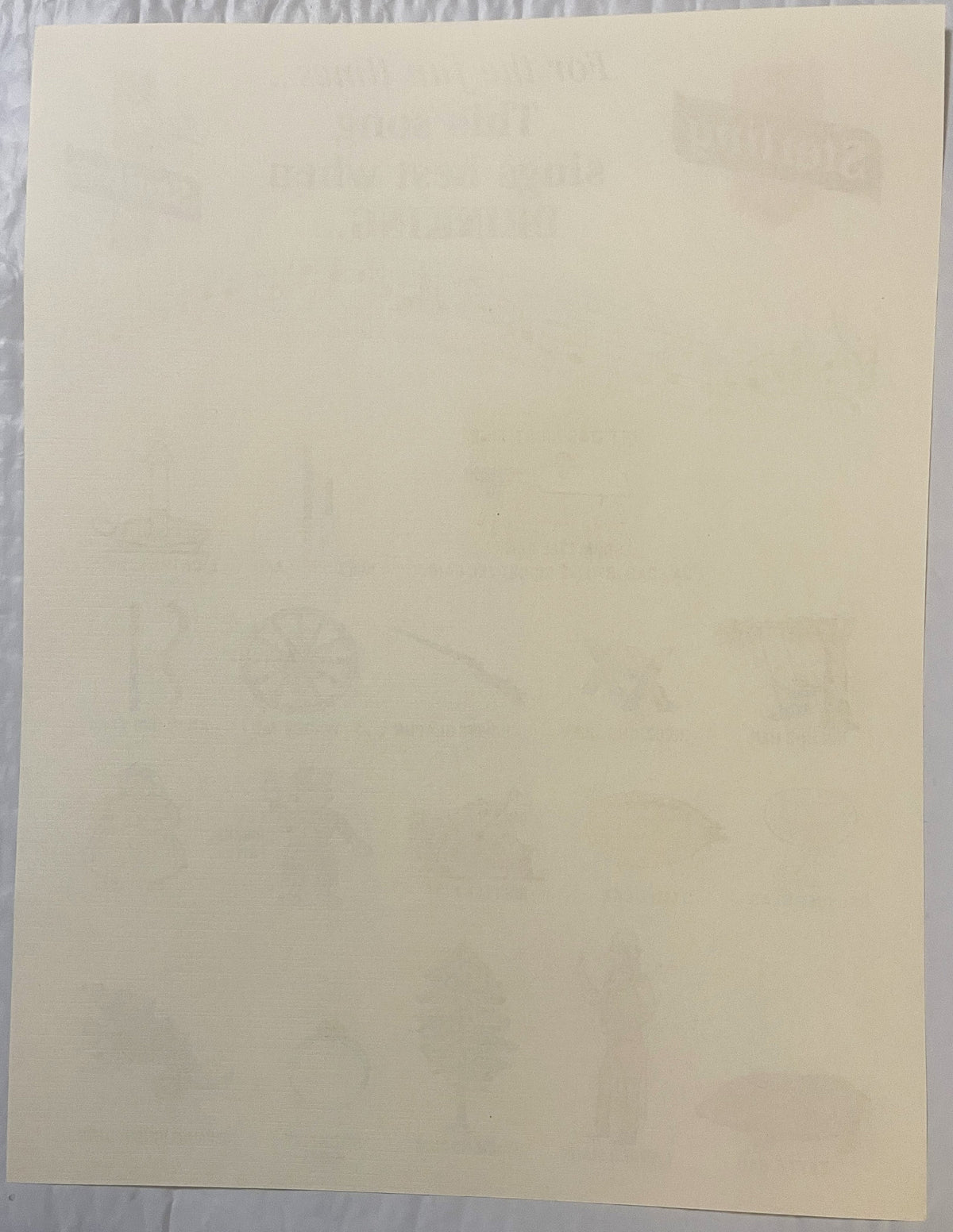
The spellings are the sheet's own, the German of the American beer hall rather than the dictionary: "Schies Gewehr" for Schiessgewehr, "Oxen Blas" for Ochsenblas, "Hauffen Mist" for Haufen Mist. The stock is a cream paper with a fine linen weave you can see in the photographs and feel under a fingertip. The reverse is blank.

The Song: A Carving Bench, a Carnival Rhyme and a Beer Hall Classic

A Schnitzelbank is, word for word, a carving bench: the shaving horse a woodworker straddled, clamping a piece of wood with a foot lever while he shaped it with a drawknife. In southwestern Germany and Switzerland the same word also means a short, comic rhyming song, the kind sung at Fasching and Fastnacht, the carnival before Lent. Folk-song pieces of it turn up in Karl Simrock's German collections of 1856, and a printed Schnitzelbank was circulating in Germany by the 1830s, long before German immigrants carried it across the Atlantic.

In America it settled in fast. The Broadway Publishing Company of Buffalo, New York, issued it as sheet music in 1900, and around the turn of the century the John Bardenheier Wine and Liquor Company printed it on an advertising poster. German-American families used it to teach children the old language, one picture at a time. Groucho Marx was singing it on the vaudeville stage by 1910. It turns up in the 1953 film Stalag 17 and again in The Five Pennies (1959), and Bill Haley recorded a rock and roll version in 1957.

The way it is sung has hardly changed. A leader points at a picture and asks "Ist das nicht ein..." ("Isn't that a..."), the crowd roars back "Ja, das ist ein...", and the pairs of opposites, short and long, crooked and straight, back and forth, give the room something to shout. Brewers noticed. Beer writers have said that just about every American brewery with German roots put out a Schnitzelbank chart at one time or another: Jacob Ruppert in New York in 1907, Huebner of Toledo before Prohibition, Drewrys in the 1940s, Falstaff in 1953, Pearl of San Antonio. Sterling's is this one.

Evansville: A German River Town That Brewed

Evansville sits on the Ohio River in the southwest corner of Indiana, and it was built in large part by Germans. On the eve of the Civil War about one in five of its 12,000 people had been born in Germany; by 1890 half the city was first- or second-generation German-American. The German migration of the 1850s is what turned Evansville into a beer town, and by the late 1800s its breweries clustered along Pigeon Creek for the water.

The singing came with the beer. Immigrants founded the Germania Männerchor, a men's singing society, in 1900. Its Volksfest began in 1934, was shut down in 1941 as anti-German feeling rose with the war, and came back in 1962 for the city's 150th birthday; it is still held every August at the Männerchor's hall and beer garden. Up the road in Jasper, in Dubois County, a tavern named the Schnitzelbank opened in 1961 and became a full German restaurant in 1971. Its glockenspiel plays the Schnitzelbank song through the day.

Sterling: From Hartmetz's Brewery to Heileman

The brewery behind Sterling started in 1863 under Henry Schneider. It went through sheriff's sales in 1869 and 1876 before John Hartmetz took it over in 1877 and made it pay. In 1893 three Evansville breweries merged into the Evansville Brewing Association, and Sterling was its beer.

Indiana went dry in April 1918. The company became Sterling Products and got through Prohibition on soft drinks, near beer and malt syrup, sold for home baking. The story goes that a good share of that syrup ended up in basement crocks rather than bread. When repeal came in 1933 the company became Sterling Brewers, Inc., put in steel tanks, started canning in 1938, and turned 100 in 1963.

A year before that centennial, Sterling created Mickey's malt liquor, a brand that outlived its birthplace and passed to Heileman, then Stroh, then Miller. Evansville lore has it that the name came from the wife of the company president. Sterling itself was a household name south of the Ohio, in Louisville and other southern markets, where it was billed as "Beer of the South."

In the 1960s Sterling joined the Associated Brewing Company group of Michigan, and in 1972 G. Heileman Brewing Company of La Crosse, Wisconsin, bought it. Heileman used the Evansville plant for the regional brands it had collected, Cook's, Champagne Velvet and Drewrys among them, and sold Sterling at a low price. Heileman closed the plant in 1988, citing too much capacity. Local investors reopened it as the Evansville Brewing Company on September 21, 1988, and by 1994 it was shipping close to 40 percent of its beer overseas. It went bankrupt and closed on October 1, 1997; the brands went to Pittsburgh Brewing, and the old brewery came down in December 1998.

Pure Sterling, Light Sterling: When This Sheet Was Printed

The two logos date the sheet. Pure Sterling is the name on the Sterling cans of the Heileman years, the aluminum cans that list G. Heileman Brewing Co. of La Crosse, Wisconsin, with plants in St. Paul, Minnesota, Newport, Kentucky and Evansville, Indiana. A Light Sterling belongs to the light beer years: Miller Lite went national in February 1975, within two years one beer in ten sold in America was a Miller Lite, Coors Light followed in 1978, and by 1982 Budweiser had its own. A sheet carrying Pure Sterling and Light Sterling side by side comes from that stretch, the 1970s and 1980s, when Heileman was brewing Sterling in Evansville.

That is what makes it good history as well as good fun: a German folk song older than the brewery itself, still being printed to sell Evansville's beer more than a century after the Evansville Brewing Association was formed.

Display and Use

Hang it by the bar or the kegerator and lead the song at the next Oktoberfest party, or frame it for an Indiana or Kentucky beer collection. It suits anyone with Evansville roots, a family that still sings the Schnitzelbank, or a German teacher who wants the old pictures on the wall.

Questions People Ask

What does Schnitzelbank mean?
Literally a carving bench, the woodworker's shaving horse. It is also the name of the German call-and-answer song built around that first picture.

How do you sing it?
A leader points at a picture and sings "Ist das nicht ein..." with its name; everyone answers "Ja, das ist ein..." and repeats it. The tune and the opening lines are printed across the top of this sheet.

When was this Sterling song sheet printed?
In the 1970s or 1980s. It carries both the Pure Sterling shield used on G. Heileman's Sterling cans and a Light Sterling Premium Pilsner mark from the light beer era.

Where was Sterling Beer brewed?
Evansville, Indiana, from the Evansville Brewing Association of 1893 through Sterling Brewers, Inc., Heileman, and the Evansville Brewing Company, which closed in 1997.

How big is it?
11" x 8 1/2" ~

Is anything printed on the back?
No. The reverse is blank.

Shipping

🚚 Shipping & Handling

  • Shipping costs and timing are calculated at checkout.
  • Items curated and shipped directly by me include U.S. shipping at no additional cost, professionally packed to ensure safe arrival of your artifact.

Items from Vetted Pro Collectors
Shipping for items offered by vetted Pro Collectors is determined at checkout. All Pro Collector listings are reviewed to ensure fair, reasonable shipping practices.

For full details, please refer to our Shipping Policy.

Returns & Exchange

Take your time — you've got a full six months. If a piece isn't right for you, send it back the way it reached you and we're good.

In the first 30 days your money goes straight back the way you paid. After that it's store credit, so you can put it toward something you'd rather have.

Return shipping we sort out between us, case by case. I don't make this difficult.

If something arrives damaged, or it isn't what I said it was, send me a photo within 48 hours and I'll make it right.

Email info@vintageantiquesgifts.com or call 802-356-9872 — that's me answering, not a call center.

The only things I can't take back are custom or special-order pieces and gift cards.

View full details

Preserving History: Authentic Objects Across Eras

— Curated by Travis Weigel