
Skip to product information
1 of 10

Vintage and Antique Gifts

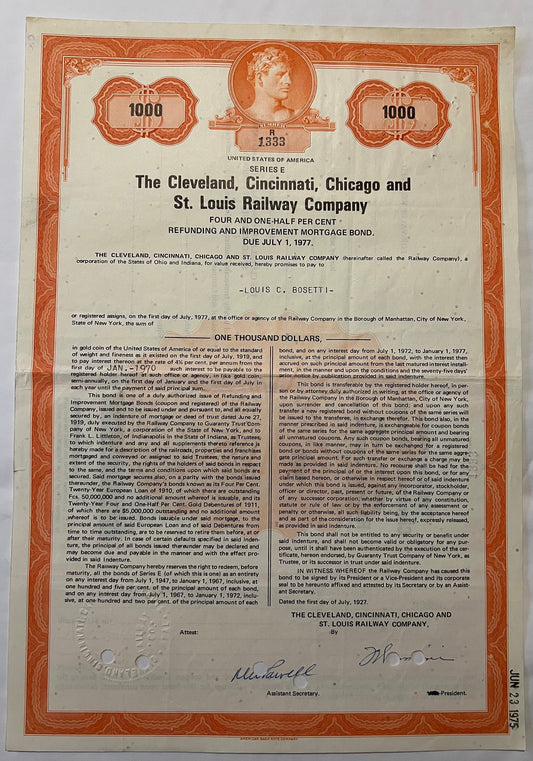
Antique 1927 Big Four Railroad Bond 🚂 Blue, Series E 4.5%, Cleveland Cincinnati Chicago St Louis $1000

Antique 1927 Big Four Railroad Bond 🚂 Blue, Series E 4.5%, Cleveland Cincinnati Chicago St Louis $1000

Regular price 13.00 USD
Regular price Sale price 13.00 USD
Sale Sold out
Shipping calculated at checkout.
Style
Quantity

🚂 What Was It Like to Hold a Promise Written in Gold-Coin Dollars, Signed by a Railroad That No Longer Exists?

Picture a boardroom in 1927 — leather chairs, brass lamps, the smell of fresh ink — where a clerk at the American Bank Note Company pulled a freshly engraved sheet from the press and held up a $1,000 bond bound for a vault, a bank, or a private investor's strongbox. That investor was betting on steel rails, steam power, and a railway system that stitched together four of America's great industrial cities. Fifty years later, in 1977, that same bond would either be redeemed for gold-standard dollars or quietly tucked into a scrapbook as a relic of a world that had already vanished. This is one of those bonds — a genuine 1927 Cleveland, Cincinnati, Chicago and St. Louis Railway Company Refunding and Improvement Mortgage Bond, better known to railroad men and collectors alike as a piece of the legendary Big Four Railroad.

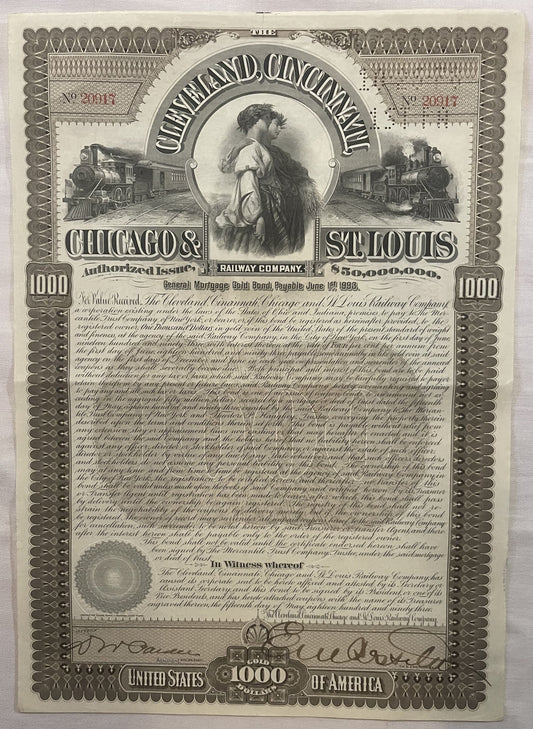
This is an original Series E, 4½% Refunding and Improvement Mortgage Bond issued by the Cleveland, Cincinnati, Chicago and St. Louis Railway Company, dated the first day of July, 1927, and made due July 1, 1977. Printed by the American Bank Note Company — the premier security engraver of its age — the bond carries the deep, richly detailed engraved intaglio printing that firm was famous for: crisp blue floral borders framing a black-and-white steel-engraved vignette of a steam locomotive emerging from a mountain tunnel while a second train crosses a stone bridge high overhead, a signal tower standing sentry beside the tracks. The palette is classic banknote blue, black, and cream — the same combination used on currency of the era to discourage counterfeiting and to signal, at a glance, that this was a document of real financial weight. Measuring a substantial 15 x 10 inches (38 x 25.4 cm), this is an original period bond, printed by the American Bank Note Company. It is an outstanding example of early 20th-century American financial engraving and railroad Americana, the kind of piece that turns heads whether it's studied up close or admired from across a room.


🛤️ The Big Four Railroad: Born From Four Roads, Running Under One Name

The Cleveland, Cincinnati, Chicago and St. Louis Railway Company came into being in 1889, formed through the consolidation of several smaller regional lines whose combined reach threaded through Ohio, Indiana, Illinois, and Michigan. Almost from its founding, railroad men and the traveling public alike shortened its unwieldy legal name to something easier to say at a lunch counter or a depot window: the "Big Four." Collectors and rail historians have long passed down the story that the nickname grew simply from the four great cities stitched into its name — Cleveland, Cincinnati, Chicago, and St. Louis — the four commercial anchors the railway was built to connect. Old-timers along the line, though, sometimes told it a little differently, holding that the "Big Four" tag actually traced back to the four smaller railroads that merged to create the company in the first place. Either way, the nickname stuck for the better part of a century, appearing on timetables, freight cars, and depot signs long after most travelers had forgotten the full corporate name printed so grandly across bonds like this one.

Almost immediately, the Big Four fell into the orbit of the much larger New York Central Railroad, which acquired a controlling interest not long after the 1889 consolidation. For decades the Big Four operated as its own corporate entity — issuing its own bonds, its own stock, its own locomotives painted in its own livery — while functioning, in practical terms, as a vital limb of the New York Central System, one of the largest and most storied rail empires in the country. This bond itself is a direct artifact of that relationship: it was refunding debt secured, per its own text, on a parity with the company's earlier "Twenty-Year European Loan of 1910" and its "Twenty-Year Four and One-Half Per Cent Gold Debentures of 1911" — a reminder that American railroads of this era weren't just raising capital on Wall Street, they were courting investors clear across the Atlantic.


🏙️ Cleveland, Cincinnati, Chicago, St. Louis — The Cities That Built an Empire

To understand why a railroad bond bearing these four city names commanded investor confidence in 1927, you have to picture what those cities were in the first decades of the twentieth century. Cleveland was a booming lake port and steel town, its docks and mills feeding an industrial machine that seemed to run around the clock. Cincinnati, older and more genteel, was a river city of pork-packing houses, breweries, and machine shops, sitting where Ohio met Kentucky commerce. Chicago was, quite simply, the railroad capital of the nation — the great hub through which lumber, grain, livestock, and manufactured goods from half the continent were funneled east and west. And St. Louis, gateway to the Mississippi and the frontier beyond it, anchored the western end of the line, a city of levees, warehouses, and steamboat trade turned railroad trade. A company whose very name promised direct connection between all four was, in effect, promising investors a seat at the table of American industrial commerce itself.

The Big Four's rails and depots became fixtures of daily life in the towns and small cities strung between those four anchors — places where a whistle in the night meant the mail was moving, where the depot was the social and commercial heart of a Main Street, where a boy could set his pocket watch by which train was due. Local legend in more than one Ohio and Indiana rail town holds that the Big Four's engineers took a particular pride in running "on the advertised" — arriving precisely on schedule — a point of honor passed down among railroad families for generations after the line itself had disappeared from the timetable.


⚙️ American Bank Note Company: The Craft Behind Every Line

The engraving on this bond is the unmistakable work of the American Bank Note Company, the New York-based security printing house that, for well over a century, produced currency, postage stamps, and financial certificates for governments and corporations across the Western Hemisphere. Their engravers were master craftsmen in a genuinely dying art: steel-plate intaglio engraving, in which an image is cut by hand into a hardened steel die, then used to stamp ink onto paper under enormous pressure — the same exacting process used to print paper money, precisely because it was so difficult to counterfeit. That's why a bond like this one carries such extraordinary fine-line detail in its locomotive vignette and its lattice of floral borders — every curl of smoke, every rivet on the boiler, every petal in the border scrollwork was cut by hand into steel before it ever touched paper. American Bank Note Company vignettes of this kind were often reused across multiple railroad and industrial bond issues of the period, which is part of why collectors prize them today — not merely as financial paper, but as miniature engravings, genuine works of commercial art produced at the very peak of the engraver's craft.


🚦 Reading the Vignette: A Story Told in Steam and Steel

Look closely at the central engraving and you're looking at a small, self-contained narrative of American railroading in the 1920s. In the foreground, a heavy steam locomotive rounds a curve emerging from a stone tunnel portal, trailing a plume of white steam and smoke that billows up and across the mountainside. Overhead, on a bridge spanning the cut, a second locomotive — a big articulated freight engine — crosses in the opposite direction, its own exhaust curling into the sky. Beside the tracks stands a classic lower-quadrant semaphore signal tower, its blades set to tell the engineer whether the block ahead is clear — the exact technology railroads like the Big Four relied on before modern signaling, when a dispatcher's telegraph and a signalman's watchful eye were what kept two trains from occupying the same stretch of track at the same time. Workers can be seen along the right-of-way, a small human touch amid the machinery, a reminder that behind every mile of track was a small army of section hands, signal men, and linemen keeping the line safe and running. It's a scene American Bank Note Company engravers rendered again and again for railroad clients of the era, because it captured, in a single frame, everything a bondholder wanted to believe about the company holding their money: power, precision, and forward motion.


🖋️ Gold-Coin Bonds and the Financial World of 1927

Read the bond's own language and you're reading a document written for a financial world that no longer exists. The company promises to pay the bearer "One Thousand Dollars… in gold coin of the United States of America… as it existed on the first day of July, 1919." This so-called gold clause was standard practice on major corporate and government bonds of the era, a promise meant to protect investors against currency devaluation over the bond's long life. It's a detail that carries its own quiet historical irony: within a few years of this bond's issue, the country plunged into the Great Depression, and in 1933 the federal government suspended the domestic gold standard and, by joint resolution of Congress, voided gold clauses in both public and private contracts — a controversial move upheld by the Supreme Court in 1935. Bonds exactly like this one became a flashpoint in that very legal and economic drama, their gold promises rendered moot even as their paper interest obligations rolled on. Series E of this refunding issue also carried its own built-in redemption schedule — callable at 105% of face value between 1947 and 1967, stepping down to 102% through 1972, and to par thereafter — the kind of fine print that shaped how railroads managed a half-century of debt across depression, war, and the eventual reshaping of the American rail industry.


🌉 What Became of the Big Four

The Cleveland, Cincinnati, Chicago and St. Louis Railway Company continued operating under its own name and its own board for decades, even as it functioned ever more tightly within the New York Central System, eventually being fully absorbed into the New York Central itself. The New York Central, in turn, merged with its old rival the Pennsylvania Railroad in 1968 to form Penn Central — one of the most spectacular corporate collapses in American business history — before large portions of the network were folded into Conrail in the mid-1970s, right around the very years this bond's own 1977 maturity date approached. Much of the old Big Four right-of-way still carries freight today under new ownership, a quiet continuity beneath all the corporate reshuffling. Perhaps the most famous physical remnant of the railroad is the great Big Four Bridge spanning the Ohio River between Louisville, Kentucky, and Jeffersonville, Indiana — once a working rail bridge for the line, it has since been reborn as one of the most beloved pedestrian and bicycle bridges in the region, carrying walkers and cyclists across the water where steam locomotives once thundered. For collectors and local historians in Ohio, Indiana, and Kentucky rail towns, that bridge remains the most visible living link to the company whose promise, in blue and black ink, you're holding in this bond.


🖼️ Display Ideas

  • 🖼️ Framed alone under glass on an office or study wall, letting the blue floral border and the locomotive vignette take center stage as a conversation piece
  • 📚 Paired with other railroad or Americana ephemera in a themed gallery wall celebrating the golden age of American rail
  • 🏠 Displayed in a den, library, or home office alongside other financial antiques — old stock certificates, vintage currency, or a pocket watch — for a cohesive "gilded age finance" vignette
  • 🎓 Used as a teaching piece or conversation starter for anyone interested in railroad history, American finance, or the art of security engraving
  • 🎁 Given as a milestone or retirement gift to a railroad enthusiast, engineer, or history buff, especially one with ties to Ohio, Indiana, Illinois, or Missouri
  • 🛋️ Set on an easel or plate stand atop a bookshelf or mantle as rotating decor alongside other antique paper collectibles

🎁 Who Collects These

Bonds and stock certificates like this one sit at the crossroads of several collecting worlds, which is part of what makes them endlessly appealing. Railroad historians and railfans seek them out for the company history and the vignette artwork — a genuine steam-era locomotive scene, engraved by a master hand, is hard to come by outside a museum. Scripophily collectors — those who specifically collect historic stock and bond certificates as a hobby — prize American Bank Note Company engravings for their craftsmanship and their place in American financial history. Fans of Americana and antique paper ephemera are drawn to the ornate blue bordering and the sheer physical presence of the piece; framed, it reads as fine art as much as financial history. And because the Big Four name is so tightly woven into the history of Cleveland, Cincinnati, Chicago, St. Louis, and the smaller Ohio and Indiana towns the line once served, local historians and regional collectors from that corridor often seek these bonds out specifically for the hometown connection.


❓ FAQ

Is this bond an original, or a reproduction?

This is an original, genuine period bond issued by the Cleveland, Cincinnati, Chicago and St. Louis Railway Company, printed by the American Bank Note Company — not a modern reproduction.

Was this bond ever redeemed or paid out?

This bond is an original period document, making it a well-preserved example of the original issue.

What does "Series E, 4½%" mean on the bond?

It identifies this as part of a specific tranche, or series, of the company's Refunding and Improvement Mortgage Bonds, carrying a stated interest rate of 4½% per annum, payable semi-annually, as spelled out in the bond's own text.

What is the "Big Four Railroad," and how does it relate to the New York Central?

"Big Four" was the popular nickname for the Cleveland, Cincinnati, Chicago and St. Louis Railway Company, a line formed in 1889 that operated through Ohio, Indiana, Illinois, and Michigan while functioning as part of the larger New York Central System for much of its corporate life.

What size is the bond, and can it be framed?

It measures a substantial 15 x 10 inches (38 x 25.4 cm), a size well suited to framing and wall display, letting both the engraved vignette and the ornate border be appreciated at full scale.

Why does the bond promise payment "in gold coin"?

Gold clauses were standard language on major American corporate bonds of the 1920s, meant to protect long-term investors against currency devaluation — a practice tied to the financial norms of the era before the gold standard was suspended in the 1930s.

What is the significance of the locomotive vignette?

It's a hand-engraved scene by American Bank Note Company artisans depicting a steam locomotive emerging from a tunnel beneath a bridge and signal tower — imagery commonly used on railroad securities of the period to convey the power and reliability investors were being asked to back.

Shipping

🚚 Shipping & Handling

  • Shipping costs and timing are calculated at checkout.
  • Items curated and shipped directly by me include U.S. shipping at no additional cost, professionally packed to ensure safe arrival of your artifact.

Items from Vetted Pro Collectors
Shipping for items offered by vetted Pro Collectors is determined at checkout. All Pro Collector listings are reviewed to ensure fair, reasonable shipping practices.

For full details, please refer to our Shipping Policy.

Returns & Exchange

Take your time — you've got a full six months. If a piece isn't right for you, send it back the way it reached you and we're good.

In the first 30 days your money goes straight back the way you paid. After that it's store credit, so you can put it toward something you'd rather have.

Return shipping we sort out between us, case by case. I don't make this difficult.

If something arrives damaged, or it isn't what I said it was, send me a photo within 48 hours and I'll make it right.

Email info@vintageantiquesgifts.com or call 802-356-9872 — that's me answering, not a call center.

The only things I can't take back are custom or special-order pieces and gift cards.

View full details
  • 5 stars: 2 (100%)
  • 4 stars: 0 (0%)
  • 3 stars: 0 (0%)
  • 2 stars: 0 (0%)
  • 1 star: 0 (0%)
t
t***a (418)

Fantastic item, and the thank you note was so sweet! Made my day!

C
Charles

Looks great framed in my office.

Thank you for your review! We are so glad to hear that our Antique 1927 Cleveland Cincinnati Chicago & St. Louis Railway Co. Bond Certificate looks great in your office! Thank you for choosing our product to add some charm to your space. Happy decorating! ✨