Skip to product information
1 of 4

Vintage and Antique Gifts

Antique 1800s Victorian Candy Box Insert Blue Plumed Hat Lady Chromolithograph Printed in Germany NOS Belle Epoque Ephemera ๐Ÿฅซ

Antique 1800s Victorian Candy Box Insert Blue Plumed Hat Lady Chromolithograph Printed in Germany NOS Belle Epoque Ephemera ๐Ÿฅซ

Regular price 17.00 USD
Regular price Sale price 17.00 USD
Sale Sold out
Shipping calculated at checkout.
Quantity

๐Ÿ‘’ The Candy Box Top That Outlived the Candy

In the 1800s a picture like this was the first thing anyone saw when a box of sweets was handed over. This is an antique Victorian candy box top, a color-printed card of a fair-haired beauty under an enormous blue plumed hat, made to dress a box of confections and very often kept long after the last bonbon was gone. This one never went on a box at all. It is new old stock, the colors fresh, the embossed oval still standing up from the board, and at the foot of the design two tiny words say where it was made: PRINTED IN GERMANY. Those words carry a story about a British law that backfired, an American tariff that cost its author his seat in Congress, and the country that printed the prettiest paper in the world. And her hat has a criminal record.

๐ŸŽจ What Is on the Card

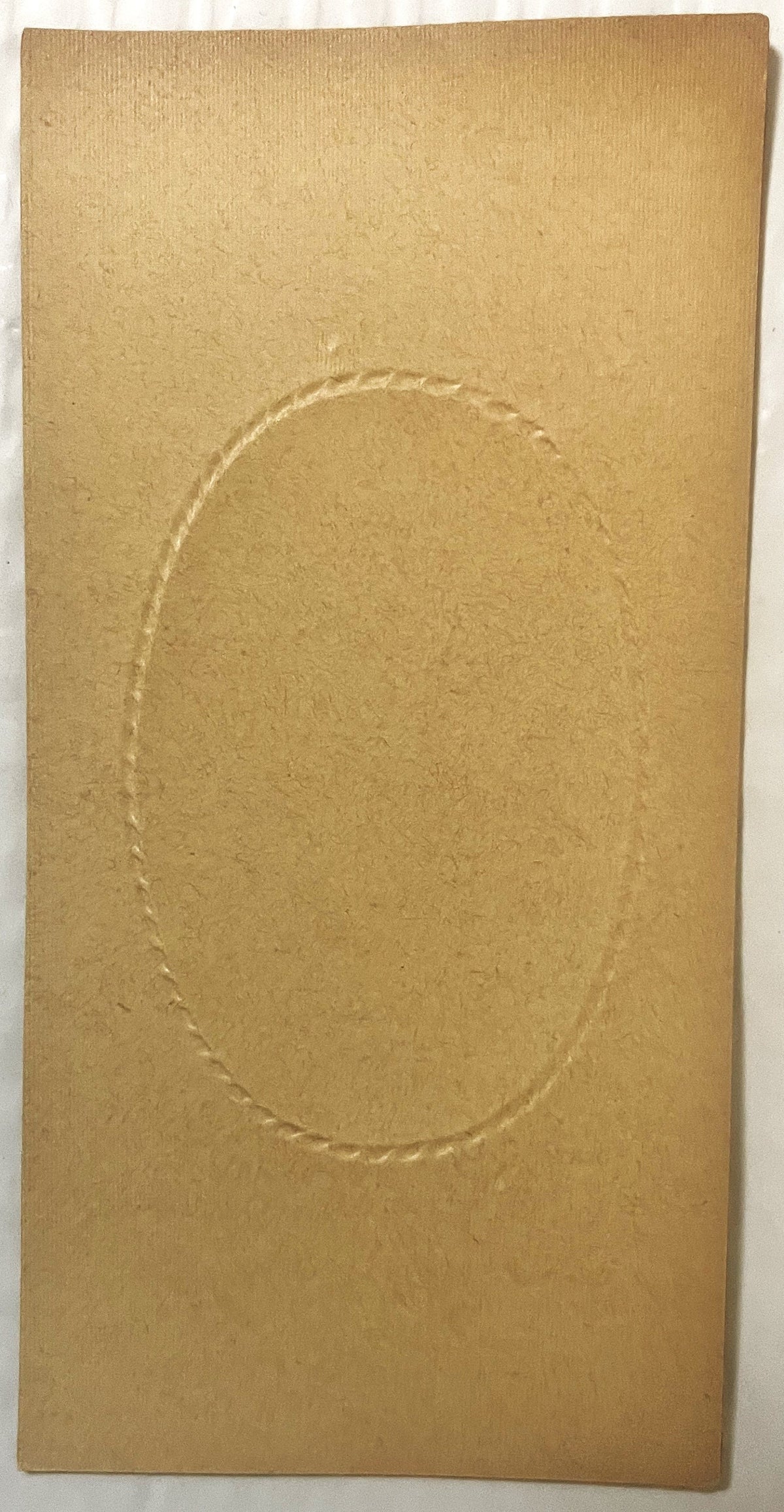
A young woman looks out from a tall oval, pale hair loose in soft curls beneath a vast blue picture hat heaped with pale silk and plume. She wears an off-the-shoulder white gown with a yellow rose at the bodice, set against a copper-brown ground printed in a fine speckled stipple. A coral rope-twist border rings the oval, embossed so it rises from the surface. Around it runs a pale green lattice of leafy ribbon, each crossing knotted with a small red rosette, and the whole front carries a fine ribbed finish. In small capitals at the lower left: PRINTED IN GERMANY. The reverse is plain kraft-tan board, with the rope oval pressed through from the front.

Her look is not the street fashion of her own day. It is the romance of the portraits Thomas Gainsborough painted before his death in 1788, borrowed by Victorian printers and served up on a candy box.

๐Ÿ–Œ Gainsborough, the Duchess and the Stolen Hat

Thomas Gainsborough painted fashionable English sitters under wide, plumed brims, and his portrait of Georgiana Cavendish, Duchess of Devonshire, smiling from beneath one, became the most famous hat in art. In May 1876 that portrait sold in London to the dealer William Agnew for $51,540, reported as the highest price yet paid for a painting at auction. Three weeks later it vanished from the gallery of Thomas Agnew & Sons. The thief was Adam Worth, a German-born American who grew up in Cambridge, Massachusetts, and whom Scotland Yard detective Robert Anderson called the "Napoleon of Crime." The story goes that he took the Duchess to raise bail for his brother, found the brother freed without it, and simply kept her for 25 years. She came back only on March 28, 1901, handed over in Chicago through the detective William Pinkerton. The writer Vincent Starrett later said Arthur Conan Doyle modeled Professor Moriarty on Worth.

While the painting was missing, its hat was everywhere. From 1878 the round-crowned, wide-brimmed hat turned up on one side, called the Gainsborough, was a leading fashion, and it held on for most of the following decade; at the end of the century it came back perched on the high pompadours of the Gibson Girls. Milliners loaded the brims with ribbon, flowers, ostrich plumes and even whole stuffed birds. The lady on this card, with her powder-soft curls, low white neckline and great plumed brim, is dressed as a Gainsborough sitter, a romantic Georgian beauty reimagined for the Victorian sweet tooth.

๐Ÿซ Richard Cadbury and the Pretty Box

Pictures on candy boxes began with a Quaker chocolate maker who liked to paint. In 1861 Richard Cadbury and his younger brother George took over the family chocolate business their father John Cadbury had founded in Birmingham, England. Richard had real artistic talent, and in 1868 Cadbury Brothers sold a box decorated with his own painting of his young daughter holding a kitten, the start of the fancy chocolate box. That same year the firm sold a heart-shaped box of chocolates for Valentine's Day. Richard went on painting boxes with children, flowers and scenes from his holidays, and the brothers built the Bournville works outside Birmingham, opened in 1879, with a model village for their workers. Late Victorians prized an elaborate box as a gift in itself and kept it for buttons and trinkets once the chocolates were eaten. The idea caught so well that "chocolate box" became the art world's put-down for anything too pretty and sentimental.

Across the Atlantic the candy trade grew just as fast. John S. Huyler, who had grown up in his father's Greenwich Village bakery, opened his candy business in New York City in 1874, and by 1885 his sweets were selling at resorts like Newport, Rhode Island and Saratoga, New York. By 1910 Huyler's ran 54 stores and 14 candy factories and was for a time the largest chocolate maker in the United States; it closed for good in 1964. Maillard, Lowney's and Rockwood were filling fancy boxes in the same years.

๐Ÿ‡ฉ๐Ÿ‡ช Printed in Germany: The Label That Backfired

Why does a card made for English-speaking buyers announce where it was printed? Because two governments made foreign goods say so. In 1887 Britain passed the Merchandise Marks Act, aimed at German makers who were stamping inferior wares with the names of respected British firms. Imports had to declare where they came from, and "Made in Germany" was meant to warn shoppers off. It backfired. The mark worked as free advertising and came to stand for reliable, well-made goods, and in 1896 the journalist Ernest Edwin Williams turned British alarm into a best-selling book called Made in Germany.

In the United States, Congressman William McKinley, a lawyer from Canton, Ohio who chaired the House Ways and Means Committee, steered through the McKinley Tariff, signed on October 1, 1890. It pushed the average duty on imports to nearly 50 percent and required foreign goods to be marked in legible English with the country they came from, starting March 1, 1891. Voters blamed it for rising prices, McKinley lost his House seat that November, and six years later he was elected president. The small capitals at the foot of this card are those laws at work.

๐Ÿชจ Chromolithography: A Picture Built Stone by Stone

Alois Senefelder, a Bavarian playwright hunting for a cheap way to print his work, invented lithography in 1796: draw with a greasy crayon on smooth stone, wet the stone, and the ink clings only to the drawing. Chromolithography gave each color its own stone and printed them one after another in careful register. The process reached the United States by 1840, and in the late 1800s it was the way to put a rich color picture on a cigar box label, a trade card or a candy box. German printing houses, with Leipzig among the great centers, led the world at it and shipped their work to customers across Europe and America. Look closely at the copper-brown ground behind this lady and you can see the fine speckled stipple that gives the portrait its depth.

๐Ÿชถ The Feathered Hat and the Birth of Bird Protection

Hats like hers carried a cost that changed American conservation. Plume hunters were killing herons, egrets, owls, woodpeckers and warblers for millinery, by one estimate five million American birds a year. In January 1896 two Boston, Massachusetts women, Harriet Hemenway and Minna Hall, learned that snowy egrets in the Florida Everglades were being shot for their plumes and the chicks left to starve. They invited fashionable women to tea, talked them out of feathered hats, some nine hundred of them, and founded the Massachusetts Audubon Society. Massachusetts outlawed the trade in wild bird feathers in 1897, the "bird-hat" campaign helped carry the federal Lacey Act in 1900, and the movement led to the National Audubon Society and the Weeks-McLean migratory bird law of 1913.

๐ŸŽฉ The Hat That Kept Growing

The big hat did not go quietly. In June 1907 the couturier Lucile dressed Lily Elsie for the London premiere of Franz Lehรกr's The Merry Widow at Daly's Theatre in a wide black hat piled with chiffon and feathers, and the "Merry Widow hat," a direct descendant of the Gainsborough, swept both sides of the Atlantic. Hatpins grew to match, and so did the rumors. In 1903 a Kansas visitor named Leoti Blaker drove a hatpin nearly a foot long into a man who groped her on a Fifth Avenue stagecoach in New York. Newspapers ran tales of hatpin deaths, among them a Scranton girl said to have pierced her sweetheart's heart in horseplay. In March 1910 Chicago's city council voted 68 to 2 to ban hatpins longer than nine inches, with a $50 fine, and suffragist Nan Davis told the aldermen to make the streets safe first.

๐ŸŒŸ Condition

New old stock: never used and never mounted on a box. The color is bright, the embossed rope border stands crisp, and the kraft back is clean. The photographs show the portrait up close, the full front, and front and back side by side.

๐Ÿ–ผ Display

Float it in a cream or soft gold mat so both the oval portrait and the rose lattice show, and keep it out of strong sun. It suits a dressing room or powder room, a wall of Victorian ladies, a shelf beside old perfume bottles and hatpin holders, or a collection of candy box, trade card and chromolithograph ephemera. For a hat lover, a milliner or a fashion historian it is the Gainsborough hat in miniature.

Shipping

๐Ÿšš Shipping & Handling

  • Shipping costs and timing are calculated at checkout.
  • Items curated and shipped directly by me include U.S. shipping at no additional cost, professionally packed to ensure safe arrival of your artifact.

Items from Vetted Pro Collectors
Shipping for items offered by vetted Pro Collectors is determined at checkout. All Pro Collector listings are reviewed to ensure fair, reasonable shipping practices.

For full details, please refer to our Shipping Policy.

Returns & Exchange

Take your time โ€” you've got a full six months. If a piece isn't right for you, send it back the way it reached you and we're good.

In the first 30 days your money goes straight back the way you paid. After that it's store credit, so you can put it toward something you'd rather have.

Return shipping we sort out between us, case by case. I don't make this difficult.

If something arrives damaged, or it isn't what I said it was, send me a photo within 48 hours and I'll make it right.

Email info@vintageantiquesgifts.com or call 802-356-9872 โ€” that's me answering, not a call center.

The only things I can't take back are custom or special-order pieces and gift cards.

View full details