Skip to product information
1 of 5

Vintage and Antique Gifts

🎩 Antique Edwardian Candy Box Insert Chromolithograph Lady in Green Picture Hat NOS Collectible Ephemera c1903-1911

🎩 Antique Edwardian Candy Box Insert Chromolithograph Lady in Green Picture Hat NOS Collectible Ephemera c1903-1911

Regular price 20.00 USD
Regular price Sale price 20.00 USD
Sale Sold out
Shipping calculated at checkout.

Description

🕰️ A Survivor of the Edwardian Sweet Shop

Step into the front parlor of a confectioner's shop in 1908, and the air is thick with the scent of boiled sugar, cocoa, and rosewater. The grandest sweets of the age did not arrive in plain paper. They came nested inside beautiful boxes, and the most luxurious of those boxes carried a decorative cover insert — a printed presentation panel designed to make the simple act of lifting a lid feel like opening a treasure. This is one of those panels. An authentic Edwardian candy box presentation insert, produced in the heart of the early twentieth century and preserved, against every odd, in New Old Stock condition.

What makes this piece quietly extraordinary is that it was never used. It never lined a finished box on a shelf. It was never handled by a shopgirl wrapping a Valentine's parcel, never tucked under a ribbon and carried home in a gentleman's coat pocket. It sat, protected and untouched, while the world that made it changed beyond recognition. To hold it now is to hold a fragment of the Belle Époque exactly as it left the lithographer's bench more than a century ago.

🎩 The Merry Widow Craze, Captured in Print

Look at the hat. That sweeping, draped, oversized confection of green silk and chiffon is not an accident of fashion — it is a portrait of a moment. In 1907, the operetta The Merry Widow took London by storm, and the enormous picture hat worn on stage ignited one of the most consuming fashion crazes of the entire Edwardian era. For the next several years, the "Merry Widow" hat ruled the avenues of New York, London, and Paris, reaching brims so wide they became the punchline of newspaper cartoons and the despair of theater managers.

The craze did not stay on the milliner's block. It poured into every corner of consumer culture aimed at women — and that included the candy counter. Chocolates, perfumes, and confections of the period borrowed the glamour of the Merry Widow shamelessly, dressing their packaging in the same plumed, romantic imagery that filled the fashion plates. A lady in a grand picture hat on a candy box was not decoration. It was marketing genius, tying a humble box of sweets to the most aspirational image a young woman of 1908 could imagine.

The powdered, piled-high hair and the soft 18th-century styling are part of the same story. The Merry Widow silhouette was itself a deliberate revival of the famous "Gainsborough" hat — the towering plumed hat immortalized in Thomas Gainsborough's portrait of the Duchess of Devonshire more than a century earlier. So this little candy box panel sits at the end of a long thread of romantic glamour, reaching back through the Edwardian craze to the powdered elegance of Georgian England. That depth of reference is exactly why pieces like this reward the collector who knows what they are looking at.

🌹 The Lady in the Green Picture Hat

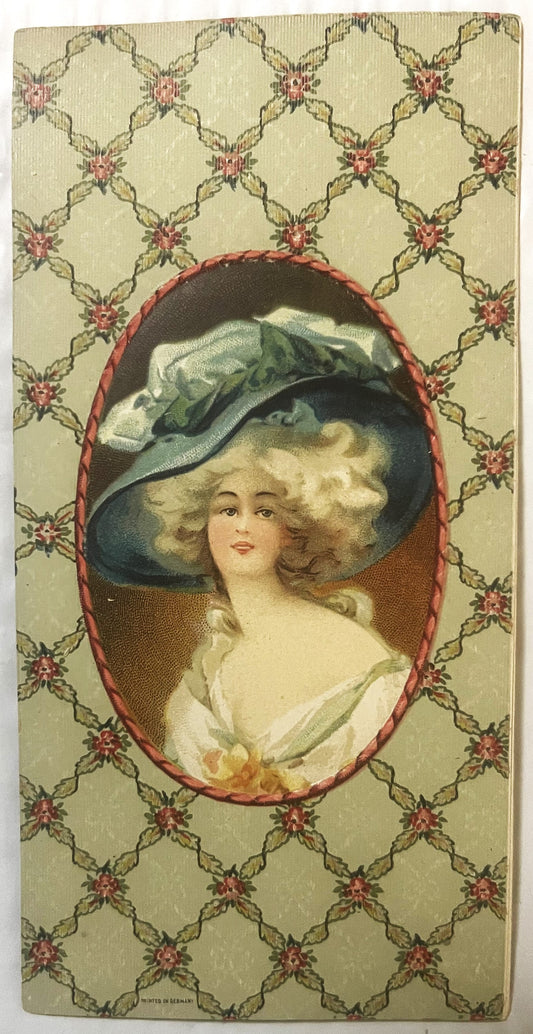
The composition is a masterclass in turn-of-the-century commercial art. A cream ground is laced edge to edge with a delicate trellis of pink roses and looping ribbon — a soft, feminine diaper pattern that frames without ever competing. At the center sits a tall vertical oval, bordered by a braided rope of rose-pink, and within it the lady herself.

She turns her face gently to her left, her expression serene and knowing, the faintest suggestion of a smile. Her hair is a cloud of powdered white curls. Her gown is a whisper of cream and white. And crowning it all, that magnificent green hat, its drapery falling in folds of olive and sage, caught with a ribbon at the throat. The chromolithographer's skill is everywhere — in the soft modeling of her cheek, the luminous highlights on the silk, the way the green of the hat plays against the warm ground behind her. This is not flat printing. It is layered, jewel-toned color built up stone by stone.

🖨️ The Golden Age of the Chromolithograph

To understand why this piece looks the way it does, you have to understand the craft behind it. Chromolithography — full-color printing built from a separate lithographic stone for each color — reached its absolute zenith in the years before the First World War. A single image like this might require a dozen or more stones, each printed in perfect registration, each adding a layer of tone and depth. It was slow, skilled, expensive work, and the results were the photographic-quality color images that flooded the late Victorian and Edwardian world: trade cards, scrap, advertising posters, and the decorative panels that dressed luxury packaging.

The heavy embossed board stock used here is part of that quality story. This was never meant to be flimsy. It was substantial, dimensional, made to convey richness the instant a customer touched it. The raised embossing and the precision die-cut oval are hallmarks of a manufacturing capability that only became commercially widespread after the turn of the century — which is one of the firm anchors that places this piece in its era.

📜 "Printed in Germany" — The Mark of a Master Trade

Along the bottom edge of the front panel runs a small, easily missed imprint: Printed in Germany. For a collector, that little line is a gift.

In the decades before the First World War, Germany was the undisputed world capital of fine chromolithography. The great printing houses of cities like Dresden and Berlin produced an astonishing volume of color-printed ephemera for the American and British markets — so much of the beautiful Victorian and Edwardian paper that survives today was, in fact, German-printed. American importers relied on German presses for exactly this kind of high-color, embossed, die-cut work.

The "Printed in Germany" mark itself is a product of trade law: country-of-origin marking on imported goods became standard practice for the American market in this period, which is precisely why so much imported paper of the era carries it. The mark tells us this panel crossed an ocean to reach the American confectionery trade, carried on the strength of German printing supremacy.

And it tells us something about the end of pieces like this, too. When the First World War severed German trade with the Allied nations after 1914, the flood of German-printed luxury ephemera into America slowed to a trickle and never fully recovered. Combined with rising costs and changing tastes, the elaborate, multi-stone, embossed-and-die-cut presentation panel became an economic relic. The world that produced this piece quite literally stopped producing it.

🗓️ Dating This Piece: circa 1903–1911

The dating is built from converging evidence rather than guesswork:

✨ The heavy embossed board and precision die-cut oval reflect manufacturing techniques that became commercially viable after roughly 1901.

✨ The grand draped picture hat aligns the imagery squarely with the Merry Widow fashion sweep of 1907–1911, placing the piece confidently within the Edwardian decade.

✨ The romantic feminine styling, the unbranded "open" presentation format, and the removable die-cut figure all reflect pre-war luxury packaging practice.

✨ The "Printed in Germany" imprint is consistent with the pre-1914 dominance of German chromolithography in the American market.

✨ After about 1912, shifting costs, changing consumer taste, and the looming disruption of war made elaborate panels like this impractical to produce.

Taken together, these point to a confident window of circa 1903 to 1911 — the warm afternoon of the Edwardian age.

🔍 What You're Looking At

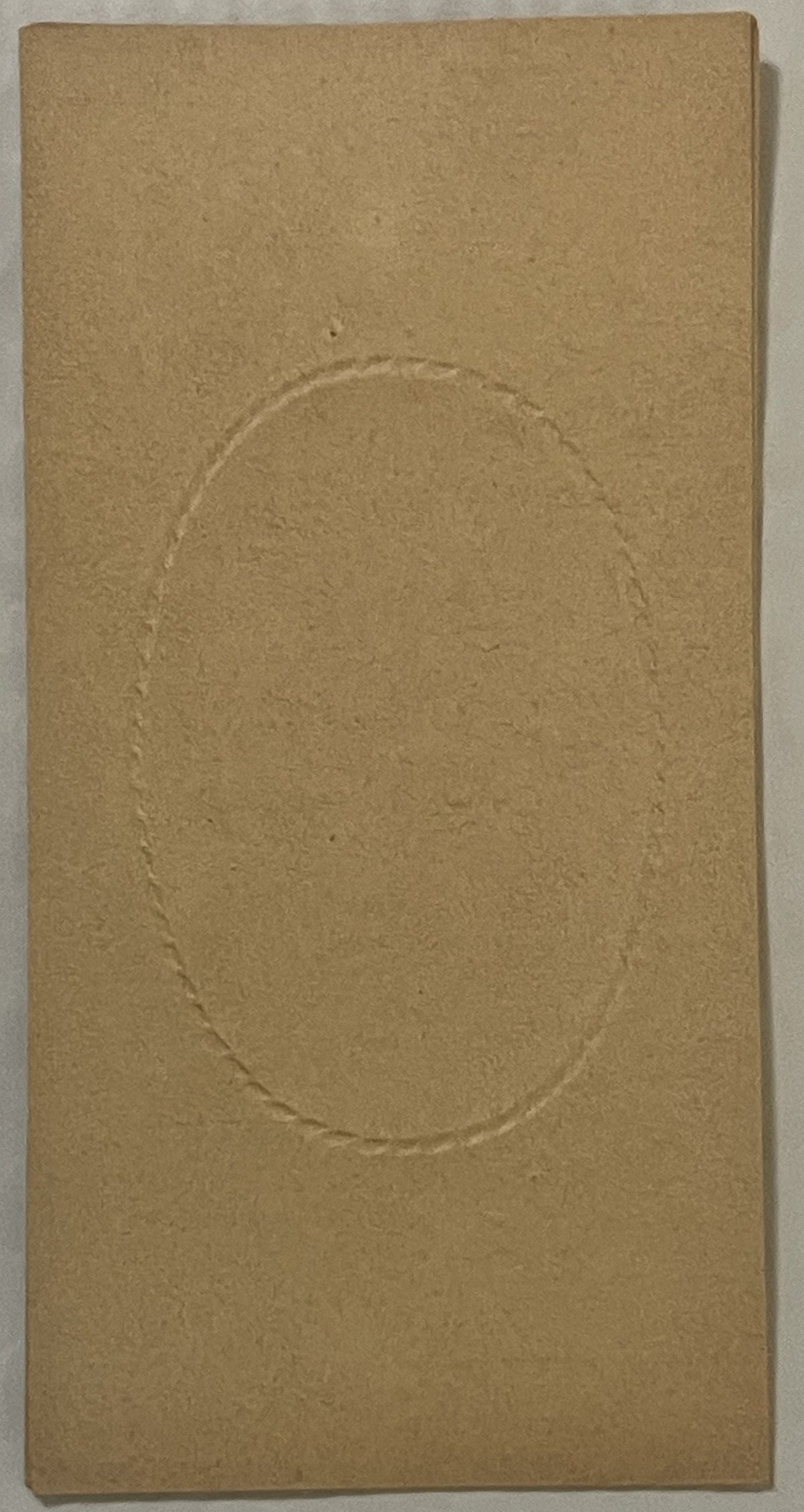
This is a single presentation insert, shown front and back. The printed face carries the full chromolithographed composition. The reverse is clean embossed board, where the debossed impression of the oval shows through — the literal back-print of the die-cut perforation that allowed the central figure to be defined and lifted. Heavy stock throughout. Tall, narrow vertical format. 6" x 3" ~

Condition: New Old Stock

This panel is New Old Stock — unused, with crisp embossing, clean die-cut perforation, and original surface integrity intact. There is no handling wear, no soiling from use, none of the softening and grime that comes from a piece that actually served its life in a shop. It presents as it did when it left the press. For a collector of early advertising and packaging ephemera, an unused example is a reference-grade piece — the standard against which used survivors are measured.

🏛️ Why Collectors Treasure Edwardian Packaging Ephemera

Packaging was meant to be thrown away. That is the whole quiet tragedy and triumph of collecting it. The box was opened, the sweets were eaten, the insert was discarded, and the moment vanished. What survives is a tiny, fragile record of how an entire culture courted, celebrated, and indulged itself. Edwardian candy packaging sits at a rich crossroads — advertising history, women's social history, fashion history, and the golden age of color printing all meet in a single beautiful panel. Collectors of trade cards, antique advertising, chromolithography, and turn-of-the-century ephemera all find a home in pieces like this, and a romantic figural subject in superb color is the kind of crossover piece that speaks to decorators and historians alike.

🎁 A Note for the Modern Collector

Whether this joins a collection of Edwardian ephemera, becomes the centerpiece of a framed display of antique packaging art, or simply lives on a shelf as a daily reminder of a softer, more decorative age, it carries its full century of story with it. A coordinating companion design exists for the collector who appreciates a matched pairing of these romantic figural panels.

🛍️ Add this antique Edwardian candy box insert to your collection and bring home a beautifully preserved piece of the Belle Époque — the lady in the green picture hat, exactly as the chromolithographer's stones first printed her.

Shipping

🚚 Shipping & Handling

  • Shipping costs and timing are calculated at checkout.
  • Items curated and shipped directly by me include U.S. shipping at no additional cost, professionally packed to ensure safe arrival of your artifact.

Items from Vetted Pro Collectors
Shipping for items offered by vetted Pro Collectors is determined at checkout. All Pro Collector listings are reviewed to ensure fair, reasonable shipping practices.

For full details, please refer to our Shipping Policy.

Returns & Exchange

Product Page Return Policy

  • 60-Day Returns – Items must be in original condition.
  • Refunds – Issued after inspection (excluding shipping costs).
  • Return Shipping – Customer is responsible unless item is damaged or incorrect.
  • Damaged/Incorrect Items – Contact us within 48 hours for a replacement or refund.
  • Easy Returns – Email info@vintageantiquesgifts.com or call 802-356-9872 to initiate a return.

For full details, visit our Refund Policy.

View full details