Skip to product information
1 of 8

Vintage and Antique Gifts

Vintage Joseph Long Elk Charcoal Portrait Print 🎨 Large Crow Chief, Cataloged N.C. Wyeth at Auction

Vintage Joseph Long Elk Charcoal Portrait Print 🎨 Large Crow Chief, Cataloged N.C. Wyeth at Auction

Regular price $74.00 USD
Regular price Sale price $74.00 USD
Sale Sold out
Shipping calculated at checkout.

Size: 26" x 18 1/2"

🚚 Free US Shipping — ships within one business day. International shipping calculated at checkout.

Quantity

Who Was Joseph Long Elk? 🪶 A Portrait With a Real Mystery Attached

Size: 26" x 18 1/2"

Some pieces are just lovely, and some pieces come with a story you can follow like a thread — this one has both. It's a large charcoal portrait print of Joseph Long Elk, a Crow chief, shown in a quiet right-facing profile, and it arrives with one of the more genuinely interesting provenance puzzles we've been able to lay out photograph by photograph. The sheet itself says the artist is unknown. The auction record says something very different. And the collection it comes from still holds the negatives, the labeled photographs, and the mailing envelope that tie the two halves of the story together. Read the caption first, then the clues, and see what you think.


🎨 What You Are Actually Looking At

This is a large charcoal-style portrait print, roughly 26 by 18.5 inches, on heavy, warm-toned textured paper with a linen-like finish. The subject is drawn in profile: dark, densely worked hair with a single feather set into it, a strong line of brow, nose and jaw, and a robe falling loosely across the shoulders, all in soft, smoky charcoal against an open, atmospheric ground. It's a striking reproduction of a charcoal study, and it presents beautifully — clean and richly toned, with little to no wear.

It's a genuinely large sheet for a portrait, with real presence on a wall. This is the print itself, and nothing else ships with it. Every sheet from this printing carries the same image and the same printed caption, and none have tears, tape, foxing or losses.


🔍 Read the Margin First

Everything starts with the line printed along the bottom of the sheet. It reads, word for word:

"JOSEPH LONG ELK, (Crow Chief) · Circa 1917 · Artist Unknown · °TROLLEY BARN ANTIQUES, MYSTIC, CONNECTICUT."

Read it slowly, because there's a small paradox hiding in it. "Circa 1917" dates the sitting — the original charcoal of Joseph Long Elk — not the printing of this sheet. Nothing on the sheet says when the reproduction itself was made; "Trolley Barn Antiques, Mystic, Connecticut" is simply the imprint the margin carries. The sheet captions its own artist as "Artist Unknown." That's the sheet's own position, quoted exactly as printed. But the story doesn't end where the margin does, because the original this print reproduces did not stay unknown for long.


🏛️ The Original Surfaced at Auction

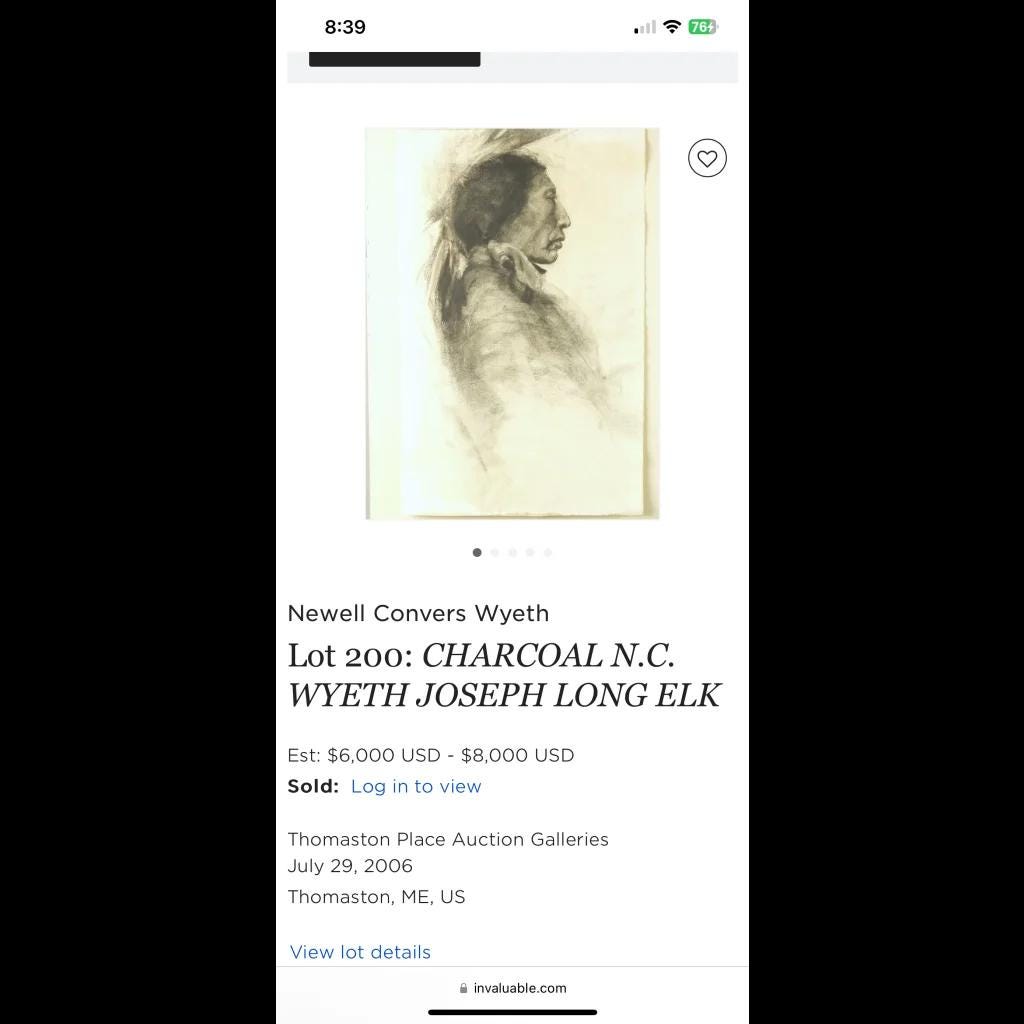
Decades after these prints were made, the original charcoal resurfaced and went to auction — and the auction record is one of the photographs on this page. It reads: Lot 200, "CHARCOAL N.C. WYETH — JOSEPH LONG ELK," cataloged under Newell Convers Wyeth, with an estimate of $6,000 to $8,000, sold at Thomaston Place Auction Galleries in Thomaston, Maine, on July 29, 2006. The auction house's own printed results — archived today in a public research library — record the hammer at $6,000. Those figures belong to the historical record of the original drawing, not to this print — but they tell you exactly how a major American auction house cataloged the very image this sheet reproduces.

That's the turn in the tale. The sheet says "Artist Unknown." Then an auction house entered the same image into its books under the name of one of the most celebrated illustrators America ever produced. What you're holding is a faithful, full-size reproduction of the drawing at the center of that record.


🗂️ The Collection Behind the Print

Here's where it gets genuinely special, and where the photographs earn their place. The paper trail connecting the two halves of the story is still with the collection:

  • 📷 A packet of glossy black-and-white photographs of the portrait, hand-captioned "N.C. WYETH (charcoal)" and signed "R. Izbicki" — the same attribution the auction house would land on years later.
  • 🎞️ The original film negatives, still on the strip, laid right beside those photographs.
  • ✉️ The mailing envelope they traveled in — printed with the letterhead of the Skowhegan School of Painting & Sculpture, its New York office at 331 East 68th Street, and marked by hand "Indian Photos." A ZIP code — 10021 — is printed right on it, and ZIP codes didn't exist before 1963, so this envelope (and whatever it carried) is 1963 or later. That dates the envelope, not the print inside it.

Skowhegan is a real and highly selective American art institution, and this envelope carries its New York executive office, separate from the summer campus in Maine. The record around the original charcoal goes further still: it was documented at auction as accompanied by a copy of a letter from Betsy Wyeth — Andrew Wyeth's wife, and the editor who compiled and published the volume of N.C. Wyeth's letters — and it carried a pencil "Sat Sketch" notation on its back.

The auction house's printed results sharpen both details. They catalog that letter as a copy of a letter from Betsy Wyeth discussing Howard Pyle's Saturday night drawing classes — the Wilmington classes where N.C. Wyeth trained beginning in 1902. Read together, the record rhymes with itself: a letter about Saturday drawing classes, and a sheet pencil-marked "Sat Sketch." The results give the letter no date, so neither do we — but the subject and the pencil note point at the same Saturday room.

And the hand that captioned those photographs has a name: Raymond A. Izbicki (1921–2007), a New London County art man with a serious New York pedigree. He helped open Betty Parsons's Section Eleven Gallery in the late 1950s and served as a director of the New York Studio School of Drawing, Painting and Sculpture, before coming home to the Mystic–Stonington shoreline in 1975 to deal in art and antiques — the very world the sheet's own "Trolley Barn Antiques, Mystic, Connecticut" imprint belongs to. Read that way, the caption on the photographs isn't a hopeful scribble; it's the considered attribution of a trained gallery eye, set down beside the negatives decades before a Maine auction house independently cataloged the original under the same name.

One plain note: the packet, the negatives, the envelope, and the documented letter are part of the story, and they're shown here in the photographs. They aren't part of the sale. Each sale is one print. What ships is one sheet, and nothing more.


✍️ A Word on N.C. Wyeth

Newell Convers Wyeth (1882–1945) was one of the great American illustrators and painters — founder of a celebrated artistic family, and maker of well over three thousand known works, from illustrations that defined a generation of adventure classics to serious easel painting. Early portrait and figure studies, including charcoal work, sit squarely within his output, which is why an auction house cataloguing a strong, unsigned charcoal of a Native American sitter reached for his name.


🧭 Attribution, Plainly

Here's what's known and how it fits together. The margin itself reads "Artist Unknown." The photo packet, decades before the auction, was captioned "N.C. Wyeth." A Maine auction house, working independently, cataloged the original as N.C. Wyeth in 2006. Two separate roads, no connection between them, arriving at the same name. The image doesn't appear in Wyeth's established catalog of known works, so we call it exactly what the record supports: a charcoal portrait cataloged and labeled as N.C. Wyeth — an attribution, not a signature. That open question is, frankly, the best part of owning it.


🪶 Joseph Long Elk, the Sitter

It's worth pausing on the man in the portrait, because he's named — and that alone sets this apart from the countless anonymous "Indian head" images of the period. He's identified on the sheet simply as a Crow chief named Joseph Long Elk, drawn circa 1917. The early twentieth century saw serious American artists turn their attention to portraits of Native leaders as individuals of real dignity and presence, and this profile belongs to that tradition: unhurried, respectful, alive with character. Whatever the final word on the artist, the sitter is rendered with genuine gravity, and the print keeps his name and likeness in front of a new generation of collectors.


🖼️ Ways to Live With It

At this scale, the print does real work in a room.

  • 🖼️ Frame it large and let it anchor a wall on its own — the profile reads powerfully from across a room.
  • 📚 Hang it in a study, library, or gallery wall of portraits and figure studies, where its story invites a second look.
  • 🏡 Lean into a Western, lodge, or Southwestern interior, where a charcoal portrait of a Crow chief sits perfectly at home.
  • 🗃️ Pair it, if you like, with the printed documentation of its own history for a display that tells the whole tale.

👤 Who It Belongs With

This one lands hardest with a few particular people. The collector of American illustration and Wyeth-adjacent material, who understands exactly why a cataloged-as-Wyeth charcoal is worth owning even as the attribution gets worked out. The collector of Native American portraiture and Western art, drawn to a named, dignified profile of a Crow chief. The lover of provenance puzzles, who'd rather own an object with a real, documented, photographed mystery than a dozen with none. And the giver looking for something with genuine weight and a story that keeps unfolding.


✨ Why It Matters

Prints like this don't stay findable forever. The surviving run lives, quietly, in one collection, and every sheet that leaves it is one more that will spend the rest of its life on a collector's wall rather than in a box. What makes this one worth owning isn't a slogan — it's the real, layered, photographed history behind a single striking image: a sheet that calls itself "Artist Unknown," an auction house that later called the same drawing N.C. Wyeth, a packet of negatives and captioned photographs, and a named Crow chief looking quietly off the page. The evidence is all here for you to read. The only copies with a future are the ones collectors take home.

Shipping

🚚 Shipping & Handling

  • Shipping costs and timing are calculated at checkout.
  • Items curated and shipped directly by me include U.S. shipping at no additional cost, professionally packed to ensure safe arrival of your artifact.

Items from Vetted Pro Collectors
Shipping for items offered by vetted Pro Collectors is determined at checkout. All Pro Collector listings are reviewed to ensure fair, reasonable shipping practices.

For full details, please refer to our Shipping Policy.

Returns & Exchange

Take your time — you've got a full six months. If a piece isn't right for you, send it back the way it reached you and we're good.

In the first 30 days your money goes straight back the way you paid. After that it's store credit, so you can put it toward something you'd rather have.

Return shipping we sort out between us, case by case. I don't make this difficult.

If something arrives damaged, or it isn't what I said it was, send me a photo within 48 hours and I'll make it right.

Email info@vintageantiquesgifts.com or call 802-356-9872 — that's me answering, not a call center.

The only things I can't take back are custom or special-order pieces and gift cards.

View full details
  • 5 stars: 2 (100%)
  • 4 stars: 0 (0%)
  • 3 stars: 0 (0%)
  • 2 stars: 0 (0%)
  • 1 star: 0 (0%)
H
Heidi Hendy

Love the piece. A very high quality reproduction. Excellent communication and service with us through a few hick ups with our Montana postal service..... Great experience.

L
Linda

Beautiful rendering of Native American. Item exactly as described. Will be proud to add this to my Native American Artwork collection. Item well packaged, and arrived in great condition.

Preserving History: Authentic Objects Across Eras

— Curated by Travis Weigel