Skip to product information
1 of 4

Vintage and Antique Gifts

Vintage 1969 Apollo 11 Moon Landing Pinback Button 🚀 America Salutes First Men on the Moon

Vintage 1969 Apollo 11 Moon Landing Pinback Button 🚀 America Salutes First Men on the Moon

Regular price 17.00 USD
Regular price Sale price 17.00 USD
Sale Sold out
Shipping calculated at checkout.
Quantity
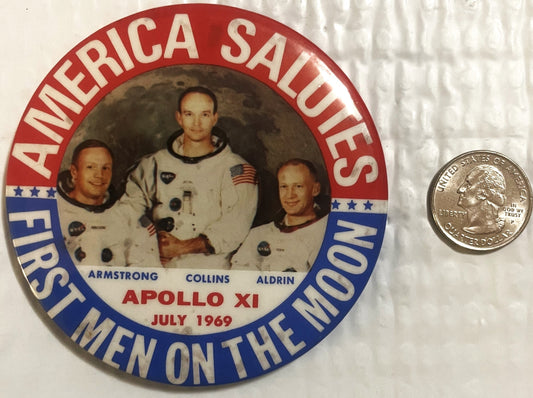
🌕 Where were you the night the whole world looked up? Ask anyone who lived through the summer of 1969 and watch their face change. They'll tell you about the black-and-white television glowing in the living room, the neighbors crowded onto the porch, the whole country holding its breath together as a grainy image beamed back from a quarter-million miles away. For one July evening, nobody cared what else was happening in the world — everyone was looking up. In the days and weeks that followed, drugstores, newsstands, and five-and-dime counters across America filled with souvenirs of the moment, and small pinback buttons like this one were among the most affordable, most wearable pieces of that pride. Pin one to a lapel that summer, and you were telling the world you'd witnessed history. This is an "America Salutes / First Men on the Moon" commemorative pinback button , issued to mark the Apollo 11 Moon landing of July 20, 1969. It measures 1¾ inches (about 4.4 cm) in diameter and is finished in bold red, white, and blue, with a full-color halftone photograph at center showing Neil Armstrong, Michael Collins, and Buzz Aldrin together in their spacesuits — the American flag patch visible on the suit at center. Their names run beneath the photograph in navy blue lettering — ARMSTRONG · COLLINS · ALDRIN — with APOLLO XI and JULY 20, 1969 printed below in red.

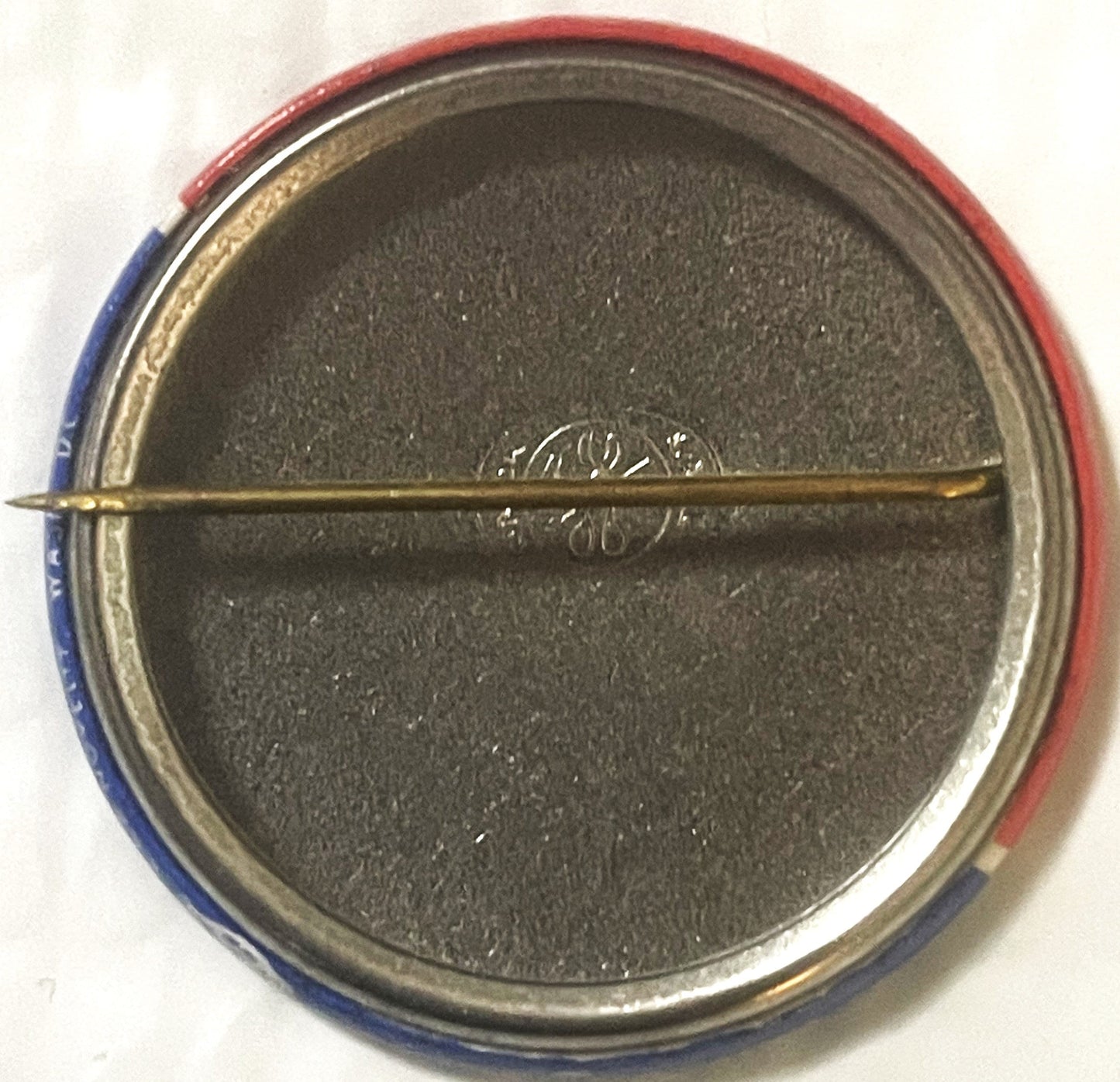
Arcing across the top rim, AMERICA SALUTES is set in crisp white-on-red lettering; along the bottom, FIRST MEN ON THE MOON runs in white on blue, with small rows of blue stars dividing the two curved bands at either side. The photographic image itself is printed under a clear protective covering over a curled metal shell with a straight-pin fastener — the same basic construction pioneered for pinback buttons decades before man ever left the earth's atmosphere, described in more detail below. This example is New Old Stock (NOS) — unused, unworn, and never sold in 1969, having sat in inventory ever since rather than on a lapel. 🚀 The Mission That Stopped the World Apollo 11 launched from Pad 39A at Cape Kennedy, Florida, on July 16, 1969, carrying Commander Neil Armstrong, Command Module Pilot Michael Collins, and Lunar Module Pilot Buzz Aldrin. Four days later, on July 20, Armstrong and Aldrin guided the lunar module Eagle down to the Sea of Tranquility while Collins orbited alone overhead in the command module Columbia — a solitude almost no human being had ever experienced before him. Roughly six hours after touchdown, Armstrong climbed down the ladder and became the first person to set foot on another world; Aldrin followed nineteen minutes later. They left behind a plaque reading, in part, that they had come in peace for all mankind. Historians estimate more than half a billion people around the globe watched it happen live — at the time, the largest television audience in human history, with an estimated 93% of American televisions tuned in that night. It was the fulfillment of a promise President Kennedy had made to the nation back in May of 1961: to land a man on the Moon and return him safely before the decade was out. Michael Collins himself designed the mission's now-famous eagle emblem, choosing the bird as a symbol of a peaceful lunar landing carried out on behalf of the United States. The exact photograph reproduced at the center of this button is Apollo 11's official crew portrait, taken by NASA before launch and catalogued in the agency's own archive — Armstrong, Collins, and Aldrin standing together in their spacesuits without helmets, the order of the men left to right matching this button precisely. It is the single most reproduced image of the entire mission, and it is worth knowing that other institutions preserve nearly identical souvenir buttons from this same summer: The Henry Ford museum in Michigan holds a "First Men on the Moon" button and ribbon carrying this same wording, Chicago's Busy Beaver Button Museum catalogues the design in its own collection, and the Smithsonian's National Air and Space Museum holds a comparable Apollo 11 souvenir button as well.

That this exact design was thought worth preserving by three separate American institutions says something about how deeply this small piece of red, white, and blue tin lodged itself in the national memory. Collectors researching the type will also find that it was struck in more than one printing that summer — some examples reading simply "July 1969," this one carrying the fuller date, July 20, 1969 — and in more than one size, with a larger 3½-inch version also circulating alongside this more pocket-friendly 1¾-inch button. 🧑‍🚀 Three Men, Three Very Different Beginnings The three faces on this button came from three entirely different corners of the world. Neil Armstrong , on the left, was born on his grandparents' farm in Auglaize County, Ohio, in 1930, and the family moved more than a dozen times before settling back near Wapakoneta, where he later earned his pilot's license at a small local airfield. He carried that home state with him all the way to the Moon: tucked into his kit on the journey were pieces of the original muslin fabric and a fragment of propeller from the Wright Brothers' Flyer, a quiet tribute from one Ohio aviator to two others. Michael Collins , pictured at center, was born in Rome, Italy, in 1930, the son of an Army officer stationed there — meaning the man who orbited the Moon alone above Tranquility Base, farther from another human being than anyone in history at that moment, was himself born in the Eternal City half a world away. Buzz Aldrin , on the right, wasn't born "Buzz" at all — his older sister's childish mispronunciation of "brother" as "buzzer" gave him the nickname that stuck for life, one he didn't legally adopt until decades later. But the loveliest piece of verified lore belonging to this crew concerns his mother: born Marion Gladys Moon, she married Aldrin's father years before her son would become the second human being to walk on the Moon. As Aldrin himself later wrote, it was tempting to think it was somehow meant to be — a woman named Moon raising the man who would leave his footprints on it. 🏭 Newark, New Jersey — the City That Invented the Pinback Button Itself Long before Apollo 11, the very form this souvenir takes — a photograph sealed under a clear protective disc, mounted to a curled metal shell with a spring pin on the back — was itself invented in one American city: Newark, New Jersey. The story starts, almost unbelievably, with a search for artificial elephant ivory. In the 1860s, an Albany billiard-ball manufacturer offered a $10,000 reward to anyone who could invent a substitute for ivory as the elephant-tusk supply dwindled. A printer named John Wesley Hyatt took up the challenge, and with his brother Isaiah founded the Celluloid Manufacturing Company, moving it to Newark in 1872, where the word "celluloid" itself was trademarked and the American plastics industry effectively began. Two decades later, a Newark partnership between printer Benjamin Whitehead and paper merchant Chester Hoag — the Whitehead & Hoag Company — bought up a series of celluloid patents and, in 1896, patented the pinback button essentially as we still know it: a paper design sealed under a clear celluloid cover, fastened to a metal shell by a coiled pin on the back. Whitehead & Hoag grew into the largest novelty-badge maker in the United States, eventually producing more than five thousand different items and shipping from branch offices as far afield as England, Australia, and Argentina — a genuinely democratic medium, its client list running from political parties of every stripe to fraternal lodges to corner drugstores. The firm's own promotional literature billed its Newark works as the largest business in the world devoted exclusively to metal, celluloid, woven, and ribbon badges. The Newark story does not have a happy ending, and it is worth telling honestly, because it is real industrial history. After the last family member with an active hand in the business died in the early 1950s, the company struggled through a string of losing years and was ultimately sold to a longtime rival, Bastian Bros. of Rochester, New York, which scrapped the old machinery and phased out the Whitehead & Hoag name by the mid-1960s — just a few years before this Apollo 11 button was struck. Every "cello" button made afterward, including souvenirs of the Moon landing, descends directly from that Newark patent, even as the trade's manufacturing center of gravity had, by 1969, long since shifted elsewhere. 🦆 Chicago and the Last Days of the American Pinback Trade By the time Apollo 11 splashed down, the heart of the American button trade beat in Chicago. The Green Duck Company, founded there in 1906 — its name a playful mash-up of its two founders' surnames — became one of the great lithographed-tin button houses of the twentieth century, producing license plates, tokens, watch fobs, and pin-back buttons by the millions. Its finest hour came during the Second World War, when Green Duck manufactured the small metal "crickets" issued to American paratroopers of the 101st and 82nd Airborne divisions ahead of the D-Day landings — two clicks to signal a fellow American in the dark, four clicks answered back to signal danger. By the 1960s Green Duck and its Chicago peers still dominated the lithographed-button business the way Whitehead & Hoag once dominated celluloid in Newark, though that era, too, was drawing to a close as manufacturing began moving south. No printer's mark or manufacturer's imprint has surfaced identifying who actually struck this particular button, and that is itself a telling piece of history rather than a gap in the record. The summer of 1969 produced a genuine flood of unlicensed, hastily printed Moon-landing souvenirs — dozens of small novelty houses racing the news cycle to get buttons onto drugstore counters before the excitement cooled, many of them turned out with no maker's name anywhere on the piece at all. This button's construction — a photolithographed image under a clear protective covering, curled over a metal shell with a straight pin, its lettering in the heavy condensed sans-serif favored by the late-1960s souvenir trade — places it squarely in that moment, even without a signed attribution to say precisely whose press it came off. 🖼️ Display Ideas 🚀 Pin it to a lapel, hat brim, or jacket the way it would have been worn on the streets in the summer of 1969 🖼️ Frame it alone in a small shadow box, the crew portrait facing forward, for a den or home office wall 📚 Pair it with vintage NASA photographs, newspapers, or magazines from July the period for a themed display 🏠 Anchor a space-race or Americana collection alongside other Apollo-era memorabilia 🎓 Use it as a teaching piece for a child or grandchild learning about the Moon landing for the first time 💼 Display on a collector's pin board among other mid-century political and commemorative buttons 🎁 Who Collects These Space-race memorabilia draws a genuinely wide circle of collectors — lifelong NASA enthusiasts building out an Apollo collection piece by piece, vintage pinback and political-button collectors for whom this sits comfortably alongside campaign buttons and world's fair souvenirs, and history-minded gift-givers looking for something small and meaningful for a father, husband, or grandparent who remembers exactly where he was that July night. It's a favorite gift for anyone with a soft spot for the space program, precisely because it is small enough to hold in one hand while carrying the weight of one of the twentieth century's defining moments. ❓ FAQ What size is this button? It measures 1¾ inches (about 4.4 cm) in diameter — the more compact of two sizes this design was issued in during the summer of 1969. Is this the original photograph used by NASA? The image reproduced at center matches NASA's own official Apollo 11 crew portrait, showing Armstrong, Collins, and Aldrin in the same left-to-right order used on this button. Is it celluloid? Collectors commonly call this style of button "celluloid" out of long habit, but by 1969 the trade had largely shifted to clear acetate coverings over the printed paper image — this button belongs to that same lineage of construction first patented decades earlier, whichever exact material was used. Who manufactured this button? No printer's mark or maker's imprint has been identified on this piece. Many Moon-landing souvenirs were produced quickly and without attribution during the wave of novelty buttons that hit drugstore and newsstand counters in the weeks following the landing. Is this New Old Stock? Yes — this button is New Old Stock, meaning it was never sold or worn and has remained in inventory since it was originally struck. Why does the wording say "July 20, 1969" when some similar buttons say only "July 1969"? This design was produced in more than one printing that summer; some carried the shorter date, while this button prints the full landing date. What era does this button date to? Its construction and printing style — the acetate-over-metal build, curled rim, straight pin, and bold condensed lettering — are consistent with the American souvenir button trade of the 1960s, produced in the wave of Apollo 11 memorabilia that followed the July 1969 landing.

Shipping

🚚 Shipping & Handling

  • Shipping costs and timing are calculated at checkout.
  • Items curated and shipped directly by me include U.S. shipping at no additional cost, professionally packed to ensure safe arrival of your artifact.

Items from Vetted Pro Collectors
Shipping for items offered by vetted Pro Collectors is determined at checkout. All Pro Collector listings are reviewed to ensure fair, reasonable shipping practices.

For full details, please refer to our Shipping Policy.

Returns & Exchange

Take your time — you've got a full six months. If a piece isn't right for you, send it back the way it reached you and we're good.

In the first 30 days your money goes straight back the way you paid. After that it's store credit, so you can put it toward something you'd rather have.

Return shipping we sort out between us, case by case. I don't make this difficult.

If something arrives damaged, or it isn't what I said it was, send me a photo within 48 hours and I'll make it right.

Email info@vintageantiquesgifts.com or call 802-356-9872 — that's me answering, not a call center.

The only things I can't take back are custom or special-order pieces and gift cards.

View full details
ShippingItemManMoonMoon landing pinPennantShapeTransaction
  • 5 stars: 61 (98%)
  • 4 stars: 1 (2%)
  • 3 stars: 0 (0%)
  • 2 stars: 0 (0%)
  • 1 star: 0 (0%)
E
Etsy customer

Great Quality, Price, Packed…. and on Time👍👍

E
Etsy customer

What an amazing find! I’ve purchased this as part of a gift package I’m putting together for my best friend. The pin was shipped safely in an envelope clearly labeled as non-machinable to protect it. The note left from this family business was almost as exciting of a find as the pin itself. Keep up the great work! Highly recommend this seller!

E
Etsy customer

Received this item very quickly and was so pleased with it ! Perfect Christmas gift for our son. Thank you so much!!

E
Etsy customer

AN EXCELLENT CUSTOMER SERVICE💯
I ordered this pin as a gift for my bf. It looks vintage and cool. The seller has an excellent communication and shipped the item so fast👏🏻! It was packaged neatly and safely!✉️✨
Overall, I would definitely purchase more items in the future for myself and as gifts for others!☺️

E
Etsy customer

I grew up in Ohio, he was a hero. I went to his museum. They sold nothing like this. I had to have it.

C
Cassidy Rees

Great pin! Looks just as described.

o
o***0 (1442)

One of the best sellers - if not the best - when it comes to customer service. I highly recommend Travis!

B
Bridget

Got as a joke for my brother. Inside jokes b/w siblings are always a goodtime.

K
KC (Alameda, US)
1969 moon landing pin

It arrived quickly, in great shape.
Looks awesome pinned to my “first man on the moon” pennant. Thank you!

m
m***r (9)

I received the pin today. It’s as described, Like new. I remember these growing up but never owned one. The moon landing was a very big deal at the time, I had a picture of Armstrong, Collins & Aldrin in my room as a kid, so this brings back a lot of memories. Thank you to the seller for the nice letter & thank you card signed by the kids. That personal touch is appreciated and seriously lacking in the world today. I will not hesitate to buy again if I see something else I like. Thanks!

D
Deborah

Received this very quickly after placing the order. Also, I received a very nice letter with the order along with a free surprise. Great service and great, quality product. Thank you so much!

y
y***p (1533)

What a great seller and from what I gather from the Thank You note enclosed, a great dad too.

A
AJ

Thanks for the incredible button. I’ve added to my badge lanyard at the US Space and Rocket center.

Hello Aj! Your 5-star review has us feeling over the moon! We're ecstatic to know you've enjoyed the Apollo NASA Pin, truly a precious nugget of Americana History. Thank you for supporting our mission in preserving these antique treasures. Can't wait for your next journey through our vintage gift galaxy!

E
Etsy customer

Great gift for my husband who loves the space program! A piece of history!

E
Etsy customer

What a great piece to add to my husband’s collection. Thanks for offering it for sale. I recommend using this seller.

E
Etsy customer

Excellent Quality 1969 Apollo 11 pin

E
Etsy customer

Great Customer Service!!!
Friendly!!! Fast shipping!!!

E
Etsy customer

item as described. woukd buy from seller again.

E
Etsy customer

10/10, great item and great seller!!

E
Etsy customer

Toook a bit of time to get the order but seller was immediate with support. Turned out to be a USPS issue and not the sellers fault

E
Etsy customer

Great experience and a pleasure to do business with.
Will definitely buy again.

E
Etsy customer

Husband is a space nerd and loved this

E
Etsy customer

Just as described. Would use seller again.

E
Etsy customer

Wonderful piece of space history. Seller included a Thank You note that was extra special.

E
Etsy customer

Husband was so excited, it was exactly what I wanted.

E
Etsy customer

Just as described. Arrived quickly. Thank you!

E
Etsy customer

I Loved it very much