Skip to product information
1 of 4

Vintage and Antique Gifts

Vintage Peace Now Dove Pinback ✌️ 1960s Vietnam War Protest Button

Vintage Peace Now Dove Pinback ✌️ 1960s Vietnam War Protest Button

Regular price 16.00 USD
Regular price Sale price 16.00 USD
Sale Sold out
Shipping calculated at checkout.
Quantity

✌️ What Was It Like to Pin On a Piece of History and Walk Into a Crowd of Half a Million People? 🕊️

Somewhere between a folding table on a college quad and a card table set up near a march route, someone reached into a coffee can full of buttons just like this one, pinned it to a denim jacket or an Army-surplus coat, and walked out to stand shoulder to shoulder with strangers who believed the same thing they did. That's the whole story of this little disc of lithographed tin. It was never meant to be precious — it was meant to be worn, seen, and understood in a single glance across a crowded street. Decades later, that's exactly why it still stops people cold when they spot it tucked into a shadow box or pinned to a lapel at a family gathering. It carries the electricity of a moment that mattered, and that electricity hasn't cooled off one bit.

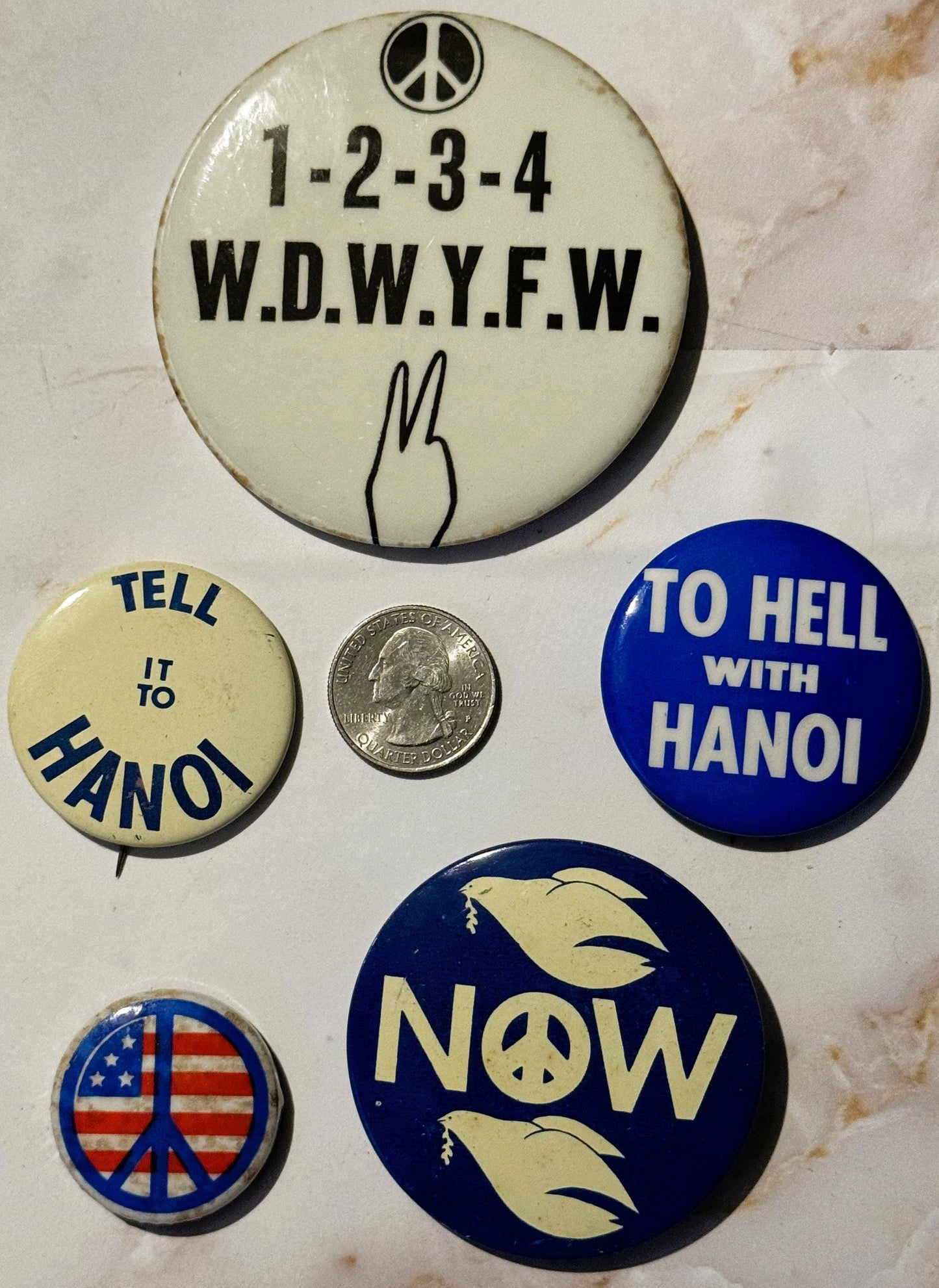
What you're looking at is a vintage "PEACE NOW" pinback button, finished in a deep, rich blue with the design rendered in a warm cream. The word NOW runs boldly across the center, and whoever laid out this design folded the peace symbol directly into the letter "O" — a clever bit of graphic economy that lets the slogan and the symbol do double duty in a single sweep of the eye. Flanking the word top and bottom fly two identical doves, each carrying an olive sprig in its beak, mirrored for balance and doubled for emphasis. There's no maker's mark anywhere on the piece, which is worth sitting with for a moment rather than treating as a gap — the peace symbol itself was famously never trademarked or copyrighted by anyone, and buttons like this one were as often run off by a local print shop, a campus print co-op, or a movement's own volunteers as by a nationally known novelty firm. The button measures roughly 2 1/2 inches across the face, with the gently domed tin body running about a quarter inch in profile — a substantial, easy-to-read size built to be spotted from across a room, not squinted at up close. Everything about the design vocabulary — the flat two-color offset printing, the heavy geometric sans-serif lettering, and the CND peace symbol used as a letterform — places this squarely in the visual language of the Vietnam War protest era, broadly the 1960s into the 1970s, when America argued with itself, loudly, in the streets. This particular button is New Old Stock: original vintage inventory that was set aside at the time, never worn, never pinned to a jacket or a picket sign, and has simply been waiting ever since.


☮️ Born in Despair: The Man Who Drew the Symbol

Long before it meant "peace" to an entire generation of Americans, that circle-and-crossbar was one man's private grief made visible. It was designed in 1958 by Gerald Holtom, a professional artist and Royal College of Art graduate working in Twickenham, England, for a very specific purpose: a march. The Direct Action Committee Against Nuclear War was organizing a walk from London to the village of Aldermaston in Berkshire — the very site where Britain built its nuclear warheads — over the Easter weekend of 1958, and they needed something to carry.

Holtom's design wasn't decoration. It's built from flag semaphore: the vertical line is the signal for the letter D, the two downward-angled arms form the letter N, standing for Nuclear Disarmament, all enclosed in a circle meant to represent the earth. In a letter he wrote years later to fellow activist Hugh Brock, Holtom described the state of mind he was in when he drew it — "deep despair," picturing himself as an individual in despair with his hands turned outward and downward, in the manner of a doomed figure from a Goya painting, before formalizing the gesture into the clean geometric line and circle we know today. It very nearly never left his sketchbook — an organizer's letter from March of 1958 rejected the design as "quite obscure" and worried it looked like the mark of a secret society. Holtom drew it expecting it might be thrown away entirely. Instead, five hundred cardboard "lollipop" placards were made for that Easter march — half black on white, half white on green — and a symbol was born that would outlive every argument anyone ever had about whether it made sense.

Aldermaston itself is worth knowing. It was a quiet Berkshire village, handsome and unremarkable, until a former Second World War airfield on its outskirts was chosen in 1950 to become the permanent home of Britain's atomic weapons program — a site that would eventually sprawl across 750 acres. Every Easter from 1958 to 1963, marchers walked the road between London and that gate and back again, carrying Holtom's circle on cardboard sticks. It's a strange and fitting bit of history that a symbol meant to soften the reality of nuclear war was first carried past the very fences where such weapons were made.

The very first wearable badges tell their own quiet story. Eric Austin of the Kensington branch of the Campaign for Nuclear Disarmament made the earliest ones out of white clay, the symbol painted on in black, and handed them out with a note explaining why he'd chosen pottery: in the event of nuclear war, fired ceramic would be among the very few human-made objects to survive the fire. Every peace badge that followed — right down to the tin one in front of you — descends, in spirit, from a badge designed to outlast the end of the world. And because Holtom's design was never trademarked or restricted by anyone, it slipped free of CND entirely, crossed an ocean, and was reinterpreted by an American generation as something closer to a universal shorthand for "peace" itself — no license required, no royalty owed, no committee to ask permission from.


🕊️ A Dove Older Than Any War

The two birds carrying olive branches on this button are drawing on a symbol with a much older pedigree than Holtom's circle. The image goes back to the biblical account of Noah's Ark, where a dove returning to the ship with an olive leaf in its beak was the first sign that the floodwaters were receding and the world could begin again — a bird, a branch, and a message that simply says "it's over now." That single image has been repeated in art and iconography for thousands of years since.

It got a very specific twentieth-century jolt in 1949, when Pablo Picasso created his lithograph "La Colombe" — The Dove — as the emblem for the World Peace Congress in Paris. That image traveled the globe and helped cement the dove, olive branch and all, as the visual shorthand for peace movements everywhere that followed, right through to the Vietnam era when it became a constant companion to Holtom's circle on buttons exactly like this one. Pairing the two symbols on a single design — the geometric, semaphore-born peace sign and the ancient, olive-carrying dove — was a way of reaching for both registers at once: the specific, modern language of nuclear disarmament, and the oldest visual promise of peace human beings have ever agreed on.


🎓 How the Symbol Crossed an Ocean

The peace symbol reached American shores through activism, not advertising. In 1958, pacifist Albert Bigelow sailed a small boat flying a CND-marked banner toward a Pacific nuclear test site, giving the symbol its first real American exposure. But the person most directly responsible for putting it on buttons in the United States was a college freshman.

Philip Altbach, a University of Chicago student and delegate to the newly formed Student Peace Union, traveled to England, saw CND's buttons in person, and brought a batch home. In his own later telling, he and his fellow students in Chicago "started printing our own buttons and handing them out." He went on to persuade the Student Peace Union to formally adopt the symbol, and between 1960 and 1964 the SPU sold thousands of these buttons on college campuses across the country — the single documented starting point for the peace symbol as an American button.

The Student Peace Union itself is a genuinely Chicago story. It was founded at the University of Chicago, ran its national office near the campus, and was built in large part by Ken Calkins, who had been badly injured sitting in protest in front of a truck at an Atlas missile site in Wyoming before returning to Chicago to build the union's network through peace seminars in the city's high schools. Membership peaked at roughly 3,500 members in 1962, with Altbach eventually serving as national chairman, before the organization's Chicago office closed and reopened in New York in 1964 and finally merged into another student union in 1967. It's a short-lived organization by most measures, but it planted the button — quite literally — that would go on to outlive it by decades.

Chicago also happened to be one of the great American centers of the button trade itself, home to some of the country's oldest and most prolific pinback manufacturers producing campaign buttons, novelty buttons, and — by the 1960s — an enormous volume of protest buttons for a country in the middle of arguing with itself. No maker's mark survives on this particular button to tie it to any one of those shops, and that absence fits the era rather than working against it: so much of this material was produced quickly, locally, and anonymously, by print shops and volunteer collectives who cared far more about getting a message onto a jacket than about putting their own name on the back of it.


📣 "Peace Now": A Slogan for a Country Arguing With Itself

By the height of the Vietnam War, "Peace Now" had become one of the most repeated phrases in the American protest vocabulary — blunt, urgent, and impossible to misread from across a street. Folding the peace symbol directly into the word's own lettering, as this button does with the "O" in NOW, was a small but sharp piece of graphic design: it meant the slogan and the symbol arrived in the eye at the same instant, no separate reading required. Buttons carrying this exact configuration — peace sign standing in for a letter, doves flanking the message — circulated widely enough during the era that they remain a recognizable and sought-after category among collectors of Vietnam-era protest ephemera today, standing alongside the era's other blunt-force slogans, from calls to bring troops home to bitter rejoinders aimed at Hanoi and Washington alike, all traded hand to hand at the same marches and campus tables.


🌍 What a Little Tin Button Still Carries

It's easy to underestimate a 2 1/2-inch disc of lithographed tin. But this one asks a viewer to hold two very different histories at once — a geometric symbol born out of one designer's private despair over the atomic bomb, and a bird-and-branch image that has meant "the flood is finally over" for thousands of years — and it does it all in the space of a single pin. It was made to be disposable, cheap, and everywhere, and most examples were worn hard, lost, or thrown away once the moment passed. A piece that survived unused and unworn, exactly as it left the press, is a genuinely different kind of object than one that spent a summer on a picket line — and both are worth honoring, but this is the rarer of the two: a voice from the era that never got the chance to actually shout.


🖼️ Display Ideas

  • 🖼️ Framed in a shadow box alongside other Vietnam-era protest buttons for a compact wall timeline of the movement
  • 📌 Pinned to a denim jacket lapel or collar as a genuine piece of period style rather than a reproduction patch
  • 📚 Displayed on a small easel stand beside period photographs, newspaper clippings, or a peace-symbol flag for a classroom or library history table
  • 🗂️ Grouped with sibling slogan buttons of the same era — anti-Hanoi rhetoric, moratorium calls, peace-flag pins — to show the full range of voices arguing at once
  • 🎓 Given as a meaningful gift to a history teacher, a Vietnam veteran, or anyone who marched, worked, or waited during those years
  • 💠 Mounted in a simple pin case on a bookshelf, where the cream lettering catches light against the deep blue ground

🎁 Who Collects These

This is a piece that draws several very different kinds of collectors to the same button. Vietnam War historians and antiwar-movement researchers seek out original protest ephemera precisely because so little of it survived intact — most of it was worn out, thrown out, or lost to time. Peace-symbol specialists and CND enthusiasts collect pieces that show the many ways Gerald Holtom's design was adapted, redrawn, and folded into new slogans once it crossed the Atlantic. General pinback and campaign-button collectors prize protest buttons as one of the richest and most graphically inventive categories in the whole hobby. And then there are the buyers for whom this is personal rather than academic — people who marched, who had a brother or a father in Vietnam, who remember exactly what it felt like to see this symbol on a stranger's jacket and know instantly whose side they were on.


❓ FAQ

Is this an original Vietnam War-era button, or a later reproduction?

The printing technique, lettering style, and use of the peace symbol as a letterform are all consistent with genuine 1960s–1970s protest-button production, and this example is offered as New Old Stock — original vintage inventory that was never worn or pinned, simply set aside at the time and preserved since.

What does the peace symbol built into the "O" actually mean?

It's the Campaign for Nuclear Disarmament symbol, designed in England in 1958 from flag-semaphore letters for "Nuclear Disarmament" enclosed in a circle. By the Vietnam era it had been adopted across the American antiwar movement as a general symbol of peace, entirely separate from any nuclear-specific meaning.

Why are there two doves, and why do they carry branches?

The dove with an olive branch is one of the oldest peace symbols in Western tradition, tracing back to the biblical story of Noah's Ark, and was given fresh visibility in the twentieth century through Picasso's 1949 dove lithograph for the World Peace Congress. Pairing it with the modern peace symbol, as this button does, layers an ancient message onto a very current one.

Is there a maker's mark on this button?

No maker's mark is present. Buttons like this were frequently produced quickly and locally by small print shops and volunteer movement groups rather than by a single nationally branded manufacturer, which makes an unmarked example entirely consistent with how this material was actually made and distributed.

What size is the button?

It measures approximately 2 1/2 inches across the face, with a gently domed tin body roughly a quarter inch deep — a substantial size designed to be read at a glance from across a room or a march line.

What does "New Old Stock" mean for a piece like this?

It means this button was produced during its era but never actually worn, sold, or distributed at the time — it was set aside and has remained in that original, unused state ever since, rather than being pulled off a jacket or a picket sign decades later.

Shipping

🚚 Shipping & Handling

  • Shipping costs and timing are calculated at checkout.
  • Items curated and shipped directly by me include U.S. shipping at no additional cost, professionally packed to ensure safe arrival of your artifact.

Items from Vetted Pro Collectors
Shipping for items offered by vetted Pro Collectors is determined at checkout. All Pro Collector listings are reviewed to ensure fair, reasonable shipping practices.

For full details, please refer to our Shipping Policy.

Returns & Exchange

Take your time — you've got a full six months. If a piece isn't right for you, send it back the way it reached you and we're good.

In the first 30 days your money goes straight back the way you paid. After that it's store credit, so you can put it toward something you'd rather have.

Return shipping we sort out between us, case by case. I don't make this difficult.

If something arrives damaged, or it isn't what I said it was, send me a photo within 48 hours and I'll make it right.

Email info@vintageantiquesgifts.com or call 802-356-9872 — that's me answering, not a call center.

The only things I can't take back are custom or special-order pieces and gift cards.

View full details
  • 5 stars: 26 (100%)
  • 4 stars: 0 (0%)
  • 3 stars: 0 (0%)
  • 2 stars: 0 (0%)
  • 1 star: 0 (0%)
E
Etsy customer

Fast shipping! Great historical piece - needed just as much today!

E
Etsy customer

Great condition and fast shipping! Made a great gift! Cousin made a joke about Mon and sent upside down pic lol!

V
Vionca

Awesome pin! Perfect addition to my collection.

E
Etsy customer

Great vintage pin in excellent condition .

E
Etsy customer

Brings back memories! Thank you. Lots of compliments

E
Etsy customer

Good quality, boyfriend loved it!

E
Etsy customer

Fast shipping and amazing product

E
Etsy customer

I love these pins takes me ack in time.

E
Etsy customer

Absolutely the best service ever

E
Etsy customer

As described
Great customer service
Recommended

E
Etsy customer

Cute pin. Shipping took a while but that's on USPS not the seller. Seller was very communicative throughout the process. Nice little thank you note included in the shipment.

E
Etsy customer

Arrived fast and is exactly as described. Would definitely order again!

E
Etsy customer

Awesome vintage button. Packed well and fast shipping- thanks!

r
r***r (8011)

Arrived in great shape; thanks! :-)

-
-***h (6469)

PERFECTLY Positive transaction, nice item, free shipping, great communicationa d a hand signed thank you card in the shipment! Very pleasent exchange! 5 stars ain't enough to say THANK YOU!

J
Judi

Great retro pin, thank you!

e
erika

Happy with purchase! Can’t wait to wear it on my bag

O
Olive

Just as pictured. Thank you!

r
r***i (17)

Quick shipping, good packaging, and exactly as described. I loved the sweet signatures on the note! Made my day. Thank you!

m
m***p (971)

Pleased with purchase!

B
Bansi

Lovely customer service and great item that reminds me to remain at peace

S
Sonia

Love this time capsule of a pin

e
e***e (40)

Good condition. Peace

S
Silver

Great vintage pin! Loving the discussions with those that lived it. Fast shipping, highly recommend seller. Peace to all.

V
V i n t

Such a wonderful find from such an amazing shop! I loved the letter the seller included and I certainly plan on shopping here often! Thank you so much!!

Hi there V! Your 5-star rating fills our hearts with peace and joy! We're thrilled that the 1960s Peace Pin has struck a chord with you, reminding us of the love and unity those symbols stood for. We can't wait to present you with more historic keepsakes from eras gone by. Stay tuned, and many thanks for the radiant review! ✌️️

C
Christopher

Great item, thank you so much