Skip to product information
1 of 4

Vintage and Antique Gifts

Vintage 1960s 🎖️ "To Hell With Hanoi" Pinback Button – Vietnam War Hawk Political Protest Pin

Vintage 1960s 🎖️ "To Hell With Hanoi" Pinback Button – Vietnam War Hawk Political Protest Pin

Regular price $10.00 USD
Regular price Sale price $10.00 USD
Sale Sold out
Shipping calculated at checkout.

Size: 1 3/4"

🚚 Free US Shipping — ships within one business day. International shipping calculated at checkout.

Quantity

Who Wore To Hell With Hanoi? 🎖️ Four Words, and Not One of Them Minced

Size: 1 3/4"

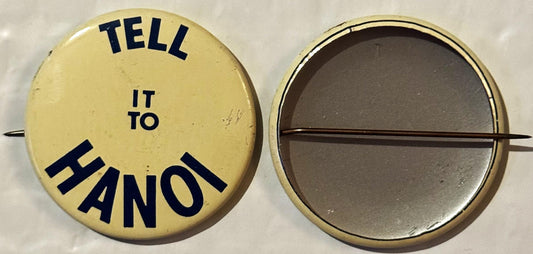
Some political buttons ask you to think it over. This one skips that step. TO HELL across the top, a short, wide WITH tucked in the middle, and HANOI along the bottom: white capitals on a royal blue face, three lines, four words. Anybody wearing one of these in the 1960s never had to explain their view on Vietnam twice.

I have a small stack of these, and every one of them is New Old Stock, unused. They were never pinned to a coat or carried to a rally. Each one measures 1.75 inches across (about 4.4 cm), a good lapel size that reads from across a room without taking over the jacket, and the one you receive comes out of the same stack as the one in my photos.

🦅 Hawks and Doves: Who Was Keeping Score

Calling somebody who is spoiling for a fight a "hawk" goes way back. The phrase "war hawk" dates to 1792, and a generation later it stuck to the young congressmen who pushed the country into the War of 1812. The matched pair, hawks and doves, entered everyday American speech in December 1962, when Stewart Alsop and Charles Bartlett used it in "In Time of Crisis," their Saturday Evening Post account of the Cuban Missile Crisis. By the time Vietnam heated up, everybody knew which bird they were.

Gallup asked the question straight out in March 1966. Forty-seven percent of Americans called themselves hawks, meaning they wanted to step up the fighting; 26 percent called themselves doves, who wanted to slow it down; and 27 percent had no opinion. So in 1966 a hawk button spoke for the bigger crowd, by close to two to one. I think that gets forgotten. In October 1967 the Citizens Committee for Peace with Freedom in Vietnam, with former Presidents Truman and Eisenhower among its members, said it spoke for the "silent center" of American life, a "bipartisan majority," and it wanted to make sure Peking and Hanoi did not mistake the loudest dissenters for the whole country.

🗺️ Why "Hanoi" Was the Word

Ho Chi Minh proclaimed Vietnam's independence in Hanoi in September 1945, and once his government took the city back from the French in October 1954, Hanoi was the capital of North Vietnam, the Democratic Republic of Vietnam. The name itself goes back to 1831, when Emperor Minh Mang renamed the city Ha Noi, roughly "inside the rivers." To an American reading the paper in the 1960s, though, it meant one thing: the government on the other side of the war.

For a long stretch Hanoi was also the place American bombers were told to leave alone. Operation Rolling Thunder started hitting North Vietnam on March 2, 1965, but airstrikes were forbidden within 30 nautical miles of Hanoi and within 10 of the port of Haiphong. President Johnson kept a tight rein on the bombing, and it infuriated American commanders and right-wing members of Congress. No wonder "Bomb Hanoi" turned up on hawk buttons. The first American strikes in the Hanoi-Haiphong area finally came on June 29, 1966, against the oil depots near both cities.

One week later, on July 6, 1966, North Vietnam marched 52 captured American airmen through Hanoi, chained in pairs, for about two miles in front of tens of thousands of people. The crowd broke through and beat them. It was staged and filmed for propaganda, and it backfired: the footage went around the world, Indira Gandhi, Harold Wilson, U Thant and Pope Paul VI all condemned it, and North Vietnam dropped the war-crimes trials it had been threatening. It's remembered as the Hanoi March.

🔒 Hell's Hole and the "Hanoi Hilton"

Here's a coincidence of language I can't resist. Hanoi's most notorious prison, Hoa Lo, was built by the French between 1896 and 1901 as the Maison Centrale, and its Vietnamese name is usually translated "fiery furnace," or more bluntly, "Hell's hole." So Hanoi already had a hell of its own long before anybody printed a button about it.

American prisoners called the place the Hanoi Hilton. Bob Shumaker, one of the POWs, was the first to put that name in writing, scratching "Welcome to the Hanoi Hilton" into the handle of a pail. The first American held there was Navy Lieutenant (j.g.) Everett Alvarez Jr., an A-4 Skyhawk pilot shot down on August 5, 1964. Alvarez was a prisoner for eight years and seven months, came home on February 12, 1973, and went on to serve as deputy director of the Peace Corps and deputy administrator of the VA. John McCain, James Stockdale and Jeremiah Denton were held there too. For the families of men like these, Hanoi was not a word in a headline. It was where their sons and husbands were.

🗽 When the Hawks Took to the Streets

The hawks did more than answer pollsters. On November 6, 1965, when five men burned their draft cards in New York's Union Square, hecklers greeted them with shouts of "Red stooge" and "traitor," and the counter-demonstrators across the street held up signs reading "Burn Yourself Instead of Your Card."

Then came the big one. After demonstrators burned an American flag at an anti-war rally in April 1967, a New York fire captain named Raymond W. Gimmler organized a "Support Our Boys in Vietnam" parade, and on May 13, 1967, thousands of people turned out for it along Fifth Avenue. Gimmler's posters showed the flag burning over the line "If this makes you mad march in support of Our Boys." Priests and nuns walked, four Hell's Angels pulled up on their bikes and joined in to cheers, and longshoremen from the ILA carried signs that, as the Village Voice described them, wanted to "drop a little sanctifying grace on Haiphong and Hanoi." Those priests were marching on the very day Pope Paul VI was at Fatima pleading for peace. Gimmler's committee kept going long after the war and in 1985 took the name We Supported Our Men in Vietnam, Inc.

That same year Diane Arbus photographed a boy in a straw hat waiting to march in a pro-war parade in New York City. Pinned to him are a big "God Bless America / Support Our Boys in Vietnam" badge and a small button reading "Bomb Hanoi." It's about as close as you can get to seeing what a hawk wore on his lapel in 1967.

The young conservatives brought the fight to the campuses. Young Americans for Freedom was founded in September 1960 by about 90 young people at William F. Buckley Jr.'s childhood home in Sharon, Connecticut, and it backed an American victory in Vietnam. YAF took up the hawks' comeback to the protesters, "Tell it to Hanoi": if the war makes you angry, take it up with the Communist government in Hanoi, not with Washington. On December 7, 1969, YAF and the Veterans of Foreign Wars held a "Tell it to Hanoi" demonstration on Boston Common in support of the war. Albert "Dapper" O'Neil, who went on to the Boston City Council, took the podium, and a North Vietnamese flag went up in flames.

TO HELL WITH HANOI is that same hawk message with the gloves off.

🔥 An Old American Way of Saying It

Americans have been telling their enemies where to go for a long time. In 1918, with the doughboys in France, Metro released a silent comedy called "To Hell with the Kaiser!" Fifty years on the target had changed and the grammar hadn't. That's what I like about these buttons: they sound like somebody's grandfather at the kitchen table, not like a committee.

🔧 How Each One Is Made

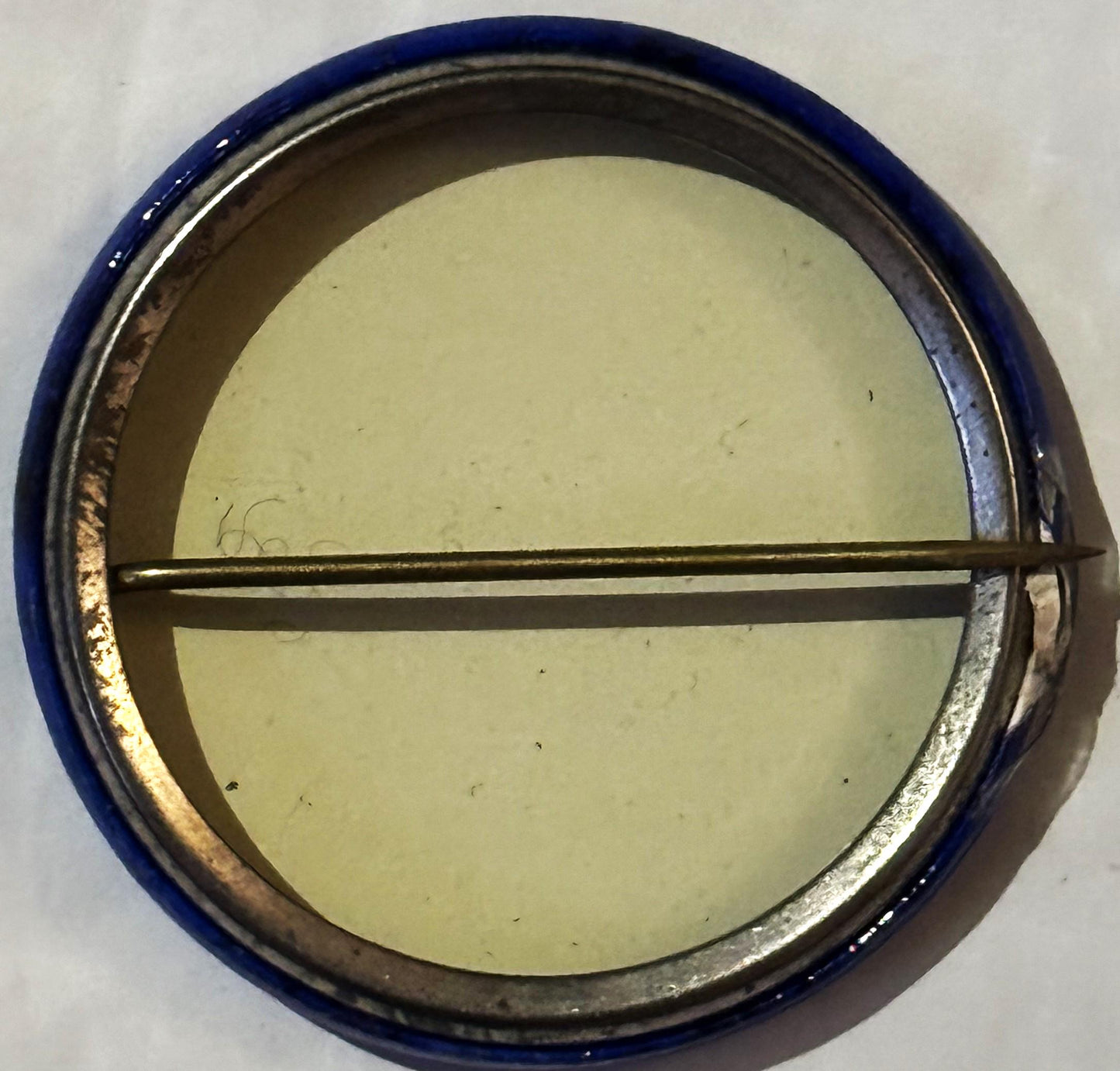
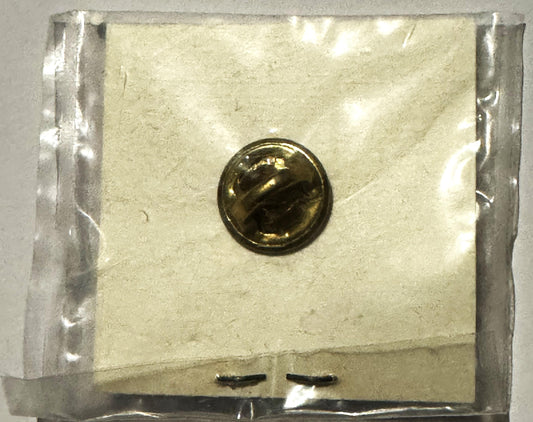
Turn one over and you can see how it was put together. The blue-and-white design is printed on paper, a clear film goes over the top, and the two are wrapped around a round metal shell and locked in from behind by a silver-tone metal ring that button people call the collet. Inside the ring sits a plain cream back paper, and a long brass pin runs straight across.

That's the celluloid method, the one that took off with William McKinley's 1896 campaign. The other way to make a button, printing the design straight onto tin, arrived in 1916. A tin litho button has no collet ring and no film edge, so once you know to look, you can tell the two apart in a second.

🏭 The Button Makers Behind the Trade

The celluloid button grew up in Newark, New Jersey. Benjamin S. Whitehead and Chester R. Hoag founded the Whitehead & Hoag Company there in 1892; Whitehead patented a clear celluloid film laid over a picture in 1893, and the firm was granted its patent for a "Badge Pin or Button" on July 21, 1896. In 1959 Whitehead & Hoag was sold to Bastian Brothers of Rochester, New York, a shop Theron and Frederick Bastian had opened in 1895, and the Newark factory closed that May.

Out in Chicago, George G. Greenburg and Henry J. Duckgeischel had started the Green Duck Co. in 1906, and you can hear both of their surnames in the company name. During the 1960 Kennedy-Nixon race Green Duck ran between one and two million buttons a day on two shifts of 125 workers. That's the kind of muscle that could put a slogan on lapels fast.

Then the slogan button went its own way. Larry Fox, known as the Button Man, made pins for most of the protest groups beginning in 1963, and in 1966 Irwin Weisfeld closed his bookstore to make joke buttons like "KILL FOR PEACE" that caught on with college students and hipsters across the country. By the middle of the 1960s a button wasn't just for elections anymore. It was how you picked a side and let the whole street know it.

🎖️ About these

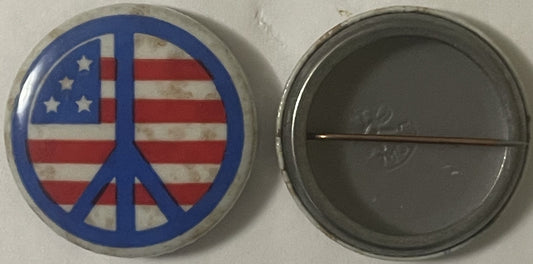
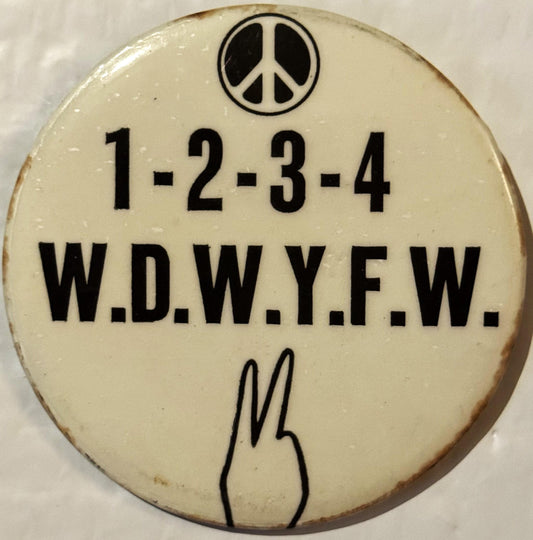
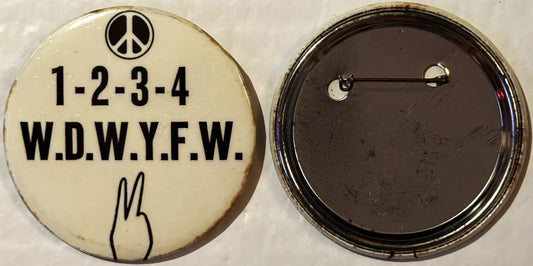
The other two buttons in the group photo, the cream Tell It to Hanoi and the big 1-2-3-4 peace button, are there for company and scale; only the blue TO HELL WITH HANOI button is in this listing. Pin one on an old field jacket, frame it with a newspaper front page from the summer of 1966, or put it in a shadow box across from a peace button and let your guests argue it out. The supply is finite - nobody's printing these again, and once this last stack is gone, they'll be very difficult to acquire.

Shipping

🚚 Shipping & Handling

  • Shipping costs and timing are calculated at checkout.
  • Items curated and shipped directly by me include U.S. shipping at no additional cost, professionally packed to ensure safe arrival of your artifact.

Items from Vetted Pro Collectors
Shipping for items offered by vetted Pro Collectors is determined at checkout. All Pro Collector listings are reviewed to ensure fair, reasonable shipping practices.

For full details, please refer to our Shipping Policy.

Returns & Exchange

Take your time — you've got a full six months. If a piece isn't right for you, send it back the way it reached you and we're good.

In the first 30 days your money goes straight back the way you paid. After that it's store credit, so you can put it toward something you'd rather have.

Return shipping we sort out between us, case by case. I don't make this difficult.

If something arrives damaged, or it isn't what I said it was, send me a photo within 48 hours and I'll make it right.

Email info@vintageantiquesgifts.com or call 802-356-9872 — that's me answering, not a call center.

The only things I can't take back are custom or special-order pieces and gift cards.

View full details
  • 5 stars: 7 (100%)
  • 4 stars: 0 (0%)
  • 3 stars: 0 (0%)
  • 2 stars: 0 (0%)
  • 1 star: 0 (0%)
j
j***u (4537)

Perfect. Thanks

h
h***b (286)

Got to love it. Have never had a problem here.

-
-***r (462)

Great product, very personal attention to detail and service.

a
a***a (1932)

Great to do business with!

r
r***5 (3694)

As described....Hope to do business with again! Thank You!

S
Stacy

Highly recommend this seller! Amazing to work with.

P
Paula

Great communication and quality itrm. Love it!

Preserving History: Authentic Objects Across Eras

— Curated by Travis Weigel