Skip to product information
1 of 4

Vintage and Antique Gifts

Vintage 1960s Vietnam War Protest Button ✊ 1-2-3-4 W.D.W.Y.F.W. Peace Sign Rally Pin 3"

Vintage 1960s Vietnam War Protest Button ✊ 1-2-3-4 W.D.W.Y.F.W. Peace Sign Rally Pin 3"

Regular price 19.00 USD
Regular price Sale price 19.00 USD
Sale Sold out
Shipping calculated at checkout.
Quantity

Size: 3 inches ~

✊ Say It Out Loud and You Will Swear. The Button Never Does.

Four numbers and six initials, and the loudest word in the sentence is the one word that is not on there. Anybody who stood in a crowd between 1965 and 1973 can finish it without reading it: One, two, three, four — we don't want your [expletive] war. The count-off is printed. The refusal is printed. The swear is left for your mouth to supply, and that was the whole trick.

Vintage 1960s Vietnam War protest pinback button. 3" ~ New Old Stock, never worn, never pinned on. Some show a little age freckling at the rolled rim - they vary a little one to the next.

📌 What Is Actually On It

  • ☮️ A peace circle inside a black ring at the top
  • 1️⃣ 1-2-3-4 in bold condensed capitals
  • 🔤 W.D.W.Y.F.W. — six initials, a period after every one of them
  • ✌️ An outline drawing of a hand holding up two fingers, down at the bottom
  • ⚫ Black on cream, printed face under a clear glossy cover, rolled over a metal shell
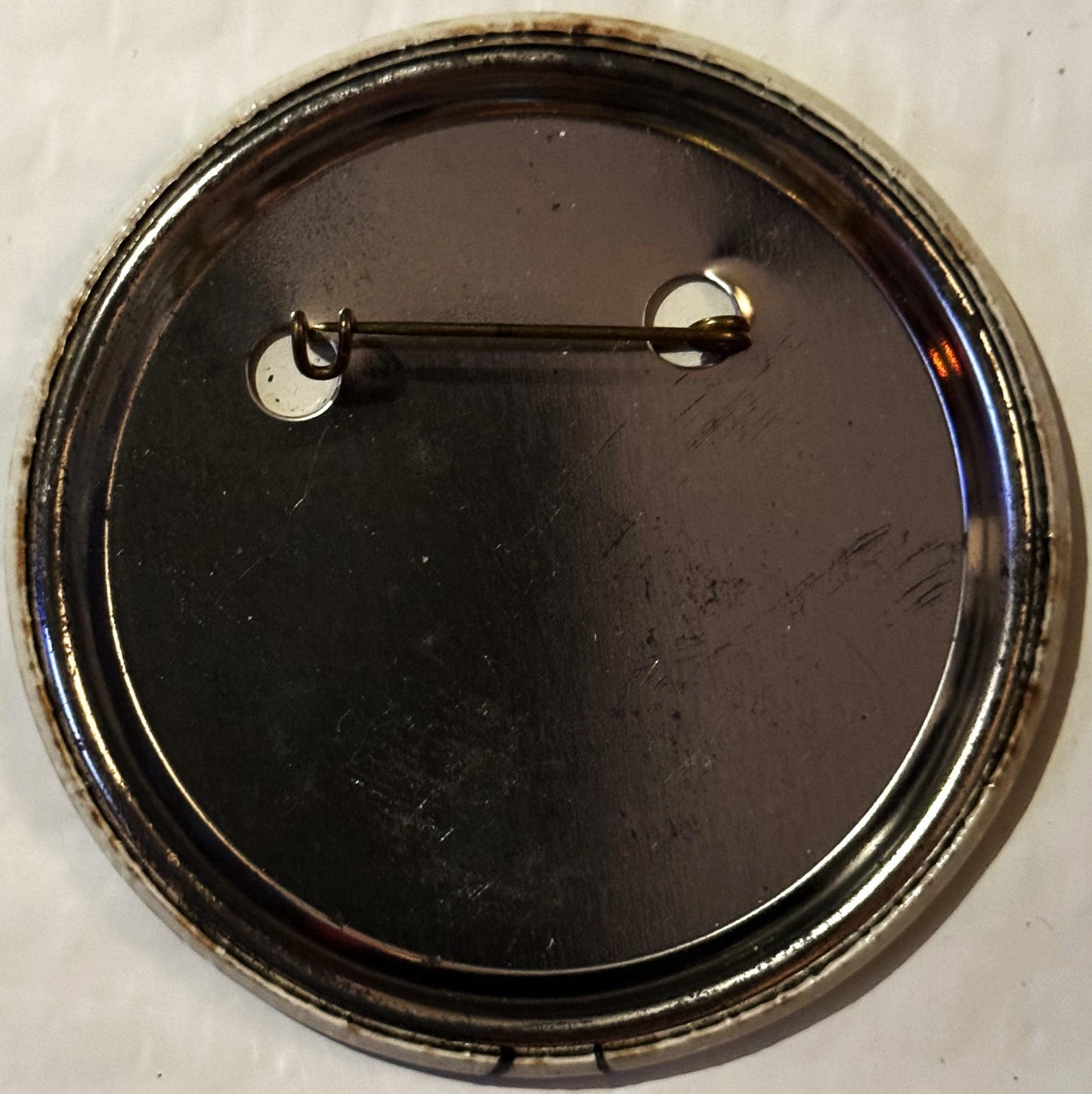
  • 🔧 Turn it over: a closed metal plate and a straight wire pin run through two punched holes. No maker's name, no printer's mark, no union label anywhere on it

I put a quarter next to it so you can see the scale. Three inches. This is not a lapel pin — this one was sized to be read across a street.

🗣️ Why the Word Is Missing

It is not shyness. In 1968 a young man named Paul Robert Cohen walked into a Los Angeles courthouse in a jacket that had the word printed across the back, over the words "the Draft." He was convicted of disturbing the peace and given thirty days. It took the Supreme Court of the United States to get him out of it: in 1971, Justice John Marshall Harlan II wrote that the state could not make the public display of one four-letter word a crime, and threw the conviction out.

That is the world this button was printed into. Wear the word and you might be explaining yourself to a judge. Wear the initials and every single person who mattered still heard the whole line. It is a coded chant, and the code was legal cover.

📣 Where the Chant Came From

The full line is one of the best-known things anybody shouted at an American war. It was on the street before it was on paper — there is a field recording catalogued as students chanting it at Columbia University in 1968, the spring Columbia students held five campus buildings for a week over the university's military research contracts and its plan to put a gymnasium in Morningside Park. Collections of anti-war quotations put its first report as a chant at 1969.

People mix it up with Country Joe McDonald's "I-Feel-Like-I'm-Fixin'-to-Die Rag" all the time, and it is not the same thing. McDonald wrote that in 1965 and Country Joe and the Fish opened their shows with the Fish Cheer, spelling out F-I-S-H like a high school pep rally. In 1968, at the Schaefer Music Festival in Central Park, drummer Gary "Chicken" Hirsh talked them into spelling a different four-letter word instead. The crowd went up. The festival banned them for life, and The Ed Sullivan Show, which had already paid them for a booking, told them to keep the money and never show up. McDonald led the cheer again at Woodstock on August 16, 1969, and the film put the words on the screen. His chorus counts to three and asks a question. This button counts to four and answers it. Same years, same crowds, two different chants.

☮️ The Circle at the Top: an English Artist in Despair

Gerald Holtom was a Twickenham artist, Royal College of Art trained, who spent the Second World War as a conscientious objector working a farm in Norfolk. On the 21st of February, 1958 he showed his drawing to the Direct Action Committee Against Nuclear War and they took it on the spot. It went up the road for the first time on the Easter march out of Trafalgar Square on April 4, 1958, fifty-two miles to the Atomic Weapons Research Establishment at Aldermaston in Berkshire, where Britain built its bombs. Five hundred of them were carried on poles, half black on white and half white on green, the colours following Easter — winter to spring, death to life.

The strokes are flag semaphore, N over D, for Nuclear Disarmament. But Holtom gave a different reading years later, in a letter to a former editor of Peace News: he was in despair, deep despair, and he drew himself — a man with his hands stretched down and out, like the peasant in front of the firing squad in Goya's The Third of May 1808 — and then put a circle round him. He thought at the time it was a puny little thing.

The first wearable badges were not metal. A member of Kensington CND made them out of white clay with the mark painted on in black, and handed them out with a note saying that fired pottery would be among the few human objects to survive a nuclear war. I love that. Somebody made a peace badge and thought about what would still be lying in the dirt afterwards.

Holtom never copyrighted it. That is why it is on this button and everything else — nobody had to ask, and nobody had to pay.

🇺🇸 How It Crossed the Atlantic

The symbol turned up in America in 1958, when the pacifist Albert Bigelow sailed a small boat toward a Pacific nuclear test under the CND banner. The buttons came two years behind it. In 1960 Philip Altbach, a freshman at the University of Chicago, went to Britain as a delegate of the Student Peace Union, met the British peace groups, and brought the badges home in his luggage. He talked the SPU into adopting the mark, and between 1960 and 1964 they sold thousands of them on college campuses. The story goes that Bayard Rustin, the strategist who would organize the March on Washington in 1963, was on that London march and carried the sign home for the civil rights movement. By 1968 it had stopped meaning nuclear disarmament to most Americans and became the sign of the whole anti-war movement - a mark that changed what it stood for twice in ten years.

✌️ The Hand at the Bottom Took the Longest Road

On January 14, 1941, Victor de Laveleye — a former Belgian Minister of Justice running the BBC's Belgian French-language broadcasts — asked people in occupied Belgium to chalk up the letter V wherever they could: victoire in French, vrijheid, freedom, in Dutch. It spread across occupied Europe within months. Winston Churchill picked it up that July and the two fingers became his signature for the rest of his life. Twenty-odd years later, American kids pointed the exact same two fingers at the exact same camera lenses and meant the opposite thing. A salute for winning a war turned into a salute for stopping one.

🗣️ Chickens, Broken Crosses, and a Trademark Fight

Not everybody saw peace in that circle, and the rumour travelled about as fast as the sign did. Young Americans for Freedom printed a bumper sticker calling it "The Footprint of the American Chicken." In 1968 the evangelist Billy James Hargis started calling it a broken cross and a mark of the Antichrist. In June 1970 the John Birch Society's magazine tied it to a broken cross the Moors were supposed to have carried into Spain in the eighth century, and that September a Republican congressional newsletter compared it to a Nazi death rune. Time answered in November that the resemblances were most likely coincidence. None of it squares with a tired Englishman drawing himself with his arms down.

Then, in 1970, two American companies — the Intercontinental Shoe Corporation of New York and Luv, Inc. of Miami — tried to register the peace symbol as a trademark and own it outright. Commissioner of Patents William E. Schuyler Jr. refused them, ruling that the thing could not work as a trademark at all. It stayed free. Everybody's.

🏭 The Button Itself Is a Newark Invention

A printed face sealed under a clear cover on a metal shell with a pin behind it is American, and it has a patent number. U.S. Patent 564,356, granted the 21st of July, 1896 to George B. Adams of Irvington, New Jersey, and assigned to the Whitehead & Hoag Company of Newark. McKinley and Bryan both campaigned with the new buttons that same year, and Whitehead & Hoag went on to be the biggest button maker in the world.

Seventy years on, the format belonged to everybody, and that is exactly what made it the right tool for this. Gift shops and head shops sold counterculture buttons by the tray, most of them nothing but words — free speech, gay rights, women's rights, legal acid, end the war. A whole chant crushed down to four numbers and six letters is that language at its sharpest.

📜 The Years This Thing Lived Through

Campus teach-ins in 1965. Tens of thousands on the Pentagon in October 1967. Columbia in April 1968, and the street fighting outside the Democratic convention in Chicago that August. The Moratorium on October 15, 1969, which emptied classrooms and offices all over the country, and hundreds of thousands in Washington a month later. Kent State on May 4, 1970, four students dead and hundreds of campuses shut in the strike that followed, and public opinion on the war was never the same afterwards. The Paris Peace Accords signed January 27, 1973, and the draft finished the same year.

A button like this was pocket change and it was everywhere, and almost every one of them got worn, sweated on and lost. An unworn one is the odd survivor, not the rule.

Shipping

🚚 Shipping & Handling

  • Shipping costs and timing are calculated at checkout.
  • Items curated and shipped directly by me include U.S. shipping at no additional cost, professionally packed to ensure safe arrival of your artifact.

Items from Vetted Pro Collectors
Shipping for items offered by vetted Pro Collectors is determined at checkout. All Pro Collector listings are reviewed to ensure fair, reasonable shipping practices.

For full details, please refer to our Shipping Policy.

Returns & Exchange

Take your time — you've got a full six months. If a piece isn't right for you, send it back the way it reached you and we're good.

In the first 30 days your money goes straight back the way you paid. After that it's store credit, so you can put it toward something you'd rather have.

Return shipping we sort out between us, case by case. I don't make this difficult.

If something arrives damaged, or it isn't what I said it was, send me a photo within 48 hours and I'll make it right.

Email info@vintageantiquesgifts.com or call 802-356-9872 — that's me answering, not a call center.

The only things I can't take back are custom or special-order pieces and gift cards.

View full details
  • 5 stars: 54 (98%)
  • 4 stars: 0 (0%)
  • 3 stars: 1 (2%)
  • 2 stars: 0 (0%)
  • 1 star: 0 (0%)
_
_***s (100)

Loved it

C
Chelsea

Absolutely awesome! Will definitely be ordering other items!!

C
Carrie Washburn

Very nice and very large! Perfect addition to my backpack and came with a lovely note

h
h***b (286)

Great site with a host of products. Condition was just as described. Fast shipping at a fair cost. And a little something else thrown in.

t
t***n (4227)

Great price and fast shipping

2
2***m (2535)

Fantastic sellers, great people to do business with!!!

s
s***7 (2069)

Super nice condition and quality for being so old. Look nice in a shadow box good price, Seller easy to work with. I give them an AAAAAAAA######

h
h***o (2708)

Very nice item with super fast shipping. Super nice guy to deal with. How eBay is done. Thanks

b
b***e (650)

Thank you very much

r
reenie1us

Love the sentiment on this vintage product; the letter alone was worth the purchase, would shop here again

9
9***9 (1196)

Nice old pin and quick shipping.

s
s***9 (3924)

Great button thanks!

t
t***c (2175)

Very nice. Thank you 🙏

2
2***2 (825)

A piece of history.

y
y***y (500)

Nice product and fast delivery!

n
n***c (26)

Perfect! Quick, excellent condition, safe and secure packaging, nice communications.

c
c***u (235)

I'm extra pleased with this item. It's as described. The extra is because my item is twice as big as I assumed and it's my age too. Thanks guys. John

p
p***p (1531)

Very Nice Vtg Pin.....A+++++.....Thank You

e
e***i (99)

Fast safe shipping item as described very nice historic pin the real deal five star thank you

n
n***d (36)

Cool vintage button!

8
8***1 (2788)

Excellent job well done my friend. Thank you ☮️

c
c***o (6434)

Just perfect!

r
r***u (1810)

Very nice pin that fits well in my collection. Was packaged well and shipped fast. Seller communicated through out the process........A+!!!

o
o***r (569)

Really wanted the item, I still do not know what happened to it. Was lost in the mail ?? I STILL WOULD LIKE the Viet button

Sir, You opened a case and never responded. It only gives me one option: to refund. I messaged you four different times. I even called and left a voicemail on your cell phone. I will not send another rare piece out unless I can communicate with you and confirm the address to see if there is an issue. After this review, I tried to contact you six more times unsuccessfully to help. I can't help if you won't let me.

2
2***w (633)

The pin arrived in perfect condition because of the care that the vendor took in the superb packaging.

a
a***s (3402)

You make eBay a pleasure…. Thanks!

r
r***l (61)

Fantastic seller!

1
1***9 (8565)

Great service, thanks

_
_***a (8)

The item arrived in good time and as described. It will be used as an artifact for a class on the Vietnam War Era. I appreciate buying from a small business.

z
zack

Great service, thank you for the letter too. Definitely recommend.

r
r***r (1326)

Nice piece of my history I apposed the war. Nicely packed and shipped fast thank you