Skip to product information
1 of 6

Vintage and Antique Gifts

Vintage 1960s Vietnam War Protest Pin Set Combo โœŒ๏ธ โ€“ Peace & Pro-War, 5 Buttons

Vintage 1960s Vietnam War Protest Pin Set Combo โœŒ๏ธ โ€“ Peace & Pro-War, 5 Buttons

Regular price $61.00 USD
Regular price Sale price $61.00 USD
Sale Sold out
Shipping calculated at checkout.

Size: 3"

๐Ÿšš Free US Shipping โ€” ships within one business day. International shipping calculated at checkout.

Quantity

Which Side Were You On? โœŒ๏ธ Vintage 1960s Vietnam War Protest & Pro-War Pin Set, 5 Buttons

Size: 3"

Five buttons, both sides of the argument ยท 1-2-3-4 W.D.W.Y.F.W. 3" ยท NOW dove button ยท flag peace sign ยท TELL IT TO HANOI 1 3/4" ยท TO HELL WITH HANOI 1 3/4"

โœŒ๏ธ Doves and Hawks in One Handful

This set is the one I always stop on, because it refuses to pick a side. Three of these five marched against the war. Two marched right back at the marchers. That isn't a flaw in the set - that's the Vietnam years in America, pinned up in five buttons.

This is a set of five original 1960s Vietnam War pinback buttons, new old stock.

The words for the two sides are older than the war. "War hawk" goes back to a 1798 letter from Thomas Jefferson to James Madison, aimed at the men who wanted war with France. The dove came later: in 1962, during the missile crisis, the Saturday Evening Post split Washington into two camps - the hawks, who wanted an air strike, and the doves, who wanted a blockade. By the Oxford English Dictionary's count it was the first time the dove was set against the hawk in print. Within a few years the two words had a war to describe, and Americans were wearing their side on their jackets. This set wears both sides: three buttons speak for the doves - a street chant, a pair of peace doves, and the American flag drawn into a peace sign - and two answer back for the hawks, and both of them point at Hanoi.

๐Ÿ“Œ The Five, As They Read

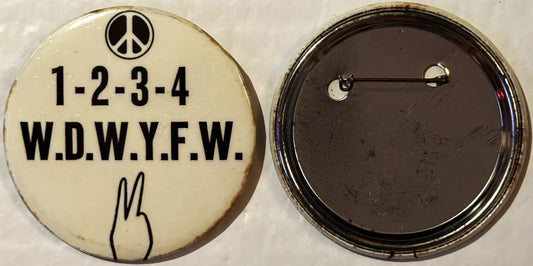
  • 1-2-3-4 / W.D.W.Y.F.W. The big one, 3 inches across. Black letters on cream, a peace symbol at the top, an outline hand throwing the V sign at the bottom.
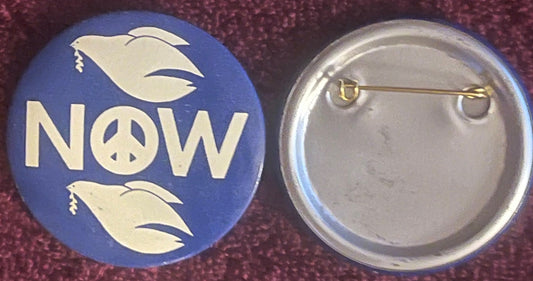
  • NOW Cream on navy blue, a peace symbol standing in for the O, a dove carrying an olive sprig above the word and another below it.
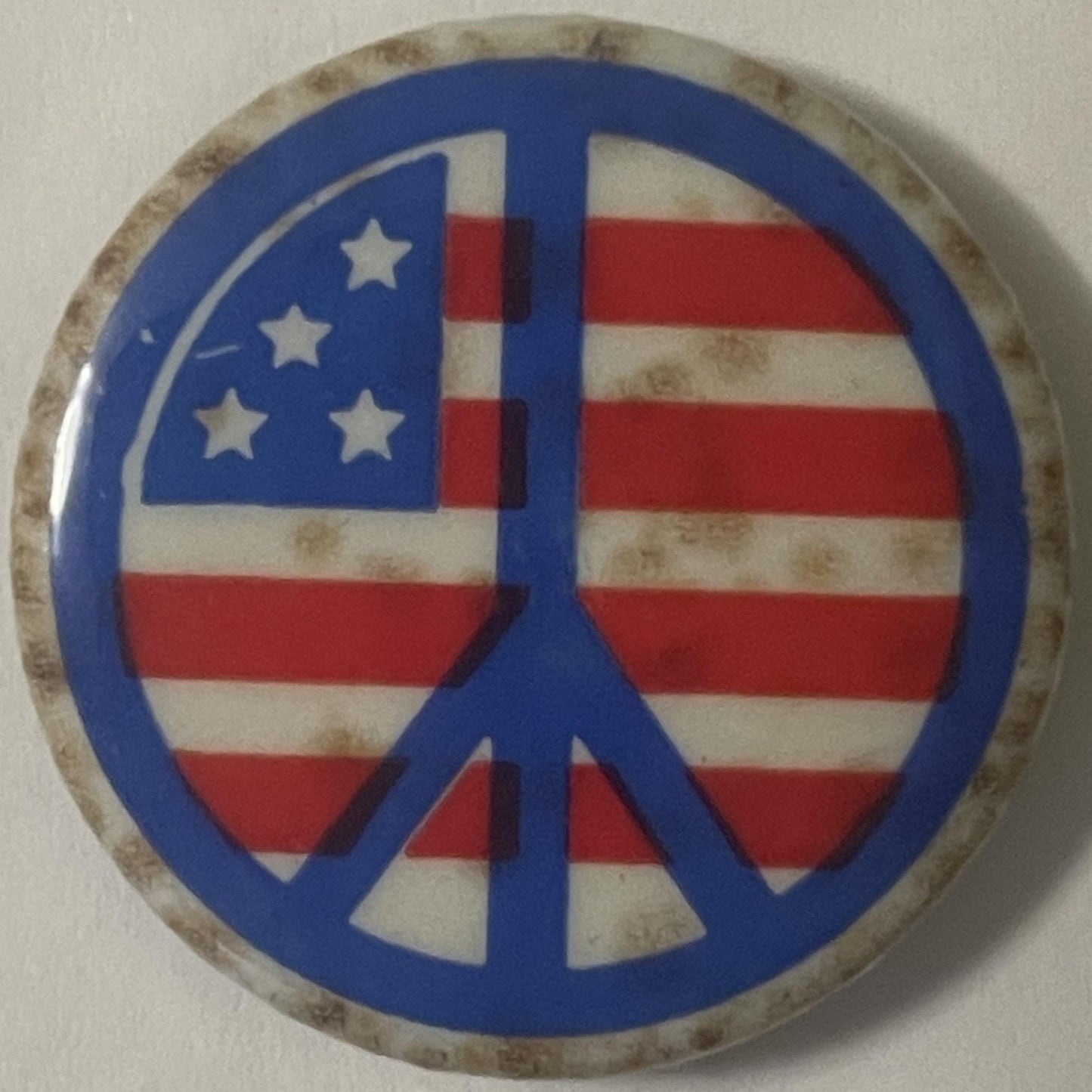
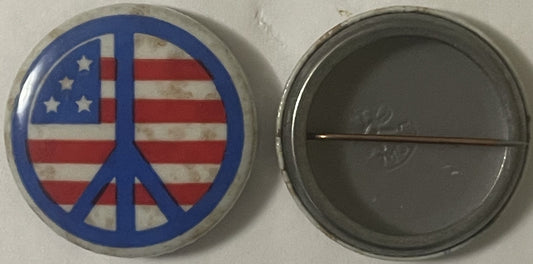
  • The flag peace sign The smallest of the five, no words at all: a blue peace symbol laid straight over red and white stripes and a field of stars.
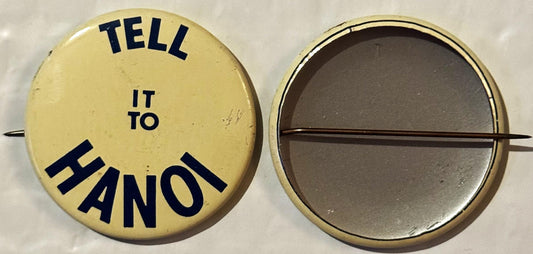
  • TELL IT TO HANOI Navy letters on cream, 1 3/4 inches, TELL arched over the top, IT TO small in the centre, and HANOI arched along the bottom.
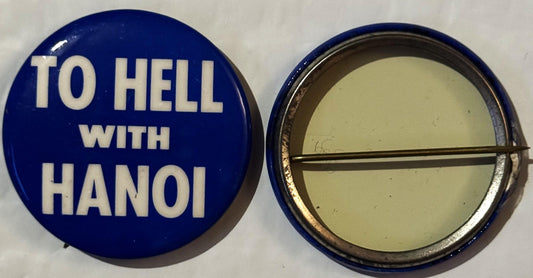
  • TO HELL WITH HANOI White block letters on glossy royal blue, 1 3/4 inches, no picture, just the words.

๐Ÿ“ฃ A Chant You Couldn't Print in Full

Read the big button out loud and it clicks: One, two, three, four, we don't want your f---ing war - a march chant collectors put at about 1970. Anyone who marched will read the big button before they finish counting. The four-count opening let a whole crowd come in on the same beat, and the last words were not something a button could spell out, so the button counts off the rhythm and leaves the rest to initials. That count comes straight out of an older protest song, Country Joe McDonald's I-Feel-Like-I'm-Fixin'-to-Die Rag - written in 1965, the title song of Country Joe and the Fish's 1967 album, and the one the Woodstock crowd sang along to in 1969. Country Joe passed away this March at 84, and a button like this still does what his song did - puts the ugly word out there for a whole crowd to feel without anybody having to say it. Vietnam Veterans Against the War's own newspaper, The Veteran, was still quoting the chant word for word in 2002. It had company on the march, too - "Hell no! We won't go!", a draft chant that seems to have started with the Student Nonviolent Coordinating Committee.

The hand making the V has its own history. In 1941, broadcasting to occupied Belgium, Victor de Laveleye asked listeners to chalk a V for victoire and vrijheid on the walls; by that July, Winston Churchill had made it his own hand sign. A generation later, Vietnam-era protesters borrowed the same two fingers and turned it from a victory sign into a peace sign - the gesture on this button.

โ˜ฎ๏ธ The Symbol on Three of the Five

The circle that stands in for the O in NOW on the big button, and sits over the flag on the smallest one, is Gerald Holtom's symbol, first shown February 21, 1958, when the English artist presented it to the Direct Action Committee for Britain's campaign against nuclear weapons. Holtom made it out of the flag-semaphore letters N and D, for nuclear disarmament, and said it was also a man in despair with his arms down, like the peasant Goya painted in front of a firing squad. It went public that April on the march from Trafalgar Square to the Atomic Weapons Research Establishment at Aldermaston, and Eric Austen adapted the design into ceramic lapel badges. Nobody ever trademarked it, which is exactly how it ended up on a British lapel badge in 1958 and an American button a decade later. Buttons like these came out of small movement print shops, and the best-remembered man in that trade was Larry Fox, known to the whole movement as "the Button Man." He made buttons for the Student Peace Union, SDS and dozens of other groups, and he was in the fight to seat the Mississippi Freedom Democratic Party at the 1964 Democratic Convention. He lived in Valley Stream, Long Island, from 1961 on, worked with Long Island CORE catching landlords who'd rent to a white man but not a Black one, and marched through Harlem in March 1965, a week after Bloody Sunday in Selma, holding up a sign that read "We Will Overcome." He was still telling the story at 79.

It crossed the ocean fast. Albert Bigelow sailed under the disarmament banner during the nuclear tests of 1958. In 1960 Philip Altbach brought the badges over and talked the Student Peace Union into adopting the symbol, and the Union sold thousands of them on campuses between 1960 and 1964. Around the same time the designer Ken Garland cleaned up Holtom's drawing so it read at a glance, and by the time the big marches came, the anti-war movement had taken it as its own. That's the circle on three of these five.

๐Ÿ•Š๏ธ NOW, and the Day 15 Million Showed Up

Swap a peace sign in for the O and NOW reads "Peace Now," which was the ask. The doves with olive sprigs go back further than any of it - in Genesis, Noah's dove brings an olive leaf back to the ark to say the flood is over - and Peace Now was the demand on the biggest day of all, October 15, 1969, when something like 15 million Americans turned out for the Vietnam Moratorium - more people protesting on a single day than the country had ever seen. On November 15 a second round brought more than half a million people to Washington, D.C. and about a quarter of a million to San Francisco.

The dove itself got its modern job from Pablo Picasso. In April 1949 his lithograph La Colombe was chosen as the emblem of the Paris peace congress, and it went on to be the bird of the whole postwar peace movement. So the little doves on this button are carrying two stories at once - Noah's olive leaf and Picasso's poster.

โš”๏ธ Tell It to Hanoi, To Hell With Hanoi

Here's where the set turns around on you. These two buttons don't join the peace movement, they answer it. Tell it to Hanoi was what the war's supporters shot back at protesters - quit griping to Washington and take it up with Hanoi, North Vietnam's communist capital: their complaint belonged in the North Vietnamese capital, not in Washington. Young Americans for Freedom, the conservative youth group founded in September 1960 at William F. Buckley Jr.'s hometown of Sharon, Connecticut, put the slogan on a 1968 poster - built, on purpose, around a peace sign of its own. "To Hell With Hanoi" makes the same argument with the manners taken off.

That side of the country got a name of its own a few weeks later. Nixon went on TV on November 3, 1969, weeks after the first Moratorium, and asked the great silent majority of my fellow Americans to stand with him, promising "peace with honor." Two crowds, two buttons, the same few weeks in the fall of '69.

Hanoi outlasted every one of the slogans, by the way. After the war it became the capital of a reunified Vietnam, in 1976.

๐Ÿ—ฝ The Little Flag Button Takes Both Sides at Once

The smallest button in the set doesn't say a word, and it might be the loudest. By the end of the decade the American flag was something both crowds claimed. A few days after Kent State, on May 8, 1970, some 400 construction workers with flags, chanting USA all the way, charged into about 1,000 students calling for Peace now in Lower Manhattan - the Hard Hat Riot - and more than 100 people got hurt. Less than three weeks after the Hard Hat Riot, on May 26, 1970, President Richard Nixon met union leaders at the White House and accepted a ceremonial hard hat. This button lays the peace sign straight over the Stars and Stripes and refuses to let go of either one. I love that about it.

๐Ÿท๏ธ Five Inches of Tin, One Argument

The pinback button itself is an old American invention. Benjamin S. Whitehead came up with the clear celluloid covering in 1893, and on 21 July 1896 a patent for a "Badge Pin or Button" was issued to George B. Adams and assigned to Whitehead & Hoag Co. of Newark, New Jersey - the same year William McKinley ran what's often called the first mass campaign built on buttons. Seventy-some years later this format was still doing exactly the job it was built for - letting somebody take a side for the price of a pin.

A button like these was made to be worn, not kept. It is a small thing, but it is proof that someone was willing to be seen taking a side. This set does something a single button cannot: it keeps the chant, the doves, the flag and both Hanoi answers together, the way the country actually was in those years.

I don't think of these as a curiosity from one camp. To me they're the whole argument in tin - what one side shouted at the rally and what the other side printed on its posters. Each set shows its age its own way - a few have a touch of rust at a rim, most are cleaner - but every set has all five buttons, front and back, intact.

๐Ÿ–ผ๏ธ Display Ideas

  • ๐Ÿ–ผ๏ธ A shadow box with the three dove buttons on one side and the two Hanoi buttons on the other
  • ๐Ÿ“ฐ Framed beside a newspaper front page or photograph from the 1969 Moratorium
  • ๐Ÿ“š On a shelf with Vietnam-era LPs, paperbacks and a peace-sign poster
  • ๐Ÿซ A classroom set: five buttons, two sides, one decade
  • ๐ŸŽ A gift for someone who marched, someone who served, or someone who remembers watching it all on the evening news

๐ŸŽ Who Collects These

Political button collectors want the slogans, on both sides. Peace-movement and counterculture collectors want the chant, the doves and the peace symbol. Vietnam War collectors and teachers want an object that shows the country arguing. And a set that holds both sides appeals to anyone who wants the era the way it was, not the way one camp remembers it.

๐Ÿ”Ž Condition

New old stock. Look for some light toning and maybe a small rust spot at a rim, which is normal for tin this old, and none of it keeps a button off your jacket or out of a shadow box. They're not making 1960s Vietnam War buttons anymore, and once the limited supply for sale is gone and on display with collectors, they will be very difficult to acquire.

Shipping

๐Ÿšš Shipping & Handling

  • Shipping costs and timing are calculated at checkout.
  • Items curated and shipped directly by me include U.S. shipping at no additional cost, professionally packed to ensure safe arrival of your artifact.

Items from Vetted Pro Collectors
Shipping for items offered by vetted Pro Collectors is determined at checkout. All Pro Collector listings are reviewed to ensure fair, reasonable shipping practices.

For full details, please refer to our Shipping Policy.

Returns & Exchange

Take your time โ€” you've got a full six months. If a piece isn't right for you, send it back the way it reached you and we're good.

In the first 30 days your money goes straight back the way you paid. After that it's store credit, so you can put it toward something you'd rather have.

Return shipping we sort out between us, case by case. I don't make this difficult.

If something arrives damaged, or it isn't what I said it was, send me a photo within 48 hours and I'll make it right.

Email info@vintageantiquesgifts.com or call 802-356-9872 โ€” that's me answering, not a call center.

The only things I can't take back are custom or special-order pieces and gift cards.

View full details
  • 5 stars: 4 (100%)
  • 4 stars: 0 (0%)
  • 3 stars: 0 (0%)
  • 2 stars: 0 (0%)
  • 1 star: 0 (0%)
A
Ande

Pins arrived promptly, and all individually wrapped.

A
AlabamaCowboyGaming

These pins are what I needed for my Vietnam war reenactment! They look awesome

E
Etsy customer

Arrived quickly, as pictured and described, packaged excellently. Donโ€™t have a single complaint, would definitely do business with again. Thank you thank you, God bless!

y
y***9 (4059)

Nice item , Many thanks A++++++++++++++

Preserving History: Authentic Objects Across Eras

โ€” Curated by Travis Weigel