Skip to product information
1 of 4

Vintage and Antique Gifts

Vintage 1960s Vietnam War Pinback Button 🎖️ "Tell It to Hanoi" Pro-War Political Slogan Pin

Vintage 1960s Vietnam War Pinback Button 🎖️ "Tell It to Hanoi" Pro-War Political Slogan Pin

Regular price 7.00 USD
Regular price Sale price 7.00 USD
Sale Sold out
Shipping calculated at checkout.
Quantity

🗽 What Did Americans Say Back to the Protesters in the Street? This Little Pin Answered in Four Words

Every era has its rallying cries, and the Vietnam years handed us more of them than almost any decade before or since — chanted at marches, spray-painted on dorm walls, stitched onto jackets, and yes, stamped onto cheap tin pinback buttons sold for a nickel at rallies, VFW halls, and street-corner tables. Most of what survives from that fight belongs to the peace movement — the black doves, the inverted "peace" symbols, the "Make Love Not War" slogans that still show up on tote bags today. This little button belongs to the other half of that argument, the half that gets collected far less often and remembered far less clearly. It's a small, blunt, four-word rebuttal from Americans who backed the war and had grown tired of hearing it condemned on their own front porch. Hold it in your palm and you're holding a genuine artifact of a country arguing with itself out loud.


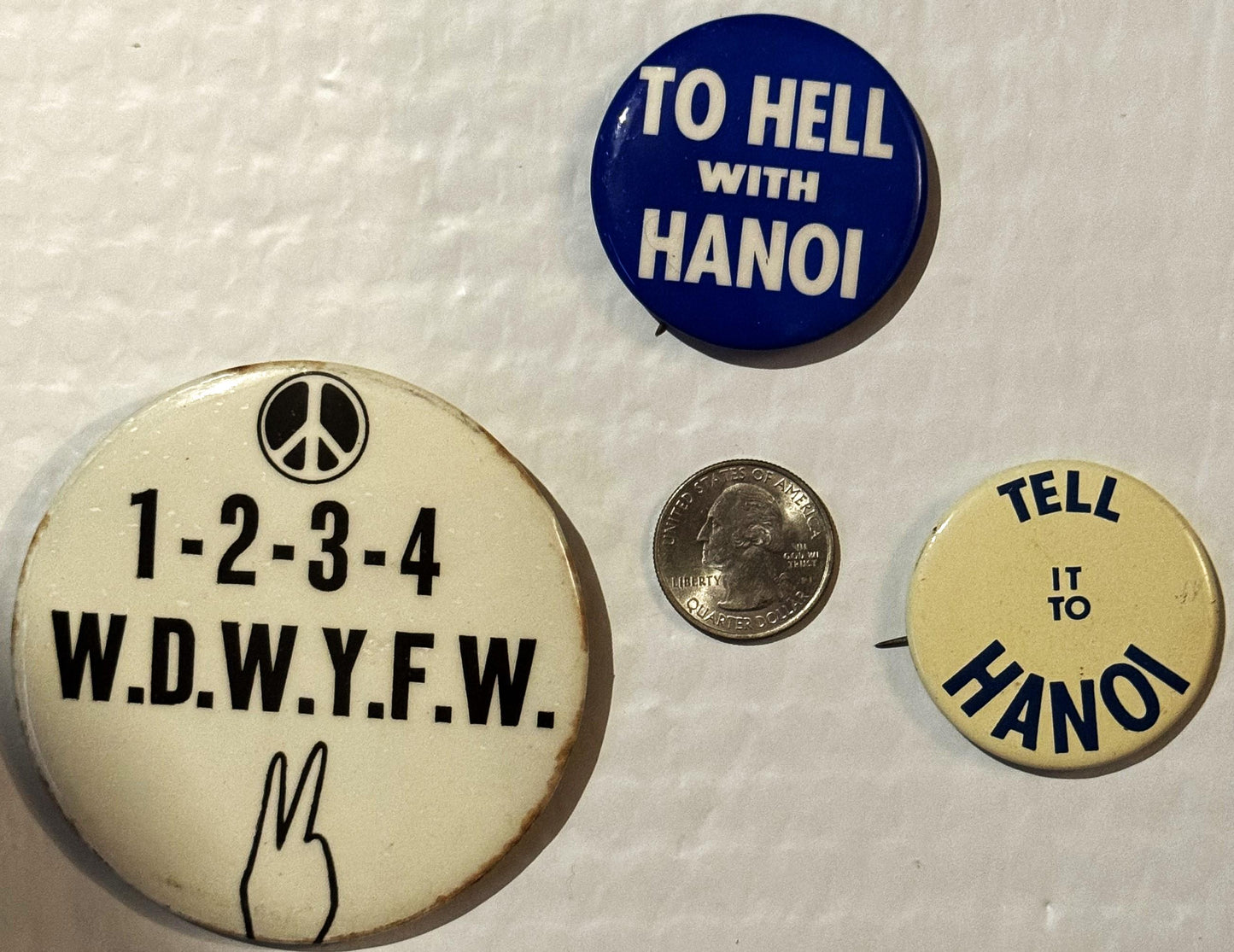
This is an original lithographed pinback button reading "TELL IT TO HANOI," printed in bold dark navy blue lettering on a plain cream/off-white ground — no imagery, no illustration, just the slogan itself, stacked and centered so the eye reads it as a single punch of a phrase. The button measures 0.75 inches (about 2 cm) across, small enough to pin quietly to a lapel or a hat brim rather than shout from across the room, which was very much the style of political pin-back culture at the time — plenty of loud graphic buttons existed, but plenty more, like this one, did their work through pure typographic bluntness.

This example is offered as new old stock (NOS) — unused and unissued stock from its original run, never worn into service, simply held back from its era and preserved rather than pinned and lost like so many of its siblings were. Its exact manufacture date can't be pinned to a single year with certainty (no printer's mark or union bug survives legibly on this style to nail it down), but the design, printing style, and subject matter place it squarely within the mid-1960s into the early 1970s — the years when the Vietnam War dominated American political life and buttons like this one were being printed, worn, and argued over on sidewalks from coast to coast.


🕊️ "Tell It to Hanoi" — A Slogan That Gets Mislabeled More Than Almost Any Other Vietnam Pin

Here's the twist that makes this piece genuinely interesting to own, and genuinely worth getting right: this is not, and never was, an anti-war protest button. It's the opposite. "Tell It to Hanoi" was a counter-slogan — worn by Americans who supported the U.S. war effort and had grown frustrated watching anti-war demonstrators direct their fury at Washington, D.C., rather than at the North Vietnamese government in Hanoi that America was actually fighting. The logic behind the phrase was simple and sharp: if you're angry about the war, the argument went, take it up with the people running the war on the other side — not with your own government, your own troops, or your own president. It was a pushback line, not a peace-sign line, and archival photo collections that catalog political ephemera from the era file it accordingly, describing it plainly as a pro-war political pin from the Vietnam War years.

This matters because plenty of secondhand listings for pins like this one lump them into "Vietnam protest button" collections without a second thought — an understandable mistake, since the button and the peace-movement pins from the same years often get boxed together in the same estate sales and the same flea-market bins. But collectors who study the material closely make a point of separating the two camps, because they represent two entirely different American voices from the same turbulent moment: the marchers on one side, and the counter-marchers — the ones who felt the war was necessary, or at least felt the criticism of it had gone too far — on the other. A pin like this one is a rare surviving voice from that second camp, and that's exactly what makes it worth preserving rather than misfiling.


📋 The Same Phrase Turns Up on a Poster — And That Tells Us the Slogan Had Legs

"Tell It to Hanoi" wasn't a one-off phrase that appeared, got worn for a season, and vanished. The same exact slogan resurfaced a few years later on a larger poster — this one featuring a peace-symbol motif twisted to make its pro-war point — sponsored by the conservative youth organization Young Americans for Freedom. A copy of that poster now lives in the Library of Congress's poster collection, credited to Young Americans for Freedom as the sponsoring organization, and traces its way into the historical record by way of Gary Yanker's landmark 1972 survey of political poster art, "Prop Art," where it was reproduced as one of the era's defining examples of pro-administration counter-messaging. That the same four words traveled from a cheap tin button worn on a lapel to a full poster produced by an organized political youth group a few years later tells you this wasn't a passing joke or a one-club slogan — it was a phrase with staying power, reused across formats as the antiwar movement grew larger and louder through the back half of the 1960s and the pro-war response grew more organized in kind.

It's worth being honest about what we don't know here, too, because that honesty is part of what makes a piece of history trustworthy rather than embellished. No source ties this particular button to Young Americans for Freedom directly — the organizational credit belongs to the later poster, not the pin — and no manufacturer's mark on a button of this style has ever surfaced to name the print shop that struck it. What we can say with confidence is that this slogan moved through the country as a genuine grassroots counter-cry during the war years, showing up wherever supporters of the war effort wanted a quick, wearable way to answer the marchers without saying a word.


A Country Arguing With Itself, One Lapel at a Time

It's easy, looking back from today, to remember the Vietnam era as a single unified story of protest — the marches on Washington, the campus sit-ins, the folk songs. But lived history is messier than that, and buttons like this one are the physical proof of it. For every young person marching with a peace sign, there was very often a father, a shopkeeper, a veteran, or a neighbor down the street who felt the opposite — who had a son or a brother serving overseas, who believed the fight against communism in Southeast Asia mattered, and who resented watching that fight get mocked on the evening news. Pins like "Tell It to Hanoi" gave that quieter, less-photographed half of the country a way to answer back without needing a megaphone. Old-timers who lived through the period will tell you these pins didn't get worn to provoke a fight so much as to simply take a stand in a crowd where silence could feel like surrender — pinned to a work jacket, a church suit, a VFW cap, worn by people who wanted it known exactly where they stood without having to argue about it on the sidewalk.

Lore passed down among button collectors holds that pro-war pins like this one were often produced in far smaller runs than their anti-war counterparts and worn for shorter stretches of time — not because there were fewer people who held these views, but because the anti-war movement's imagery proved more durable in the culture's memory afterward, and so more of its ephemera got saved, framed, and passed down deliberately, while pins like this one were more likely to be tossed in a drawer, lost to a move, or simply not thought of as worth keeping once the headlines moved on. That imbalance is exactly why a surviving example like this one carries real weight today — it's a voice from the quieter, less-preserved side of a national argument, and it's a voice that deserves a place at the table alongside the more famous peace-sign pins it's so often confused with.


📌 Its Place in the Story of the American Pinback Button

The political pinback itself has its own long American history, stretching back to campaign buttons of the late 1800s and running straight through to the protest culture of the 1960s and beyond — a cheap, fast, endlessly flexible way to broadcast a political stance to strangers on a sidewalk. By the time the Vietnam War split the country down the middle, the pinback button had become the fastest and most democratic form of political speech available: no printing press needed beyond the button shop itself, no committee approval, just a slogan, a die press, and a pin back. That immediacy is exactly why the format captured both sides of the Vietnam argument so well — the peace movement and the pro-war response alike reached for the same cheap, quick medium to make their case, which is part of why a pin like this one, decades later, reads less like a museum piece and more like a message still warm from the press.


🖼️ Display Ideas

  • 🎖️ Pin it into a shadow box alongside period Vietnam-era ephemera — draft cards, ration-era photos, or period newspaper clippings — to tell the "two Americas" story in one frame.
  • 📌 Mount it on a felt or cork board with other political pinbacks from the same years, pairing pro-war and anti-war voices side by side for a genuinely balanced history display.
  • 🗂️ Store it in an archival pin sleeve inside a themed political-memorabilia binder, cataloged alongside other 1960s campaign and cause buttons.
  • 🏺 Set it on a small stand inside a glass display dome as a single standout conversation piece on a bookshelf or mantel.
  • 🎗️ Clip it to a military-history or Americana-themed display board next to other Vietnam War collectibles for a veterans' room or den.
  • 📖 Frame it beside a printed copy of the slogan's history — a small placard noting its pro-war meaning — for a gift that teaches as much as it displays.

🎁 Who Collects These

This little pin draws a specific and devoted crowd: Vietnam War historians and collectors who want the full political picture rather than just the peace-movement half of it; political ephemera and campaign-button collectors chasing the lesser-preserved "silent majority" side of 1960s messaging; military history buffs and veterans' families building out a personal or family archive of the era; and Americana collectors who prize small, honest, unglamorous objects precisely because they carry real historical weight rather than reproduction gloss. It also makes a genuinely thoughtful gift for anyone with a personal connection to the Vietnam era — a parent, grandparent, or veteran who lived through those years and remembers exactly which side of this argument their own community stood on.


❓ FAQ

Was this an anti-war protest pin?

No — and this is the single most important thing to know about it. "Tell It to Hanoi" was a pro-war counter-slogan, worn by Americans who supported U.S. involvement in Vietnam and wanted protesters to direct their frustration at the North Vietnamese government rather than at Washington.

How old is this button, exactly?

There's no legible manufacturer's mark to pin down a single production year, so we date it honestly to its style and subject matter: the mid-1960s into the early 1970s, the height of the Vietnam War years, rather than claiming a precise date we can't verify.

Who made or sponsored the "Tell It to Hanoi" slogan?

The clearest documented sponsor tied to this slogan is Young Americans for Freedom, credited on a related poster version of the phrase held today by the Library of Congress. No manufacturer credit survives for the pinback button format itself.

What size is the button?

It measures 0.75 inches (about 2 cm) in diameter — a compact, lapel-scale pin rather than an oversized display button.

What condition is it in?

It's offered as new old stock (NOS) — unused, unissued stock from its original era, never worn into service.

Is this the same as a "peace symbol" Vietnam pin?

No — this piece carries text only, no peace symbol or other imagery, and it represents the pro-war side of the era's political argument rather than the anti-war peace movement most people associate with 1960s pinback buttons.

Why does this piece matter historically if it wasn't part of the more famous protest movement?

Because it preserves the other half of a national conversation that's often told from only one side. Pins like this one give voice to the many Americans who supported the war effort during one of the most divided decades in modern U.S. history — a perspective far less commonly preserved in ephemera collections today.

Shipping

🚚 Shipping & Handling

  • Shipping costs and timing are calculated at checkout.
  • Items curated and shipped directly by me include U.S. shipping at no additional cost, professionally packed to ensure safe arrival of your artifact.

Items from Vetted Pro Collectors
Shipping for items offered by vetted Pro Collectors is determined at checkout. All Pro Collector listings are reviewed to ensure fair, reasonable shipping practices.

For full details, please refer to our Shipping Policy.

Returns & Exchange

Take your time — you've got a full six months. If a piece isn't right for you, send it back the way it reached you and we're good.

In the first 30 days your money goes straight back the way you paid. After that it's store credit, so you can put it toward something you'd rather have.

Return shipping we sort out between us, case by case. I don't make this difficult.

If something arrives damaged, or it isn't what I said it was, send me a photo within 48 hours and I'll make it right.

Email info@vintageantiquesgifts.com or call 802-356-9872 — that's me answering, not a call center.

The only things I can't take back are custom or special-order pieces and gift cards.

View full details
  • 5 stars: 4 (100%)
  • 4 stars: 0 (0%)
  • 3 stars: 0 (0%)
  • 2 stars: 0 (0%)
  • 1 star: 0 (0%)
a
a***n (2406)

Great service and a great productAAAA***********

s
s***w (9629)

GREAT!

m
marcia437

The perfect vintage piece for my costume. Great product and fast delivery!

-
-***h (6323)

Great pin - great communication - packed well, shipped fast and free shipping! Thank you!