Skip to product information
1 of 4

Vintage and Antique Gifts

Vintage Vietnam War Era Peace Sign Pin - American Flag Pinback Button NOS Unused 📌

Regular price 13.00 USD
Regular price Sale price 13.00 USD
Sale Sold out
Shipping calculated at checkout.

Description

Did a Two-Inch Piece of Tin Really Say What an Entire Generation Was Feeling? ✌️

There was a time — and if you lived through it, you know exactly the time I mean — when you didn't need a caption, a hashtag, or a single spoken word to tell the world where you stood. You just pinned it to your denim jacket, your book bag strap, your collar, and let it do the talking all day long. No explanation required. Anyone who caught the glint of it on the sidewalk, in the quad, at the diner counter, knew exactly what you meant. That's the kind of object I'm holding here — small enough to close a fist around, but carrying a weight far bigger than its size. It's the sort of piece that makes a person stop mid-sentence and say, "I remember these."

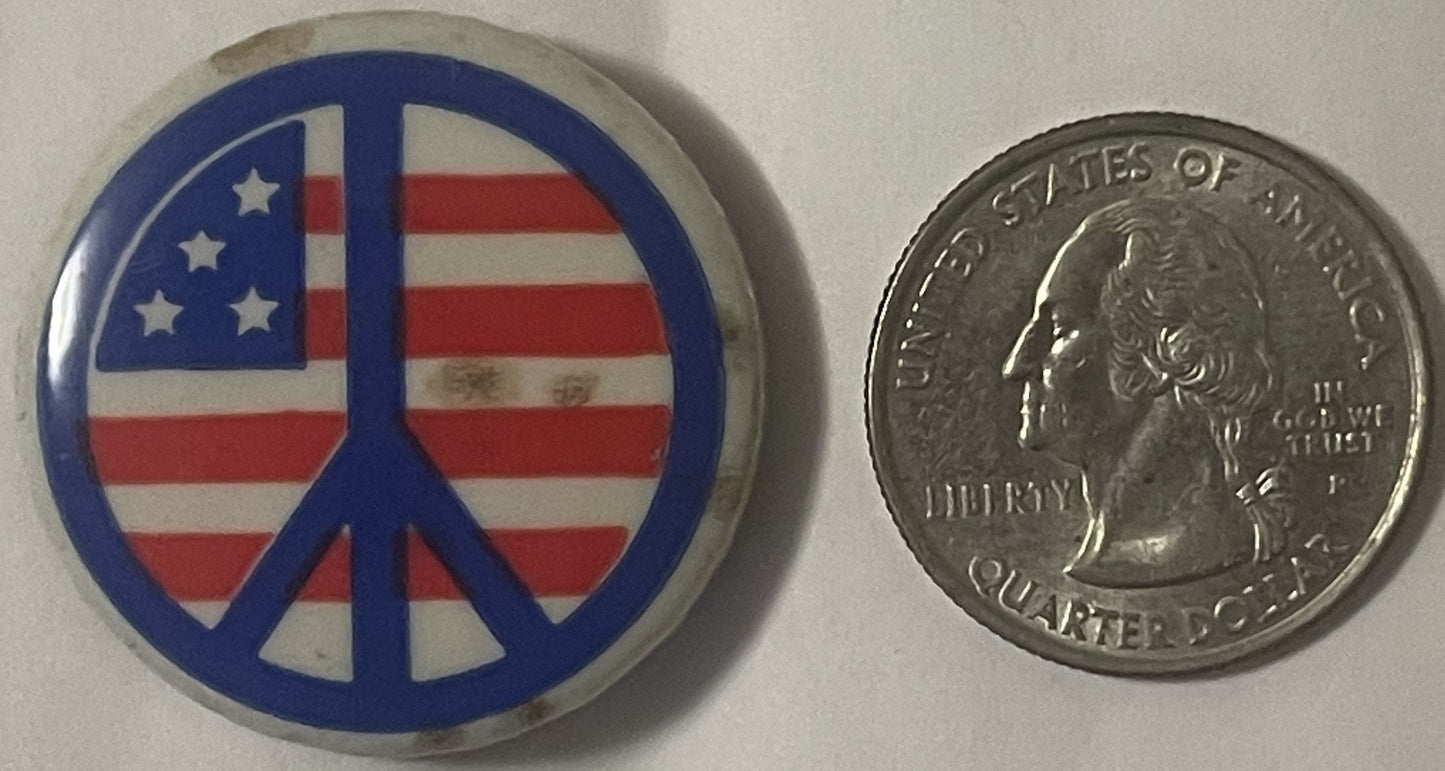
What you're looking at is a lithographed tin pinback button that fuses two of the most loaded visual symbols in twentieth-century American life: the peace sign and the stars and stripes. The artwork is bold and unapologetically graphic — a thick blue peace symbol laid directly over crisp red-and-white horizontal stripes, with a wedge of white stars set into a blue field in the upper corner, echoing the canton of the American flag itself. The color separation is flat, confident, and clean, the kind of printing that let a design like this get struck by the thousands and still stop a room from twenty feet away. This particular button is offered as New Old Stock (NOS) — unused inventory that sat tucked away in storage rather than out on a lapel catching sun and sweat and years of handling, which is precisely why a piece like this still exists today as a genuine, sharp artifact of its moment rather than a dim memory of one. The era this visual language belongs to runs across the 1960s into the 1970s — the years when peace symbol and flag, fused together on one small piece of tin, became a shorthand understood from one coast to the other.


🕊️ Before It Was "The Peace Sign," It Was a Cry Against the Bomb

The mark riding at the center of this button carries one of the best-documented origin stories in modern design — and it doesn't begin in America at all. It begins in Britain, in February of 1958, when a graphic artist named Gerald Holtom sat down to design a logo for the very first Aldermaston March, a protest walk organized by Britain's Direct Action Committee against nuclear weapons, bound for the Atomic Weapons Research Establishment at Aldermaston. Holtom, who had been a conscientious objector during the Second World War, built his symbol out of flag semaphore — the old maritime signal alphabet sailors once used to talk ship-to-ship without a spoken word. The vertical line down the center of the design is the semaphore signal for the letter "D." The two downward-angled lines flanking it form the letter "N." Together: N and D, for Nuclear Disarmament.

Holtom later gave the mark a second, more personal reading. He described the figure as a kind of self-portrait of despair — a human form with arms flung outward and downward, in the manner of the doomed peasant kneeling before the firing squad in Goya's famous painting. Whichever reading you prefer, both were baked into the same three lines and a circle, adopted that same year by the Campaign for Nuclear Disarmament and carried down the road to Aldermaston by marchers who had no idea they were carrying what would become one of the most recognized images on Earth.

Here's the detail that matters most for a piece like the one in your hands: Holtom and the CND never trademarked the design. It was released to be used, freely, by anyone who wanted to carry the message forward. That single decision — to let the mark go unowned — is the reason a symbol drawn for one specific British anti-nuclear march in 1958 could, within a decade, end up pressed onto an American novelty pin with no license required, no royalty owed, and no manufacturer's permission needed. Any button maker, large or small, corner shop or mail-order house, could legally strike it onto tin.


🗽 How a British Protest Mark Became American Shorthand

The symbol's American story has its own specific starting point. It became widely known in the United States in 1958, the same year it was born, when a pacifist protester named Albert Bigelow sailed a small boat flying the CND banner into the vicinity of a nuclear weapons test — an act of protest that put the mark in front of American eyes for the first time. From there it moved outward from the anti-nuclear cause into the broader youth and civil rights movements of the decade. The American Student Peace Union picked it up and helped cement it as one of the defining icons of the Vietnam-era protest movement, and from campuses it spread into coffeehouses, record shops, church basements, and eventually onto exactly the kind of cheap, wearable tin button you're looking at now.

What makes the symbol's American journey so fascinating is how far it traveled beyond any one side of the conflict. A 1971 photograph — often cited by historians of the period — shows an American soldier serving in Vietnam wearing a collection of personal amulets around his neck, among them the peace symbol itself, worn alongside other tokens entirely unrelated to protest politics. That image captures something worth sitting with: by the early 1970s, a mark born from a British anti-nuclear march had become so universally understood as shorthand for "peace" that even young men serving in the war it was so often raised against wore it as a private talisman. The symbol had stopped belonging to any one camp. It belonged to the whole era.


🏭 Newark's "Celluloid City" and the Trade That Made Buttons Like This Possible

Whoever struck this particular button was working inside a manufacturing tradition with a real, documented American hometown — Newark, New Jersey, a city old-timers in the printing and novelty trades still refer to, with real affection, as "Newark's Celluloid Capital." The pinback button as a physical format — a printed paper disc sealed under a clear celluloid dome, mounted to a metal shell fitted with a pin fastener — was invented there. The Whitehead & Hoag Company was founded in Newark in 1892 by Chester R. Hoag and Benjamin S. Whitehead, and in 1896 the firm patented the pin-back button design that would go on to define the entire industry. Within that same year, the format had its first great cultural moment: the William McKinley presidential campaign of 1896 mass-produced celluloid campaign buttons, and a whole new category of American self-expression — worn, wearable political speech — was born almost overnight.

Whitehead & Hoag became, for decades, the world's largest manufacturer of this style of button, and the Smithsonian's own National Museum of American History credits the firm with acquiring the key celluloid pin-back patents that made the format commercially possible. But by the time a button pairing the peace symbol with the American flag would have rolled off a press — deep into the Vietnam era of the 1960s and '70s — the founding firm itself had already wound down or changed hands, its pioneering days behind it. This button, then, almost certainly isn't a Whitehead & Hoag piece. It carries no legible maker's mark at all — no company name, no city stamp, no union bug. But it is a direct descendant of the Newark invention all the same, made in the same spirit and by the same basic method: cheap, colorful, wearable conviction, available to anyone with a dime or a quarter to spare.

By the height of the Vietnam protest years, that same button-making trade had scattered far beyond any single Newark workshop. Small presses, novelty houses, and mail-order button makers advertised in the back pages of underground newspapers and campus bulletins, cranking out cause buttons, band buttons, slogan buttons, and flag-and-peace-sign buttons like this one by the thousands, sold at rallies, head shops, record counters, and five-and-dime spinner racks across the country. The lack of a stamped name on this particular piece isn't unusual for that world — plenty of these small operations never marked their work at all, more interested in getting a message onto a chest than a name onto a rim.


Two Symbols, One Circle: What It Meant to Wear Both at Once

Putting the peace symbol directly on top of the American flag wasn't a neutral design choice — it was a statement in itself. For a lot of young Americans in this era, the two marks were assumed by outsiders to be opposites: the flag stood for the war, the peace symbol stood against it. A button like this one refused that assumption outright. Wearing peace and flag fused into a single circle was a way of saying that loving your country and opposing the war weren't contradictions at all — that dissent could be patriotic, that the stripes and the circle belonged together rather than at war with each other.

The flag's own colors carry old, familiar American associations that this button leans on without needing to spell out: red for valor, white for purity, blue for vigilance and justice — the traditional readings passed down since the earliest days of the republic. Here, that same palette gets reassigned into a peace symbol rendered in flag-blue, laid over flag-stripes, with a handful of stars standing in for the full field — a stylized shorthand rather than a literal count, the kind of graphic simplification button and poster artists of the era used constantly to get bold, instantly readable Americana onto a small printed surface. It's not meant as a precise flag reproduction; it's meant to be recognized in half a second across a crowded quad or a packed rally, and it still works exactly that way today.


🎖️ The People Who Carried This Symbol — Then and Now

What strikes me most about pieces like this one is how differently they landed depending on who wore them. For campus protesters, this button was a badge of the movement. For families with a son or a husband overseas, it could be a quiet plea for his safe return rather than a political statement at all. And for veterans themselves — including those who came home, and the prisoners of war whose release played out on televisions in living rooms across the country as one of the era's most emotional public moments — a pin like this has come to mean something else again: not protest, but remembrance. Collectors today who are veterans themselves often describe wearing this exact style of pin not as a relic of division, but as a personal marker of having lived through it and carried it home.

That's the real gift of an object like this one. It never insists on a single meaning. It holds space for the campus organizer, the anxious parent, and the returning soldier all at once — which is exactly why, decades later, it still resonates the moment someone spots it on a jacket, a bag, or a shelf.


📦 Why "New Old Stock" Matters for a Piece Like This

Buttons from this era were made to be worn hard — clipped to a jacket lapel through rain and rallies, jostled in a coat pocket, handled and re-pinned a hundred times over. Very few from any given run were ever set aside untouched. This one was. Sitting as unsold inventory rather than living its intended life on someone's collar, it comes down to us today as a clean, direct window into exactly how it looked the day it left whatever small shop or mail-order house first offered it — a genuine slice of the five-and-dime counters, campus bookstores, and rally tables where this whole visual language was sold a quarter or a dime at a time.


🖼️ Display Ideas

  • 🪟 Mounted in a small shadow box alongside other Vietnam-era ephemera — ticket stubs, protest flyers, campus newspaper clippings — for a mini time capsule under glass
  • 🧥 Pinned to a denim jacket lapel or collar, worn exactly the way it was meant to be seen back in its own decade
  • 👜 Clipped to a canvas tote or messenger bag strap, keeping the button's original everyday, walk-around spirit alive
  • 📌 Grouped on a cork or felt display board with other flag and peace-themed pins for a wall of period Americana
  • 🎖️ Given as a meaningful keepsake to a veteran or a family member who lived through the era firsthand
  • 🎵 Displayed near a vintage turntable or record collection from the same years, letting the visual and the sound of the decade sit side by side

🎁 Who Collects These

This button sits at the crossroads of several serious collecting worlds, which is part of what makes it such a satisfying find. Pinback button collectors — a genuinely organized hobby with its own long history going back to the celluloid campaign buttons of the 1890s — prize exactly this kind of bold, well-preserved graphic piece. Vietnam-era and counterculture collectors seek out anti-war and peace-movement ephemera specifically, while flag and patriotic-Americana collectors are drawn to anything that plays with the stars and stripes in an unexpected, meaningful way. Veterans and military families often collect these buttons for deeply personal reasons that have nothing to do with politics and everything to do with memory. And plenty of buyers simply want a genuine, tangible piece of the 1960s and '70s — a small object that carries an entire decade's worth of feeling in the space of a couple of inches.


❓ FAQ

What does "New Old Stock" mean for this button?
It means this piece was manufactured during its era but never sold or worn — it sat as unused inventory rather than living out its intended life on someone's jacket, which is why it survives today as such a clean, direct example of the style rather than a piece that spent years in active daily use.

Who actually designed the peace symbol, and when?
British artist Gerald Holtom designed it in February 1958 for the Campaign for Nuclear Disarmament's first Aldermaston March, building the image out of flag semaphore signals for the letters N and D — Nuclear Disarmament.

Why is the peace symbol combined with the American flag on this button?
The pairing reflected a real sentiment among many who wore it during the Vietnam era: that opposing the war and loving the country weren't contradictions, and that the flag and the peace symbol belonged together rather than at odds.

Was the peace symbol ever owned or trademarked by anyone?
No. It was released without trademark protection from the start, which is exactly why it spread so widely and so quickly onto buttons, posters, and countless other objects with no licensing required.

Is this tied specifically to anti-war protest, or to veterans as well?
Both, genuinely. It was worn widely by anti-war demonstrators, but the symbol also turned up among soldiers themselves during the war, and today it's collected and cherished by veterans and their families as often as by anyone connected to the protest movement.

Who made this particular button?
There's no legible maker's mark on this piece, which was common among the many small button shops and mail-order houses producing cause and slogan buttons throughout the 1960s and '70s. It stands firmly within that broader American pinback button tradition, even without a single company name attached to it.

How should I display or wear it?
However suits you best — pinned to a jacket or bag the way it was originally intended, or set into a small display alongside other period pieces. Either way keeps its story visible rather than tucked in a drawer.

Shipping

🚚 Shipping & Handling

  • Shipping costs and timing are calculated at checkout.
  • Items curated and shipped directly by me include U.S. shipping at no additional cost, professionally packed to ensure safe arrival of your artifact.

Items from Vetted Pro Collectors
Shipping for items offered by vetted Pro Collectors is determined at checkout. All Pro Collector listings are reviewed to ensure fair, reasonable shipping practices.

For full details, please refer to our Shipping Policy.

Returns & Exchange

Product Page Return Policy

  • 60-Day Returns – Items must be in original condition.
  • Refunds – Issued after inspection (excluding shipping costs).
  • Return Shipping – Customer is responsible unless item is damaged or incorrect.
  • Damaged/Incorrect Items – Contact us within 48 hours for a replacement or refund.
  • Easy Returns – Email [email protected] or call 802-356-9872 to initiate a return.

For full details, visit our Refund Policy.

View full details