Skip to product information
1 of 3

Vintage and Antique Gifts

Antique House of Crane Cigar Band 🦢 Gold Embossed Indianapolis Tobacciana Collector's Piece American Made

Antique House of Crane Cigar Band 🦢 Gold Embossed Indianapolis Tobacciana Collector's Piece American Made

Regular price 4.50 USD
Regular price Sale price 4.50 USD
Sale Sold out
Shipping calculated at checkout.

Description

Can One Tiny Strip of Paper Hold an Entire Vanished City? 🦢

There is a particular kind of ache that comes from holding something small and perfect that the world forgot to mourn. A cigar band — two and three-quarter inches wide, three-quarters of an inch tall — ought to be a throwaway thing, a paper collar destined for an ashtray. And yet here one sits, more than a century after it was pressed and embossed and tucked into stock, still crisp at the edges, still gleaming with gold that catches the light in that warm, slightly amber way that only genuine metallic printing does. The building it came from is gone. The street it came from has changed almost beyond recognition. The ritual it was made to accompany — the quiet daily ceremony of a gentleman clipping and lighting a good imported cigar — has faded into folklore. But the band survives. That is the particular stubbornness of paper made with care and stored with intention. It outlasts everything else.

That feeling — the quiet shock of holding something this intact from this far back — is exactly why people collect tobacciana. Not for the tobacco. For the world the tobacco carried with it.


🕰️ What You Are Looking At

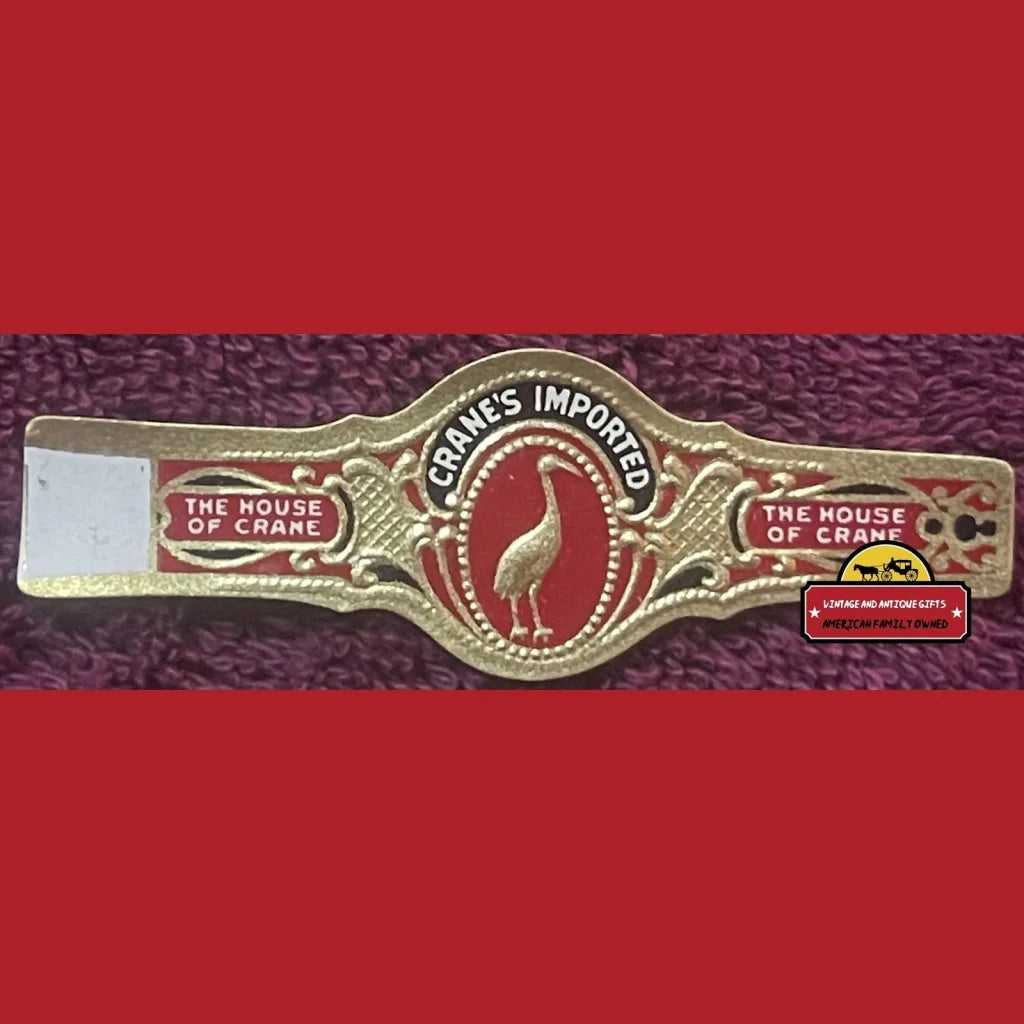
This is an antique gold-embossed cigar band from the House of Crane, Indianapolis's most celebrated cigar wholesaler, produced in the early decades of the twentieth century during the golden age of American commercial lithography. The band measures approximately 2.75 inches by 0.75 inches — the standard ring size for a premium imported cigar of that era — and it is New Old Stock: never mounted on a cigar, never handled in use, never folded or creased. It came out of old inventory, and it has been sitting quietly ever since, waiting for someone who would understand what it represents.

The design itself is a masterwork of small-scale commercial art. At the center of the band, a crane bird — the House of Crane's signature mark — is silhouetted in rich red inside a beaded oval medallion, the bird's long neck and elegant posture unmistakable even at this scale. Surrounding the oval medallion is dense, intricate gold scrollwork, pressed and embossed so that the gold elements rise slightly from the surface — a tactile dimension that flat printing simply cannot produce. Tilt it one direction and the scrollwork catches the light as a warm blaze. Tilt it another and the shadows fall into the recessed lines, giving the design the kind of depth you associate with engraved stationery or fine currency printing. The words CRANE'S IMPORTED arc across the top of the oval in bold white lettering set against a black ground. On both flanking panels, THE HOUSE OF CRANE appears — repeated, like a confident declaration, like a brand that knew it had earned the right to say its name twice.

The printing process that produced this band was the finest available in its era: chromolithography and embossing combined, executed by commercial printers who treated a cigar band with the same seriousness they brought to a railway poster or a product label for a nationally distributed brand. Hiring the finest lithographers in the country to dress up what was, technically, a paper ring discarded after the first inch of ash — that tells you something about the ambitions of the House of Crane and about the standards of the Indianapolis merchant class in the early twentieth century. Presentation mattered. The band was a promise before the first match was struck.


🏛️ The House of Crane — Indianapolis's Tobacco Royalty

To understand why this band matters, you have to understand what South Meridian Street in Indianapolis was at the turn of the twentieth century. It was not a peripheral commercial strip. It was the commercial and civic spine of one of the fastest-growing inland cities in the country, a street of Italianate brick facades and iron-front storefronts where wholesalers, importers, and manufacturers competed for the attention of retailers from across Indiana and the surrounding states. Indianapolis sat at the crossroads of critical rail lines — freight moving east and west, north and south — which made it a natural distribution hub for goods that needed to reach the American interior. Tobacco was exactly the kind of goods that moved through hubs like this. It came in from the ports, it came up from the Kentucky leaf markets, and it was blended, banded, boxed, and sent back out again carrying the name of an Indianapolis house.

In 1866 and 1867, a merchant named Edward Beck put up an Italianate commercial building at 124 South Meridian Street — solid brick, built to last, built to impress. That building would eventually become the home of the House of Crane, a cigar importing and wholesale operation that represented exactly the kind of ambition Indianapolis merchants brought to their trade: the city wasn't a manufacturer of tobacco, but it would be a merchant of tobacco, and it would do that with enough style and commercial savvy to build a brand that tobacciana collectors still search for more than a hundred years later. The House of Crane imported cigars — the band says so plainly, CRANE'S IMPORTED — blended and selected stock, and shipped product out to retailers across the region. The brand identity was the crane: that tall, aristocratic bird, a natural symbol of refinement and deliberate elegance, the kind of creature that takes its time and carries itself with purpose.

The building that housed all of this commerce is gone now. Its facade was swallowed into the development that reshaped that stretch of Meridian Street over the latter half of the twentieth century — a fate shared by dozens of Indianapolis's finest Victorian commercial structures. The marble and brick and the pressed-tin ceilings and the loading docks where cigar boxes were stacked and counted and loaded onto delivery wagons: all of it gone. But this is precisely why the band becomes something more than a band. It is a primary document of that vanished commercial culture. It is what remains when the building doesn't.


🌿 The Five-Cent Cigar and the Rituals It Carried

In the early twentieth century, the cigar was embedded in American social life in a way that is genuinely difficult to recover imaginatively today. The phrase "what this country needs is a good five-cent cigar" — attributed variously to Thomas Marshall, Woodrow Wilson's Vice President, and to Mark Twain before him — was funny because it was true: the cigar was a daily ritual for working men and a mark of occasion for everyone. A good imported cigar from a reputable house like Crane's wasn't the five-cent variety; it was the aspirational step up, the cigar you reached for on a Saturday afternoon or after a good week of business. The band it wore told you something about the man who was smoking it, and by extension about the house that had sold it to him.

Tobacconists of this era competed as much on presentation as on product. The leaf inside a cigar was often blended by the importing house from stock sourced across Cuba, Honduras, Sumatra, and the American domestic crop — but the customer couldn't see the leaf. What he could see was the band, the box, the label, the reputation of the name. The House of Crane invested in that presentation seriously enough to commission embossed gold lithography when flat printing would have cost a fraction of the price. That decision, made sometime in the early decades of the 1900s, is what produced this object and what makes it worth having today.

Lore passed down among Midwest tobacciana collectors holds that the House of Crane was known on the wholesale circuit for packing cigar boxes with more care than virtually any other Indianapolis house — that retailers from as far as Fort Wayne and Terre Haute specifically requested Crane's stock because the boxes arrived without damage and the bands were always clean and tight. Whether that speaks to the packing operation, the quality of their cigar molds, or simply to the pride of the staff, the reputation traveled. Local legend in Indianapolis collecting circles holds that the Crane brand had a loyal following among the city's legal and political community — the men who spent long afternoons in offices along Capitol Avenue and Monument Circle — and that the crane motif was chosen deliberately to evoke the stateliness of that clientele. None of this is documented in a surviving ledger that has come to light, but it is the kind of story that tends to accumulate around brands that earned genuine loyalty, and it is worth recording before it fades entirely.


📜 New Old Stock — Why It Matters to Collectors

The phrase New Old Stock carries a specific weight in the antique and vintage collecting world, and it is worth unpacking here. This band was never mounted on a cigar. It was never handled as part of a smoking ritual, never exposed to the oils and moisture of human fingers wrapping a band tight around a rolled leaf, never placed near the heat of a lit end. It came out of old inventory — surplus stock from the printing run or from the House of Crane's own supplies — and it has been stored, apparently in good conditions, ever since. The result is a band that presents at a condition level simply not available in bands that were actually used. The embossing is fully intact. The gold has not been compressed or abraded by handling. The paper has not been humidified or dried by proximity to tobacco. What you are looking at is the band exactly as the lithographer intended it to look: crisp, dimensional, alive with color and metallic sheen.

For paper ephemera collectors, NOS material from this period is genuinely difficult to come by. Most cigar bands that survive do so because someone peeled them carefully from the cigar and preserved them — a practice with a long history; Victorian and Edwardian children collected cigar bands as a hobby in the same way later generations collected stamps. But even carefully peeled bands show evidence of their use. An NOS band, pulled from old stock, is a different category of rarity. It is the object in its original state, its intended state, the state it was in on the day it left the press.


🖼️ Display Ideas

  • 🪟 Frame it alone on a clean white or ivory mat — a small, well-chosen frame around a single extraordinary band lets the embossing and the gold do their work without competition. Under glass, with even ambient light, the scrollwork reads beautifully.
  • 📚 Mount it in a tobacco ephemera composition alongside other Indianapolis or Indiana tobacciana — trade cards, tin signs, a vintage tobacco tin — as a curated grouping that tells a regional commercial story.
  • 🗺️ Pair it with a period map or photograph of South Meridian Street, Indianapolis, circa 1900–1920, so the band and its building can be seen together — the physical document and the visual context reunited.
  • 📖 House it in an archival sleeve in a collector's reference binder alongside notes on the House of Crane, Indianapolis commercial history, and related ephemera — the scholarly approach that serious tobacciana collectors favor.
  • 🎨 Use it as the centerpiece of a Victorian or Edwardian parlor vignette — on a small display stand, alongside a period humidor, a match safe, or a vintage lithographed cigar box — evoking the complete ritual world it came from.
  • 🏛️ Donate or loan it to a local Indianapolis history exhibition — this is the kind of small primary document that regional history museums and libraries actively seek for exhibits about the city's commercial past. Its condition makes it exhibition-ready.

🎁 Who Collects These

The world of tobacciana collecting is larger, more serious, and more geographically specific than most people realize until they encounter it. Cigar bands alone have their own dedicated collector community — philatelists sometimes come to them through the common ground of small printed paper objects, but the tobacciana world has its own organizations, its own reference literature, and its own price hierarchy that is quite independent of the broader antique market.

At the top of the tobacciana collector's wish list are bands with strong regional identity, demonstrably rare brands, exceptional printing quality, and — above all — NOS condition. This band checks every one of those boxes. Indianapolis collectors and Indiana local historians represent one natural audience: this is a piece of their city's commercial past, printed and used within the city, representing a business that operated on one of the city's most historically significant streets. For them, the band is not just tobacciana — it is a primary artifact of Indianapolis's early-twentieth-century merchant culture.

Beyond the regional audience, chromolithography enthusiasts collect cigar bands specifically for the printing art: the combination of embossing and metallic inks, the precision of registration required to produce a legible design at this scale, the evidence of genuine craft investment in an ephemeral object. Paper arts collectors, commercial art historians, and graphic design scholars have all developed serious interest in tobacciana as a record of what American commercial printing looked like at its most competitive and ambitious. And then there are the generalist antique collectors who simply respond to the object itself: something this old, this intact, this beautiful, and this directly connected to a specific place and time has an appeal that transcends category.

This is also, genuinely, an exceptional gift for someone with Indianapolis roots, for a cigar aficionado with an appreciation for history, for a collector who has everything and needs something they have never seen before. A piece this specific — this precisely located in time and place — is not a generic antique. It is a find.


❓ Frequently Asked Questions

Is this band genuinely New Old Stock, or has it been restored or cleaned?

This band is genuinely New Old Stock — meaning it was never mounted on a cigar and was pulled from old inventory rather than recovered from a used cigar. It has not been restored, cleaned with any chemical treatment, pressed, or otherwise altered. What you see is the band in its original printed and embossed state. The gold is original metallic lithographic ink, not reapplied or touched up. This is the condition that NOS designation promises, and it is the reason NOS material commands the attention it does among serious paper ephemera collectors.

How was the embossing on this band actually produced?

The embossed effect on cigar bands of this era was produced through a combination of intaglio and relief printing techniques. After the chromolithographic color layers were applied — each color requiring a separate stone or plate, printed in sequence with careful registration — the sheet would be run through an embossing press that used a male die and a female counter-die to press the paper into the raised relief you can feel with your fingertip. The metallic gold ink was applied either as part of the lithographic sequence or through a separate bronzing process in which metallic powder was applied to a tacky adhesive ink layer. The result is gold that has genuine metallic luster and that rises from the paper surface — not a flat gold that merely looks metallic. This process was labor-intensive and expensive relative to simpler printing methods, which is why it was reserved for premium products and why bands produced this way are so valued by collectors today.

What is known about the House of Crane's history in Indianapolis?

The House of Crane operated as a cigar importing and wholesale business in Indianapolis, with its premises at 124 South Meridian Street in a building originally constructed by merchant Edward Beck in 1866–1867. Indianapolis's position at the intersection of major rail freight lines made it an effective distribution hub for imported and blended tobacco products reaching Indiana and the surrounding Midwest states. The House of Crane built sufficient brand identity to commission high-quality embossed lithographic bands — a significant investment — suggesting a business of real commercial scale and ambition. The building that housed the operation no longer stands, having been absorbed into later development along Meridian Street. Documentary records of the business are scattered across city directories, commercial registers, and the surviving ephemera itself — bands like this one being among the most vivid remaining evidence of the brand's existence and its visual identity.

How should I store or preserve this band?

For long-term preservation, the primary concerns are humidity, light, and acid. Paper ephemera of this age is best stored in archival-quality sleeves made from polyester, polypropylene, or acid-free paper — never standard plastic, which can off-gas and cause damage over time. Keep the band away from direct sunlight or strong UV light sources, which will fade chromolithographic inks over time even when they have been stable for a century in storage. Avoid significant temperature swings and high humidity environments, both of which stress paper fibers and can cause the embossing to flatten over time. If you display the band in a frame, use UV-filtering glass or acrylic and mount it on an acid-free mat board. These are standard archival practices for any paper ephemera of this age and quality, and they will ensure this band remains in its current exceptional condition for another century or more.

Is there a collector community or reference resource for cigar band collecting?

Yes — cigar band collecting has a dedicated international community with roots going back to the Victorian era, when collecting cigar bands was a popular pastime particularly among children and young people, much as stamp collecting was. In the contemporary collector world, tobacciana organizations, paper ephemera societies, and antique advertising collector groups all include active cigar band collectors among their membership. Reference literature on cigar band lithography and brand identification exists, though it is specialized enough that regional brands like the House of Crane appear more reliably in local historical records and collector databases than in broad national price guides. Online collector communities — forums, social media groups dedicated to tobacciana and paper ephemera — are often the most current resource for identifying rare regional brands and understanding current collector demand. Indianapolis-specific historical societies and the Indiana State Library's digital collections are useful starting points for documentary research on the House of Crane specifically.

Why is Indianapolis specifically significant in the American cigar trade?

Indianapolis's significance in the cigar trade derives from its geography and its railroad infrastructure rather than from tobacco cultivation — Indiana was not a major leaf-growing state. But Indianapolis sat at the convergence of freight lines connecting the Eastern Seaboard ports (where imported tobacco arrived from Cuba, Sumatra, and Central America) with the American interior markets of the Midwest. Wholesalers and importing houses in Indianapolis could receive leaf, blend and band it, and redistribute it to retailers across a multi-state region with relative efficiency. This made cities like Indianapolis, Cincinnati, and Chicago important nodes in the tobacco distribution network even without any agricultural connection to the crop. The House of Crane represents exactly this model: an Indianapolis merchant house that built a brand around importing and wholesaling rather than manufacturing, leveraging the city's commercial infrastructure and its own carefully cultivated reputation. The cigar band is the most vivid surviving artifact of how that brand presented itself to the world.

Could this band be authenticated or appraised?

Authentication of cigar band ephemera at this age typically proceeds through examination of the paper stock, the printing techniques, the ink composition, and the design details against known period examples. The embossing press technology, the chromolithographic ink palette, and the paper weight on a band like this are all consistent with early-twentieth-century commercial printing practice and are recognizable to experienced paper ephemera specialists. Formal appraisal by a certified appraiser specializing in paper ephemera, tobacciana, or antique advertising art is available through organizations such as the American Society of Appraisers or the Antique Advertising Association of America, and is worth pursuing if you intend to insure the piece or include it in an estate. For collectors building a serious tobacciana collection, documentation — provenance notes, condition reports, any research into the issuing brand — adds long-term value and is worth assembling from the beginning.

Shipping

🚚 Shipping & Handling

  • Shipping costs and timing are calculated at checkout.
  • Items curated and shipped directly by me include U.S. shipping at no additional cost, professionally packed to ensure safe arrival of your artifact.

Items from Vetted Pro Collectors
Shipping for items offered by vetted Pro Collectors is determined at checkout. All Pro Collector listings are reviewed to ensure fair, reasonable shipping practices.

For full details, please refer to our Shipping Policy.

Returns & Exchange

Product Page Return Policy

  • 60-Day Returns – Items must be in original condition.
  • Refunds – Issued after inspection (excluding shipping costs).
  • Return Shipping – Customer is responsible unless item is damaged or incorrect.
  • Damaged/Incorrect Items – Contact us within 48 hours for a replacement or refund.
  • Easy Returns – Email info@vintageantiquesgifts.com or call 802-356-9872 to initiate a return.

For full details, visit our Refund Policy.

View full details