Skip to product information
1 of 4

Vintage and Antique Gifts

Vintage 1961 Civil War Centennial Jefferson Davis Cover ✉️ DIXIPEX IV Birmingham, Fort Sumter or 49-Star Flag Stamp

Vintage 1961 Civil War Centennial Jefferson Davis Cover ✉️ DIXIPEX IV Birmingham, Fort Sumter or 49-Star Flag Stamp

Regular price $6.00 USD
Regular price Sale price $6.00 USD
Sale Sold out
Shipping calculated at checkout.

Size: 6 1/2" x 3 3/4"

🚚 Free US Shipping — ships within one business day. International shipping calculated at checkout.

Style
Quantity

Ever wonder what it felt like when the whole country paused, exactly one hundred years later, to remember the war that nearly tore it apart? 🕰️

Size: 6 1/2" x 3 3/4"

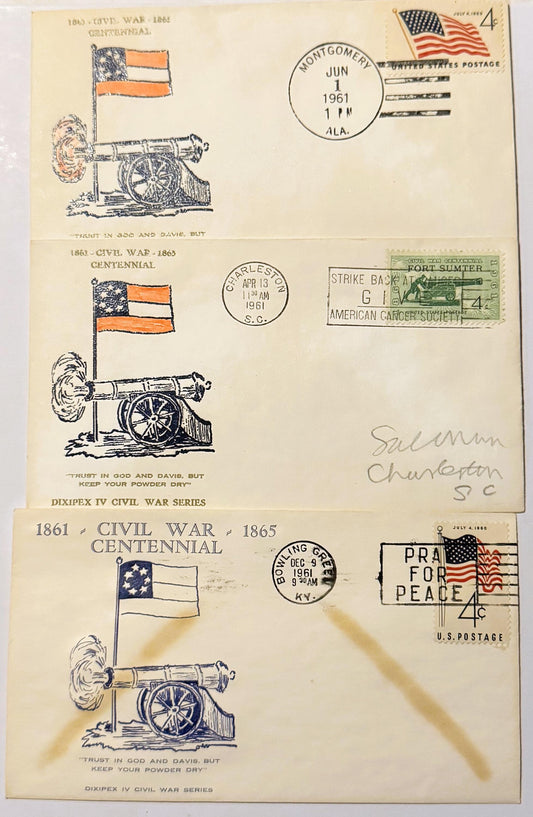
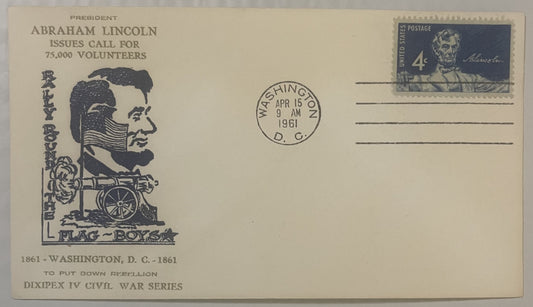
There was a stretch of years in the early 1960s when American history buffs, stamp collectors, and small-town postmasters all conspired together to mark something enormous: the Civil War Centennial. Philatelic clubs commissioned custom artwork, collectors lined up at post office windows on the anniversary dates, and everyday envelopes became tiny time capsules — stamped, cancelled, and tucked away as keepsakes of a hundred-year milestone. These envelopes are those keepsakes, and they've carried their little piece of that moment ever since.

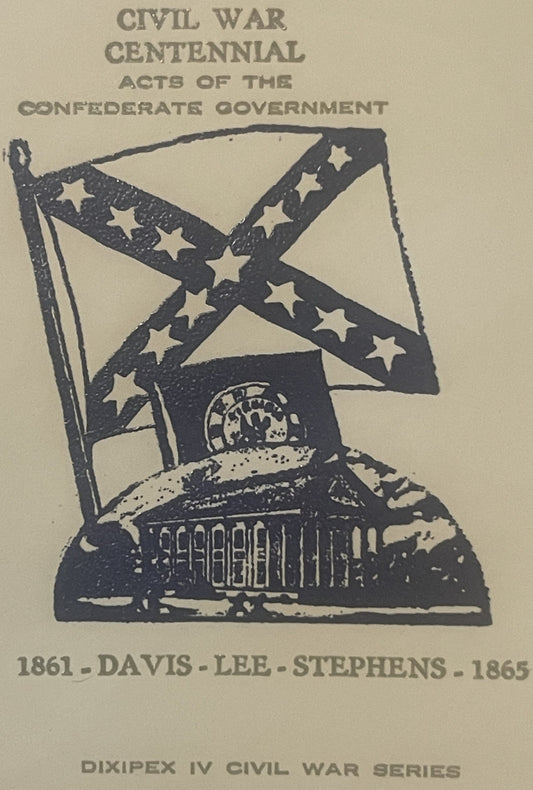
This is a Civil War Centennial cacheted envelope — what collectors call an "event cover" — made for DIXIPEX IV, the Birmingham, Alabama stamp show of June 1961, and the cachet's own dateline, June 1861 to June 1961, is the whole point. On June 1, 1861, the Confederate Post Office Department took over the mails across the seceded states and postal service between North and South was cut off. A century later, Birmingham's collectors built their show around that anniversary. The front carries a two-color printed cachet: a dark blue, line-engraving-style illustration accented in red, printed on a cream envelope.

At its center sits a seal-style medallion reading "CONFEDERATE STATES OF AMERICA," framing a portrait of Jefferson Davis captioned "OUR FIRST PRESIDENT." Two crossed Confederate flags rise on either side, a scatter of stars fills the sky above, and a laurel-wreathed landscape vignette anchors the bottom. Across the top, in dignified serif lettering, the cachet reads "CIVIL WAR CENTENNIAL / DIXIPEX IV COMMEMORATES," and along the bottom, "CONFEDERATE STATES POSTAL SERVICE / 1861 - JUNE - 1961." These come in two versions, and you choose which one you get. The Fort Sumter covers carry the green 4-cent Fort Sumter commemorative, tied by a wavy-line machine cancel dated JUN 1, 1961, the centennial to the day, from either Birmingham or Selma, Alabama. The Flag covers carry the 4-cent 49-star flag stamp and a round "DIXIPEX IV EXHIBITION STATION, JUN 26, 9 AM, 1961, BIRMINGHAM, ALA." cancel, struck at the show itself. The envelopes measure 6.5 x 3.75 inches (about 16.5 x 9.5 cm), and they were never addressed or sent to anyone; they were cancelled as souvenirs and kept, which is exactly what they were made for.


🎖️ The Civil War Centennial: America's Moment to Remember

By the time the calendar turned to 1961, the Civil War had passed from living memory into something closer to legend — but the country wasn't ready to let it go quietly. A national Civil War Centennial Commission had been organized to coordinate five years of commemoration, from the firing on Fort Sumter in 1861 through Appomattox in 1865, and states across the country stood up their own centennial commissions to plan reenactments, pageants, publications, and public events.

Stamp collecting clubs jumped in with particular enthusiasm. It was, after all, the golden age of American philately — a hobby that counted millions of hobbyists, young and old, and postal exhibitions were genuine public draws. Clubs printed cacheted envelopes for the big anniversary dates, put a new commemorative stamp on each one, and took them to the post office to be cancelled on the exact day, so the date in the postmark matched the date in history. The bigger shows went further and had the Post Office Department open a temporary "exhibition station" right on the show floor, with its own cancel that would never be used anywhere else.

That's the ritual captured right here, twice over: covers cancelled on the hundredth anniversary of the day the Confederate States took over their own mail, and covers cancelled at the DIXIPEX IV station itself, because Alabama's collectors wanted their own chapter in the national centennial story.


🏛️ Why Alabama? The Cradle of the Confederacy

It's no accident that a Confederate-themed centennial cover was produced in Alabama rather than somewhere else. Long before Richmond became its capital, the Confederate States of America was born in Montgomery, Alabama — the delegates who drafted its founding constitution met there in February 1861, and it was on the steps of the Alabama State Capitol that Jefferson Davis took the oath as the Confederacy's first and only president. For Alabama's collectors and centennial organizers in 1961, that wasn't distant textbook history — it was their own state's founding chapter, and commemorating "our first president" carried a very local, very personal weight. That regional pride is written all over this cachet: the choice of Jefferson Davis as its central figure, the Confederate seal styling, and the deliberate framing of the Confederate States Postal Service as something worth its own hundred-year tribute.


🏭 Birmingham, Alabama: The Magic City's Own Philatelic Moment

Birmingham itself has a story worth knowing on its own terms. Founded in 1871 at the crossing of two rail lines, it grew so explosively on the strength of its iron and steel industry that locals nicknamed it "The Magic City" — and with furnaces and mills that rivaled the industrial North, it also earned the moniker "The Pittsburgh of the South." By 1961, Birmingham was a full-grown industrial hub with an active civic and hobbyist culture, and it had its own stamp show to prove it. DIXIPEX was Birmingham's show: DIXIPEX II ran in 1959, DIXIPEX III in 1960 served as the first-day show for a new 1 1/4-cent Franklin stamped envelope, and DIXIPEX IV came in June 1961, right as the centennial got underway. That year's souvenir sheet printed "1861 - June - 1961 / Birmingham, Alabama" over four reproduced Confederate 10-cent Jefferson Davis stamps. Old-timers in Alabama philatelic circles have long spoken of DIXIPEX as one of the standout regional shows of its day — a "-PEX" exhibition, following the naming convention used by clubs nationwide (short for "philatelic exhibition," the same pattern behind familiar names like NAPEX and TEXPEX). The Fort Sumter covers went through the Birmingham and Selma post offices on June 1; Selma sits down in the Black Belt on the Alabama River, so the show's collectors clearly spread their covers around more than one post office.


📬 What Exactly Is a "Cacheted Cover"?

For anyone new to this corner of collecting, a cachet is simply the decorative artwork printed on the left side of an envelope to commemorate a specific event, date, or anniversary — distinct from the postage stamp itself, which pays for the mailing. Clubs and collectors would commission local or in-house artists to design a cachet, have a run of envelopes printed, then stamp them and get them cancelled on the anniversary day or at the show's own station. The result is a hybrid object: part folk art, part official postal history, entirely of its moment. That's precisely what you get here — a cover designed for DIXIPEX IV, franked with genuine U.S. postage, and cancelled either on June 1, 1961, a century to the day after the South's own postal service took charge, or at the show itself on June 26.


👤 Jefferson Davis: The Man Behind the Portrait

The face at the center of this cachet belonged to one of the most consequential — and controversial — figures of 19th-century America. Jefferson Davis served as a U.S. Senator from Mississippi and as Secretary of War under President Franklin Pierce before being chosen in February 1861 as the first and only president of the Confederate States of America. He led the Confederacy through the entirety of the Civil War, was captured by Union cavalry in Georgia in May 1865, and spent two years imprisoned at Fort Monroe before being released without ever standing trial. A century later, when the Civil War Centennial rolled around, Davis's image had become the natural emblem for any commemoration built specifically around the Confederate side of the story — exactly the role this cachet gives him, seal-framed and captioned simply, "Our First President."


🚩 Reading the Flags: Two Confederate Banners, One Cover

Look closely at the crossed flags flanking the central seal and you'll notice they aren't the same design — a detail that rewards a careful eye. One flag, with its blue canton of white stars and broad red-and-white bars, is styled after the Confederacy's first official national flag, popularly known as the "Stars and Bars." The other, a field of red crossed by a blue saltier studded with white stars, is styled after the Confederate battle flag, sometimes called the "Southern Cross." Pairing the two together on a single cachet was a deliberate choice by whoever designed it — a nod to two distinct chapters of Confederate flag history rather than a single generic symbol, the kind of detail that tells you the artist behind this piece knew their subject.


📯 The Stamps in the Corner: Fort Sumter, and a Flag That Flew for One Year

Don't overlook the stamp doing the postage work here. It's the 4-cent Civil War Centennial Fort Sumter stamp, issued April 12, 1961 at Charleston, South Carolina, exactly one hundred years after the first shots of the war were fired on the fort. It was the first of five Civil War Centennial stamps the Post Office issued, one a year through 1965, and more than 101 million were printed. The design comes from a Harper's Weekly illustration of the day: a seacoast gun from the fort, manned by an officer, with palmetto leaves behind, drawn in the quick-sketch style of the combat artists who covered the war. So you get the Union's own centennial stamp, for the battle that started it all, on a cover celebrating the Confederate postal service. That's the Civil War Centennial in a nutshell.

The Flag versions carry a stamp with its own small story: the 4-cent United States flag stamp first issued July 4, 1959, showing a flag most Americans only saw for a single year. Alaska joined the Union in January 1959, and the 49-star flag became official on July 4, 1959. Hawaii followed that August, but a new star waits for the next Fourth of July, so the 49-star flag was the official flag for exactly one year, until July 4, 1960. By the time these covers were cancelled at the show in June 1961, the 50-star flag had already taken over, which makes the stamp a little artifact of its own, riding alongside the Confederate centennial artwork it paid to send.


🖼️ Display Ideas

  • 🖋️ Frame it alongside other Civil War Centennial ephemera for a themed vignette on a study or office wall
  • 📚 Slip it into a protective sleeve inside a philatelic album, shelved with other event covers and exhibition postmarks
  • 🏛️ Pair it with Alabama or Southern history memorabilia for a regional history display
  • 🎓 Use it as a hands-on teaching piece when discussing the Civil War Centennial, the postal history hobby, or vexillology
  • 🖼️ Shadow-box it with a period photo or map of Birmingham for a conversation-starting wall piece
  • 🎁 Gift it to a stamp-collecting relative or history buff who already has an album with an empty spot marked "Centennial"

🎁 Who Collects These

This piece sits at the crossroads of several collecting worlds, which is part of what makes it so satisfying to track down. Philatelists collecting event covers will want it for the DIXIPEX IV cachet and its anniversary and show cancels. Civil War Centennial collectors — a category with its own dedicated following — look specifically for cacheted covers like this one from the 1961–1965 commemorative window. Alabama and Southern regional history collectors value it as a tangible artifact of Birmingham's mid-century civic and hobbyist life. Civil War stamp collectors appreciate the Fort Sumter stamp that opened the whole centennial series, and flag collectors like the short-lived 49-star stamp on the Flag versions. Whether it's destined for a philatelic album, a history classroom, or a framed spot on the wall, it rewards a buyer who enjoys a piece with several layers of story packed into one small envelope.


❓ FAQ

What's a "cacheted cover" or "event cover"?
It's an envelope with custom decorative artwork (the cachet) printed to commemorate a specific event, then mailed and postmarked at that event to create a one-time collectible combining art, postage, and postal history.

What does "DIXIPEX IV" mean?
"-PEX" is a naming convention widely used by American philatelic exhibitions of the era (short for "philatelic exhibition"), and "IV" marks this as the fourth staging of Birmingham's own stamp show, held in June 1961.

Why is Jefferson Davis featured on a U.S. postal item?
The cachet was privately designed and printed by the exhibition's organizers to commemorate the Confederate States Postal Service's centennial; the postage stamp and postmark are official U.S. Post Office Department elements, while the illustrated artwork is separate, unofficial commemorative design.

Is the postage stamp itself significant?
Yes. The Fort Sumter commemorative came out on the hundredth anniversary of the attack on the fort, and it opened the Post Office's five-stamp centennial series. The Flag versions carry the 49-star flag stamp, for a flag that was official for just one year.

Why June 1, 1961?
That's the anniversary. On the first of June, 1861, the Confederacy's own postmaster general took charge of the Southern mails, and letters stopped crossing between the two sides. The cachet's dateline and the cancel both point at that day. The Fort Sumter versions were cancelled that day in Birmingham or Selma, and you choose which town. The Flag versions were cancelled at the DIXIPEX IV exhibition station in Birmingham on June 26, during the show.

What size is this envelope?
Six and a half by three and three-quarter inches, the standard event-cover size of the day.

Was it mailed to anyone?
No. The covers are cancelled but unaddressed: they were made to be kept, not sent, and they've been kept ever since as a piece of early 1960s Civil War Centennial philatelic Americana and Southern postal history.

Shipping

🚚 Shipping & Handling

  • Shipping costs and timing are calculated at checkout.
  • Items curated and shipped directly by me include U.S. shipping at no additional cost, professionally packed to ensure safe arrival of your artifact.

Items from Vetted Pro Collectors
Shipping for items offered by vetted Pro Collectors is determined at checkout. All Pro Collector listings are reviewed to ensure fair, reasonable shipping practices.

For full details, please refer to our Shipping Policy.

Returns & Exchange

Take your time — you've got a full six months. If a piece isn't right for you, send it back the way it reached you and we're good.

In the first 30 days your money goes straight back the way you paid. After that it's store credit, so you can put it toward something you'd rather have.

Return shipping we sort out between us, case by case. I don't make this difficult.

If something arrives damaged, or it isn't what I said it was, send me a photo within 48 hours and I'll make it right.

Email info@vintageantiquesgifts.com or call 802-356-9872 — that's me answering, not a call center.

The only things I can't take back are custom or special-order pieces and gift cards.

View full details
  • 5 stars: 11 (100%)
  • 4 stars: 0 (0%)
  • 3 stars: 0 (0%)
  • 2 stars: 0 (0%)
  • 1 star: 0 (0%)
e
e***9 (3640)

Good business! Thanks!

D
Davd Allsup

Arrived on time good condition.

M
Mariano

The item is exceptionally. Looking forward to add to my collection.

t
t***k (3162)

Excellent transaction! Accurate listing, with fast & safe shipping. Fun seller! Thank you! A+++++

_
_***8 (766)

a o.k.

S
Sam

Thank you very much. It’s for the museum

D
David

A wonderful postmarked envelope. Very crisp and clean. Shipped very fast and very securely. 5 stars all around for this seller and this transaction.

8
8***t (454)

Beautiful cover!!

-
-***m (114)

Arrived on time as described, a very nice piece of Southern memorabilia. Included with my item was a very nice personalized letter, a very nice touch. And a bonus beer bottle label which is cool since I collect beer memorabilia as well. I'm very satisfied with my purchase. Thank You Travis Michael Michael

C
Commando

The two that I ordered look absolutely amazing either as display, or to show to guests!

E
Eric

Real people and was excatly what the said it was when I got it! Thank you!

Preserving History: Authentic Objects Across Eras

— Curated by Travis Weigel