Skip to product information
1 of 6

Vintage and Antique Gifts

Vintage 1961 Civil War Centennial Series Lincoln ✉️ Embossed Stamped Envelope

Vintage 1961 Civil War Centennial Series Lincoln ✉️ Embossed Stamped Envelope

Regular price $10.00 USD
Regular price Sale price $10.00 USD
Sale Sold out
Shipping calculated at checkout.

Size: 6 1/2" x 3 3/4"

🚚 Free US Shipping — ships within one business day. International shipping calculated at checkout.

Style
Quantity

What Was DIXIPEX IV? ✉️ DIXIPEX IV Civil War Series Cover: Lincoln Calls for 75,000 Volunteers, Washington, D.C., April 15, 1961

Size: 6 1/2" x 3 3/4" ~ little to no storage wear.

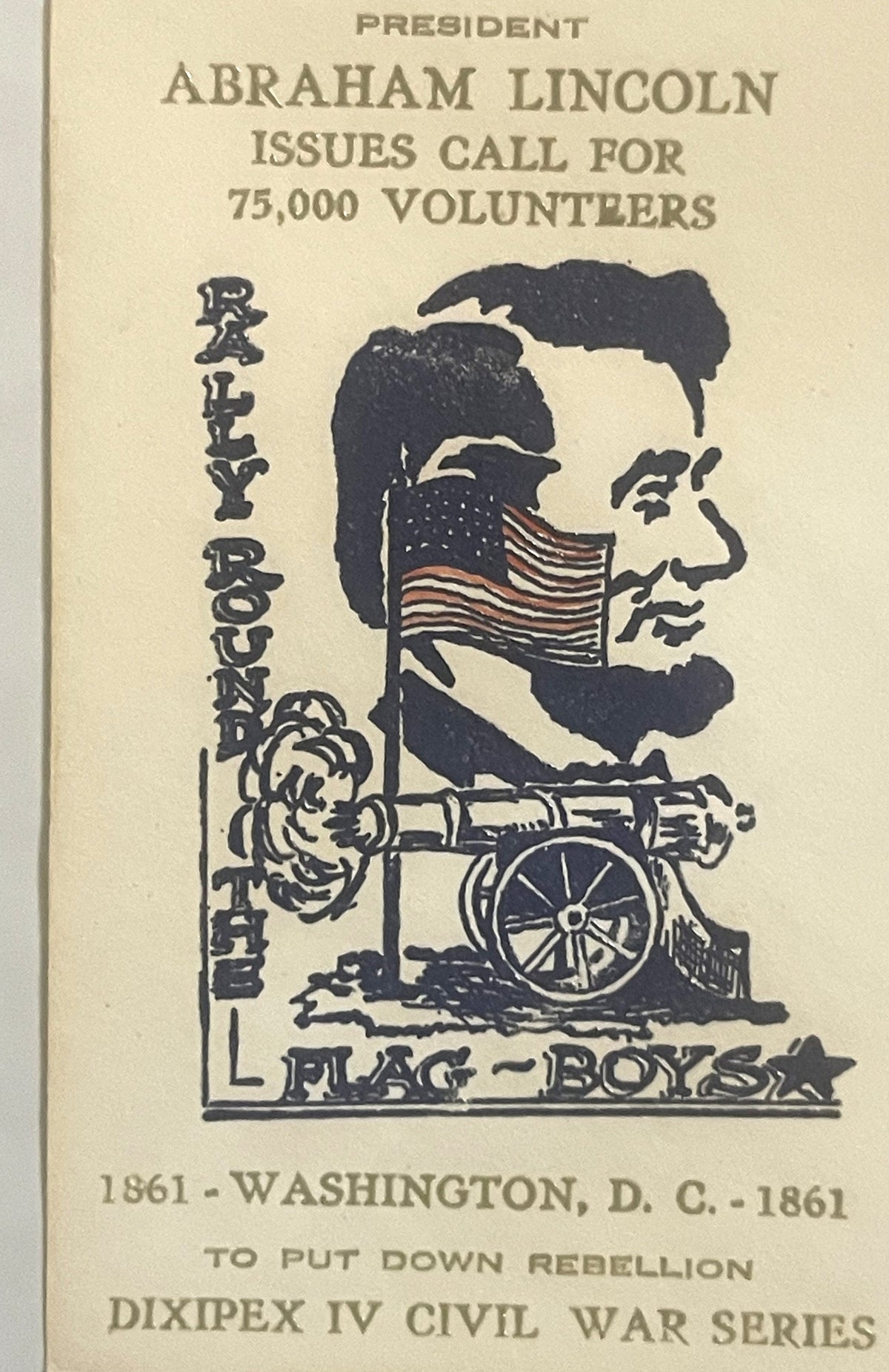
Lincoln's famous profile behind the Stars and Stripes and a smoking field cannon, framed by RALLY ROUND THE FLAG ~ BOYS. This is a vintage 1961 Civil War Centennial cachet cover from the DIXIPEX IV Civil War Series, with a 4-cent stamp cancelled WASHINGTON, D.C., APR 15, 9 AM, 1961, one hundred years to the day after President Lincoln called for 75,000 volunteers. I love a cover that's postmarked on the exact anniversary, that's the whole point of it!

That's the whole craft of a cachet cover in one envelope. Take the postmark away and you've got pretty stationery. Keep it, and you've got a dated, government-applied record that ties a printed picture to nine o'clock in the morning on the one day that matters, in the city where Lincoln issued the call.

🔍 What's on it

In raised gold lettering at the top, PRESIDENT ABRAHAM LINCOLN ISSUES CALL FOR 75,000 VOLUNTEERS. Below, the cachet in dark ink: Lincoln's bearded profile with a U.S. flag in front of it and a cannon firing a puff of smoke, with RALLY ROUND THE running down the left side and FLAG ~ BOYS ★ along the bottom. Then 1861 - WASHINGTON, D. C. - 1861, TO PUT DOWN REBELLION and DIXIPEX IV CIVIL WAR SERIES. Up in the corner, the 4-cent stamp and a round WASHINGTON APR 15 9 AM 1961 D.C. postmark with four cancel bars. Some covers have the flag in the cachet printed in red, white and blue, and some in dark ink only. The envelopes are unaddressed.

The portrait is bold, heavy black line work, the familiar brow and beard, with the flag on its staff crossing in front of him and the cannon's muzzle blast drawn as a curl of smoke. RALLY ROUND THE is stacked one letter over the next down the left side, and FLAG ~ BOYS is set in outlined display letters closed off with a solid star. Run a finger over the gold lettering and it stands up off the paper with a glossy, slightly domed edge, which gives the cover a real presence in your hand that a flat offset print never has.

📮 The stamps

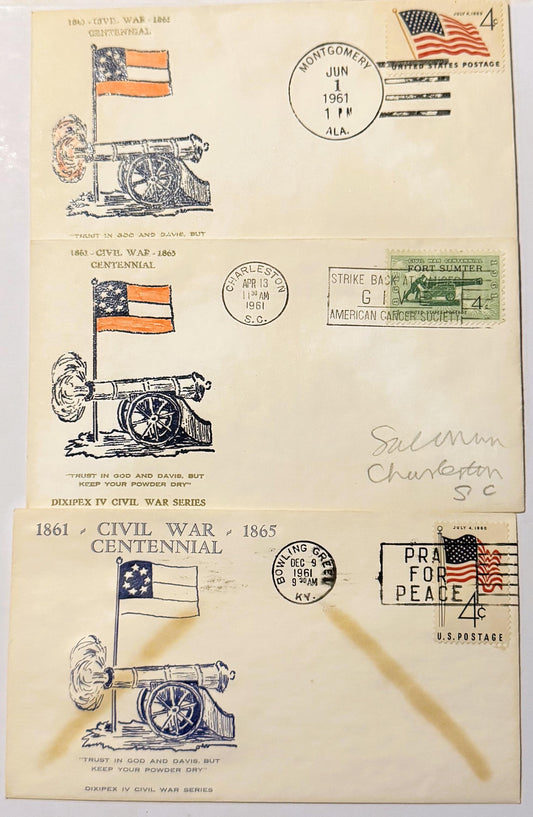
These covers were made up with different 4-cent stamps, and you can pick your style from the menu:

The Lincoln stamp is the 1959 Lincoln Sesquicentennial issue, showing part of Daniel Chester French's great seated statue in the Lincoln Memorial. It was issued in Washington on May 30, 1959, the anniversary of the Memorial's dedication, with the first day ceremony held right at the Memorial.

The quote stamp is the American Credo issue (Scott 1143) with Lincoln's words, "Those who deny freedom to others deserve it not for themselves," from an April 1859 letter to Henry L. Pierce. It came out in New York on November 19, 1960, the anniversary of the Gettysburg Address. The American Credo stamps were a short series of 1960 and 1961, each carrying a quotation from a great American beside a small green medallion. This one has a maroon frame lettered The UNITED STATES, POSTAGE and OF AMERICA, Credo running down the side in script, and Lincoln's signature in facsimile.

On the Lincoln and quote versions, the cover carries Lincoln twice: in the picture on the left, calling the country to arms, and up in the stamp corner, in his own words or his own statue, put out by the same government a hundred years on. Whoever made these up was making a point.

The flag stamp is the 49-star flag, issued at Auburn, New York on July 4, 1959, the day the 49-star flag debuted after Alaska became a state.

🥁 April 15, 1861 and "Rally Round the Flag"

The cover remembers one of the biggest days of the war. The Confederate guns opened on Fort Sumter on April 12, 1861, and on April 15 President Lincoln called for 75,000 volunteers to put down the rebellion. His proclamation called forth the militia of the several states to put down combinations too powerful to be suppressed by the ordinary course of judicial proceedings, and that call turned a secession crisis into a war. A hundred years later, during the Civil War Centennial, these DIXIPEX covers were cancelled in Washington on April 15, 1961, right on the anniversary. The words around the picture come from George F. Root's 1862 song "The Battle Cry of Freedom," better known as "Rally 'Round the Flag." It ran through the Union camps like wildfire, sold more than 700,000 copies of sheet music, and was the campaign song for Lincoln and Johnson in 1864. It caught on so well that the South got its own version too, adapted for the Confederacy by H. L. Schreiner and W. H. Barnes. Put that phrase next to the volunteer call and a firing cannon, and the whole spring of 1861 fits in one little printed panel.

DIXIPEX was a Southern stamp show, "Dixie" plus the "-pex" collectors put on their exhibitions, put on every year by a Birmingham, Alabama club called the Dixie Stamp Collectors. Linn's Weekly Stamp News for May 8, 1961 called DIXIPEX IV "the fourth annual philatelic extravaganza sponsored by the Dixie Stamp Collectors," so the IV marks the show's fourth time out, and DIXIPEX II would have been the 1959 show in Birmingham. The 1961 show ran all through June, with a special competitive session on June 26 and 27 at the Dinkler-Tutwiler Hotel in Birmingham, a branch post office right in the hotel putting a cancellation on the mail every day, and an open invitation to Confederate specialists to bring their best. With Birmingham and the centennial together, Linn's figured the Civil War displays "will be in abundance." Club business went through Raymond J. Rowell, Sr., on Steiner Avenue in Birmingham. I love that a club of Southern stamp collectors put Lincoln's call to arms on a Washington cover, right on the hundredth anniversary. Collectors say each cover in its Civil War Series took one moment of the war and was cancelled at a post office tied to it, which is exactly why a Lincoln call-to-arms cover belongs on a Washington, D.C. cancel.

Covers like this were usually made by small operators, a printer, a stamp club, an exhibition committee, working short runs for people who knew what they were looking at, and the designs were often better than they needed to be: bold, graphic, and not shy about a solid black. With its stacked letters, outlined type and firing cannon, this one is mid-century commercial art at its most confident, aimed at a hundred-year-old subject.

🎖️ The Centennial

Congress set up the U.S. Civil War Centennial Commission in 1957, and the observance ran until 1965 and the hundredth anniversary of the surrender at Appomattox. Almost every state set up its own centennial commission, the Post Office issued a series of commemorative stamps, and the whole Civil War reenactment hobby grew up out of those years. A lot of the paper the centennial turned out was printed quickly and thrown away just as fast. Covers held up better for a simple reason: collectors saved them on purpose, in albums, from the day they were cancelled.

🏡 Display

This looks great framed in a study, a den or a classroom, and it's a perfect gift for a Civil War buff, a Lincoln collector, a stamp collector, or a history teacher.

A cover is one of the easiest pieces of history to live with: flat, light, a standard envelope size, and it looks sharp behind glass in a simple frame or a shallow shadow box where the cachet and the postmark both stay readable. Stamp collectors usually keep them on album pages by series or subject, and a Lincoln cachet cancelled in Washington on the centennial of the call is a natural anchor for a Civil War Centennial page, a Lincoln page or a page built around the American Credo stamps. It suits cachet and first-day-cover collectors building a Civil War Centennial or DIXIPEX run, framers looking for a small, graphic piece of real history for a study or library wall, and teachers who want something that carries a specific date instead of a vague era.

Everything I sell is stored in the dark, below 40% relative humidity, at a steady 72°F in climate control, so whatever age a piece shows, it already had when it came to me. And nobody can postmark April 15, 1961 again: the supply is finite, and once these last covers are gone they'll be very difficult to acquire.

Shipping

🚚 Shipping & Handling

  • Shipping costs and timing are calculated at checkout.
  • Items curated and shipped directly by me include U.S. shipping at no additional cost, professionally packed to ensure safe arrival of your artifact.

Items from Vetted Pro Collectors
Shipping for items offered by vetted Pro Collectors is determined at checkout. All Pro Collector listings are reviewed to ensure fair, reasonable shipping practices.

For full details, please refer to our Shipping Policy.

Returns & Exchange

Take your time — you've got a full six months. If a piece isn't right for you, send it back the way it reached you and we're good.

In the first 30 days your money goes straight back the way you paid. After that it's store credit, so you can put it toward something you'd rather have.

Return shipping we sort out between us, case by case. I don't make this difficult.

If something arrives damaged, or it isn't what I said it was, send me a photo within 48 hours and I'll make it right.

Email info@vintageantiquesgifts.com or call 802-356-9872 — that's me answering, not a call center.

The only things I can't take back are custom or special-order pieces and gift cards.

View full details
  • 5 stars: 1 (100%)
  • 4 stars: 0 (0%)
  • 3 stars: 0 (0%)
  • 2 stars: 0 (0%)
  • 1 star: 0 (0%)
B
Brandon

Great item as shown quick delivery

Rescuing American History Since 2007

— Travis & the Kids