Skip to product information
1 of 4

Vintage and Antique Gifts

Vintage 1944 Pittsburgh Cincinnati Chicago & St. Louis Railroad $1,000 Bond 🚂 Pan Handle Route, Pennsylvania

Vintage 1944 Pittsburgh Cincinnati Chicago & St. Louis Railroad $1,000 Bond 🚂 Pan Handle Route, Pennsylvania

Regular price 11.00 USD
Regular price Sale price 11.00 USD
Sale Sold out
Shipping calculated at checkout.
Quantity

Ever wonder what it felt like to hold a piece of the Pennsylvania Railroad's promise to the future? 🚂

There's a particular kind of American optimism baked into a railroad bond — the belief that steel rails, steam power, and the men who kept both running would still be moving freight and passengers three decades down the line. This one promised October 1, 1975. It was printed in the middle of a world war, backed by one of the great trunk lines of the Pennsylvania Railroad system, and it has sat ever since — a genuine piece of Americana whose obligation was overtaken when the company itself changed hands long before the due date ever arrived.

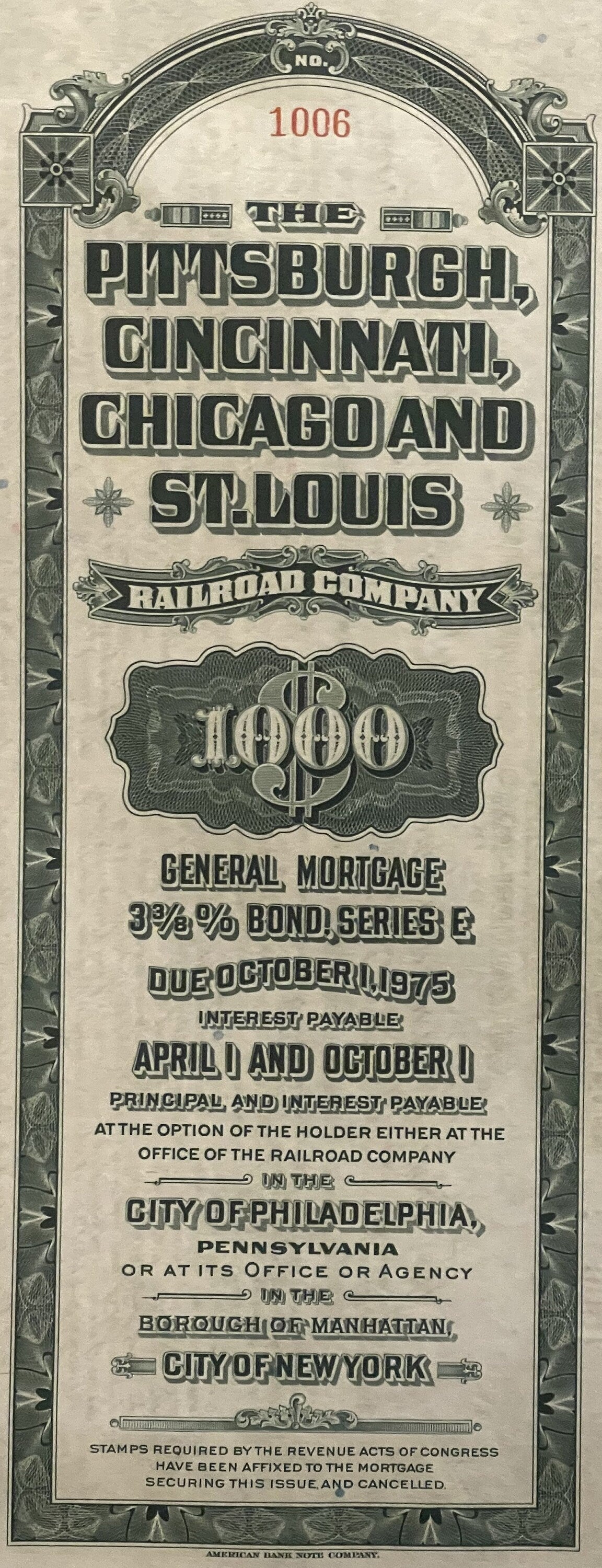
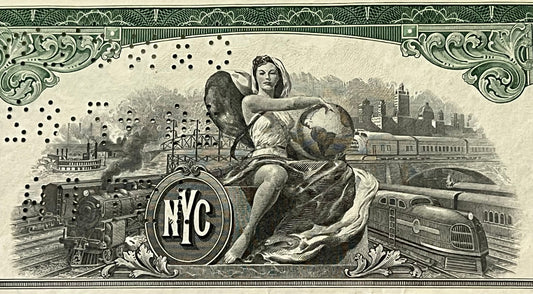
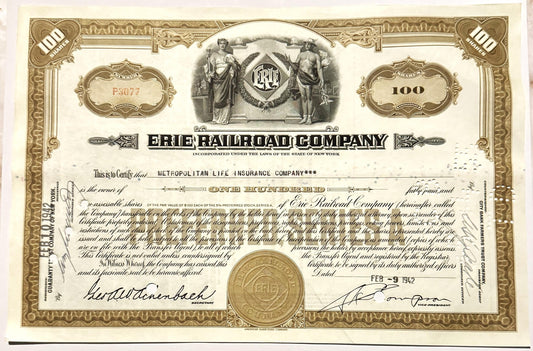
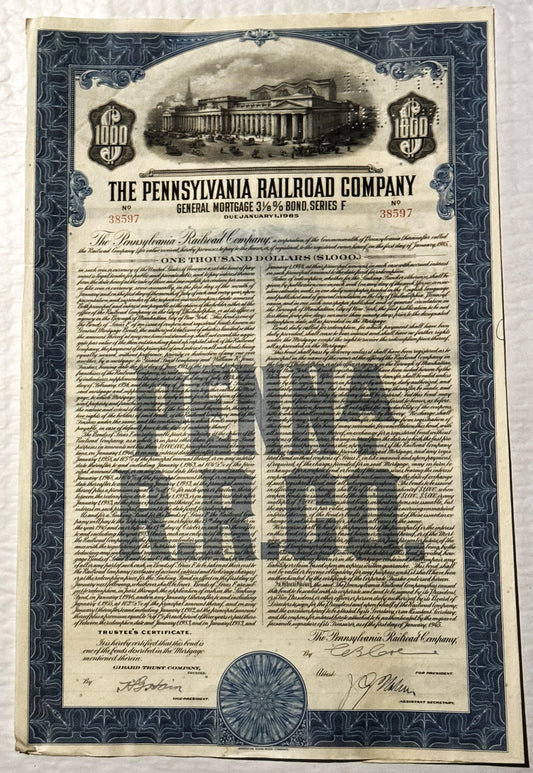
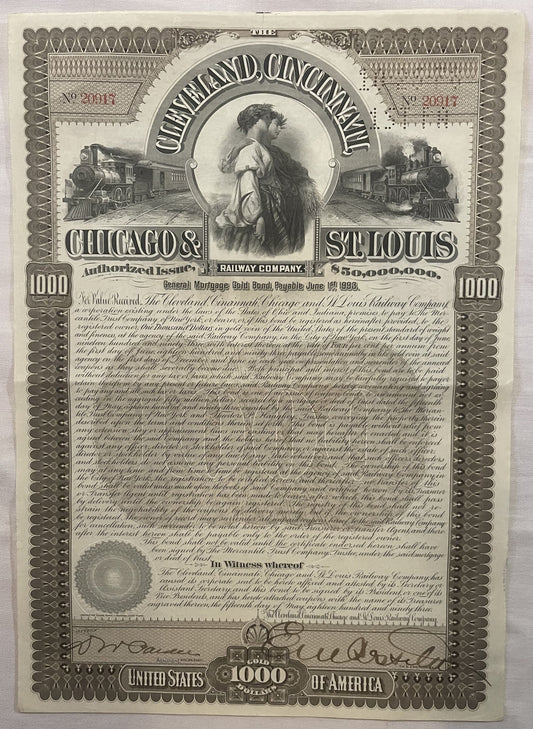
This is a General Mortgage 3-3/8% Bond, Series E, issued in the $1,000 denomination by The Pittsburgh, Cincinnati, Chicago and St. Louis Railroad Company — the celebrated "Pan Handle Route" of the Pennsylvania Railroad system. The certificate carries a 1944 series date printed right on its face, placing it squarely in the World War II years, when this railroad was hauling coal, steel, troops, and mail across a network that stretched from Pittsburgh, Pennsylvania out through Ohio, Indiana, and Illinois. Payable at the option of the holder in either the City of Philadelphia, Pennsylvania or the Borough of Manhattan, City of New York, and trusteed by The Union Trust Company of Pittsburgh, this bond was engraved by the American Bank Note Company, the powerhouse security printer whose steel-engraved intaglio work is instantly recognizable to anyone who collects scripophily. At a substantial 15 x 10 inches (approximately 38 x 25 cm), it is offered here as a genuine issued bond — executed by the railroad's officers, certified in ink by the trustee, and punch-cancelled when it was retired. The design is a study in mid-century financial engraving at its finest: a deep green guilloche border twists and loops around the entire sheet, ornate scrollwork corners frame the top like something lifted off a bank note, and at the center sits a dramatic black-and-white vignette of a steam locomotive barreling through an industrial scene, trailing a cloud of smoke while a gang of trackworkers labors along the rails in the foreground, with the silhouettes of factory smokestacks rising behind it. Bold lettering announces the company name across the top, and the bond's numeral appears in bright red ink alongside the dense, formal legal language that fills the body of the certificate — the kind of florid, contract-perfect prose that only 1940s corporate lawyers and engravers could produce together.


🚂 The Pan Handle Route: Pittsburgh's Great Western Artery

Ask an old railroad man where the "Pan Handle" got its name, and he'll tell you it wasn't fancy marketing — it was geography, plain and simple. The railroad's main line ran west out of Pittsburgh and had to cross the narrow northern panhandle of what is now West Virginia, that thin sliver of land wedged between Ohio and Pennsylvania, before continuing on into Ohio proper. From there the route split in two: one line pushed north and west toward Chicago, the other swung south through Indianapolis and on to East St. Louis, Illinois. Together those lines tied together some of the hardest-working industrial cities in the American Midwest — the steel towns along the Ohio River, the grain and livestock markets of central Indiana, the rail yards of Chicago, and the river port of St. Louis on the far bank of the Mississippi.

At its peak, the Panhandle system controlled well over 2,600 miles of owned track and used hundreds more miles besides, spread across Pennsylvania, West Virginia, Ohio, Indiana, and Illinois. Federal valuation records from the era describe a heavily engineered, double-tracked main line between Pittsburgh and Chicago, with extra third and fourth tracks laid near the busiest terminals — a railroad built not for scenery but for volume, moving coal, steel, grain, and general merchandise at a scale few other regional carriers could match.

The company's roots go back to a tangle of small 1850s and 1860s predecessor lines — the Pittsburgh and Steubenville Railroad, the Steubenville and Indiana Railroad, and the Hollidays Cove Railroad among them. Old-timers along the Ohio River still tell the story of why the route had to detour through that narrow strip of Virginia territory at all: the state of Virginia, before West Virginia broke away during the Civil War, had little appetite for letting a Pennsylvania railroad cut across its land, and it took a special charter in 1860 for the Hollidays Cove Railroad to build the short connecting stretch that finally stitched the route together. A bridge across the Ohio River completed the link in 1865, and from there the various pieces merged and remerged — first into the Pittsburgh, Cincinnati and St. Louis Railway in 1868, then, after reaching all the way to Chicago and East St. Louis by 1870, into the larger Pittsburgh, Cincinnati, Chicago and St. Louis Railway in a major 1890 consolidation.

The company named right on this bond — the Railroad, not the earlier Railway — came into being in a final merger completed at the start of 1917, when the Panhandle absorbed the Vandalia Railroad and several smaller connecting lines to form one unified corporate entity. That is the company whose name appears across the top of this certificate, and it is the company that, by 1921, had been formally leased to and folded into the operational control of the mighty Pennsylvania Railroad — the "Pennsy," at the time one of the largest and most powerful railroads in the world. By the time this bond was printed in 1944, the Panhandle had been running under Pennsylvania Railroad management for over two decades, and the bond itself carried the added weight of a guarantee from the Pennsylvania Railroad Company — meaning that when an investor bought this security, they were trusting not just a regional carrier but the full financial muscle of the PRR system standing behind it.


🏙️ Philadelphia, Pittsburgh, and Manhattan: Three Cities, One Bond

Look closely at the language printed on this certificate and you'll find a small geography lesson in early-to-mid-20th-century American finance. The bond was made payable, at the bondholder's choice, at the railroad company's office in the City of Philadelphia, Pennsylvania, or at an office or agency in the Borough of Manhattan, City of New York — a reflection of how thoroughly Philadelphia and New York dominated American corporate finance in this era. Philadelphia was home to the Pennsylvania Railroad's own headquarters and much of its administrative machinery, while New York's financial district was where bonds like this one were actually bought, sold, and traded among investors and brokerage houses.

Pittsburgh enters the story through a different door: the bond's mortgage was held in trust by The Union Trust Company of Pittsburgh, named right on the certificate as Trustee, with its own officers' signatures certifying that this bond was one of the genuine issue described in the underlying mortgage. Trust companies like this one were the quiet guardians of American railroad finance — institutions that held the legal mortgage on a railroad's physical property (its tracks, bridges, yards, and equipment) on behalf of thousands of individual bondholders who could never have negotiated such protections on their own. Pittsburgh, sitting at the literal starting point of the Panhandle's main line and at the confluence of the Allegheny, Monongahela, and Ohio rivers, was as fitting a home for that trusteeship as any city in America — a steel town through and through, and the true gateway to the Panhandle's westward reach.


⚙️ Steel, Steam, and the Working Railroad: Reading the Vignette

The image at the heart of this bond is worth lingering over. It shows a steam locomotive charging forward, smoke billowing from its stack, while a small crew of trackworkers labors along the rails in the foreground — a scene that could have been lifted from any number of the Panhandle's own yards along the Ohio River. Industrial smokestacks rise in the background, hinting at the blast furnaces and steel mills that lined so much of this railroad's route through western Pennsylvania and the West Virginia panhandle. It's not an idle decoration. Engravers at firms like the American Bank Note Company chose these working scenes deliberately, because they told investors exactly what their money was buying into: not a speculative venture, but the unglamorous, essential business of moving coal, ore, and finished steel along a well-worn industrial corridor.

Collectors of scripophily — the hobby of collecting historic stock and bond certificates — often point to this exact combination of elements as the gold standard of the genre: a dense, legally airtight body of text; a bold, dramatic vignette; a border so ornate it borders on jewelry; and the imprint of a security printer whose reputation for fighting counterfeiters was second only to the U.S. Treasury's own engravers. The American Bank Note Company built its name printing currency-grade security documents for governments and corporations alike, and a certificate like this one — with its fine guilloche lathework and crisp intaglio printing — carries the unmistakable look of a document built to be trusted at a glance, long before anyone read a single word of the fine print.


💵 A Wartime Promise: The General Mortgage Bond of 1944

Picture the year printed on this bond: 1944. American factories were running around the clock, troop trains crisscrossed the country, and railroads like the Panhandle were doing some of the heaviest lifting of the entire war effort, hauling coal to steel mills, steel to shipyards and munitions plants, and soldiers to ports of embarkation. Against that backdrop, a general mortgage bond like this one wasn't a speculative gamble — it was viewed by the investing public as about as safe a place to park $1,000 as existed outside of the U.S. Treasury itself. Railroads had been the backbone of American commerce for the better part of a century by then, and a bond secured by a mortgage on an entire railroad's physical property, backed further by the guarantee of the Pennsylvania Railroad, represented old-school, blue-chip confidence at a moment when the whole country needed exactly that.

The bond promised interest twice a year, every April and October, and a full return of principal on October 1, 1975 — a date that must have felt impossibly distant to the investor who first purchased it in the middle of the Second World War. What that investor likely never anticipated was that the company itself wouldn't survive to see that date arrive. The Pittsburgh, Cincinnati, Chicago and St. Louis Railroad's corporate identity was folded into another Pennsylvania Railroad subsidiary in the mid-1950s, more than fifteen years before this bond's stated maturity — a reminder that even the most established names in American railroading were, by mid-century, already being consolidated into ever-larger systems, a trend that would only accelerate in the decades that followed.


🛤️ From the Panhandle to Penn Central: A Route That Outlived Its Name

The Panhandle name itself didn't survive the corporate reshuffling of the later 20th century, though the rails it once claimed carried its legacy forward for decades. The Pennsylvania Railroad folded the Panhandle's corporate identity into another of its subsidiaries in 1956, and then in the late 1960s the Pennsylvania Railroad itself merged with its longtime rival, the New York Central, to form the short-lived and famously troubled Penn Central. When Penn Central collapsed under its own financial weight in the 1970s, the federal government stepped in to create Conrail, consolidating what remained of the Northeast's freight rail network — and it was Conrail that ultimately judged large stretches of the old Panhandle route no longer necessary, abandoning segments that had once carried some of the heaviest freight traffic in the Midwest.

Today, portions of that old right-of-way live on in an entirely different form. Near Pittsburgh, a stretch of the former Panhandle corridor has been converted into the Panhandle Trail, a recreational path now used by hikers and cyclists where steam locomotives like the one pictured on this very bond once thundered through with tonnage bound for the steel mills. Local rail history buffs and trail walkers alike still trade stories about the old route — where the tunnels once ran, which towns owed their growth to a Panhandle depot, and how much of the region's industrial rise traces straight back to this railroad's rails. It's a quiet kind of afterlife for a company whose name no longer appears on any map, but whose financial paper — bonds just like this one — remains one of the few tangible ways to hold a piece of that history in your hands.


🖼️ Display Ideas

  • 🚂 Frame it solo as a statement piece for a den, office, or home library — the scale and detail carry a wall on their own.
  • 🗺️ Pair it with a vintage railroad map of Pennsylvania, Ohio, and Indiana to trace the actual Panhandle route on the wall.
  • 🎟️ Group it with old timetables, dining car menus, or ticket stubs for a layered railroad-history gallery wall.
  • 🏭 Hang it in a home bar or man cave alongside industrial and steel-mill photography for a Rust Belt heritage theme.
  • 🎁 Give it as a milestone gift to a train collector, model railroader, or anyone with roots in Pittsburgh, Ohio, or Indiana rail towns.
  • 💼 Display it in a shadow box with a magnifying glass nearby, inviting guests to read the engraved fine print up close.

🎁 Who Collects These

This bond speaks to several kinds of collectors at once. Scripophily enthusiasts — collectors of historic stock and bond certificates — prize a $1,000 denomination like this one for its size, its American Bank Note Company engraving, and its connection to a genuinely significant carrier within the Pennsylvania Railroad system. Railroad history buffs, especially those with ties to Pittsburgh, the Ohio Valley, or the Midwest cities the Panhandle once served, are drawn to it as a direct artifact of a route their grandfathers may have ridden or worked. Collectors of World War II-era Americana appreciate it as a home-front financial document from a pivotal year in American industry. And plenty of buyers simply love the graphic power of the piece — the steam locomotive vignette, the green engraved border, the sheer physical presence of it — and want it purely as bold, historically grounded wall art for an office, den, or train room.


❓ FAQ

What exactly is a railroad mortgage bond, like this one?

It's a corporate debt instrument, not a stock. The railroad borrowed money from investors and pledged its own physical property — track, yards, equipment — as collateral through a mortgage held by an independent trustee. In exchange, the company promised to pay interest twice a year and return the full $1,000 principal at maturity.

Was this bond ever paid out or redeemed?

This is an issued certificate that circulated through an actual investor's hands and was later redeemed and cancelled. It exists today exactly as it left the American Bank Note Company's presses.

Why is it called the "Pan Handle Route" if the company served Ohio, Indiana, and Illinois too?

The nickname comes specifically from the railroad's main line crossing the narrow northern panhandle of West Virginia on its way west out of Pittsburgh — a small but essential stretch of the much larger route that eventually reached Chicago and East St. Louis.

How does the Pennsylvania Railroad connect to this company?

The Pittsburgh, Cincinnati, Chicago and St. Louis Railroad was leased to and operated under the Pennsylvania Railroad from the early 1920s onward, and this bond additionally carried the Pennsylvania Railroad's own corporate guarantee — meaning the PRR's financial strength stood behind the Panhandle's promise to bondholders.

How big is the certificate, and does it frame well?

It measures 15 x 10 inches (about 38 x 25 cm), a genuinely substantial size that displays with real presence — closer to a small poster than a typical paper document, which is exactly why it works so well framed.

Who made this bond, and what makes the printing special?

It was engraved by the American Bank Note Company using steel-engraved intaglio printing in green and black ink — the same security-printing techniques used on currency and government bonds, prized by collectors for their fine detail and durability.

Is this a good gift for a railroad or history collector?

Very much so. Between the Pennsylvania Railroad pedigree, the dramatic steam locomotive vignette, and its connection to Pittsburgh and the industrial Midwest, it's a meaningful gift for anyone building a railroad-themed collection or with family roots along the old Panhandle route.

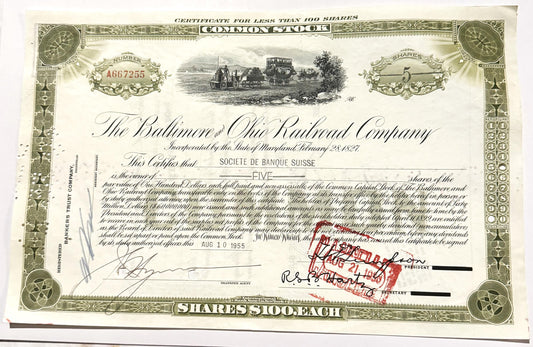
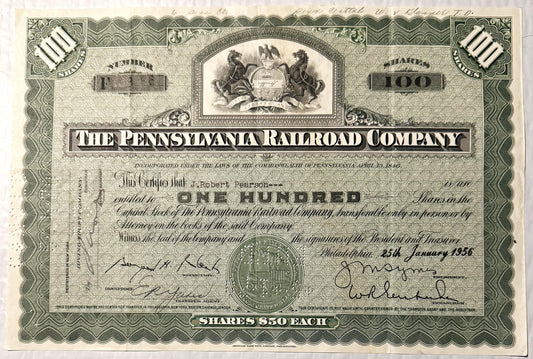
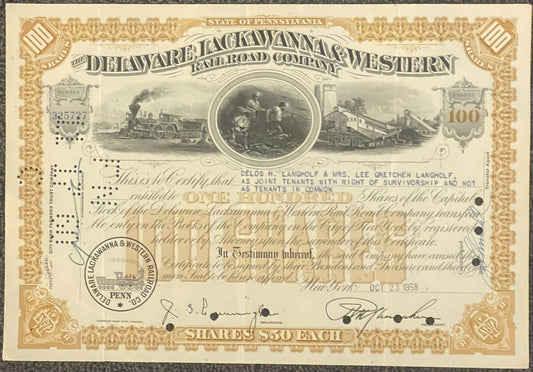
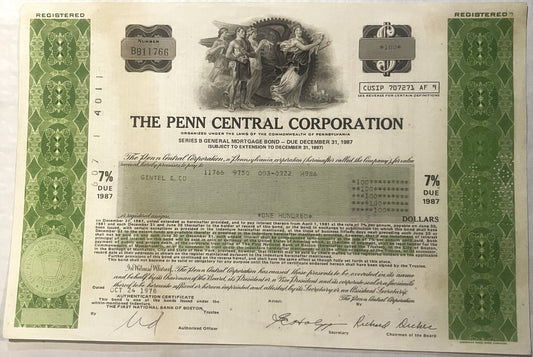
These are issued instruments rather than blanks. Bonds and debentures of this type were registered to a holder, authenticated by the trustee, and punch- or cut-cancelled when they were finally redeemed. Expect financial writings, markings, stamps, hole punches and staple holes as part of the life of the instrument: endorsements and signatures, trustee and registrar stamps, revenue or documentary tax stamps, cancellation punches, staple holes from being bound into a transfer book, pencil ledger notations. That is the paper trail of a security that actually did its job, and it is what separates a document that lived from a blank that never did. No two are alike: holder details, serial numbers, dates, signatures, stamps and punch patterns vary from example to example, so the photographs show the type rather than the exact sheet that ships.

Shipping

🚚 Shipping & Handling

  • Shipping costs and timing are calculated at checkout.
  • Items curated and shipped directly by me include U.S. shipping at no additional cost, professionally packed to ensure safe arrival of your artifact.

Items from Vetted Pro Collectors
Shipping for items offered by vetted Pro Collectors is determined at checkout. All Pro Collector listings are reviewed to ensure fair, reasonable shipping practices.

For full details, please refer to our Shipping Policy.

Returns & Exchange

Take your time — you've got a full six months. If a piece isn't right for you, send it back the way it reached you and we're good.

In the first 30 days your money goes straight back the way you paid. After that it's store credit, so you can put it toward something you'd rather have.

Return shipping we sort out between us, case by case. I don't make this difficult.

If something arrives damaged, or it isn't what I said it was, send me a photo within 48 hours and I'll make it right.

Email info@vintageantiquesgifts.com or call 802-356-9872 — that's me answering, not a call center.

The only things I can't take back are custom or special-order pieces and gift cards.

View full details